

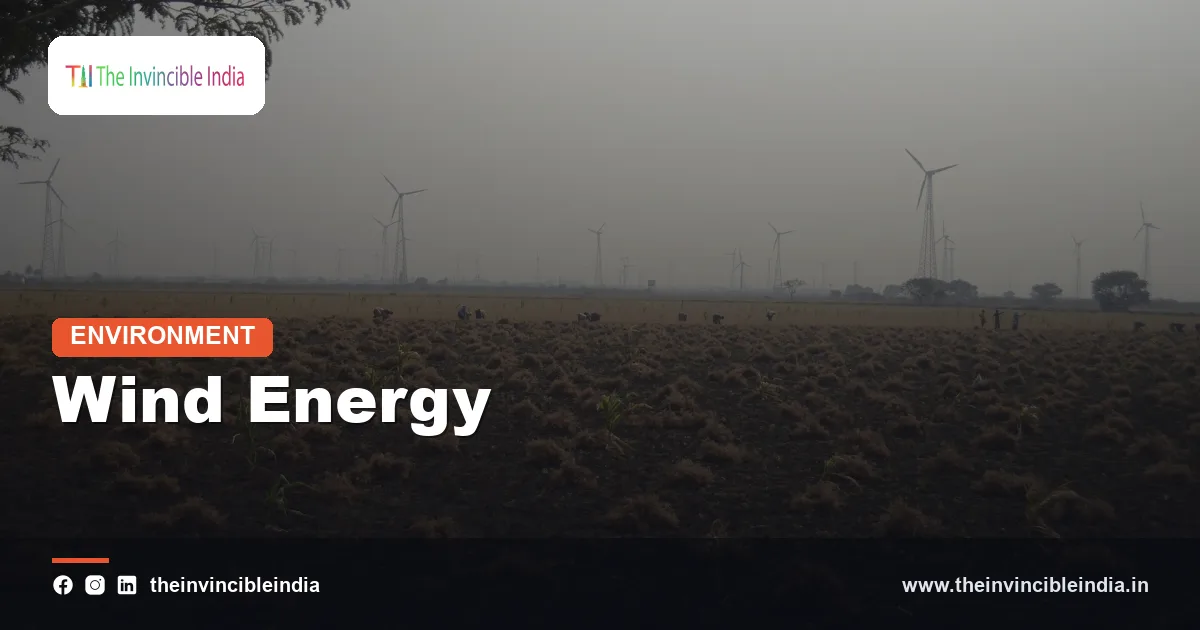
Wind energy is electricity generated by turbines that convert the kinetic energy of moving air into rotation and then into power, and India has built one of the largest wind fleets in the world. From the windswept Kanyakumari tip of Tamil Nadu to the salt flats of Kutch and the ridgelines of the Deccan plateau, tall white towers now form a familiar part of the Indian landscape. This explainer, last updated 4 November 2026, walks through how the technology works, where India’s best wind sites lie, how much power the country draws from them, what is planned offshore and what limits the growth of the sector.
Wind power matters in India for three practical reasons. It adds electricity without burning coal, it costs very little to run once the turbines are standing, and it can be built quickly on land that remains largely usable for farming or grazing. At the same time, wind is variable, tied to seasons and geography, and needs a grid that can absorb its swings. Understanding both sides is the key to understanding why the sector is celebrated and why it still faces hurdles.
Quick Facts
| What it is | Electricity produced when wind turns the blades of a turbine connected to a generator |
|---|---|
| India’s global standing | Among the top handful of wind-power countries by installed capacity, usually ranked fourth |
| Installed capacity | Roughly 50 gigawatts, the largest share of India’s non-hydro renewable fleet after solar |
| Leading states | Tamil Nadu, Gujarat, Karnataka, Maharashtra and Rajasthan, with Andhra Pradesh also prominent |
| Best-known wind area | Muppandal in Kanyakumari district, Tamil Nadu, one of the largest wind clusters in the country |
| Peak wind season | The southwest monsoon, roughly May to September, in the southern and western states |
| Typical capacity utilisation | Often about 20 to 35 per cent of the theoretical maximum output over a year |
| Next frontier | Offshore wind off Gujarat and Tamil Nadu, still at the early stage of planning and first tenders |
Key Takeaways
- Wind energy turns moving air into electricity through turbines, and India ranks among the world’s top wind-power nations with an installed fleet of roughly 50 gigawatts.
- Tamil Nadu, Gujarat, Karnataka, Maharashtra and Rajasthan hold most of India’s turbines, and their strongest winds arrive during the southwest monsoon months.
- Wind output in India is seasonal and variable, so it works best when paired with solar, storage, hydropower and a flexible, well-connected grid.
- India is preparing offshore wind along the Gujarat and Tamil Nadu coasts, where winds are steadier, but costs and port and grid needs remain significant challenges.
- Old small turbines can be swapped for fewer, taller and more powerful ones through repowering, which can raise output from the same windy sites.
- Wind farms have local trade-offs, including land use, bird and bat collisions and transmission delays, that good siting and planning can reduce but not remove.
What is wind energy and how does a turbine produce electricity?
Wind energy is a form of solar energy at one remove, because uneven heating of land and sea by the sun creates pressure differences that drive moving air, and a turbine captures part of that motion. The blades of a modern turbine are shaped like aircraft wings, so moving air creates lift that spins a rotor. The rotor turns a shaft linked, usually through a gearbox, to a generator inside a housing called the nacelle, which sits at the top of a tall tower. The electricity is stepped up by a transformer and sent along cables to a substation and then to the grid.
The power in wind rises steeply with its speed. Doubling the wind speed raises the available energy roughly eightfold, which is why a site with a modestly stronger breeze can be far more productive than a calmer one. This is also why turbines are built tall. Wind is faster and smoother higher up, away from the drag of trees, buildings and uneven ground, so a taller tower with longer blades captures much more energy from the same piece of land.
Turbines start generating at a low speed, known as the cut-in speed, reach their rated output at a moderate wind speed, and shut down in storm-force winds to protect the machine. Between those limits, an electronic control system turns the nacelle to face the wind and adjusts the blade angle, called pitch, to keep the rotor at a safe and efficient speed.
How big is wind power in India today?
India’s wind sector is one of the largest in the world, with an installed capacity of roughly 50 gigawatts, placing it among the top few nations alongside China, the United States and Germany. Wind supplies a meaningful but modest share of the country’s electricity, in the range of a few per cent to around ten per cent of generation depending on the season and the year, because the turbines run well below their full rated output for much of the time.
India’s wind story began in the 1980s, when pilot projects and early demonstration farms came up in Gujarat, Maharashtra and Tamil Nadu. Generous fiscal incentives in the 1990s, including accelerated depreciation, drew private investors, and the sector grew in waves. A national wind-resource assessment programme run by the National Institute of Wind Energy in Chennai mapped the best locations. More recent assessments at greater hub heights suggest a technical potential running into hundreds of gigawatts, far above what has been built, though only a part of that is likely to be economically usable.
The government has set a national goal of 500 gigawatts of non-fossil power capacity by 2030, and wind is expected to contribute a sizeable block of that alongside solar, hydropower and nuclear energy. Much of the recent growth has come through competitive auctions run by central agencies, which pushed down the price of wind power and shifted the market from small individual investors to large developers and utilities.
Which Indian states generate the most wind energy?
Tamil Nadu, Gujarat, Karnataka, Maharashtra and Rajasthan together account for the great majority of India’s installed wind capacity, with Andhra Pradesh and Madhya Pradesh adding smaller shares. These states sit in the corridors where the monsoon winds are channelled by landforms, giving them the strongest and most reliable resource.
Tamil Nadu has long led the country. Its best sites cluster around the Palghat gap in the Western Ghats and the southern tip near Aralvaimozhi and Muppandal in Kanyakumari district, where the Ghats open up and funnel the southwest monsoon winds onto the plains. Muppandal, with its dense forest of turbines, is often called the heart of Indian wind power and became a symbol of the early industry.
Gujarat has strong winds along the Saurashtra and Kutch coasts, supported by flat open terrain and good road and port access. Karnataka’s turbines stand on the dry ridges of districts such as Chitradurga and Gadag, while Maharashtra’s wind farms crowd the plateau and ridges around Satara, Sangli and Dhule. Rajasthan’s Jaisalmer area, in the Thar desert, has a large cluster, benefiting from open land and steady summer winds. Andhra Pradesh’s Anantapur and Kurnool areas have grown rapidly in recent years.
| State | Notable wind areas | What makes it windy |
|---|---|---|
| Tamil Nadu | Muppandal, Aralvaimozhi, Palghat gap, Tirunelveli | Gaps in the Western Ghats that funnel monsoon winds |
| Gujarat | Kutch, Saurashtra, Okha, Lamba | Open coastal plains exposed to Arabian Sea winds |
| Karnataka | Chitradurga, Gadag, Davanagere | Elevated dry ridges on the Deccan plateau |
| Maharashtra | Satara, Sangli, Dhule, Ahmednagar | Ridgelines and plateau tops along the Sahyadris |
| Rajasthan | Jaisalmer, Barmer | Open desert terrain with strong summer winds |
| Andhra Pradesh | Anantapur, Kurnool, Kadapa | Dry uplands with a good seasonal wind regime |
Why is the wind strongest in India during the monsoon?
The wind is strongest during the southwest monsoon because the intense summer heating of the Indian landmass pulls moist air in from the Arabian Sea at high speed. As the Indian subcontinent heats up in April and May, a vast low-pressure zone forms over the land. The cooler, denser air over the ocean rushes in to fill it, and in the months from about May to September these winds blow with great force over the southern and western states.
This seasonal rhythm shapes the economics. Wind farms in Tamil Nadu, Karnataka, Maharashtra and Gujarat produce a large share of their annual energy in just a few monsoon months. In the post-monsoon and winter period their output often drops sharply. The northeast monsoon helps Tamil Nadu a little in October to December, but the southwest monsoon remains the main driver.
The timing is partly helpful and partly awkward. During the monsoon, solar output dips because of cloud cover, so wind complements it. But summer evening demand in some regions and winter demand in the north fall outside the best wind months, which means other sources must fill the gaps. This mismatch is a key reason for interest in hybrid projects that combine wind, solar and batteries.
What is repowering and why does it matter?
Repowering means replacing old, small, low-capacity turbines with fewer, taller and more efficient modern machines on the same or nearby windy sites. Many of India’s earliest turbines, installed in the 1990s and early 2000s, have capacities well below one megawatt and stand on towers far shorter than today’s. Modern turbines commonly range from two to over three megawatts each and reach much higher into the wind.
The advantage is that the best wind locations are already known, are already connected to the grid and are already acceptable to the local community. Putting taller machines there can raise energy output several times over without needing much new land. A national repowering policy has encouraged this approach, and some state governments have added their own incentives.
Repowering is not simple. Land ownership may be fragmented among many small holders, old power purchase agreements may carry high tariffs that owners are reluctant to give up, and the transmission lines may need upgrades. Still, it is widely seen as one of the cheapest ways to grow wind output, particularly in Tamil Nadu where ageing turbines occupy the finest sites.
Can India build offshore wind farms?
India can build offshore wind farms, and the government has identified the waters off Gujarat and Tamil Nadu as the most promising zones, but the first commercial project is still to be completed. A national offshore wind policy introduced in 2015 set out a framework, and subsequent studies, including a Europe-supported feasibility effort known as the FOWIND project, pointed to strong potential near the Gulf of Khambhat and Gulf of Kutch in Gujarat and off the southern tip of Tamil Nadu. Official estimates of the technical potential run to tens of gigawatts.
Offshore winds are stronger and steadier than those on land, so each turbine can produce more power for more hours, and the machines can be much larger. But building at sea is costly. It needs specialised vessels, strengthened ports to handle huge blades and foundations, subsea cables and a robust grid link on shore. India has been working on supportive measures, including financial assistance for the first offshore projects, seabed leasing rules and port upgrades, and early tenders have been planned.
There are also environmental questions. Offshore sites near the Gulf of Kutch and Khambhat overlap with rich fishing grounds, sensitive coastal habitats and seasonal bird routes. Any large offshore project needs careful marine surveys, and local fishing communities must be consulted so that livelihoods are not harmed. Cyclones on both coasts add a design challenge, since turbines must survive violent storms.
Why is wind power unreliable, and how is the grid coping?
Wind power is variable because the wind itself changes by the hour, the day and the season, so output rises and falls independently of when people need electricity. A calm spell can cut a wind farm’s output to a small fraction of its capacity, while a strong gust period can push the grid to its limits. This is called intermittency, and it is the central technical challenge of all wind power.
India has several tools to handle it. Weather forecasting for wind has improved, allowing grid operators to schedule other sources in advance. Wind is spread across several states with different weather patterns, which smooths some of the variation. Hydropower, particularly stations with reservoirs, can ramp up or down quickly, and pumped storage plants can store surplus energy. The country is also adding grid-scale batteries and developing hybrid projects that pair wind with solar, using shared transmission lines to make better use of expensive infrastructure.
A separate problem has been transmission. In the past, some windy areas had more generation than the local lines could carry, leading to curtailment, when turbines are told to stop even though the wind is blowing. The Green Energy Corridor programme and new inter-state transmission lines aim to move renewable power from the wind belts to distant cities. Delays in land acquisition and clearances for lines remain a stubborn bottleneck.
What are the environmental and social impacts of wind farms?
Wind farms have far lower lifetime emissions than coal or gas plants, but they are not free of environmental and social impacts, and good siting is essential. A turbine produces electricity without burning fuel, emitting smoke or consuming cooling water, and the carbon emitted during manufacture is typically repaid within months of operation.
The main wildlife concern is collisions. Birds and bats can be struck by moving blades, and large raptors, bustards and migratory species are of particular worry. The critically endangered Great Indian Bustard, which lives in the open grasslands of Rajasthan and Gujarat, faces danger from power lines in the same areas where wind and solar farms are expanding, and conservation groups have asked for careful routing and, in sensitive stretches, underground cabling. Turbines built along ridgelines in the Western Ghats raise questions about forest clearing and habitat fragmentation.
Local communities may face other issues, including land disputes, noise and shadow flicker near homes, and the loss of grazing paths for pastoral groups. The benefits of rental payments and local jobs are real, but they are not shared evenly. Transparent consultation, fair land leases and strict environmental screening can reduce conflicts, and several states are tightening guidelines on distance from habitations and protected areas.
What does the future hold for wind energy in India?
The future of wind in India points towards larger turbines, hybrid projects, repowering and, eventually, offshore farms, all working within a grid that is becoming more flexible. Indian manufacturers have built a sizeable domestic industry, with several companies producing turbines and components locally, and the country is also a base for exports. Policy support has shifted from tax breaks to competitive auctions and, more recently, to measures that encourage round-the-clock power by combining generation and storage.
Several factors will decide how fast the sector grows. Land availability near the best wind sites is limited. Transmission must keep pace with generation. Financing costs and the financial health of electricity distribution companies affect developers’ willingness to bid. Public acceptance and wildlife safeguards will determine how many sites can be used without conflict.
If these hurdles are managed, wind could provide a substantial and growing share of India’s clean electricity, helping to cut emissions while meeting rising demand. Few other low-carbon options match its combination of low operating cost, rapid construction and domestic manufacturing capacity.
Bottom Line
Wind energy has already made India a global wind power, with tens of gigawatts of turbines mostly in Tamil Nadu, Gujarat, Karnataka, Maharashtra and Rajasthan. Its output is seasonal and variable, so it works best alongside solar, storage and hydropower. Repowering and offshore projects offer the next big gains, provided that grids, ports and wildlife safeguards keep pace.
Frequently Asked Questions
Which state has the most wind power in India?
Tamil Nadu has traditionally had the largest wind capacity, with Gujarat, Karnataka, Maharashtra and Rajasthan following closely. Their rankings shift slightly as new projects are added.
Where is the Muppandal wind farm?
Muppandal is in Kanyakumari district at the southern tip of Tamil Nadu. It lies near a gap in the Western Ghats that funnels strong monsoon winds and is among the best-known wind clusters in the country.
What share of India’s electricity comes from wind?
Wind supplies a modest share of India’s electricity, generally a few per cent to around ten per cent depending on the season. Its capacity is far larger than its generation because turbines rarely run at full output.
Does India have any offshore wind farms?
India does not yet have a commercial offshore wind farm in operation. The coasts of Gujarat and Tamil Nadu have been identified as promising zones, and support schemes and early tenders are being developed.
Why does wind power drop in winter in southern and western India?
Much of India’s wind comes from the southwest monsoon, which blows strongly from about May to September. After the monsoon withdraws, the pressure contrast weakens and winds in many wind-belt states become lighter.
Are wind turbines harmful to birds?
Turbines can kill birds and bats through collisions, and large birds such as raptors and the Great Indian Bustard are of particular concern. Careful site selection, avoiding sensitive habitats and burying power lines can reduce the risk.
{“@context”:”https://schema.org”,”@graph”:[{“@type”:”FAQPage”,”mainEntity”:[{“@type”:”Question”,”name”:”Which state has the most wind power in India?”,”acceptedAnswer”:{“@type”:”Answer”,”text”:”Tamil Nadu has traditionally had the largest wind capacity, with Gujarat, Karnataka, Maharashtra and Rajasthan following closely. Their rankings shift slightly as new projects are added.”}},{“@type”:”Question”,”name”:”Where is the Muppandal wind farm?”,”acceptedAnswer”:{“@type”:”Answer”,”text”:”Muppandal is in Kanyakumari district at the southern tip of Tamil Nadu. It lies near a gap in the Western Ghats that funnels strong monsoon winds and is among the best-known wind clusters in the country.”}},{“@type”:”Question”,”name”:”What share of India’s electricity comes from wind?”,”acceptedAnswer”:{“@type”:”Answer”,”text”:”Wind supplies a modest share of India’s electricity, generally a few per cent to around ten per cent depending on the season. Its capacity is far larger than its generation because turbines rarely run at full output.”}},{“@type”:”Question”,”name”:”Does India have any offshore wind farms?”,”acceptedAnswer”:{“@type”:”Answer”,”text”:”India does not yet have a commercial offshore wind farm in operation. The coasts of Gujarat and Tamil Nadu have been identified as promising zones, and support schemes and early tenders are being developed.”}},{“@type”:”Question”,”name”:”Why does wind power drop in winter in southern and western India?”,”acceptedAnswer”:{“@type”:”Answer”,”text”:”Much of India’s wind comes from the southwest monsoon, which blows strongly from about May to September. After the monsoon withdraws, the pressure contrast weakens and winds in many wind-belt states become lighter.”}},{“@type”:”Question”,”name”:”Are wind turbines harmful to birds?”,”acceptedAnswer”:{“@type”:”Answer”,”text”:”Turbines can kill birds and bats through collisions, and large birds such as raptors and the Great Indian Bustard are of particular concern. Careful site selection, avoiding sensitive habitats and burying power lines can reduce the risk.”}}]}]}


