

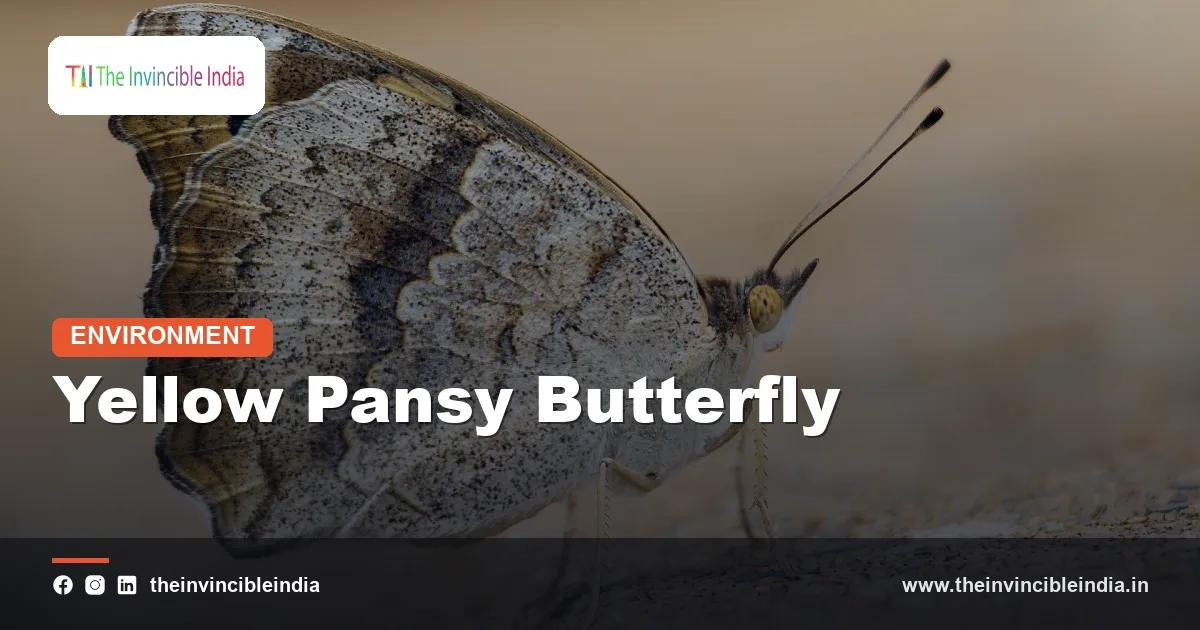
The yellow pansy (Junonia hierta) is a small, bright yellow-and-black butterfly of the brush-footed family Nymphalidae, easily recognised by the large blue eyespot on each hindwing and common in gardens, scrub and open ground across India. It is a restless, sun-loving species that spends much of the day basking with its wings spread flat on the ground, on a low rock or on a bare patch of earth.
The yellow pansy is one of the easiest butterflies for beginners to identify, since few other Indian species combine such a vivid yellow patch with a deep blue spot. This explainer covers its appearance, range, habits, host plants and life cycle, and how it differs from its close relatives in the pansy group.
Quick Facts
| Attribute | Detail |
|---|---|
| Common name | Yellow pansy |
| Scientific name | Junonia hierta |
| Family | Nymphalidae (brush-footed butterflies) |
| Wingspan | Roughly 4.5 to 6 centimetres, a small to medium-sized butterfly |
| Host plants | Herbs and shrubs of the acanthus family (Acanthaceae), such as Barleria, Asystasia, Justicia and Hygrophila |
| Range and habitat | Widespread in India and the Palaeotropics, including Africa and Southeast Asia; open scrub, grassland, roadsides and gardens |
| Broods | Several overlapping broods a year, with numbers peaking after the monsoon |
| Similar species | Lemon pansy, peacock pansy, chocolate pansy, blue pansy, grey pansy |
Key Takeaways
- The yellow pansy, Junonia hierta, is a small Nymphalidae butterfly with bright yellow forewing and hindwing patches and a prominent blue eyespot on each hindwing.
- The yellow pansy is common and widespread across India in open, sunny habitats such as grassland, scrub, roadsides and gardens.
- Yellow pansy caterpillars feed on plants of the acanthus family (Acanthaceae), which include Barleria, Asystasia and Justicia.
- The yellow pansy basks with its wings fully open, a habit that helps the butterfly warm its flight muscles in the morning.
- Male and female yellow pansies look different, with the male carrying a bigger and brighter blue patch on the hindwing while the female is generally duller.
- The yellow pansy produces several broods a year and shows seasonal forms, with the underside of the dry-season form being darker and more heavily speckled.
What Does the Yellow Pansy Look Like?
The yellow pansy is a compact butterfly with bright yellow on the upper side of its wings, a black wing tip and edges, and a large, velvety blue spot on the hindwing. The yellow colour covers the central and outer areas of the forewing and much of the hindwing, set against dark borders.
The blue spot is the most striking feature and has given the butterfly its pansy name, as the hindwing markings resemble the dark, bold face of the garden pansy flower. The forewing carries a broad black patch near the tip. When the butterfly closes its wings, the underside is a paler, more muted yellow-buff, patterned with small spots and fine lines, which provides camouflage on dry ground and dead leaves.
Males and females differ slightly. Males typically show a larger, brighter blue patch on the hindwing, while females tend to have duller colouring and heavier markings on the underside. Seasonal forms add further variation, because butterflies that emerge in the dry season often have a darker, more sprinkled underside than those that emerge during the rains.
How Big Is the Yellow Pansy?
The yellow pansy has a wingspan of roughly 4.5 to 6 centimetres, which makes it a small to medium-sized butterfly. Individuals vary a little by season and region, with some seasonal forms slightly larger than others.
Although small, the species is easy to spot because of its contrasting colours and its habit of landing in the open. Photographers and butterfly watchers often get close because the butterfly returns again and again to the same perches.
Where Is the Yellow Pansy Found in India?
The yellow pansy is found across most of India, from the plains of the peninsula and the Deccan to the foothills of the Himalayas, and it is one of the commonest garden and roadside butterflies in the country. It is especially numerous in dry and moderately moist open habitats.
Outside India, the yellow pansy belongs to the Palaeotropics, a range that includes Africa, the Arabian region and parts of South and Southeast Asia. Different populations in this broad range are often treated as subspecies, which show small differences in colour and pattern.
The species avoids dense, shaded forest and prefers open and disturbed ground. Typical habitats include:
- Open scrub and thorn forest
- Dry grassland and fallow fields
- Roadsides and railway embankments
- Village edges, parks and urban gardens
- Dry river beds and rocky clearings
How Does the Yellow Pansy Behave?
The yellow pansy is a fast, low-flying butterfly that darts across open ground in short flights and settles frequently to bask with its wings wide open. This behaviour makes it conspicuous on sunny mornings, when it lands on bare earth, stones and paths to warm up.
Males are territorial. A male usually picks a favourable perch, such as a bare patch or a low plant, and chases away other males or passing insects that enter his space. When a female arrives, courtship consists of a short chase and an exchange of movements near the ground.
Adults feed mostly on nectar from small flowers and on moisture from damp soil, a behaviour called mud-puddling, in which butterflies absorb salts and minerals. They are active mainly during the day and are most numerous in bright weather. At night and during cloudy or rainy spells, they rest low in vegetation, with their wings closed.
What Do Yellow Pansy Caterpillars Eat?
Yellow pansy caterpillars eat the leaves of plants in the acanthus family, Acanthaceae, which includes many common herbs and shrubs of Indian scrub and gardens. Typical host plants belong to genera such as Barleria, Asystasia, Justicia, Hygrophila and Blepharis.
Because these plants grow wild on waste ground and roadsides, the butterfly is able to breed in gardens as well as in natural habitats. Gardeners who allow some acanthus weeds to grow, or who plant ornamental Barleria, often attract the butterfly and see its caterpillars.
The table below lists the host plant family and a few of the genera involved.
| Host plant group | Examples | Typical habitat |
|---|---|---|
| Barleria | Porcupine flower and related species | Dry scrub, hedges and gardens |
| Asystasia | Creeping foxglove and related species | Gardens and disturbed ground |
| Justicia | Various herbs and shrubs | Scrub and forest edges |
| Hygrophila | Marsh and moist-ground herbs | Damp ground and water edges |
| Blepharis | Dry-zone acanthus herbs | Dry, open land |
What Is the Life Cycle of the Yellow Pansy?
The yellow pansy goes through complete metamorphosis in four stages, namely egg, caterpillar, pupa and adult butterfly, and the whole cycle takes a few weeks in warm weather. Like other brush-footed butterflies, the species completes each stage in turn and then begins again, with several generations in a year.
Egg
The female lays single eggs on the leaves or shoots of host plants. The eggs are small and rounded, and they hatch within a few days in warm conditions.
Caterpillar
The caterpillar is dark, brownish or greyish, with black branched spines along its body and a row of small whitish and bluish spots. It feeds on the leaves and grows through several stages, shedding its skin between each stage.
Pupa
The pupa, or chrysalis, is dull reddish or brownish and hangs head down from a twig or stem. After a short time, usually about a week in warm weather, the adult emerges.
Adult
The adult butterfly lives for a few weeks, during which it feeds, mates and lays eggs. The speed of the whole cycle depends on temperature, humidity and the availability of fresh host plant leaves.
How Many Broods Does the Yellow Pansy Have?
The yellow pansy has several overlapping broods in a year, and in warm parts of India adults can be seen in most months. Numbers are generally highest during and after the monsoon, when fresh host plants are abundant and caterpillars find plenty of food.
In drier regions, the butterfly may become scarce in the hottest months, and populations then recover with the rains. The seasonal change affects the colour of the underside, so the wet-season and dry-season forms of the same species can look noticeably different.
This ability to produce quick generations helps the species recover from disturbances such as grass cutting, grazing and the clearing of waste ground.
How Is the Yellow Pansy Different from Other Pansies?
The yellow pansy is different from other Indian pansies mainly because of its bright yellow ground colour, whereas relatives such as the peacock pansy, lemon pansy, chocolate pansy and blue pansy are brown, lemon-coloured, dark brown or blue. All belong to the genus Junonia and have eyespots, which is why they are collectively called pansies.
| Species | Scientific name | Main colour and feature |
|---|---|---|
| Yellow pansy | Junonia hierta | Bright yellow patches with a large blue hindwing spot |
| Lemon pansy | Junonia lemonias | Brownish upper side with a pale yellow-lemon patterning and several eyespots |
| Peacock pansy | Junonia almana | Orange-brown with large, peacock-like eyespots |
| Chocolate pansy | Junonia iphita | Dark chocolate brown with a pale band |
| Blue pansy | Junonia orithya | Males have bright blue wings; females are browner |
| Grey pansy | Junonia atlites | Greyish with fine, wavy lines |
The yellow pansy can be confused with a few yellow butterflies of other families, such as the grass yellows. The combination of broad black wing tips and the blue hindwing spot is the quickest way to identify the species with confidence.
A short checklist helps with field identification of the yellow pansy:
- Look for a bright yellow ground colour on the upper side of the wings, which no other common pansy shows.
- Check the hindwing for a single large, bluish spot that appears velvety in good light.
- Note the broad black wing tip and dark outer margins of the forewing.
- Observe the flight, which is low, quick and made up of short darting hops between perches in the open.
- Watch the resting posture, since the yellow pansy often settles on bare ground with wings flat and open.
- Confirm the habitat, because the butterfly is most often found in sunny, open and disturbed places rather than deep forest.
Is the Yellow Pansy Threatened?
The yellow pansy is not regarded as a threatened butterfly, because it is common and widespread and breeds on abundant weedy host plants. Its use of disturbed ground and gardens means it is more resilient to habitat change than butterflies that depend on pristine forest.
Even so, heavy pesticide use, the paving of open ground and the clearing of roadside weeds can reduce local numbers. Gardeners can support the species by leaving some native acanthus plants in place and by avoiding spraying on host plants.
How Can You Attract and Watch Yellow Pansies?
The easiest way to attract yellow pansies is to plant acanthus-family host plants such as Barleria and to provide sunny, open patches of bare soil or flat stones for basking. A garden that has small nectar flowers and a shallow, damp patch of ground will also draw adults.
- Visit open, sunny areas in the morning, when the butterflies bask.
- Look low, near the ground, and scan bare patches and paths.
- Move slowly, since the butterfly returns to the same perch after being disturbed.
- Check the undersides of host plant leaves for eggs and small caterpillars.
- Use a camera or binoculars rather than touching the insect, as handling can damage the wings.
Bottom Line
The yellow pansy is a small, vividly coloured, sun-loving butterfly that thrives in the open habitats most Indians see every day. Its blue hindwing spot, basking habit and acanthus host plants make it a good first species for anyone learning to watch butterflies.
Frequently Asked Questions
What is a yellow pansy butterfly?
The yellow pansy is a small butterfly, Junonia hierta, of the brush-footed family Nymphalidae. It is recognised by its bright yellow wings, black wing tips and a large blue spot on each hindwing. It is common in open habitats across India.
What do yellow pansy caterpillars eat?
Yellow pansy caterpillars eat the leaves of acanthus-family plants (Acanthaceae). Common host plants include Barleria, Asystasia, Justicia and Hygrophila. Because these plants grow widely in scrub and gardens, the butterfly breeds easily in both.
Where is the yellow pansy found?
The yellow pansy is found across most of India, in open scrub, grassland, roadsides and gardens. It is also found in Africa and parts of Southeast Asia. The butterfly generally avoids dense, shaded forest.
How big is a yellow pansy butterfly?
A yellow pansy butterfly has a wingspan of roughly 4.5 to 6 centimetres, so it is small to medium in size. Size varies a little with season and region. Despite its modest size, its bright colours make it easy to notice.
Why is it called a pansy?
The butterfly is called a pansy because the bold eyespots on its wings resemble the dark, rounded markings on the face of a pansy flower. The name is shared by all butterflies of the genus Junonia, which includes the peacock pansy, lemon pansy and blue pansy.
How many broods does the yellow pansy have in a year?
The yellow pansy has several overlapping broods in a year. In warm parts of India, adults can be seen in most months, with numbers usually peaking after the monsoon. The exact number of generations depends on temperature, rainfall and host plant availability.
{“@context”:”https://schema.org”,”@graph”:[{“@type”:”FAQPage”,”mainEntity”:[{“@type”:”Question”,”name”:”What is a yellow pansy butterfly?”,”acceptedAnswer”:{“@type”:”Answer”,”text”:”The yellow pansy is a small butterfly, Junonia hierta, of the brush-footed family Nymphalidae. It is recognised by its bright yellow wings, black wing tips and a large blue spot on each hindwing. It is common in open habitats across India.”}},{“@type”:”Question”,”name”:”What do yellow pansy caterpillars eat?”,”acceptedAnswer”:{“@type”:”Answer”,”text”:”Yellow pansy caterpillars eat the leaves of acanthus-family plants (Acanthaceae). Common host plants include Barleria, Asystasia, Justicia and Hygrophila. Because these plants grow widely in scrub and gardens, the butterfly breeds easily in both.”}},{“@type”:”Question”,”name”:”Where is the yellow pansy found?”,”acceptedAnswer”:{“@type”:”Answer”,”text”:”The yellow pansy is found across most of India, in open scrub, grassland, roadsides and gardens. It is also found in Africa and parts of Southeast Asia. The butterfly generally avoids dense, shaded forest.”}},{“@type”:”Question”,”name”:”How big is a yellow pansy butterfly?”,”acceptedAnswer”:{“@type”:”Answer”,”text”:”A yellow pansy butterfly has a wingspan of roughly 4.5 to 6 centimetres, so it is small to medium in size. Size varies a little with season and region. Despite its modest size, its bright colours make it easy to notice.”}},{“@type”:”Question”,”name”:”Why is it called a pansy?”,”acceptedAnswer”:{“@type”:”Answer”,”text”:”The butterfly is called a pansy because the bold eyespots on its wings resemble the dark, rounded markings on the face of a pansy flower. The name is shared by all butterflies of the genus Junonia, which includes the peacock pansy, lemon pansy and blue pansy.”}},{“@type”:”Question”,”name”:”How many broods does the yellow pansy have in a year?”,”acceptedAnswer”:{“@type”:”Answer”,”text”:”The yellow pansy has several overlapping broods in a year. In warm parts of India, adults can be seen in most months, with numbers usually peaking after the monsoon. The exact number of generations depends on temperature, rainfall and host plant availability.”}}]}]}


