

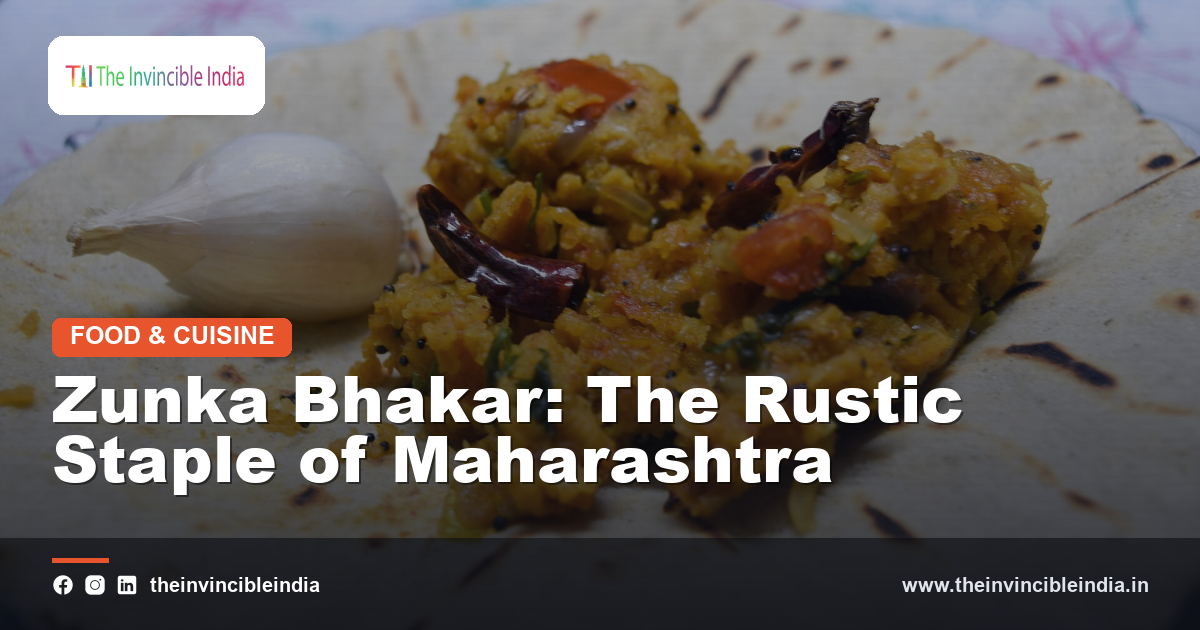
Zunka bhakar, also spelled zunka bhakri, jhunka bhakar or jhunka bhakri and closely related to pithla bhakri, is a rustic Maharashtrian meal of a dry, spiced gram-flour preparation eaten with a flat, hand-patted millet bread. The zunka is cooked with onions, garlic, green chillies and mustard seeds until it turns crumbly and fragrant, while the bhakar is an unleavened bread traditionally made from sorghum or pearl millet. It is hearty, inexpensive and deeply associated with village life, farm work and roadside eateries. Among the many dishes of Maharashtrian cuisine, it is perhaps the clearest expression of simple, filling country food. This guide explains what zunka bhakar is, how it is made and why it endures.
Quick answer: Zunka bhakar is a traditional Maharashtrian meal made of zunka, a dry, spiced preparation of gram flour (besan) cooked with onions, garlic and green chillies, served with bhakar (also called bhakri), an unleavened flatbread of sorghum (jowar) or pearl millet (bajra). It is also known as zunka bhakri or jhunka bhakar and is usually eaten with thecha, a coarse green chilli and garlic chutney.
Key Takeaways
- Zunka bhakar is a rustic meal of Maharashtra, in western India, pairing a gram-flour dish with a millet flatbread.
- It is also written zunka bhakri or jhunka bhakar, and the wetter, porridge-like version of the same dish is called pithla.
- Zunka is made from gram flour (besan), onions, garlic, green chillies, mustard seeds, cumin and turmeric.
- Bhakar is an unleavened, hand-patted flatbread made from jowar (sorghum), bajra (pearl millet) or sometimes rice flour.
- The meal is commonly eaten with thecha (a green chilli-garlic chutney), raw onion and sometimes buttermilk or jaggery.
- It is a staple of rural Maharashtra and is also served at dedicated roadside eateries and restaurants.
Read on for the ingredients, method, serving customs, and cultural role in detail.
Quick Facts
| Detail | Information |
|---|---|
| Dish | Zunka bhakar (zunka bhakri, jhunka bhakar) |
| Region | Maharashtra, western India |
| Type | Rustic main meal |
| Main ingredients | Gram flour (besan) zunka and millet flatbread (bhakar) |
| Key flavourings | Onion, garlic, green chilli, mustard, cumin, turmeric |
| Texture | Dry and crumbly zunka with firm, earthy bhakar |
| Usually served with | Thecha, raw onion, buttermilk, jaggery |
| Cultural role | Everyday farm food and a symbol of rural Maharashtra |
What is zunka bhakar?
Zunka bhakar is a complete rustic meal of Maharashtra consisting of a dry, spiced gram-flour dish called zunka and a flat millet bread called bhakar. The zunka is made by cooking besan with sautéed onions, garlic and green chillies until the flour turns into soft, fragrant crumbs. The bhakar is patted by hand into a thin disc and roasted on a griddle until it puffs lightly and develops brown spots. Eaten together, the earthy bread and the savoury crumble make a filling, balanced plate. Raw onion and a fiery chutney complete the experience. Zunka bhakar is therefore best understood as farm-style food, simple in ingredients yet generous in flavour.
What are the other names and spellings of zunka bhakar?
Zunka bhakar is also written as zunka bhakri, jhunka bhakar, jhunka bhakri and zunka bhakari, and a closely related dish is called pithla bhakri. Marathi has several transliterations, so menus and cookbooks print different spellings for the same dish. Bhakar and bhakri refer to the same type of flatbread. The terms zunka and pithla are often used together and sometimes interchangeably, although cooks usually distinguish a dry zunka from a looser, gravy-like pithla. English menus may describe it as gram-flour curry with millet bread. Knowing these alternative names helps readers recognise the dish in different regions, restaurants and family kitchens across Maharashtra.
Where does zunka bhakar come from?
Zunka bhakar comes from Maharashtra, and it is especially associated with the rural and semi-arid parts of the state where millets and pulses are grown. The dish developed as everyday farm food, quick to prepare and made from inexpensive, durable ingredients. Its exact origin is not recorded, and like many village dishes it is the product of long practice rather than a single inventor. The reliance on sorghum and pearl millet reflects the traditional crops of the Deccan plateau, while gram flour provides plant protein. Zunka bhakar therefore belongs to the working food of the countryside, and its spread into towns and restaurants came later, carrying with it a strong sense of rural identity.
Zunka Bhakar in the Setting of Maharashtrian Cuisine
Zunka bhakar represents the simple, rustic side of Maharashtrian cuisine, which ranges from coastal seafood and coconut-rich curries to the fiery meat dishes of the interior. In the Deccan and Marathwada regions, millet breads and spicy chutneys are everyday food, and zunka bhakar fits this pattern. It differs sharply from festive dishes such as puran poli or elaborate thalis, and it needs little equipment or time. The meal shows how Maharashtrian cooks use pulses, millets, onions and chillies to create strong flavours with modest means. In the wider story of regional cuisines of India, it stands as a clear example of food shaped by land and labour.
What ingredients go into zunka?
Zunka is made from gram flour, onions, garlic, green chillies, oil, mustard seeds, cumin seeds, turmeric, asafoetida, salt and fresh coriander. Many cooks also add curry leaves, and a little water is used to bind the flour into soft crumbs. Chopped spring onions or their greens are used in some seasonal versions, and a few households add grated coconut or peanut. The base of onions and garlic gives depth, the chillies give heat and the turmeric gives a bright yellow colour. The ingredient list is brief and uses only pantry staples, so the dish can be made quickly. The skill lies in the sequence of cooking, which draws the best flavour from each item.
What is the difference between zunka and pithla?
Zunka is a dry, crumbly gram-flour preparation, while pithla is a softer, wetter version cooked with more water so it resembles a thick porridge or gravy. Both use the same basic ingredients of besan, onion, garlic, chilli and mustard seeds, and both are eaten with bhakri. The difference lies in the amount of liquid and the length of cooking: zunka is stirred until the flour dries into granules, while pithla is allowed to stay moist. Some regions and families use the names loosely, and the line between the two is not strict. Understanding the distinction helps explain why the same meal can be called by different names in different parts of Maharashtra.
What is bhakar made of?
Bhakar, also called bhakri, is made from millet flour, most often jowar (sorghum) or bajra (pearl millet), and sometimes from rice or finger millet flour. The flour is mixed with warm water and a pinch of salt to form a dough, which has no leavening and no gluten to hold it together. This makes the dough crumbly, so the bread is shaped by patting it with wet hands rather than rolling it. Jowar bhakri is the most common version in the Deccan, bajra bhakri is popular in cooler months, and rice and finger millet versions appear in other areas. Millets are valued as hardy, drought-tolerant grains, and bhakar is the traditional way of turning them into a daily staple.
How is zunka made?
Zunka is made by tempering spices in oil, cooking onions and garlic, adding gram flour and a little water, and stirring until the mixture turns dry and crumbly. First mustard seeds, cumin, asafoetida and turmeric are sizzled in hot oil, followed by chopped green chillies and onions, which are cooked until soft. Gram flour is then sprinkled over and stirred in, and a small amount of water is added in stages so the flour forms soft granules without lumps. The pan is covered briefly to steam the zunka, then uncovered and stirred until the crumbs are dry and cooked. Fresh coriander is added at the end. Careful stirring is the key to a fluffy, non-sticky zunka.
How is bhakar made?
Bhakar is made by kneading millet flour with warm water, patting the dough into thin discs by hand, and roasting them on a hot griddle. Because millet dough lacks gluten, cooks press it flat on a board or in their palms using damp fingers, a skill that takes practice. The disc is placed on a hot tawa, sprinkled with a little water on the top, and then flipped and cooked directly on the flame in some households so it puffs. The finished bread is firm, slightly dry and earthy in taste, with small dark spots. It is often brushed with a little ghee or butter. Making good bhakar is regarded as a mark of a skilled home cook.
What Is Thecha and Why Is It Served with Zunka Bhakar?
Thecha is a coarse chutney of green chillies and garlic, pounded with salt and sometimes roasted peanuts, and it is the classic fiery partner of zunka bhakar. It is traditionally ground on a stone mortar or pestle so the texture stays rough rather than smooth. A small spoonful added to the plate gives the mild bhakar and zunka a sharp, garlicky heat. Thecha is often served alongside raw onion, which offers a cooling crunch. Its role in the meal is to lift the flavour and add contrast. Variations may use red chillies or additional ingredients such as coriander. The pairing shows how Maharashtrian meals balance mild staples with strong accompaniments.
How Is Zunka Bhakar Traditionally Served and Eaten?
Zunka bhakar is traditionally served on a simple plate with zunka, bhakar, thecha, a raw onion and sometimes buttermilk, a piece of jaggery or a green chilli. The bhakar is broken into pieces and used to scoop the zunka, with bites of onion and thecha taken in between. In villages, the meal is often eaten in the fields, wrapped in cloth, because it keeps well and travels easily. In restaurants it may be served on a steel plate with extras such as a small portion of curd. The way it is eaten is as important as the ingredients, for the contrast of textures and flavours is what makes the plate satisfying.
Why Is Zunka Bhakar Considered Nutritious and Practical?
Zunka bhakar is considered a practical and wholesome meal because it combines millet, a fibre-rich grain, with gram flour, a plant source of protein, in a single plate. Millets such as jowar and bajra have long been staples in dry regions of India, and gram flour is made from chickpeas, a widely eaten pulse. Together they give lasting energy for physical work. The dish is also quick to prepare, uses little fuel and requires few ingredients, which made it ideal for farm families. These qualities are traditional observations rather than medical claims. The meal’s value lies in its balance of staples, its low cost and its fit with the rhythms of rural life.
Zunka Bhakar Eateries and Their Place in Maharashtra
Zunka bhakar is sold in small roadside eateries, dhabas and dedicated restaurants across Maharashtra, where it is promoted as honest, affordable country food. The state has at times encouraged low-cost outlets serving zunka bhakar, which helped make the dish familiar to town and city dwellers. Many restaurants now serve it with decorative village-style settings, and tourist routes often include a stop for a plate. The dish is also a feature of rural fairs and festivals. Its presence in commercial settings has helped preserve the skill of making bhakar and given millet-based cooking a wider audience. Zunka bhakar thus carries both nostalgic and practical value for Maharashtrians.
Variations of Zunka Bhakar
Zunka bhakar has many regional and family variations, varying in the spices, the vegetables and the type of bread. Some versions are made with spring onion greens in winter, others add grated coconut, peanuts or curry leaves, and a few use a splash of buttermilk. In western Maharashtra the bread may be jowar, while bajra is common in colder months and in certain districts. Some households serve the zunka with chapati rather than bhakar, especially in towns. The spice level ranges from mild to very hot depending on the chillies used. These variations show that the dish is flexible, adapting to seasons, resources and tastes while keeping its identity.
Tips for a Good Zunka and a Soft Bhakar
A good zunka depends on adding water slowly and stirring continuously, and a soft bhakar depends on warm water, proper kneading and a hot griddle. Cooks sprinkle the gram flour evenly to prevent lumps, steam the zunka briefly, and then stir until it is dry and crumbly. For bhakar, the dough is kneaded well while warm so it holds together, and the disc is patted evenly so it cooks through. Keeping the griddle hot but not smoking helps the bread puff and brown without hardening. Serving both immediately gives the best result. These small points explain why a plain meal can taste so different from one kitchen to another.
Zunka Bhakar Today
Zunka bhakar today remains a defining dish of Maharashtra, enjoyed at home, in village eateries and increasingly in city restaurants and food festivals. The growing interest in millets has brought fresh attention to bhakar, and many cooks and chefs now present zunka bhakar as both comfort food and a heritage dish. It continues to be linked with farm life, thrift and hospitality. Even as lifestyles change, a plate of zunka, bhakar, thecha and onion carries a strong sense of place. Zunka bhakar endures as a reminder that the simplest food, made with skill, can express the character of an entire region.
Sources & Further Reading
- Ministry of Culture, Government of India (indiaculture.gov.in).
- Ministry of Tourism, Government of India (tourism.gov.in).
Frequently Asked Questions
What is zunka bhakar?
Zunka bhakar is a traditional Maharashtrian meal of a dry, spiced gram-flour preparation called zunka eaten with a millet flatbread called bhakar. It is usually served with thecha, a chilli-garlic chutney, and raw onion.
What is the difference between zunka and pithla?
Zunka is a dry, crumbly gram-flour dish, while pithla is a softer, wetter version similar to a thick porridge. Both are made from besan, onions, garlic and chillies and are eaten with bhakri.
What is bhakar made from?
Bhakar is made from millet flour, most commonly jowar (sorghum) or bajra (pearl millet), mixed with warm water and salt. The dough is patted by hand into discs and roasted on a griddle.
Why is thecha served with zunka bhakar?
Thecha is served with zunka bhakar because its sharp green chilli and garlic heat balances the mild, earthy flavour of the zunka and bhakar. It is traditionally pounded coarsely and added in small amounts.
Is zunka bhakar vegetarian?
Yes, zunka bhakar is a vegetarian dish made from gram flour, millet, onions and spices. Both the zunka and the bhakar are plant-based, and any ghee or butter is optional.
Where is zunka bhakar popular?
Zunka bhakar is popular across Maharashtra, especially in the rural Deccan and Marathwada regions, and is also served in roadside eateries and restaurants in towns and cities.


