

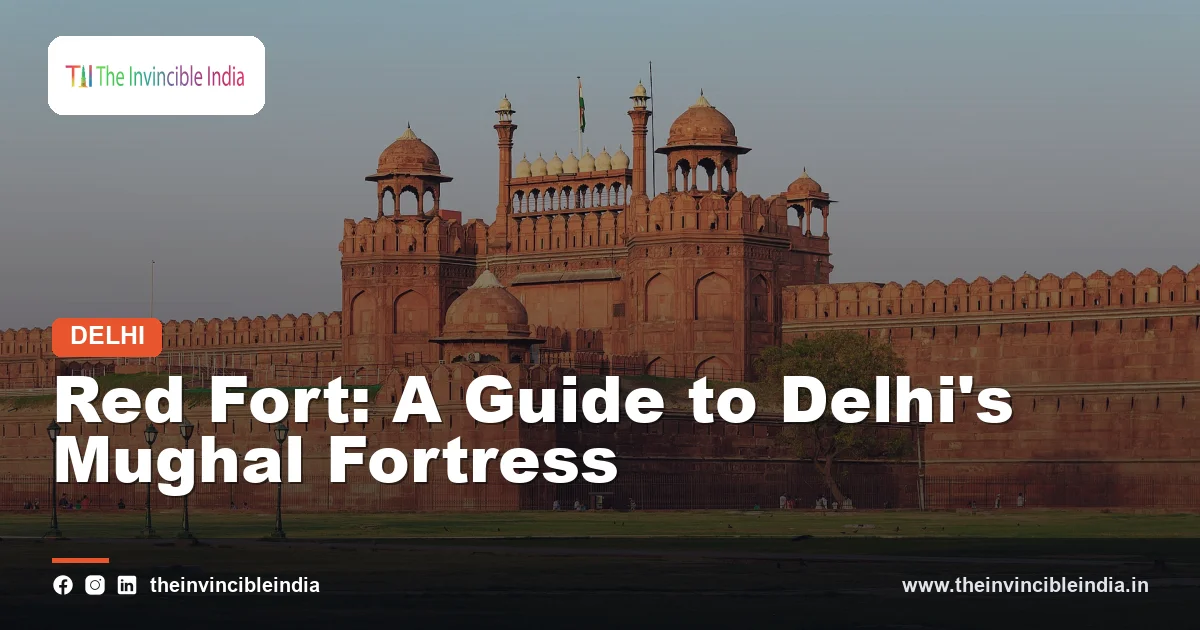
Standing majestically in the heart of Old Delhi, the Red Fort is one of India’s most iconic monuments and a powerful symbol of the nation itself. Built by the Mughal emperor Shah Jahan in the 17th century as the palace fortress of his new capital, this magnificent complex of red sandstone walls, grand halls and elegant gardens embodies the height of Mughal power and artistry. A UNESCO World Heritage Site, the Red Fort is also where India’s Prime Minister addresses the nation each Independence Day. This guide explores the history, architecture and enduring significance of this great fortress.
Quick Facts: The Red Fort
| Detail | Information |
|---|---|
| Location | Old Delhi |
| Built by | Emperor Shah Jahan |
| Construction | Around 1638 to 1648 |
| Material | Red sandstone |
| Also known as | Lal Qila |
| UNESCO status | World Heritage Site (2007) |
The History of the Red Fort
The Red Fort was built when Emperor Shah Jahan, the same ruler who created the Taj Mahal, decided to move the Mughal capital from Agra to Delhi. He founded a new city called Shahjahanabad, at the heart of which he built this grand palace fortress as his imperial residence. Construction began around 1638 and took about a decade to complete. For nearly two hundred years, the Red Fort served as the main residence of the Mughal emperors and the ceremonial and political centre of their empire, witnessing the grandeur of the dynasty as well as its eventual decline.
The Architecture and Design
The Red Fort takes its name from the massive red sandstone walls that enclose it, stretching for over two kilometres and rising to considerable heights. The fort is roughly octagonal in plan and is surrounded by a moat. Within its walls lies a carefully planned complex of palaces, halls, pavilions, gardens and water channels, reflecting the sophistication of Mughal architecture and urban design. The layout combined Persian, Timurid and Indian architectural traditions into a harmonious whole, and the fort represented the peak of Mughal creativity, its style influencing buildings across the subcontinent for generations.
The Grand Gateways
The Red Fort has two main gateways, the Lahori Gate and the Delhi Gate, both imposing structures of red sandstone. The Lahori Gate, facing towards Lahore, is the principal and most famous entrance, and it is from the ramparts above it that the Prime Minister of India addresses the nation each Independence Day. Passing through the Lahori Gate, visitors enter the Chatta Chowk, a covered bazaar where, in Mughal times, merchants sold silks, jewellery and other luxury goods to the imperial household. These grand entrances set the tone for the magnificence that lies within.
The Diwan-i-Aam
One of the most important structures within the fort is the Diwan-i-Aam, or Hall of Public Audience, where the emperor would sit to hear petitions and grievances from the common people and to conduct the general business of the court. This spacious hall, with its rows of elegant columns and arches, was designed to accommodate large gatherings, and the emperor would appear on a raised, ornately decorated throne beneath a canopy. The Diwan-i-Aam symbolised the emperor’s role as a just ruler accessible to his subjects, and its scale and decoration reflected the dignity of the Mughal court.
The Diwan-i-Khas and the Peacock Throne
Even more richly decorated is the Diwan-i-Khas, or Hall of Private Audience, where the emperor received important dignitaries and conducted confidential affairs of state. This exquisite hall, adorned with marble, precious stones and intricate inlay work, once housed the legendary Peacock Throne, a fabulously jewelled seat that was among the most magnificent thrones in the world before it was later carried off. Inscribed on the walls of the Diwan-i-Khas is a famous Persian couplet that translates as: “If there be a paradise on earth, it is this, it is this, it is this”, capturing the sublime beauty of the hall.
Palaces, Pavilions and Gardens
The Red Fort contains a series of beautiful palaces and pavilions along its eastern side, overlooking what was once the river Yamuna. Among them is the Rang Mahal, or Palace of Colours, once part of the imperial harem and famed for its painted and mirrored decoration; the Khas Mahal, the emperor’s private apartments; and the Moti Masjid, or Pearl Mosque, a delicate structure of white marble. These buildings were connected by a channel of flowing water known as the Nahr-i-Behisht, or Stream of Paradise, and were set amid gardens, creating an atmosphere of serene royal luxury.
The Red Fort and India’s Freedom
The Red Fort holds a special place in the story of modern India. After the Mughal decline and the events of 1857, the fort came under British control and witnessed significant historical episodes, including the trials of Indian National Army officers after the Second World War. Most importantly, on 15 August 1947, when India gained independence, the national flag was raised over the Red Fort, and it was from here that the country’s first Prime Minister addressed the new nation. This tradition continues every Independence Day, making the Red Fort a living symbol of India’s freedom and sovereignty.
Planning Your Visit
The Red Fort is located in Old Delhi and is easily reached by the Delhi Metro and by road, close to other famous sites such as the Jama Masjid and the bustling markets of Chandni Chowk. The fort is open every day except Mondays, and the best time to visit is during the cooler months from October to March, ideally in the morning. An evening sound-and-light show narrates the history of the fort against its illuminated backdrop. Allow a couple of hours to explore the complex, and consider a guide to bring its rich history vividly to life.
The Capital of Shahjahanabad
The Red Fort was the centrepiece of a magnificent new capital city called Shahjahanabad, which Shah Jahan built when he moved the seat of the Mughal Empire from Agra to Delhi. This walled city, much of which survives as the area known today as Old Delhi, was laid out with the fort at its heart, connected to the grand Jama Masjid and the bustling market street of Chandni Chowk, which ran from the fort itself. The city was one of the most splendid of its age, a thriving centre of trade, culture and courtly life, and the Red Fort stood as its crowning glory and the residence of the emperor at the summit of Mughal power.
The Later History of the Fort
The fortunes of the Red Fort mirrored those of the Mughal Empire itself. After the reign of Shah Jahan and his successors, the empire gradually declined, and the fort suffered plunder and neglect, losing many of its treasures over the eighteenth and nineteenth centuries. Following the great uprising of 1857, the last Mughal emperor was deposed and the fort came under British control, which brought further alterations and the loss of several structures. Despite these upheavals, the core of the fort survived, and after independence it passed into the care of the Indian nation, which has worked to preserve and restore this priceless heritage.
A Symbol in the National Imagination
Few monuments occupy so central a place in the Indian national imagination as the Red Fort. Its image is instantly recognisable across the country, and its association with the Independence Day address by the Prime Minister has made it a powerful emblem of the sovereign, democratic nation. The sight of the national flag flying over its ramparts, and the annual ceremony held there, connect the historic fortress of the emperors to the story of modern, independent India. In this way, the Red Fort bridges the country’s imperial past and its democratic present, embodying continuity, resilience and national pride.
Nearby Attractions
A visit to the Red Fort can easily be combined with the many other attractions of Old Delhi, which lie within a short distance. The magnificent Jama Masjid, one of the largest mosques in India and also built by Shah Jahan, is close by, as is the vibrant and historic market of Chandni Chowk, famous for its shops, street food and atmosphere. The area is rich in history, culture and culinary delights, and exploring it on foot or by cycle-rickshaw offers a wonderful immersion in the old heart of Delhi, making the Red Fort the perfect starting point for a day of discovery.
The Sound and Light Show
One of the most atmospheric ways to experience the Red Fort is through the evening sound-and-light show, held against the illuminated backdrop of the historic ramparts. The presentation narrates the dramatic history of the fort and the Mughal Empire, from the glory of Shah Jahan’s reign through the centuries of change to the events surrounding India’s independence, brought to life through light, sound and stirring narration. Sitting before the great walls as their story unfolds is a memorable experience that deepens one’s appreciation of the monument, and it is a popular way for visitors to round off a day exploring the fort and Old Delhi.
The Enduring Majesty of the Red Fort
The Red Fort endures as one of the great monuments of India, a magnificent embodiment of the power, artistry and vision of the Mughal age and a living symbol of the nation’s journey to freedom. Its soaring red walls, splendid halls and elegant pavilions continue to evoke the grandeur of a bygone era, while its association with Independence Day binds it to the story of modern India. To walk through its gates is to step into centuries of history, and the Red Fort remains an essential destination for anyone seeking to understand the rich and dramatic heritage of Delhi and of India itself.
A Monument for Every Visitor
Whether you come as a lover of history, an admirer of architecture, or simply a traveller wishing to feel the pulse of Old Delhi, the Red Fort offers something unforgettable. Its towering gateways, magnificent halls and peaceful gardens speak of a glorious past, while its role in the nation’s freedom gives it a living significance that resonates with every Indian. Set amid the vibrant bustle of the old city, the Red Fort is more than a monument; it is a place where the history of an empire and the birth of a nation come together, making it a truly essential Delhi experience.
Frequently Asked Questions
Who built the Red Fort?
The Red Fort was built by the Mughal emperor Shah Jahan, who constructed it as the palace fortress of his new capital, Shahjahanabad, between around 1638 and 1648.
Why is the Red Fort important to India?
Besides being a masterpiece of Mughal architecture and a UNESCO World Heritage Site, the Red Fort is where the national flag was first raised at independence, and the Prime Minister addresses the nation from its ramparts every Independence Day.
What is the Diwan-i-Khas famous for?
The Diwan-i-Khas, or Hall of Private Audience, once housed the legendary Peacock Throne and bears the famous inscription describing it as a paradise on earth.
What is the best time to visit the Red Fort?
The best time is during the cooler months from October to March. The fort is closed on Mondays, and mornings are ideal for a comfortable visit.


