

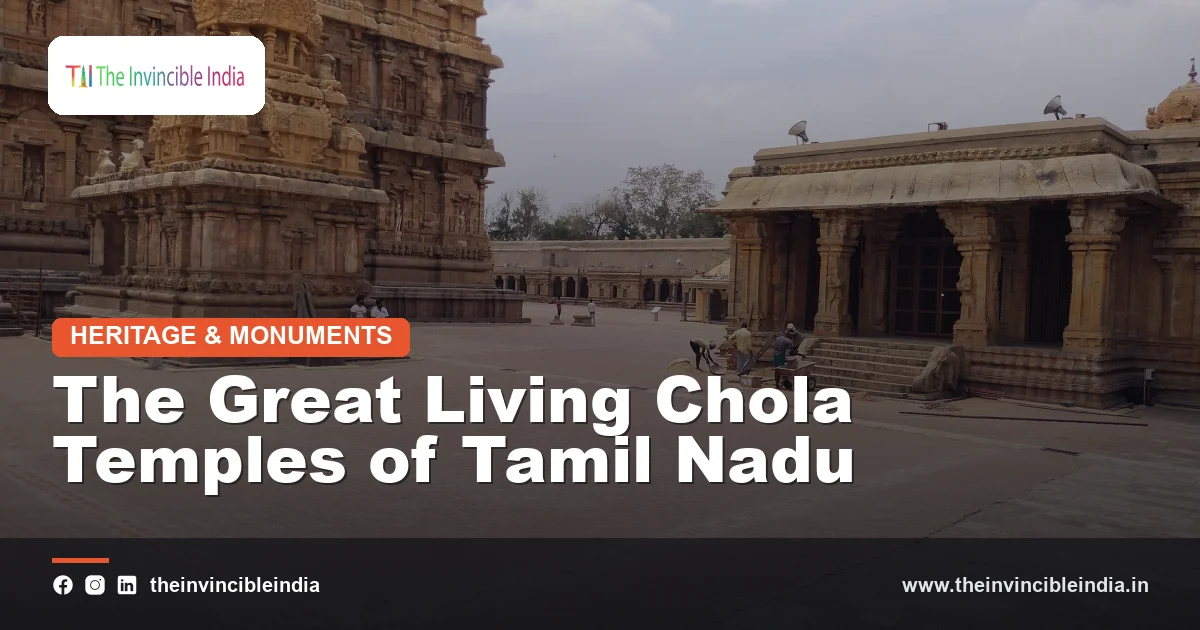
The Great Living Chola Temples of Tamil Nadu are among the most magnificent achievements of Indian architecture, monuments of staggering scale and beauty built by the mighty Chola dynasty a thousand years ago. Comprising three temples — the Brihadeeswarar Temple at Thanjavur, the temple at Gangaikonda Cholapuram, and the Airavatesvara Temple at Darasuram — they represent the very pinnacle of Dravidian temple architecture and remain active places of worship to this day. Together they form a UNESCO World Heritage Site. This guide explores the history, architecture and enduring glory of these extraordinary temples.
Quick Facts: Great Living Chola Temples
| Detail | Information |
|---|---|
| Location | Tamil Nadu (Thanjavur region) |
| Built by | The Chola dynasty (11th–12th century CE) |
| Three temples | Thanjavur, Gangaikonda Cholapuram, Darasuram |
| Style | Dravidian architecture |
| Thanjavur temple built by | Raja Raja Chola I (completed 1010 CE) |
| UNESCO status | World Heritage Site (1987, extended 2004) |
The Mighty Chola Empire
The Cholas were one of the longest-ruling and most powerful dynasties in Indian history, dominating southern India and beyond from the 9th to the 13th centuries. At the height of their power, the Cholas built a formidable empire with a strong navy that projected their influence across the seas to Sri Lanka and Southeast Asia. Great patrons of art, literature, religion and architecture, the Chola kings channelled the wealth of their empire into building magnificent temples that served as centres of religious, cultural, economic and administrative life. These temples stand today as enduring symbols of the empire’s golden age.
The Brihadeeswarar Temple at Thanjavur
The crowning glory of Chola architecture is the Brihadeeswarar Temple at Thanjavur, also known as the Peruvudaiyar Kovil or Big Temple. Completed around 1010 CE by the great emperor Raja Raja Chola I, it was one of the largest and tallest temples of its time and remains one of the greatest achievements of Indian architecture. Dedicated to Lord Shiva, the temple is renowned for its towering vimana, the pyramidal tower over the sanctum, which rises to a height of around 66 metres, making it one of the tallest of its kind in the world.
The Engineering Marvel of the Vimana
The great vimana of the Thanjavur temple is an engineering marvel that continues to inspire wonder. Built entirely of granite, a notoriously hard stone, in a region where granite is not locally abundant, its construction required immense resources, planning and skill. The tower is crowned by a massive monolithic capstone said to weigh many tonnes, and legend holds that it was raised into position using a long earthen ramp. Remarkably, the temple was constructed without the use of mortar, its precisely cut stones held together by their own weight and interlocking design, a testament to the extraordinary abilities of Chola engineers.
Art and Sculpture of the Temples
The Chola temples are adorned with a wealth of sublime sculpture and art. The walls, niches and towers feature exquisite stone carvings of deities, guardians, dancers and mythological scenes, while the temples are also famous for their association with the magnificent Chola bronzes, among the finest metal sculptures ever created. The temples once contained beautiful frescoes and murals, some of which survive, depicting religious and courtly scenes. The famous depictions of the 108 karanas, or dance poses of classical Bharatanatyam, connect the temples to the rich performing-arts traditions of Tamil culture.
Gangaikonda Cholapuram
The second of the great temples was built by Raja Raja Chola’s son, Rajendra Chola I, at Gangaikonda Cholapuram, the city he founded as his new capital to commemorate his victorious military campaign to the banks of the Ganga in the north. Completed around 1035 CE, this temple is a worthy successor to the Thanjavur temple, slightly lower but considered by many to be even more refined and graceful in its proportions and sculpture. Though the city that once surrounded it has long vanished, the magnificent temple survives as a monument to the Cholas’ imperial ambition and artistic genius.
The Airavatesvara Temple at Darasuram
The third temple in the group is the Airavatesvara Temple at Darasuram, near Kumbakonam, built by Rajaraja Chola II in the 12th century. Smaller than the other two but exquisitely detailed, it is a jewel of Chola art, celebrated for its intricate carvings and unique features. The temple is famous for its stone chariot-like mandapa and for a set of musical steps that are said to produce different notes when struck. Every surface is covered in delicate sculpture, making Darasuram a masterpiece of refinement that showcases the sophistication reached by Chola craftsmen in the later period of the empire.
Living Temples of Faith
What makes these monuments especially remarkable is that they are described as “living” temples, meaning they remain active centres of Hindu worship a thousand years after they were built. Daily rituals, festivals and prayers continue within their ancient walls, and they are thronged with devotees and pilgrims. This unbroken continuity of worship gives the temples a vibrancy and spiritual atmosphere that a mere museum could never possess, allowing visitors to experience them not just as historical monuments but as living expressions of a faith and culture that have endured for millennia.
Planning Your Visit
The three temples are located in the fertile Kaveri delta region of Tamil Nadu, with Thanjavur as the main hub, well connected by rail and road to Chennai and other cities, with the nearest airport at Tiruchirappalli. The temples can be explored over a day or two, ideally combined with the temple town of Kumbakonam nearby. The best time to visit is during the cooler months from October to March. As active places of worship, modest dress is expected, and footwear must be removed before entering. A guide greatly enhances the experience by explaining the rich history and symbolism of these extraordinary temples.
The Magnificent Chola Bronzes
Alongside their architectural achievements, the Cholas are celebrated for producing some of the finest bronze sculptures ever created. Cast using the demanding lost-wax technique, Chola bronzes depict Hindu deities with extraordinary grace, fluidity and spiritual power. The most iconic of all is the image of Nataraja, Lord Shiva as the cosmic dancer, encircled by a ring of flames, a masterpiece of both art and philosophy that has become world-famous. These bronzes, many of which once resided in the great Chola temples and were carried in procession during festivals, represent a high point of Indian metal sculpture and are treasured in museums and temples across India and the world.
Temples as Centres of Life
The great Chola temples were far more than places of worship; they were the beating hearts of their communities and the empire itself. These vast complexes served as centres of religion, education, art, music and dance, and as major economic institutions that owned land, employed hundreds of people, and administered charity and irrigation. Detailed records show that the temples supported priests, dancers, musicians, craftsmen, cooks and countless others, functioning almost as self-contained towns. This central role in society meant that building a great temple was an act of enormous political and cultural significance, projecting the power, piety and prosperity of the Chola kings.
Inscriptions and Historical Records
One of the most remarkable features of the Chola temples is the wealth of inscriptions carved into their walls, which provide an extraordinarily detailed record of the age. Written mainly in Tamil, these inscriptions document royal gifts and endowments, the administration of the temples, land grants, and the daily activities of the community, offering historians an invaluable window into the economy, society and governance of the Chola Empire. The great temple at Thanjavur in particular is covered in such inscriptions, making it not only an architectural masterpiece but also one of the richest historical archives of medieval South India, preserving the voices of a civilisation across a thousand years.
The Enduring Glory of Chola Architecture
The Great Living Chola Temples represent the supreme achievement of Dravidian temple architecture and one of the crowning glories of Indian civilisation. Their monumental scale, engineering brilliance, sublime sculpture and unbroken traditions of worship combine to make them truly extraordinary. To stand before the towering vimana at Thanjavur, to admire the refined beauty of Gangaikonda Cholapuram, or to marvel at the delicate carvings of Darasuram, is to witness the genius of a great empire captured in stone. A thousand years on, these temples continue to inspire awe and devotion, standing as timeless monuments to the artistry, faith and ambition of the mighty Cholas.
Festivals and Living Traditions
As active places of worship, the great Chola temples come especially alive during their annual festivals, when the ancient rituals established centuries ago are performed with great devotion and splendour. Deities are adorned, processions wind through the temple precincts, and traditional music and dance fill the air, drawing thousands of pilgrims and visitors. These vibrant celebrations, unbroken across a thousand years, offer a rare and moving glimpse of a living heritage, allowing visitors to experience the temples not as silent relics but as thriving centres of faith and culture.
How to Reach the Chola Temples
The great Chola temples lie in the Kaveri delta of Tamil Nadu, with Thanjavur as the main base, well connected by rail and road to Chennai and other cities, and served by the nearest airport at Tiruchirappalli. Gangaikonda Cholapuram and Darasuram are within easy driving distance, and the temple town of Kumbakonam makes a convenient hub for exploring the region. The cool months from October to March are the best time to visit.
A Thousand Years of Glory
The Great Living Chola Temples stand today as enduring symbols of one of the most brilliant civilisations in Indian history. Uniting monumental architecture, sublime art and unbroken traditions of worship, they continue to inspire wonder and devotion a thousand years after their creation. To visit them is to step into the golden age of the Cholas and to witness, in stone and bronze, the genius of a great empire that has left an indelible mark on the culture and heritage of southern India.
Visitor Tips for the Chola Temples
As these are active places of worship, visitors should dress modestly and be prepared to remove their footwear before entering the temple precincts. Photography is generally permitted in the outer areas but may be restricted within the inner sanctums. Allowing time to walk slowly around each temple reveals the astonishing detail of the sculpture and inscriptions, and engaging a knowledgeable guide greatly enriches the experience. Starting early helps you avoid both the midday heat and the crowds, ensuring a peaceful and rewarding encounter with these thousand-year-old masterpieces.
Frequently Asked Questions
What are the Great Living Chola Temples?
They are three magnificent temples in Tamil Nadu built by the Chola dynasty — the Brihadeeswarar Temple at Thanjavur, the temple at Gangaikonda Cholapuram, and the Airavatesvara Temple at Darasuram — together forming a UNESCO World Heritage Site.
Who built the Brihadeeswarar Temple at Thanjavur?
The Brihadeeswarar Temple was built by the great Chola emperor Raja Raja Chola I and completed around 1010 CE. It is one of the tallest and grandest temples in India.
Why are they called “living” temples?
They are called living temples because they remain active places of Hindu worship, with daily rituals and festivals continuing a thousand years after they were built.
What is the best time to visit the Chola temples?
The best time is during the cooler, drier months from October to March, when the weather in Tamil Nadu is pleasant for temple visits.


