

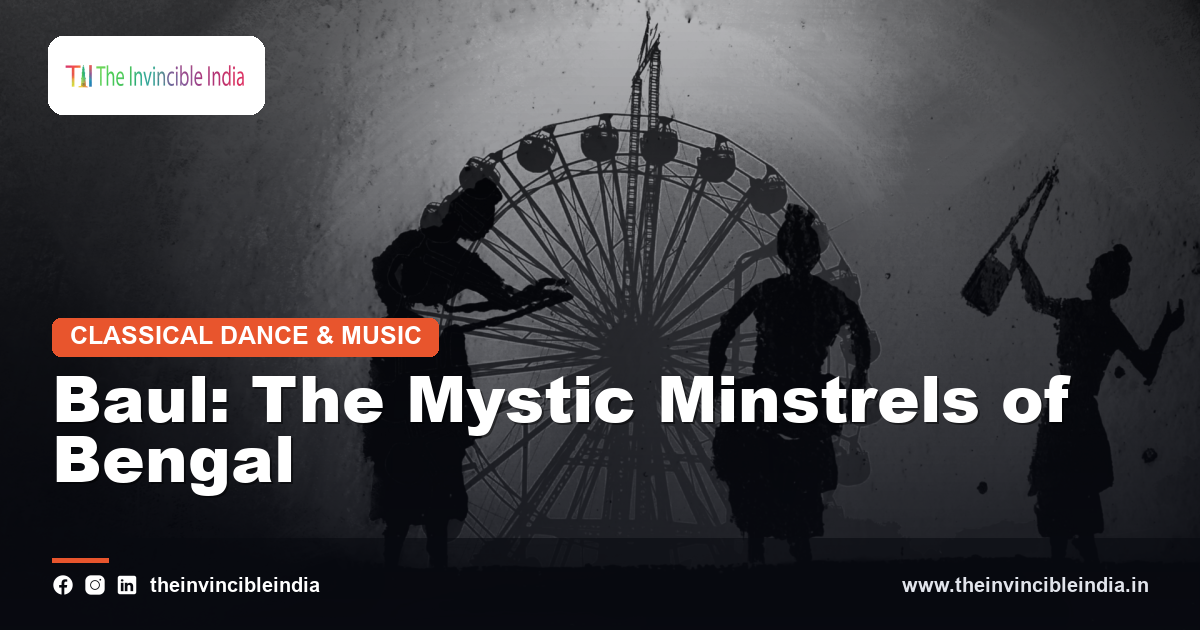
Baul music is the haunting folk and mystic tradition of Bengal, carried for generations by wandering minstrels whose simple, one-stringed ektara accompanies songs of profound spiritual searching. Distinct from the courtly refinement of Hindustani classical music, Baul song draws instead on a syncretic folk philosophy that weaves together devotional, Sufi and Tantric threads into a distinctly personal path toward the divine, understood as residing within the human body itself. Bauls live outside conventional social and religious categories, moving from village to village and gathering at seasonal fairs to sing of longing, unity and the mystery of the self. This guide explores the origins, philosophy, instruments, lyrics and living practice of this remarkable tradition.
Quick Facts
| Detail | Information |
|---|---|
| Type | Folk and mystic musical tradition |
| Origin | Bengal (West Bengal, India, and Bangladesh) |
| Philosophy | Syncretic, blending Vaishnav, Sufi and Tantric thought |
| Main instrument | Ektara, a one-stringed drone instrument |
| Performers | Wandering minstrels known as Bauls |
| Recognition | Inscribed on UNESCO’s Representative List of Intangible Cultural Heritage |
Who Are the Bauls
Bauls are wandering minstrels of Bengal who express a deeply personal spiritual philosophy through song, dance and simple stringed instruments rather than through formal ritual or scripture. Living outside conventional caste and religious boundaries, they form a loosely organised community bound less by doctrine than by shared practice and a common repertoire of songs passed down through oral transmission. Bauls are recognisable by their distinctive dress, often simple robes, and by the ektara or other folk instruments they carry as they travel. Their music, at once earthy and profound, has made them among the most recognisable and celebrated folk figures of the Bengal countryside, admired for their independence and their searching, unconventional wisdom.
Origins and Etymology
The word Baul is generally understood to derive from a term suggesting madness or wild abandon, reflecting the unconventional, free-spirited character of these singers who reject rigid social and religious classification. The tradition is believed to have taken shape over several centuries in Bengal, absorbing influences from multiple religious currents present in the region and gradually developing its own distinct body of song, philosophy and practice. Rather than tracing to a single founder or fixed moment of origin, Baul tradition appears to have grown organically from the interaction of various folk, devotional and mystic streams active in rural Bengal, producing a living synthesis that continues to evolve through each generation of practitioners.
A Syncretic Spiritual Path
What distinguishes Baul thought most sharply is its syncretism, a deliberate blending of ideas drawn from different religious traditions into a path that belongs fully to none of them. Bauls draw on devotional Vaishnav concepts of divine love, on Sufi ideas of union with the beloved, and on Tantric notions of the body as a vessel of spiritual power, weaving these strands into songs that speak in a shared, accessible language. This openness allows Bauls to move fluidly between communities and to appeal to seekers regardless of formal religious identity. Their philosophy privileges direct personal experience and inner realisation over ritual observance or textual authority, placing them at the mystical fringes of Bengal’s religious landscape.
The Body as Instrument of the Divine
Central to Baul philosophy is the idea that the human body itself is the site of spiritual truth, containing within it the divine that seekers often look for elsewhere. This body-centred spirituality, sometimes described through the term deho-tattva or body philosophy, holds that disciplined attention to the self, breath and inner experience can lead the practitioner toward union with the divine principle understood to dwell within. Songs frequently use the metaphor of the body as a house, a boat or an instrument that must be properly tuned and cared for on the spiritual journey. This inward-turning philosophy sets Baul thought apart from traditions that locate the sacred primarily in external ritual or scripture.
Vaishnav and Sufi Influences
Baul song and thought owe a substantial debt to the devotional Vaishnav tradition of Bengal, with its emphasis on intense personal love for the divine, often expressed through the imagery of human romantic longing, and to Sufi mysticism, with its poetry of the seeker’s yearning for union with the beloved. These two streams, one rooted in Hindu devotionalism and the other in Islamic mysticism, meet in Baul song without contradiction, since both traditions share a common emphasis on love, longing and the dissolution of the self in the divine. This confluence has made Baul music a powerful symbol of Bengal’s syncretic religious culture, in which Hindu and Muslim spiritual vocabularies intertwine within a shared folk idiom.
The Ektara: Voice of the Baul
The ektara, a simple one-stringed instrument with a resonating gourd body, is the most iconic instrument of Baul music, providing a steady drone that underlies and supports the singer’s voice. Held and plucked with one hand while the singer performs, often while walking or dancing, the ektara demands no elaborate technique yet produces a distinctive resonant twang that has become inseparable from the visual and sonic identity of the Baul minstrel. Its simplicity mirrors the philosophy of the tradition itself, which favours directness and inward focus over ornamentation. For many listeners, the sound of the ektara alone is enough to evoke the image of a wandering Baul singer on a Bengal country road.
The Dotara and Other Instruments
Alongside the ektara, Baul musicians often play the dotara, a plucked lute with multiple strings that provides fuller melodic accompaniment than the drone-based ektara. Other instruments associated with Baul performance include hand cymbals and small drums that mark rhythm during more energetic passages, as well as ankle bells worn by some performers to accent their dance-like movements. This modest instrumental palette, easily carried by a travelling musician, suits the itinerant lifestyle central to Baul practice. Despite its simplicity, the combination of voice, drone and light percussion creates a hypnotic, meditative soundscape well suited to the introspective and often trance-like character of Baul singing.
Baul Song Form and Lyrics
Baul songs are composed in Bengali verse, often deceptively simple in language yet dense with layered spiritual meaning, using everyday imagery of rivers, boats, birds and household objects as metaphors for the soul’s journey. This accessible, homespun poetic style allows profound philosophical ideas to reach audiences without formal education in mysticism or scripture, since the songs speak in the vocabulary of ordinary rural life. Melodies tend to be flowing and repetitive, supporting an almost meditative absorption in both singer and listener. The combination of plain language and deep meaning is considered one of the great achievements of Baul poetry, admired by scholars and lovers of Bengali literature alike.
Wandering Minstrelsy and Way of Life
Bauls traditionally live an itinerant life, travelling from village to village and singing for alms, food or simple hospitality rather than pursuing settled professions or accumulating possessions. This wandering existence is not merely a practical arrangement but an expression of their spiritual outlook, which values detachment from worldly ties and a continual openness to new encounters and experiences. Many Bauls live simply, owning little beyond their instrument and a few garments, and this voluntary simplicity is regarded as part of the discipline of their path. Their mobile lifestyle has also helped spread Baul songs and philosophy widely across the towns and villages of Bengal over generations.
Baul Communities and Gurus
Although Bauls are known for their independence, the tradition is transmitted through informal communities and through the guidance of a guru, an experienced practitioner who initiates and instructs younger seekers in both the musical and philosophical dimensions of the path. Such relationships give structure to what might otherwise appear an entirely unregulated wandering existence, ensuring that songs, melodies and teachings are passed down with reasonable consistency even without written texts. Communities of Bauls sometimes gather at particular shrines or settlements associated with respected teachers, forming loose centres of practice. This blend of individual freedom and communal transmission has allowed Baul tradition to remain both flexible and coherent across generations.
Women Among the Bauls
Women have long participated in Baul tradition both as singers and as spiritual partners in practices that regard the union of male and female principles as significant to the philosophy of the body. Female Baul performers have contributed substantially to the tradition’s musical repertoire and continue to tour, perform and teach alongside their male counterparts. Their presence reflects the relatively open and non-hierarchical character of Baul community life compared with more institutionalised religious structures. The visibility of women within Baul performance has grown in recent decades as recordings, festivals and media attention have introduced individual singers to wider audiences beyond their home region.
Baul Melas and Gatherings
Seasonal fairs and gatherings, known as melas, provide important occasions for Bauls to congregate, perform and exchange songs with fellow practitioners from across the region. These gatherings, often associated with particular festivals or auspicious dates in the Bengali calendar, draw large crowds of both devoted followers and curious visitors eager to hear live Baul singing. Such events function as informal centres of cultural transmission, where younger singers can learn from respected elders and where the wider public can encounter a tradition that might otherwise remain confined to remote villages. The continued popularity of these melas has played a significant role in sustaining public interest in Baul music.
Baul Influence on Bengali Culture
Baul philosophy and imagery have exerted a notable influence on Bengali literature, poetry and music well beyond the community of practising minstrels, inspiring writers and composers drawn to its themes of inward searching and universal love. The imagery and cadences of Baul song can be traced in the work of later Bengali poets and songwriters, who admired the tradition’s directness and emotional honesty. This cross-pollination between folk mysticism and mainstream literary culture reflects the deep respect Baul thought commands within Bengal’s broader intellectual and artistic life. It also illustrates how a tradition rooted in humble, itinerant practice can shape the wider cultural imagination of an entire region.
Modern Recognition and UNESCO Status
In recognition of its unique cultural and spiritual value, Baul music has been inscribed on UNESCO’s Representative List of the Intangible Cultural Heritage of Humanity, an honour that has drawn international attention to a tradition long confined mainly to rural Bengal. This recognition has encouraged greater documentation, academic study and cultural tourism centred on Baul performance, while also raising awareness of the need to support practitioners and safeguard the tradition’s future. International festivals and recordings have introduced Baul singing to audiences far beyond South Asia, and the honour stands as an acknowledgement of the depth and originality of this distinctively Bengali contribution to the world’s musical and spiritual heritage.
Preservation Challenges Today
Despite growing recognition, Baul practitioners face real challenges in sustaining their traditional way of life amid changing rural economies, shifting patterns of patronage and the pressures of modern livelihoods. Younger generations may find fewer opportunities to pursue the itinerant lifestyle central to older Baul practice, and the informal, oral means of transmission can be vulnerable to disruption. Cultural organisations, festivals and government initiatives have worked to support musicians through recordings, performance opportunities and documentation projects, seeking to balance respect for the tradition’s authentic, unregulated character with the practical needs of contemporary practitioners. These ongoing efforts aim to ensure that the distinctive voice of the Baul continues to be heard.
Baul Music Today
Today Baul music continues to be performed at rural fairs, urban concert halls and international festivals alike, carried forward by practitioners who maintain its traditional simplicity even as it reaches new and wider audiences. Recordings and media exposure have introduced individual Baul singers to listeners well beyond Bengal, while scholars continue to study its rich philosophical content and poetic craft. The image of the wandering minstrel with an ektara remains a potent symbol of Bengal’s spiritual and cultural life, embodying a message of inner searching and universal love that continues to resonate. In its blend of humble means and profound insight, Baul music endures as one of India’s most distinctive living folk traditions.
Sources & Further Reading
- Sangeet Natak Akademi, national academy for music, dance and drama, on the folk and mystic music traditions of India (sangeetnatak.gov.in).
- Ministry of Culture, Government of India, on the intangible cultural heritage traditions of Bengal (indiaculture.gov.in).
Frequently Asked Questions
What is Baul music?
Baul music is a mystic folk tradition of Bengal, performed by wandering minstrels called Bauls whose songs blend Vaishnav, Sufi and Tantric ideas into a personal spiritual philosophy centred on the human body and inner experience.
What instrument is most associated with Baul singers?
The ektara, a simple one-stringed drone instrument with a gourd resonator, is the instrument most closely associated with Baul singers, though many also play the multi-stringed dotara and light percussion.
What is the Baul philosophy of the body?
Baul philosophy, sometimes called deho-tattva, holds that the human body itself is the site of divine truth, and that disciplined inner attention can lead the seeker toward union with the divine believed to reside within.
Has Baul music received international recognition?
Yes, Baul music has been inscribed on UNESCO’s Representative List of the Intangible Cultural Heritage of Humanity, an honour that has drawn wider international attention and support to the tradition.
Where does Baul music come from?
Baul music comes from Bengal, a region spanning West Bengal in India and Bangladesh, where the tradition developed over centuries by drawing on multiple religious and folk currents active in rural society.


