

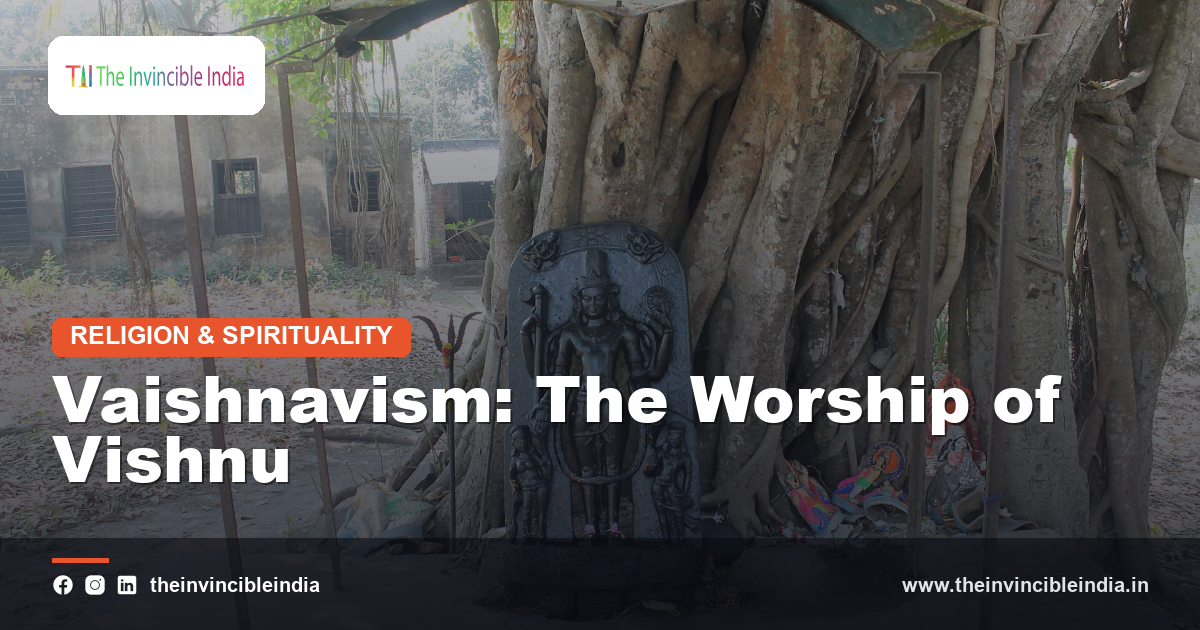
Among the great devotional streams of Hinduism, Vaishnavism holds a place of enduring importance, centering worship on Vishnu, understood by its followers as the preserver and sustainer within the wider framework described in our guide to Hindu gods and goddesses. Followers, known as Vaishnavas, direct their devotion toward Vishnu and his avatars, weaving together scripture, philosophy, temple ritual, and personal devotion into a rich and varied tradition practiced across the subcontinent and beyond. Its influence extends far past formal theology, shaping regional literature, temple architecture, classical performing arts, and popular festival life. This guide surveys the origins, core beliefs, major scriptures, philosophical schools, and living practices that together make Vaishnavism one of the most widely followed devotional traditions within Hinduism today.
Quick Facts
| Detail | Information |
|---|---|
| Tradition | Vaishnavism |
| Principal Deity | Vishnu and his avatars |
| Followers Called | Vaishnavas |
| Core Practice | Bhakti (devotion) |
| Key Scriptures | Vedas, Puranas, Bhagavad Gita |
| Notable Centers | Tirupati, Puri, Dwarka, Vrindavan |
Origins and Historical Roots
Vaishnavism traces its roots to ancient Vedic hymns that first honored Vishnu as a deity associated with pervasive cosmic order, though his prominence grew substantially in the centuries that followed as devotional and epic literature elevated him to a position of supreme importance for his followers. Over time, older regional deities and heroic figures became closely identified with Vishnu or recognized as his avatars, a process of assimilation that broadened the tradition’s reach across diverse communities and geographic regions. Temple building, royal patronage, and the composition of extensive devotional and philosophical texts through the classical and medieval periods gave Vaishnavism an increasingly organized institutional presence. By the medieval era, distinct lineages of teachers and commentators had formalized much of its theology. This long historical development, rather than a single point of origin, explains the tradition’s depth, regional diversity, and continuing vitality.
Vishnu as Supreme Deity
At the heart of Vaishnavism lies the belief that Vishnu is the supreme, all-pervading reality, the sustainer of the universe who maintains cosmic order and periodically intervenes in the world to restore balance. He is typically depicted as a serene, four-armed figure holding a conch, a discus, a mace, and a lotus, often shown reclining upon a cosmic serpent or seated with his consort Lakshmi, the goddess of prosperity and grace. Vaishnava theology generally presents Vishnu not merely as one deity among many but as the ultimate ground of existence, with other gods understood as functioning under his broader cosmic authority. This conviction shapes the tradition’s devotional orientation, encouraging worshippers to see every aspect of creation as connected to and sustained by Vishnu. Such a comprehensive, unifying vision of the divine gives Vaishnavism its distinctive theological center.
The Concept of Avatars
Central to Vaishnava belief is the idea that Vishnu periodically descends to earth in various forms, known as avatars, to restore righteousness and protect the world during times of great need. Tradition speaks of a set of principal avatars, encompassing both animal and human forms, each associated with a particular episode in the cosmic order’s preservation. This framework allows Vaishnavas to understand diverse mythological narratives as expressions of a single underlying divine purpose, unifying otherwise distinct stories under one theological principle. The avatar concept also gives the tradition remarkable flexibility, since regional heroes and deities could be incorporated as manifestations of Vishnu without disrupting the coherence of the broader belief system. Devotion to specific avatars, particularly Rama and Krishna, has in turn generated entire devotional movements, literatures, and temple traditions of their own within the wider Vaishnava fold.
Rama and the Ramayana Tradition
Rama, revered as an avatar of Vishnu, occupies a central place in Vaishnava devotion, his life and character narrated in the great epic tradition of the Ramayana and celebrated for embodying ideals of duty, righteousness, and steadfast virtue. Devotees regard Rama’s story as a model for ethical conduct within family, kingship, and personal relationships, and his exemplary qualities have made him a widely beloved figure across regions and languages. The Ramayana narrative has been retold in numerous regional versions across the subcontinent and beyond, each reflecting local language, artistic style, and devotional emphasis while retaining the core story. Temples dedicated to Rama, often alongside his consort Sita and brother Lakshmana, remain important centers of pilgrimage and worship. This enduring devotion to Rama illustrates how a single avatar narrative can generate a vast, living tradition of literature, performance, and worship.
Krishna and the Bhagavad Gita
Krishna, another central avatar of Vishnu, is venerated across a wide spectrum of moods, from the playful, endearing child of Vrindavan to the wise charioteer and teacher of the Bhagavad Gita, whose dialogue on duty, devotion, and inner discipline has become one of the most widely read texts of Hindu philosophy. This range allows devotees to relate to Krishna through many emotional postures, including parental affection, friendship, and romantic devotion expressed through the figure of Radha. Krishna devotion has generated distinct literary, musical, and performance traditions, particularly associated with regions such as Braj and Bengal, where storytelling, song, and dance continue to bring his life and teachings to devotees. The Bhagavad Gita’s teachings on selfless action and surrender to the divine remain foundational to Vaishnava thought. Together, these dimensions make Krishna one of the most richly celebrated figures within the entire Vaishnava tradition.
Key Vaishnava Scriptures
Vaishnavism draws upon a broad body of scripture, beginning with the ancient Vedas and extending through the epics and the Puranas, texts that narrate the deeds of Vishnu and his avatars in extensive detail. Among these, texts devoted to the life of Krishna and to devotional theology hold particular importance, alongside the Ramayana’s account of Rama’s life and reign. The Bhagavad Gita, embedded within the larger epic tradition, stands as one of the most influential texts for Vaishnava philosophy, offering guidance on duty, devotion, and the nature of the self. Regional devotional poetry composed by beloved saints in numerous Indian languages has further enriched this scriptural landscape, bringing Vaishnava teachings into everyday worship and song. Together, these diverse texts form a layered scriptural tradition that continues to guide both philosophical reflection and daily devotional practice among Vaishnavas.
Vaishnava Philosophy and Theology
Vaishnava philosophy has been shaped over the centuries by a succession of influential teachers and commentators who developed distinct schools of thought regarding the relationship between the individual soul, the world, and Vishnu as supreme reality. Some schools emphasize a qualified non-dualism, in which the soul and world are understood as real but ultimately dependent upon and inseparable from the divine, while others articulate a more dualistic relationship that stresses eternal distinction between the soul and God, approached through loving devotion. Despite these philosophical differences, nearly all Vaishnava schools place devotion, or bhakti, at the center of spiritual practice, viewing loving surrender to Vishnu as the most direct and accessible path to liberation. This combination of rigorous philosophical inquiry with heartfelt devotional practice is a hallmark of the tradition. It has allowed Vaishnavism to appeal to both scholarly and popular audiences across many centuries.
Major Vaishnava Traditions
Over time, Vaishnavism developed into several distinct devotional lineages, each associated with particular teachers, regions, and theological emphases, yet united by shared devotion to Vishnu and his avatars. Some lineages trace their authority to particular medieval philosopher-saints who established communities of disciples and systematized their teachings into enduring institutional structures. Regional traditions centered on Krishna devotion flourished especially in parts of eastern and northern India, developing distinctive practices of communal chanting and emotional devotion. Other lineages placed greater emphasis on temple ritual, structured theology, and disciplined philosophical study. This diversity of lineages, each contributing its own texts, practices, and institutions, has given Vaishnavism a rich internal variety while maintaining a recognizable shared devotional core across all its branches.
Vaishnava Temples and Worship
Temples dedicated to Vishnu and his avatars stand among the most visited and revered sacred sites in India, ranging from ancient stone sanctuaries to grand temple complexes that draw pilgrims from across the country and beyond. Within these temples, the deity is honored through elaborate daily rituals involving bathing, adornment, offerings of food and flowers, and the recitation of prayers and hymns. Many major Vaishnava temples have become the focus of significant pilgrimage traditions, with devotees traveling considerable distances to seek blessings and participate in temple festivals. Architectural styles vary considerably by region, reflecting broader traditions of temple design while incorporating iconography specific to Vishnu and his various forms. These temples function not only as centers of ritual worship but also as hubs of community life, music, and charitable activity, reflecting the holistic role of the temple within Vaishnava devotional culture.
Rituals and Daily Practice
Everyday Vaishnava practice typically includes personal devotion at a home shrine, recitation of prayers and sacred names, and observance of dietary and ethical guidelines consistent with the tradition’s values of purity and non-violence. Many devotees mark their foreheads with a distinctive tilak associated with Vishnu worship, signaling their devotional identity in daily life. Congregational practices, including collective chanting of devotional songs and recitation of scripture, play an important role in reinforcing community bonds and shared faith. Fasting on particular days associated with Vishnu is also a common devotional practice among many Vaishnavas. These daily and periodic practices, ranging from private meditation to public gathering, together sustain a living devotional culture that connects individual worshippers to the broader Vaishnava community and its theological worldview.
Vaishnava Festivals
The Vaishnava calendar is marked by numerous festivals celebrating episodes from the lives of Vishnu’s avatars, among the most prominent being the joyous celebration of Krishna’s birth and the festival marking Rama’s return and the triumph of righteousness. These occasions typically involve temple decoration, all-night vigils, devotional singing, dramatic reenactments, and communal feasting, drawing together entire communities in shared celebration. Regional festivals dedicated to other avatars and aspects of Vishnu further enrich the annual devotional cycle, each carrying its own distinctive customs and local traditions. Pilgrimage often intensifies around these festival periods, as devotees travel to major temples to participate in special rites and processions. Through these vibrant seasonal celebrations, Vaishnava theology is translated into shared, joyous public expression that reinforces communal identity and devotional memory.
Vaishnava Saints and Acharyas
The growth and organization of Vaishnavism owes much to a lineage of revered teachers, or acharyas, who articulated its philosophy, composed devotional literature, and established communities of practice that endured long after their own lifetimes. These teachers often traveled widely, engaging in philosophical debate and establishing centers of learning that trained future generations of scholars and devotees. Alongside these philosopher-teachers, numerous poet-saints composed devotional songs in regional languages that brought Vaishnava theology directly into popular culture, sung in homes, fields, and temples alike. Their combined legacy, spanning formal philosophy and popular devotional song, gave Vaishnavism both an intellectual foundation and an emotional accessibility. This dual heritage of rigorous teaching and heartfelt devotion continues to shape how the tradition is transmitted and experienced today.
Vaishnavism and the Bhakti Movement
Vaishnavism found powerful expression through the wider Bhakti movement, a broad devotional current that swept across the Indian subcontinent over several centuries, emphasizing personal, emotional devotion to a chosen deity over elaborate ritual or scholarly learning alone. Vaishnava poet-saints associated with this movement composed songs and verses in regional languages that expressed intense love and longing for Vishnu, Rama, or Krishna, making profound theological ideas accessible to ordinary devotees regardless of formal education or social standing. This devotional current helped spread Vaishnava ideas widely, embedding them within regional music, storytelling, and community worship. The relationship between Vaishnavism and the Bhakti movement remains close, since much of what is popularly recognized as Bhakti devotion today draws directly on Vaishnava theology and imagery. This connection underscores how devotional feeling and philosophical structure reinforced one another throughout the tradition’s history.
Vaishnavism in Art and Literature
Vaishnava themes have profoundly shaped Indian art, literature, music, and dance, with episodes from the lives of Vishnu’s avatars providing enduring subject matter for painters, sculptors, poets, and performers across many centuries. Classical and folk painting traditions frequently depict scenes from Krishna’s youth or Rama’s exile and triumphant return, rendered in styles that vary by region and period. Devotional poetry composed in numerous Indian languages remains widely recited and sung, forming an essential part of regional literary heritage. Classical dance forms across India often draw their narrative content directly from Vaishnava mythology, using gesture and expression to convey familiar devotional stories. This deep artistic engagement demonstrates how Vaishnava theology has moved beyond formal worship to become a shared cultural inheritance expressed across nearly every artistic medium in India.
Vaishnavism Beyond India
While rooted firmly in the Indian subcontinent, Vaishnavism has spread well beyond its geographic origins through migration, trade, and organized missionary activity, establishing devotional communities and temples in many countries around the world. Krishna-centered devotional organizations founded in the twentieth century have played a particularly visible role in introducing Vaishnava practice, chanting, and philosophy to audiences far from South Asia. Temples built by diaspora communities abroad often serve as vital cultural and religious centers, helping sustain Vaishnava identity and practice across generations living outside India. International festivals and pilgrimage tourism have further extended the tradition’s global visibility. This worldwide presence reflects both the historical mobility of Indian communities and the broader appeal of Vaishnava devotional practice, which continues to attract sincere interest from people of diverse backgrounds.
Vaishnavism Today
Vaishnavism remains one of the most widely practiced devotional traditions within contemporary Hinduism, its temples drawing vast numbers of pilgrims and its festivals continuing to animate community life across India and the wider Indian diaspora. Modern technology has extended the tradition’s reach, with devotional music, teachings, and temple broadcasts now widely accessible to audiences far from traditional centers of worship. Scholarly interest in Vaishnava philosophy, literature, and history continues to deepen understanding of its diverse historical development. At the same time, everyday devotional practice, rooted in centuries-old ritual and song, continues largely unchanged in spirit even as its modes of expression adapt to contemporary life. This blend of deep historical continuity and ongoing vitality ensures that Vaishnavism remains a living, evolving tradition rather than a static inheritance from the past.
Sources & Further Reading
- Ministry of Culture, Government of India (indiaculture.gov.in).
- Sahitya Akademi.
Frequently Asked Questions
What is Vaishnavism?
Vaishnavism is a major Hindu devotional tradition centered on the worship of Vishnu, regarded by his followers as the supreme, all-pervading deity who sustains the universe and periodically appears in the world through his avatars.
Who are the main avatars worshipped in Vaishnavism?
Rama and Krishna are the most widely worshipped avatars of Vishnu, each associated with extensive devotional literature, temple traditions, and festivals, though tradition recognizes a wider set of avatars overall.
What scriptures are important to Vaishnavas?
Important Vaishnava scriptures include the Vedas, the Puranas, the epics such as the Ramayana, and the Bhagavad Gita, alongside a rich body of regional devotional poetry composed by Vaishnava saints.
How is Vaishnavism connected to the Bhakti movement?
The Bhakti movement gave powerful popular expression to Vaishnava theology, as poet-saints composed devotional songs in regional languages expressing personal love for Vishnu, Rama, and Krishna, spreading Vaishnava ideas widely.
Is Vaishnavism practiced outside India?
Yes. Through migration and organized devotional movements, Vaishnavism has established temples and communities in many countries, with Krishna-centered organizations in particular introducing its practices to a global audience.


