

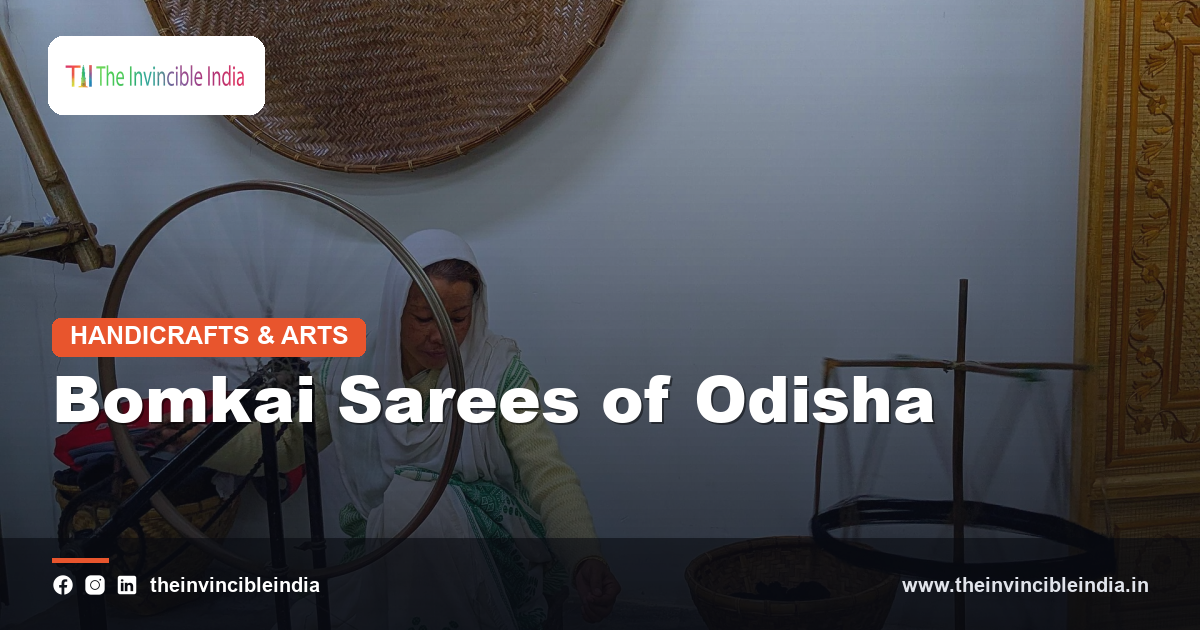
The Bomkai saree is a distinctive handloom textile from Odisha, known for its striking combination of ikat weaving and embroidery-inspired motifs worked directly into the fabric on the loom. Originating in the Ganjam region of the state, Bomkai sarees are recognised by their bold borders, contrasting colour blocks and thread-work patterns drawn from nature, temple architecture and local folk traditions. The style occupies a distinctive place within Odisha’s rich handloom heritage, standing apart from other regional weaves such as the ikat traditions represented by Pochampally ikat in the neighbouring Telangana region. This guide traces the technique, motifs and cultural significance of Bomkai weaving as practised today.
Quick Facts
| Detail | Information |
|---|---|
| Region | Ganjam district, Odisha |
| Material | Cotton and silk variants |
| Known For | Ikat combined with embroidery-style motifs |
| Weave Type | Extra-weft and tie-dye combination weave |
| Recognition | Geographical Indication (GI) tag |
| Typical Use | Festive wear and formal occasions |
Origins in Odisha's Ganjam Region
The Bomkai saree traces its roots to villages in Odisha’s Ganjam district, an area long associated with skilled handloom weaving communities. Weavers in this region developed a distinctive style that combined tie-dye based ikat with additional decorative thread work, setting their textiles apart from other Odisha weaves produced in neighbouring districts. Over time, the style associated with these villages came to be known more broadly by the Bomkai name, and its influence spread to other weaving centres within the state that adopted similar techniques. Local patronage, along with the practical needs of everyday and ceremonial dress, encouraged weavers to refine motifs and colour combinations that would become closely identified with the style. This regional origin remains an important part of how the saree is marketed and understood today, anchoring it firmly within Odisha’s broader handloom identity. The craft’s continued association with its home region reflects the deep local roots from which it grew.
The Bomkai Weaving Technique
Bomkai weaving is distinguished by its combination of tie-and-dye ikat patterning with extra-weft techniques that allow decorative motifs to be woven directly into the fabric rather than added afterward through embroidery. This dual approach requires considerable skill, since the weaver must plan and dye yarn in advance for the ikat sections while also managing additional threads during weaving to create the embroidery-like patterns. The result is a textile that carries the soft, slightly blurred edges characteristic of ikat alongside sharply defined decorative elements produced through the extra-weft process. Coordinating these two techniques within a single fabric demands careful planning from the earliest stages of yarn preparation through to the final weaving. This combination of methods is one of the features that most clearly distinguishes Bomkai from other Odisha handloom styles that rely on a single primary technique. The resulting complexity is central to the saree’s reputation for intricate, labour-intensive craftsmanship.
Ikat and Embroidery-Style Motifs Combined
What sets Bomkai apart from many other ikat traditions is the way it layers embroidery-style motifs onto a base of tie-dyed patterning, creating a textile that reads as both woven and hand-finished. The extra-weft threads used to create these motifs are worked in during the weaving process itself, giving the appearance of embroidery while remaining fully integrated into the structure of the cloth. This technique allows for detailed decorative elements, such as small geometric or floral forms, to be placed precisely along the border, pallu or body of the saree. The visual effect is a rich, textured surface that rewards close inspection, distinguishing Bomkai sarees from more uniformly patterned ikat textiles found elsewhere in India. This layered approach reflects a broader tendency in Odisha’s handloom traditions to combine multiple techniques within a single fabric. The result is a textile prized for both its technical complexity and its distinctive visual character.
Motifs Drawn from Nature and Temple Art
The decorative vocabulary of Bomkai sarees draws heavily on motifs inspired by nature, local temple architecture and everyday rural life, reflecting the cultural surroundings in which the craft developed. Common design elements include stylised fish, flowers, conch shells and geometric forms, many of which carry symbolic associations tied to prosperity, auspiciousness or regional identity. Temple architecture, an important feature of Odisha’s cultural landscape, has also influenced certain motifs used in the borders and pallu of these sarees. These design choices are not arbitrary; they reflect a long-standing visual language shared across various Odisha handloom traditions, adapted specifically to the Bomkai technique. The placement of motifs, often concentrated along the border and pallu with the body kept relatively simple, allows the intricate detailing to stand out clearly. This connection between motif and regional culture gives Bomkai sarees a distinct sense of place that many wearers and collectors value.
The Pallu and Border Design
The pallu and border are typically the most elaborately worked sections of a Bomkai saree, carrying the densest concentration of ikat patterning and extra-weft motifs. Borders often feature bold, contrasting colours that create a strong visual frame around the more simply woven body of the saree, drawing the eye toward the decorative elements. The pallu, meant to be visible when the saree is draped, is frequently treated as a showcase for the weaver’s skill, combining multiple motifs and colour transitions within a relatively compact space. This emphasis on the border and pallu reflects a broader design principle common to many Indian handloom sarees, in which decorative effort is concentrated where it will be most visible. The careful balance between ornamented edges and a calmer central field allows the saree to feel rich without becoming visually overwhelming. This structural approach to design remains a defining feature of the Bomkai aesthetic.
Cotton and Silk Variants
Bomkai sarees are woven in both cotton and silk, with each material offering a somewhat different character while retaining the same core weaving techniques. Cotton versions tend to be lighter and more suited to everyday or semi-formal wear, while silk variants carry a richer sheen and are generally reserved for weddings and significant festive occasions. The choice of fibre also affects how the ikat and extra-weft motifs appear, with silk lending additional lustre to the decorative elements. Weavers adjust their approach slightly depending on the fibre used, since silk and cotton behave differently during dyeing and weaving. This flexibility has allowed Bomkai weaving to serve a range of markets, from relatively affordable cotton sarees to more premium silk pieces. The availability of both variants has contributed to the tradition’s broad appeal across different consumer segments and price points.
Natural and Modern Dyes
Historically, many Odisha handloom traditions, including early Bomkai weaving, relied on natural dyes derived from plant and mineral sources to colour yarn before weaving. While natural dyeing methods are still practised in some workshops and valued for their subtle, earthy tones, much of contemporary Bomkai production uses synthetic dyes that offer a wider colour range and greater consistency. The dyeing stage is particularly important for the ikat portions of the fabric, where precise, resist-dyed patterns must be achieved before weaving begins. Any inconsistency at this stage can affect the clarity of the final pattern, making skilled dyeing an essential complement to skilled weaving. Some contemporary revival efforts have sought to reintroduce natural dyeing techniques as part of broader sustainability and craft preservation initiatives. The choice between natural and synthetic dyes continues to shape both the aesthetic and the market positioning of individual Bomkai sarees.
The Weaving Community
Bomkai weaving is sustained by communities of artisans in Odisha whose skills are typically learned within families and passed down across generations through direct practice rather than formal instruction. These communities often work through cooperative societies that help coordinate raw material supply, production standards and access to markets beyond the immediate local area. The specialised skills required for the combined ikat and extra-weft technique mean that experienced weavers hold particular value within their communities, often training younger relatives over an extended period. As with many handloom traditions, the livelihoods of these communities are closely tied to demand for genuine handwoven textiles, making fair pricing and market access significant concerns. Various state and cooperative initiatives have worked to support these weaving communities through training, credit access and promotional efforts. The continuity of Bomkai weaving depends directly on the wellbeing and continued engagement of these artisan communities.
Loom and Tools
Bomkai sarees are traditionally woven on pit looms or frame looms adapted to accommodate the combined ikat and extra-weft techniques central to the style. Preparing the loom for a Bomkai saree involves careful setup of the warp threads, particularly for sections where tie-dyed ikat patterns must align precisely once weaving begins. Additional tools and small shuttles are used to introduce the extra-weft threads that create the embroidery-style motifs, requiring the weaver to work with multiple threads simultaneously in a coordinated sequence. This setup process can take considerable time before actual weaving begins, reflecting the technical complexity involved in producing a single saree. The physical demands of operating these looms, often over many hours across several days or weeks per saree, underscore the labour-intensive nature of the craft. Such tools and techniques, refined over generations, remain central to how Bomkai sarees are produced today.
Regional Variations within Odisha
While closely associated with the Ganjam region, Bomkai-style weaving has also been adopted, with local variations, by weaving communities in other parts of Odisha. These regional variants may differ subtly in motif selection, colour preference or the specific balance between ikat and extra-weft work, reflecting local tastes and available materials. Such variation is common across Indian handloom traditions, where a core technique often spreads and adapts to different weaving centres over time. Buyers and collectors familiar with Odisha textiles sometimes learn to identify these subtle regional differences, even as all such sarees are generally marketed under the broader Bomkai name. This spread has helped sustain demand for the technique across a wider weaving base within the state, supporting more artisans than would be possible if production remained confined to a single district. These regional variations collectively contribute to the richness and diversity found within the broader Bomkai tradition.
Occasions and Ceremonial Use
Bomkai sarees, particularly silk variants, are closely associated with weddings, religious festivals and other significant ceremonial occasions within Odisha and among Odia communities elsewhere in India. Their bold, distinctive appearance makes them a popular choice for formal family events, where traditional handloom textiles are often preferred over more contemporary alternatives. Cotton Bomkai sarees, being lighter and more practical, are also worn for everyday or semi-formal occasions, extending the tradition’s relevance beyond purely ceremonial contexts. The saree’s association with cultural identity has made it a common choice during regional festivals and cultural celebrations that highlight Odisha’s artistic heritage. In many families, a Bomkai saree may be gifted during weddings or passed down across generations as a valued textile heirloom. This continued ceremonial relevance helps sustain both demand for the saree and broader appreciation for the craftsmanship behind it.
Odisha's Broader Handloom Heritage
Bomkai weaving forms one part of a much broader handloom heritage in Odisha, a state long recognised for its diverse textile traditions rooted in ikat, tie-dye and other regional weaving techniques. This broader heritage reflects centuries of accumulated skill among weaving communities across different districts, each contributing distinct styles shaped by local materials, motifs and cultural practices. Bomkai’s combination of ikat and extra-weft embroidery represents one particularly distinctive strand within this wider tradition, admired for its technical complexity relative to some other regional styles. Understanding Bomkai within this broader context helps highlight both its uniqueness and its connection to shared regional weaving practices. Odisha’s handloom sector as a whole has received sustained attention from cultural and economic policy perspectives, given its significance for both heritage preservation and rural livelihoods. Bomkai’s continued prominence within this landscape reflects its enduring appeal among both traditional and contemporary audiences.
Comparisons with Related Odisha Weaves
Bomkai is often discussed alongside other notable Odisha handloom styles that also rely on ikat or tie-dye techniques, each with its own distinct character and regional association. While these various styles share a common technical foundation in resist-dyeing, they differ in motif style, colour preference and the degree to which additional techniques such as extra-weft embroidery are incorporated. Bomkai’s particular emphasis on combining ikat with embroidery-style motifs sets it apart from styles that rely more purely on ikat patterning alone. Such comparisons are useful for understanding the diversity within Odisha’s textile heritage, where multiple distinct traditions coexist within a relatively compact geographic area. Buyers seeking authentic Odisha handloom textiles often benefit from understanding these distinctions, which can otherwise be difficult to identify without close familiarity with the craft. This diversity of related but distinct weaving styles is itself a notable feature of the state’s textile landscape.
Government Recognition and GI Status
Bomkai sarees have received a Geographical Indication tag, formally recognising the association between the textile and its region of origin within Odisha. This recognition serves both a protective and promotional function, helping to distinguish authentic Bomkai textiles from imitations produced elsewhere while also raising the profile of the craft in wider markets. Government schemes related to handloom development have periodically extended support to Bomkai weaving communities, covering areas such as skill training, raw material access and marketing assistance. Such institutional recognition can play an important role in helping traditional crafts remain economically viable, particularly when combined with efforts to connect artisans directly with buyers. The GI tag also contributes to consumer confidence, offering some assurance regarding the authenticity of sarees marketed under the Bomkai name. These recognition efforts represent an important component of the broader ecosystem supporting the craft’s continuity.
Contemporary Designers and Markets
In recent years, Bomkai textiles have attracted growing interest from contemporary fashion designers, who have incorporated the fabric into modern garment forms while drawing on its traditional motifs and techniques. This interest has helped introduce Bomkai to audiences beyond Odisha and traditional saree markets, including younger consumers exploring handloom textiles for the first time. Online marketplaces and handloom promotion platforms have further expanded the reach of Bomkai products, connecting weaving communities more directly with buyers across India and internationally. At the same time, demand for classic, traditionally styled Bomkai sarees remains strong, particularly for weddings and formal occasions where authenticity and craftsmanship are highly valued. This combination of contemporary interest and sustained traditional demand has helped support the craft commercially in recent decades. Such market diversification is generally seen as beneficial for the long-term sustainability of the weaving tradition.
Bomkai Sarees Today
Today, Bomkai sarees remain a celebrated part of Odisha’s handloom heritage, recognised for their distinctive combination of ikat weaving and embroidery-style motifs drawn from nature and local culture. The tradition continues to be sustained by dedicated weaving communities, supported by cooperative structures, government recognition and growing interest from contemporary fashion markets. While the craft faces ongoing challenges common to many handloom traditions, including competition from machine-made textiles and the need to attract younger artisans, its distinctive technical and aesthetic qualities continue to sustain strong demand. Bomkai sarees remain closely associated with important ceremonial occasions, reflecting their continued cultural significance among Odia communities and beyond. Ongoing efforts to document, promote and support the craft aim to ensure its continuity for future generations of both weavers and wearers. Bomkai stands today as a vivid expression of Odisha’s rich and continuing handloom tradition.
Sources & Further Reading
- Ministry of Textiles, Government of India (texmin.nic.in).
- Development Commissioner for Handlooms, Government of India (handlooms.nic.in).
Frequently Asked Questions
What makes a Bomkai saree unique?
Bomkai sarees are distinguished by their combination of tie-dye ikat weaving with extra-weft, embroidery-style motifs worked directly into the fabric, a technique that sets them apart from many other Indian handloom traditions.
Are Bomkai sarees made only in silk?
No, Bomkai sarees are woven in both cotton and silk, with cotton versions suited to everyday or semi-formal wear and silk versions typically reserved for weddings and festive occasions.
Where does the Bomkai saree originate from?
The style originates from the Ganjam region of Odisha, where local weaving communities developed the distinctive combination of ikat and embroidery-style techniques associated with the name.
Do Bomkai sarees have a Geographical Indication tag?
Yes, Bomkai sarees have received GI recognition, which helps protect the name and supports quality assurance for textiles genuinely produced using the traditional technique.
What kinds of motifs appear on Bomkai sarees?
Common motifs include stylised fish, flowers, conch shells and geometric patterns, many inspired by nature, temple architecture and local cultural symbolism associated with Odisha.


