

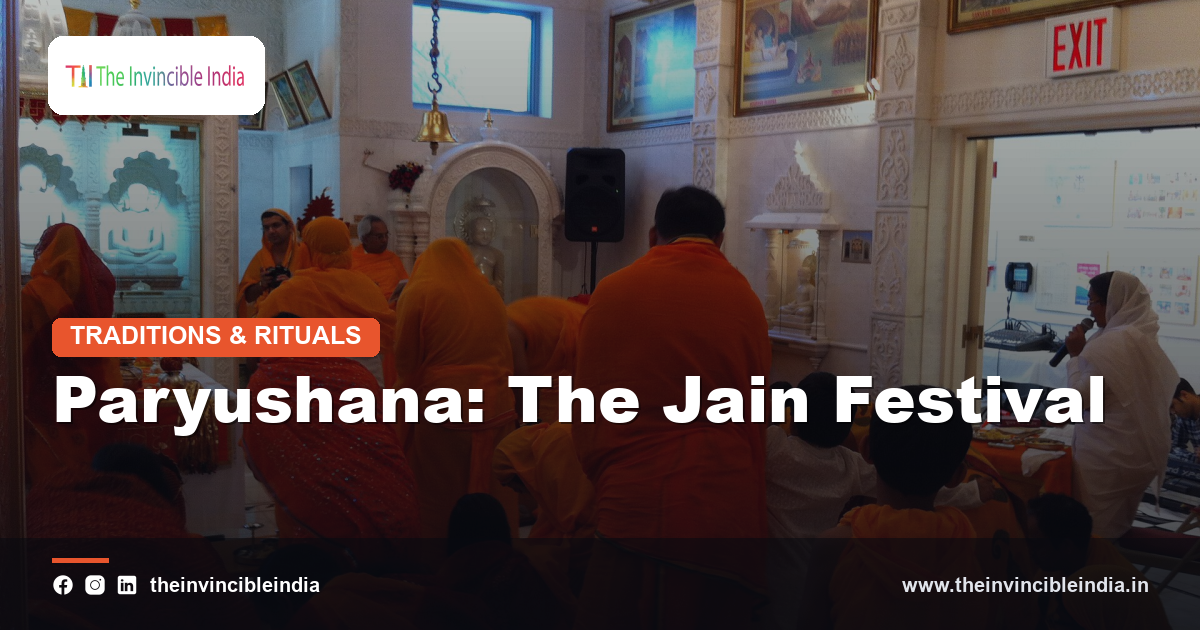
Paryushana is regarded as the most significant festival in the Jain religious calendar, a period devoted not to celebration in the conventional sense but to self-reflection, penance, and spiritual renewal. Observed by both major Jain traditions, though for differing durations, the festival emphasises fasting, meditation, and the recitation of sacred texts as means of purifying the mind and body. Much as periods of fasting mark observances such as Navratri in Hindu tradition, Paryushana centres discipline and restraint, though its purpose is distinctly Jain, rooted in the pursuit of non-violence and inner purification. The festival culminates in Samvatsari, a day dedicated to seeking forgiveness from all beings for any harm caused, knowingly or unknowingly, during the year.
Quick Facts
| Detail | Information |
|---|---|
| Festival Type | Principal Jain festival of the annual calendar |
| Observed By | Svetambara and Digambara Jain communities |
| Core Themes | Self-reflection, penance, and forgiveness |
| Duration | Eight days among Svetambara Jains, ten days among Digambara Jains |
| Concluding Day | Samvatsari, marked by seeking forgiveness |
| Associated Practices | Fasting, meditation, and recitation of scripture |
Origins and Significance of Paryushana
Paryushana holds a central place in Jain religious life, observed annually as a period dedicated to intensive spiritual practice, self-examination, and moral renewal. The festival’s name relates to the idea of dwelling closely with one’s own conduct and conscience, reflecting its essential purpose as a time for introspection rather than outward celebration. Unlike many festivals marked by feasting or public display, Paryushana is characterised by restraint, discipline, and a turning inward toward personal and communal accountability. Its observance draws directly upon core Jain principles, particularly non-violence and truthfulness, encouraging practitioners to examine their actions over the preceding year and to make amends where necessary. This distinctive character sets Paryushana apart from many other festivals in the Indian religious calendar, emphasising ethical reflection as its defining feature.
Svetambara and Digambara Observances
Jainism’s two principal traditions, Svetambara and Digambara, both observe Paryushana, though with some differences in duration and specific practice. Svetambara Jains typically observe the festival over eight days, referring to it as Paryushana Parva, while Digambara Jains extend their observance to ten days, known as Das Lakshana Parva, during which ten cardinal virtues are contemplated in sequence. Despite these differences in length and terminology, both traditions share the festival’s underlying emphasis on fasting, scriptural study, and moral reflection. This shared foundation across otherwise distinct Jain communities highlights the centrality of Paryushana’s core themes to Jain religious identity as a whole, transcending the particular doctrinal and practical differences that distinguish the two traditions in other respects.
The Meaning of Paryushana
The term Paryushana is generally understood to convey the idea of abiding or dwelling, in this context referring to a period in which practitioners dwell closely with their own conscience and conduct. This etymological sense underscores the festival’s purpose as an occasion for sustained self-examination rather than a single ritual event. During this period, Jains are encouraged to set aside ordinary distractions and devote greater attention to religious study, ethical reflection, and community worship. The festival thus functions as an annual checkpoint within Jain religious life, a designated time in which the ongoing pursuit of ethical and spiritual discipline that characterises Jain practice throughout the year receives concentrated and communal attention, reinforcing values that might otherwise remain part of everyday, less deliberate observance.
Fasting and Austerities
Fasting occupies a central place in the observance of Paryushana, with practitioners undertaking various forms of dietary restriction according to their personal capacity and commitment. Some observe complete fasts for extended periods, while others limit their intake to specific foods or restrict eating to certain times of day. These practices are understood as a means of cultivating self-discipline, reducing attachment to bodily comfort, and focusing attention on spiritual rather than material concerns. Fasting during Paryushana is approached as a voluntary and personal undertaking, with individuals choosing a level of austerity appropriate to their own circumstances and spiritual aspiration. This flexibility allows broad participation across the Jain community, from rigorous ascetic practice to more modest forms of restraint, united by a shared commitment to the festival’s disciplinary purpose.
The Kalpa Sutra and Its Recitation
Among Svetambara Jains, the recitation of the Kalpa Sutra forms an important part of Paryushana observance, particularly the sections recounting the life of Mahavira, the final Tirthankara of the current cycle in Jain cosmology. This recitation, typically conducted by monks or learned scholars within the community, serves both an educational and devotional function, reacquainting practitioners with foundational narratives and teachings of their faith. Listening to these recitations is considered a meaningful way to deepen understanding of Jain principles during the festival period. The practice reflects the broader emphasis within Paryushana on scriptural study as a vehicle for ethical and spiritual reflection, reinforcing the connection between religious knowledge and personal conduct that the festival seeks to strengthen.
The Principle of Ahimsa
Non-violence, or ahimsa, stands as the foundational ethical principle of Jainism, and Paryushana provides a dedicated occasion for practitioners to reflect deeply on this value in both thought and action. During the festival, Jains are encouraged to examine instances throughout the year where they may have caused harm, whether through action, speech, or thought, to any living being. This reflection extends beyond obvious physical harm to include more subtle forms of injury, such as harsh words or careless conduct. The festival’s emphasis on ahimsa reinforces its broader purpose of moral accountability, encouraging practitioners not merely to avoid future harm but to actively acknowledge and address past lapses, reflecting the comprehensive and demanding nature of the Jain ethical framework.
Daily Practices During the Festival
Throughout the days of Paryushana, practitioners typically engage in a structured routine that includes temple visits, scriptural study, meditation, and communal prayer. Many Jains attend daily discourses given by monks or knowledgeable lay leaders, which explore themes of ethics, self-discipline, and the teachings of the Tirthankaras. Time is also set aside for personal reflection, often guided by specific texts or contemplative practices associated with the festival. These daily observances create a sustained rhythm of spiritual engagement across the festival period, distinguishing Paryushana from single-day celebrations and allowing for gradual, cumulative reflection. The structured nature of these daily practices reflects the festival’s broader purpose as an extended period of disciplined self-examination rather than a momentary religious observance.
Samvatsari: The Day of Forgiveness
Samvatsari marks the culminating day of Paryushana among Svetambara Jains, dedicated specifically to the practice of seeking and granting forgiveness. On this day, practitioners formally ask pardon from family, friends, and the broader community for any harm caused during the preceding year, whether intentional or unintentional. This ritual act of seeking forgiveness is considered essential to Jain ethical practice, reflecting the belief that unresolved conflict or resentment carries spiritual as well as social consequences. Samvatsari’s emphasis on reconciliation extends beyond personal relationships to a broader aspiration for forgiveness toward all living beings, encapsulating the festival’s overarching themes of humility, accountability, and the pursuit of a clear conscience.
Micchami Dukkadam and Seeking Pardon
The phrase Micchami Dukkadam, exchanged widely among Jains on Samvatsari, expresses a wish that any wrong committed, knowingly or unknowingly, may be forgiven. This exchange typically occurs in person, by letter, or increasingly through modern communication, extending beyond immediate family and friends to acquaintances and even those with whom relationships may have grown strained over the year. The practice reflects a distinctly proactive approach to reconciliation, in which individuals take the initiative to seek forgiveness rather than waiting for grievances to be raised by others. This custom is widely regarded as one of the most distinctive and admired aspects of Jain festival practice, embodying the tradition’s deep commitment to non-violence extended into the realm of social and interpersonal relationships.
The Role of Jain Monks and Nuns
Jain monks and nuns play a significant guiding role during Paryushana, delivering discourses, leading recitations of scripture, and providing spiritual counsel to the lay community throughout the festival period. Their presence and teaching are considered central to the festival’s educational and devotional dimension, as monastic figures are regarded as living examples of the ascetic discipline that Jainism holds as its highest ideal. Lay practitioners often organise their festival observance around the schedule and teachings offered by visiting or resident monastics, attending discourses and seeking guidance on questions of practice and ethics. This close relationship between monastic and lay communities during Paryushana reflects the broader structure of Jain religious life, in which renunciate teachers serve as guides for those pursuing a householder’s path.
Community and Temple Gatherings
Paryushana is marked by significant communal activity, with Jain temples serving as focal points for daily worship, scriptural recitation, and collective reflection throughout the festival period. Community members gather regularly during this time, strengthening social bonds alongside their individual spiritual practice. Temples are often specially decorated, and additional programmes, including lectures and discussions on Jain philosophy, are organised to support deeper engagement with the festival’s themes. This communal dimension ensures that Paryushana, despite its introspective focus, remains a shared and socially connective experience, bringing together individuals and families in collective religious observance and reinforcing the sense of community that supports individual practitioners in their personal disciplines during this demanding period.
Charitable Giving and Compassion
Acts of charity and compassion toward others form an important complementary practice during Paryushana, reflecting the festival’s broader ethical concerns beyond personal fasting and reflection. Many Jains use the occasion to make donations to religious institutions, support charitable causes, or engage in acts of service within their communities. This emphasis on generosity is consistent with core Jain values regarding compassion for all living beings and the reduction of attachment to material possessions. Charitable activity during Paryushana is understood not as separate from the festival’s spiritual purpose but as a natural extension of the self-examination and ethical renewal that the period is meant to encourage, translating internal reflection into tangible, outward-facing action within the wider community.
Meditation and Self-Reflection
Meditation forms a core practice during Paryushana, providing practitioners with structured opportunities for silent reflection on their conduct, values, and spiritual progress. This meditative practice often accompanies fasting and scriptural study, together forming a comprehensive framework for the introspective work the festival is intended to support. Practitioners are encouraged to use this time to examine not only specific actions but also underlying patterns of thought and behaviour that may require correction. The combination of physical discipline through fasting and mental discipline through meditation reflects the holistic approach Jainism takes toward spiritual development, treating body and mind as interconnected aspects of the ethical and spiritual progress that Paryushana is designed to encourage among its observers.
Dietary Restrictions and Their Purpose
Beyond general fasting, Paryushana often involves specific dietary restrictions consistent with broader Jain principles of non-violence, including abstention from foods associated with harm to living organisms, such as certain root vegetables. These restrictions, while rooted in everyday Jain dietary practice, are frequently observed with heightened strictness during the festival period as an expression of intensified commitment to ahimsa. The purpose of these dietary choices extends beyond mere physical discipline, serving as a continual, tangible reminder of the ethical principles the festival seeks to reinforce. By linking daily eating practices directly to core religious values, Paryushana integrates ethical reflection into even the most routine aspects of daily life during the festival period.
Das Lakshana Parva Among Digambaras
Digambara Jains observe Paryushana as Das Lakshana Parva, a ten-day festival structured around the contemplation of ten cardinal virtues, including forgiveness, humility, straightforwardness, and non-attachment. Each day of the festival is dedicated to reflection on one specific virtue, providing a structured framework for ethical contemplation across the full duration of the observance. This systematic approach distinguishes the Digambara observance in form from the Svetambara tradition, while sharing the same underlying commitment to moral and spiritual renewal. The ten virtues contemplated during Das Lakshana Parva are drawn from established Jain ethical teaching, offering practitioners a comprehensive framework for annual self-assessment that mirrors, in its own structure, the broader introspective purpose shared across all Paryushana observance.
Paryushana Today
Today, Paryushana continues to be observed with deep commitment by Jain communities across India and among Jain diaspora populations worldwide, adapting practical arrangements to modern life while preserving its core spiritual disciplines. Temples and community organisations continue to host daily discourses, recitations, and communal gatherings, while individual practitioners maintain personal commitments to fasting, meditation, and reflection according to their own capacity. The custom of exchanging Micchami Dukkadam has, in recent years, extended into digital communication, allowing practitioners to seek and extend forgiveness across greater distances than in the past. This continued vibrancy reflects the enduring relevance of Paryushana’s core message, that of accountability, non-violence, and reconciliation, to Jain communities navigating contemporary life while maintaining their ancient religious heritage.
Sources & Further Reading
- Ministry of Culture, Government of India (indiaculture.gov.in).
- Sahitya Akademi.
Frequently Asked Questions
What is Paryushana?
Paryushana is the most important festival in the Jain calendar, a period of fasting, scriptural study, and self-reflection observed by both Svetambara and Digambara Jain communities.
How long does Paryushana last?
Svetambara Jains observe Paryushana over eight days, while Digambara Jains observe a related ten-day festival known as Das Lakshana Parva.
What happens on Samvatsari?
Samvatsari is the concluding day of Paryushana among Svetambara Jains, dedicated to seeking and granting forgiveness for any harm caused during the year.
What does Micchami Dukkadam mean?
Micchami Dukkadam is a phrase exchanged among Jains on Samvatsari expressing a wish that any wrong committed, knowingly or unknowingly, be forgiven.
Why is fasting important during Paryushana?
Fasting during Paryushana is practised as a means of cultivating self-discipline and reducing attachment to bodily comfort, supporting the festival’s broader goals of reflection and spiritual renewal.


