

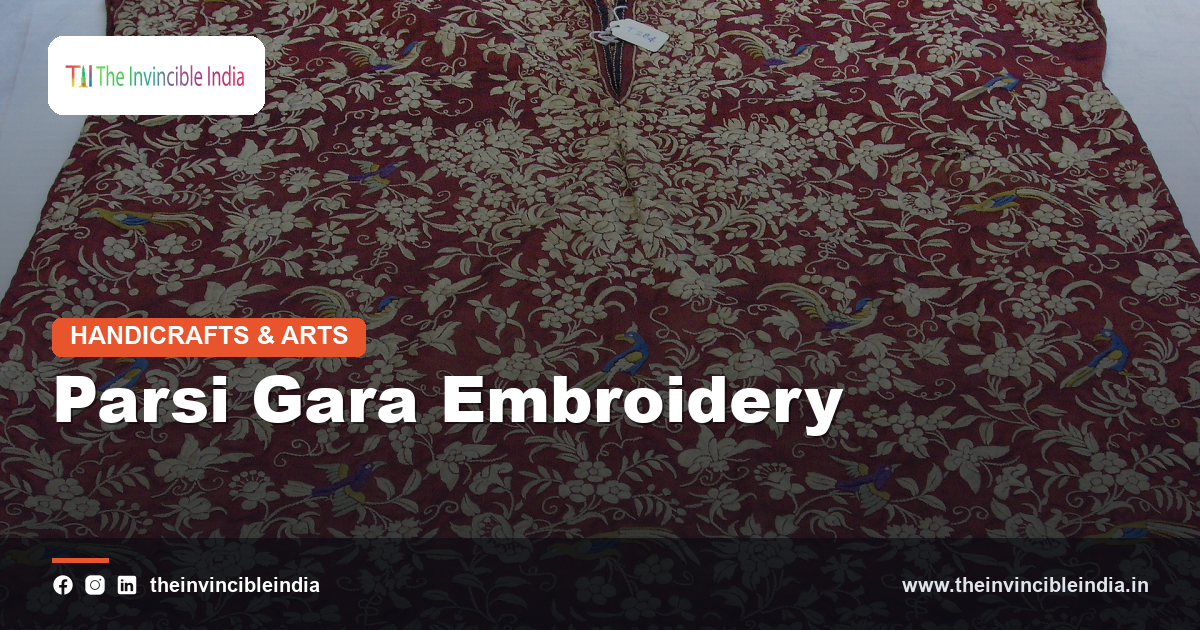
Parsi Gara embroidery is a refined tradition of silk-thread needlework practised historically by the Parsi community, a small Zoroastrian population settled mainly in and around Mumbai and Gujarat. Distinguished by densely worked motifs rendered in fine silk thread on silk or georgette fabric, Gara embroidery developed through centuries of trade contact between Parsi merchants and China, absorbing decorative themes rarely found elsewhere in Indian textile art. Alongside other celebrated Indian hand-embroidery traditions such as Chikankari embroidery from Lucknow, Gara work occupies its own distinct place, shaped less by regional folk motifs than by a community’s particular history of overseas trade and cultural exchange. Worked chiefly onto sarees, Gara embroidery remains a treasured marker of Parsi identity and craftsmanship.
Quick Facts
| Detail | Information |
|---|---|
| Community | Parsi (Zoroastrian) |
| Primary Regions | Mumbai, Gujarat |
| Core Material | Fine silk thread on silk or georgette |
| Key Stitches | Satin stitch, French knots, stem stitch |
| Historical Influence | Chinese silk trade |
| Common Motifs | Birds, chrysanthemums, pagodas, cranes |
Origins in Maritime Trade
Parsi Gara embroidery traces its origins to the maritime trade links that Parsi merchants and traders built with China from the eighteenth century onward, journeys that carried not only goods such as silk and porcelain but also decorative textile traditions back to India. Parsi families settled along India’s western coast, particularly around Mumbai and Surat, developed close commercial ties with Chinese ports, and these exchanges left a lasting mark on their domestic textile culture.
Embroidered silk pieces brought home from these voyages inspired local artisans and Parsi women to recreate similar motifs on Indian fabric, gradually giving rise to a distinct embroidery style. Over time, this borrowed aesthetic was absorbed so completely into Parsi domestic life that Gara embroidery came to be regarded as a defining feature of the community’s own textile identity rather than a foreign import.
Meaning of the Word Gara
The term Gara refers specifically to the embroidered silk saree associated with Parsi tradition, though it is sometimes used more broadly to describe the embroidery style itself regardless of the garment it appears on. This naming convention reflects how closely the craft is tied to a particular textile form within Parsi households.
Within the community, a finished Gara saree is often distinguished by the density and placement of its embroidery, with fully worked pieces covering large sections of the fabric considered especially prized. Understanding the term Gara as referring to both a specific saree type and a broader embroidery tradition helps clarify why the word appears in slightly different contexts across historical and contemporary descriptions of the craft.
The Parsi Community and Textile Heritage
The Parsi community, followers of Zoroastrianism who settled in India many centuries ago, developed a distinct cultural identity that combines Persian heritage with strong local Indian influences, and textile craft forms an important part of this identity. Gara embroidery sits alongside other markers of Parsi material culture as a visible expression of the community’s particular history.
Because the Parsi population has historically been concentrated in a few urban centres, particularly Mumbai, Gara embroidery developed within a relatively close-knit social context, often passed down within families and among women who shared both skill and finished garments across generations. This intimate, community-based transmission has shaped the craft’s continuity even as the number of active practitioners has changed over time.
Threads and Fabric Foundations
Gara embroidery is traditionally worked using fine silk thread on a base fabric of silk or georgette, materials chosen for their smooth surface and their ability to display delicate stitchwork clearly. The quality of both thread and base cloth directly affects the finished appearance and durability of the embroidered piece.
Silk thread allows embroiderers to achieve a subtle sheen and precise detail that would be difficult to replicate with coarser materials, supporting the intricate, densely worked motifs characteristic of the style. Selecting suitable fabric and thread remains an important early step in creating a Gara piece, since the final visual effect depends heavily on how well the materials interact with the chosen stitches.
Core Embroidery Stitches
Several stitches recur throughout Gara embroidery, including satin stitch for filling shapes with smooth blocks of colour, French knots for creating small raised dots often used in floral centres, and fine stem stitch for outlining and linear detail. Skilled embroiderers combine these stitches to build up complex pictorial scenes.
Mastery of these techniques requires years of practice, since achieving even, consistent stitchwork across a large piece demands both patience and a steady hand. The combination of stitch types used in a single Gara piece often reflects the specific motifs being depicted, with denser stitches reserved for focal elements and lighter work used for background or transitional details.
Chinese-Inspired Motifs
Gara embroidery is particularly notable for motifs drawn directly from Chinese decorative art, including stylised landscapes, pagodas, and figures that reflect the craft’s origins in cross-cultural trade contact rather than purely indigenous design traditions. These motifs set Gara apart from most other Indian embroidery styles.
Over time, these borrowed elements were reinterpreted through a Parsi aesthetic sensibility, blending with locally favoured colours and compositional choices to create a hybrid visual language unique to the craft. This fusion of Chinese motif and Parsi styling remains one of the most distinctive and widely recognised features of Gara embroidery today.
Birds, Cranes and Auspicious Symbols
Birds, particularly cranes, appear frequently in Gara embroidery, often depicted amid flowering branches or alongside other auspicious symbols associated with longevity and good fortune in the Chinese decorative tradition from which they were adapted. These figures are typically rendered with careful attention to plumage and posture.
Other recurring symbolic elements include butterflies and small animals, chosen for their decorative appeal as well as their traditional associations with positive meaning. The presence of these auspicious motifs reflects how thoroughly Gara embroidery absorbed not just the visual style but also some of the symbolic vocabulary of its Chinese source material.
Floral and Botanical Patterns
Floral motifs, especially chrysanthemums and stylised flowering branches, form another central element of Gara design, often arranged in flowing compositions that fill borders or spread across the body of a saree. These botanical patterns balance the more pictorial bird and landscape motifs found in the same designs.
Embroiderers pay close attention to how floral elements are scaled and spaced, ensuring that dense areas of stitching do not overwhelm the fabric while still achieving the richly worked appearance associated with fine Gara pieces. This careful balance between density and openness is part of what distinguishes accomplished Gara work from simpler imitations.
Colour Palettes in Gara Work
Gara embroidery traditionally favours a restrained yet rich colour palette, with silk thread in shades that complement rather than overpower the base fabric, allowing individual motifs to remain clearly legible even in densely embroidered areas. Ivory, deep reds, and muted pastel tones are commonly seen in older pieces.
Colour choices in Gara work often reflect both aesthetic preference and the occasion for which a piece is intended, with more elaborate, richly coloured sarees reserved for weddings and other significant events. This attention to colour balance, alongside stitch technique and motif selection, contributes to the overall refined character associated with the craft.
The Gara Saree as a Canvas
The saree serves as the primary canvas for Gara embroidery, with the border, pallu, and sometimes the entire body of the fabric worked in dense, coordinated motifs that together form a unified design. The scale of a saree allows embroiderers to develop extended pictorial compositions across its length.
Some Gara sarees feature embroidery concentrated along the border and pallu, while more elaborate examples are covered almost entirely in stitched motifs, representing a significant investment of time and skill. This range, from lightly embroidered to fully worked pieces, allows Gara sarees to suit both everyday elegance and the most formal occasions.
Time and Skill Required
Producing a fully embroidered Gara saree can take many months of careful, sustained work, particularly for pieces with dense, all-over embroidery covering large areas of fabric. This time investment reflects both the fineness of the stitches involved and the complexity of the motifs being depicted.
Because of the skill and patience required, accomplished Gara embroiderers are highly regarded within their communities, and finished pieces are valued as much for the labour they represent as for their finished appearance. This combination of technical demand and time investment has always limited the number of true Gara masterpieces produced in any given period.
Wedding and Ceremonial Significance
Gara sarees hold particular significance within Parsi wedding traditions, where brides and family members often wear specially commissioned or inherited pieces as part of ceremonial dress. The richness of the embroidery is considered appropriate to the importance of the occasion.
Beyond weddings, Gara sarees are worn at other significant community gatherings and religious observances, reinforcing their role as garments reserved for meaningful occasions rather than everyday wear. This association with important life events has helped Gara sarees retain strong symbolic value within Parsi households across generations.
Navjote and Family Heirlooms
Gara sarees are frequently passed down as heirlooms within Parsi families, with pieces originally made for one generation’s wedding or Navjote, the Zoroastrian initiation ceremony, sometimes re-worn or carefully preserved for descendants. This practice reflects both the durability of well-made silk embroidery and its deep sentimental value.
Family heirloom Gara pieces often carry personal histories alongside their craftsmanship, with specific sarees associated with particular relatives or occasions remembered within family lore. This tradition of preservation and inheritance has played an important role in keeping historical examples of fine Gara work in circulation and memory.
Decline and Near Disappearance
Over the course of the twentieth century, the number of artisans skilled in authentic Gara embroidery declined significantly, as changing fashions, the labour-intensive nature of the craft, and a shrinking Parsi population combined to reduce both demand and the pool of practitioners. At points, the tradition risked disappearing almost entirely.
This decline prompted concern among community members and craft historians alike, who recognised Gara embroidery as a uniquely Parsi contribution to India’s textile heritage that could not easily be recreated once the specific skills and knowledge were lost. This recognition eventually contributed to organised efforts to document and revive the craft.
Revival Efforts and Master Artisans
In recent decades, dedicated individuals and organisations have worked to document historical Gara pieces, train new embroiderers, and reconnect the craft with younger generations of Parsis and interested artisans from other communities. These efforts have included workshops, exhibitions, and detailed study of surviving antique sarees.
Master artisans who retained traditional stitch knowledge have played a central role in these revival initiatives, passing on techniques that might otherwise have been lost entirely. This combination of historical documentation and hands-on training has helped stabilise the craft and ensure that authentic Gara embroidery techniques continue to be practised rather than existing only in museum collections.
Parsi Gara Embroidery Today
Parsi Gara embroidery today occupies a respected place within India’s textile heritage, recognised both for its distinctive fusion of Chinese motifs with Parsi craftsmanship and for the delicate skill its production demands. Ongoing revival efforts continue to support a small but committed community of practitioners.
Contemporary designers have also drawn on Gara motifs and techniques for modern garments, helping introduce the craft to wider audiences while remaining conscious of its specific cultural origins. As documentation and training efforts continue, Gara embroidery is likely to remain a valued, if specialised, thread within India’s broader embroidery traditions.
Sources & Further Reading
- Ministry of Textiles, Government of India (texmin.nic.in).
- Ministry of Culture, Government of India (indiaculture.gov.in).
Frequently Asked Questions
What makes Parsi Gara embroidery distinctive?
Parsi Gara embroidery is distinctive for combining fine silk-thread stitchwork with motifs adapted from Chinese decorative art, a fusion that reflects historical trade contact between Parsi merchants and China.
What stitches are used in Gara work?
Gara embroidery relies mainly on satin stitch, French knots, and fine stem stitch, combined to build detailed pictorial motifs such as birds, flowers, and landscapes.
When are Gara sarees typically worn?
Gara sarees are traditionally worn on significant occasions such as weddings and Navjote ceremonies, and richly embroidered pieces are often preserved as family heirlooms.
Why did Gara embroidery decline?
Gara embroidery declined during the twentieth century due to changing fashions, the craft’s labour-intensive nature, and a shrinking pool of skilled artisans, though revival efforts have since helped sustain it.
Where does the Chinese influence in Gara embroidery come from?
The Chinese influence in Gara embroidery comes from historical maritime trade between Parsi merchants and Chinese ports, through which embroidered textiles and motifs were introduced into Parsi domestic culture.


