

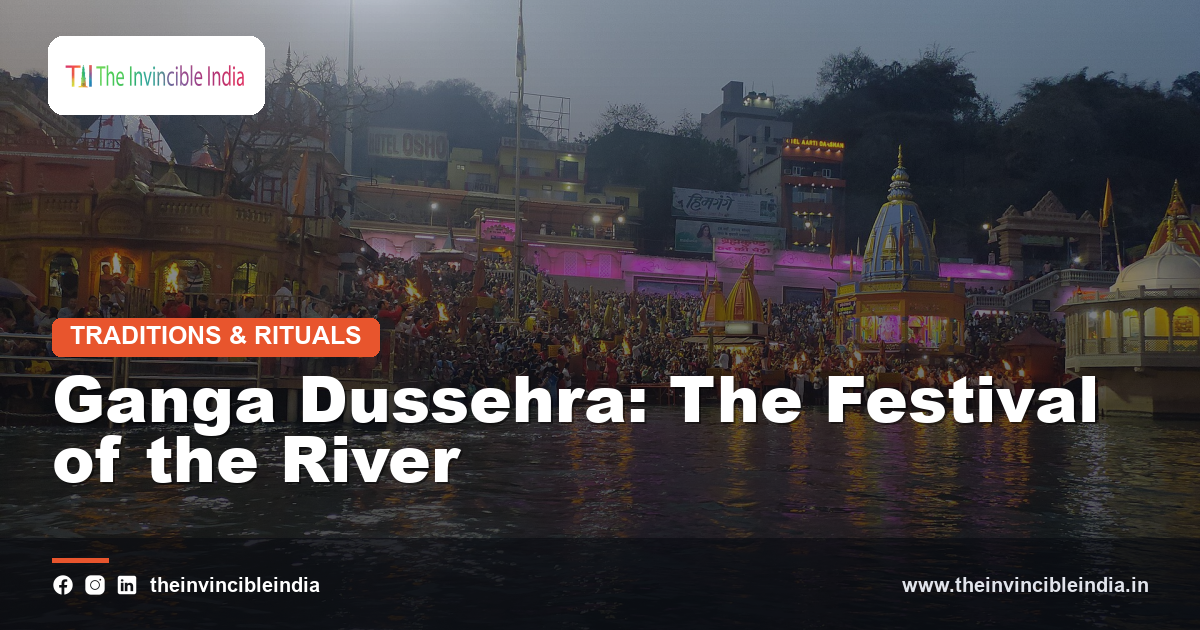
Ganga Dussehra is a significant Hindu festival that commemorates the descent of the sacred river Ganga from the heavens to the earth, an event of deep importance in Hindu cosmology. Observed during the month of Jyeshtha, the festival draws large numbers of devotees to riverside ghats in cities such as Haridwar, Varanasi, and Rishikesh, where ritual bathing is believed to cleanse worshippers of accumulated sin, a purificatory theme echoed in Makar Sankranti’s sacred bathing traditions. The festival’s name draws on the belief that contact with the river’s waters on this day removes ten categories of sin, linking the observance to themes of penance and renewal found throughout Hindu tradition. Evening aarti ceremonies, offerings, and prayers accompany the central ritual of bathing, making Ganga Dussehra one of the most visible expressions of reverence for the Ganga.
Quick Facts
| Detail | Information |
|---|---|
| Festival Type | Hindu river festival |
| Primary Region | North India, especially Uttarakhand and Uttar Pradesh |
| Presiding Deity | Goddess Ganga |
| Timing | Hindu month of Jyeshtha, on the tenth day of the waxing moon |
| Key Sites | Haridwar, Varanasi, and Rishikesh |
| Associated Practices | Ritual bathing, aarti, and offerings to the river |
Origins and Mythological Background
Ganga Dussehra commemorates the descent of the river Ganga from the heavens to the earth, an event central to Hindu cosmology and revered across northern India. The festival’s name combines Ganga, the river deity, with Dussehra, understood here as marking the removal of ten sins through contact with the river’s sacred waters. Hindu tradition holds that the Ganga originated in the celestial realm and was brought down to purify the earth and its inhabitants, a narrative that forms the devotional backbone of the observance. Temples, ghats, and riverside shrines dedicated to the goddess become centres of activity as devotees gather to mark this descent through prayer and ritual bathing. The festival’s mythological grounding gives ordinary contact with the river an added dimension of sanctity during this period, reinforcing the belief that the Ganga’s waters carry the power to cleanse both body and spirit.
The Descent of Ganga: The Bhagiratha Legend
Central to Ganga Dussehra is the story of King Bhagiratha, whose long penance is credited with persuading the goddess Ganga to descend from the heavens to the earth. According to the narrative, Bhagiratha undertook this effort to liberate the souls of his ancestors, who could find peace only through contact with the river’s purifying waters. Unable to bear the force of her descent, the earth is said to have required the intervention of Lord Shiva, who received the Ganga upon his head before releasing her in gentler streams. This legend explains both the river’s sacred origin and Shiva’s enduring association with the Ganga, often depicted with the river flowing from his matted hair. The story of Bhagiratha remains one of the most widely recounted narratives in Hindu tradition, and its retelling during Ganga Dussehra reinforces the festival’s central themes of penance, devotion, and redemption.
Meaning of the Name Dussehra
The term Dussehra in Ganga Dussehra is generally understood to mean the removal or destruction of ten sins, distinguishing this festival’s meaning from the more widely known autumn Dussehra associated with the Ramayana narrative. Devotees who bathe in the Ganga during this period are believed to be cleansed of these ten categories of sin, spanning transgressions of the body, speech, and mind. This interpretation situates Ganga Dussehra within a broader Hindu tradition of ritual purification, where physical acts such as bathing carry symbolic spiritual weight. The shared name with the autumn festival can create some confusion for newcomers to Hindu tradition, though the two observances differ entirely in timing, mythology, and ritual practice. Understanding this distinction helps clarify why Ganga Dussehra, despite its name, is fundamentally a river festival centred on purification rather than a celebration tied to the Ramayana.
Timing and the Hindu Calendar
Ganga Dussehra is observed on the tenth day of the waxing moon in the Hindu month of Jyeshtha, which typically falls during the late spring or early summer period in the Gregorian calendar. This timing situates the festival within a season traditionally associated with the arrival of the monsoon and renewed reliance on the river for agriculture and daily life across the Gangetic plain. The lunar and nakshatra-based calculation of the date follows conventions common to many Hindu festivals, requiring annual calculation by religious calendars and temple authorities. Preparations at major riverside sites often begin in the days leading up to the observance, with priests and local communities organising the rituals, decorations, and gatherings that mark the main day. This calendrical placement reflects the broader pattern in Hindu tradition of aligning significant religious observances with specific lunar phases tied to agricultural and seasonal rhythms.
Ganga as a Goddess in Hindu Tradition
Within Hindu belief, the river Ganga is venerated not merely as a body of water but as a goddess in her own right, worshipped for her power to purify and sustain life. She is regarded as a nurturing maternal figure, often referred to reverentially as Ganga Maiya, or Mother Ganga, reflecting the deep emotional and spiritual bond many devotees feel toward the river. Temples dedicated to the goddess exist along her course, and her image, often depicted seated upon a mythical aquatic creature, appears widely in devotional art. This personification allows devotees to approach the river through the same forms of worship, offering, and prayer directed toward other deities in the Hindu pantheon. Ganga Dussehra, as a festival dedicated specifically to her descent and continued presence, offers one of the clearest expressions of this goddess-centred reverence for the river within the broader devotional calendar.
Ritual Bathing and Its Significance
The central ritual act of Ganga Dussehra is bathing in the river, undertaken by devotees who gather at ghats and riverbanks in large numbers on the main day of observance. This bathing is understood as an act of spiritual purification, believed to cleanse the participant of accumulated sin and to invite blessings for the year ahead. Many devotees also collect river water to take home, using it in household worship or preserving it for later ceremonies, reflecting a belief in the water’s enduring sanctity beyond the festival day itself. Priests are often present at major ghats to guide devotees through accompanying prayers and offerings performed alongside the bath. This emphasis on physical immersion as a vehicle for spiritual cleansing situates Ganga Dussehra within a wider tradition of sacred bathing observed at numerous points along India’s rivers throughout the religious calendar.
Haridwar: The Epicentre of Celebration
Haridwar, one of the seven sacred cities in Hindu tradition and a principal gateway where the Ganga descends onto the northern plains, serves as the most prominent centre for Ganga Dussehra celebrations. The city’s ghats, particularly along the river’s edge, draw vast numbers of pilgrims who arrive specifically to bathe and participate in the festival’s rituals. Local temples and religious organisations coordinate the day’s events, including special prayers, decorations, and processions that mark the occasion with particular grandeur. The city’s association with the Ganga’s descent gives its celebration a heightened sense of significance compared to observances elsewhere, drawing devotees from across northern India and beyond. Haridwar’s role as a focal point during Ganga Dussehra reflects its broader standing as one of the most important pilgrimage destinations connected to the river throughout the year.
Ganga Aarti at Har Ki Pauri
Among the most recognisable rituals associated with Ganga Dussehra is the evening Ganga aarti performed at Har Ki Pauri, a prominent ghat in Haridwar closely linked to the river’s descent. During the ceremony, priests holding large, multi-tiered lamps perform synchronized movements to the accompaniment of devotional hymns and bells, while devotees gather along the ghat and float small lamps upon the water. This aarti, performed as a regular evening ritual throughout the year, takes on heightened significance and scale during the Ganga Dussehra period, drawing especially large crowds of worshippers. The visual and auditory spectacle of the ceremony, combined with its devotional intensity, makes it one of the most memorable public expressions of the festival for both local devotees and visitors, reinforcing Haridwar’s identity as a living centre of Ganga worship.
Celebrations in Varanasi
Varanasi, another of Hinduism’s most sacred cities, situated along the Ganga’s course further downstream, holds its own significant celebrations for Ganga Dussehra. The city’s numerous ghats become sites of ritual bathing, prayer, and aarti ceremonies performed with particular devotion during the festival period. Given Varanasi’s longstanding association with pilgrimage, death rites, and spiritual practice along the river, its Ganga Dussehra observance carries an additional layer of reverence tied to the city’s broader religious identity. Boats decorated for the occasion carry devotees along the river, while priests conduct rituals at prominent ghats associated with the city’s major temples. The combination of Varanasi’s ancient religious heritage and its central position along the Ganga makes its Ganga Dussehra celebrations a significant counterpart to those observed in Haridwar, each reflecting the distinct character of its host city.
Celebrations in Rishikesh and Other Ghats
Rishikesh, located near Haridwar and known for its association with yoga and spiritual retreat, also observes Ganga Dussehra with considerable devotion along its own riverside ghats. The town’s ashrams and temples often organise special prayers and aarti ceremonies timed to coincide with the festival, drawing both local residents and visiting spiritual seekers. Beyond these well-known pilgrimage towns, numerous smaller riverside communities along the Ganga’s course mark the occasion with modest but heartfelt local observances, reflecting the festival’s broad geographic reach. These local celebrations, while less publicised than those of Haridwar or Varanasi, demonstrate the extent to which reverence for the Ganga permeates communities settled along its banks. This widespread pattern of observance, adapted to the scale and resources of each community, underscores the deeply rooted and geographically extensive nature of Ganga worship in northern India.
Offerings, Rituals, and Practices
Alongside ritual bathing, devotees observing Ganga Dussehra commonly make offerings to the river, including flowers, small lamps, and sweets placed upon leaf boats and set adrift on the water. Many worshippers also perform puja at riverside shrines, reciting prayers and hymns dedicated to the goddess Ganga as part of their personal or family observance. Priests at major ghats assist devotees in conducting these rituals correctly, often reciting Sanskrit verses associated with the river’s sanctity. Some devotees additionally undertake charitable acts on this day, considered especially meritorious when performed during the festival period. These varied practices, ranging from simple personal prayer to elaborate temple ceremony, together constitute the devotional fabric of Ganga Dussehra, allowing participation across a wide spectrum of individual circumstance and religious inclination.
Fasting and Charitable Giving
Many devotees observe a period of fasting on Ganga Dussehra, considered an act of discipline and devotion that complements the ritual bath in the river. This fasting may extend for the full day or be limited to specific meals, depending on individual or family custom, and is often broken only after the completion of prayers and bathing rituals. Charitable giving, including the donation of food, clothing, or money to those in need, is also commonly practised on this day, reflecting a belief that generosity performed during sacred periods carries heightened spiritual merit. These complementary practices of fasting and charity situate the physical act of bathing within a broader framework of personal discipline and social responsibility, reflecting values commonly emphasised across many Hindu festival observances throughout the year.
Ganga Dussehra and Environmental Consciousness
In recent years, Ganga Dussehra has increasingly become an occasion associated with public awareness of river conservation and environmental stewardship, given the Ganga’s ecological significance alongside its religious importance. Government bodies, religious organisations, and civil society groups have used the festival period to highlight the importance of protecting the river from pollution and the need for sustainable use of its waters. Some observances now incorporate messages encouraging devotees to use biodegradable materials for offerings and to avoid practices that could harm the river’s ecosystem. This growing environmental dimension reflects a broader recognition that reverence for the Ganga, expressed through the festival’s rituals, can be meaningfully extended into practical efforts to preserve the river for future generations, blending traditional devotion with contemporary ecological concern.
Regional Variations Across North India
While Haridwar, Varanasi, and Rishikesh host some of the most prominent Ganga Dussehra celebrations, the festival is observed with local variation across many towns and villages along the river’s course through northern India. Communities in Uttarakhand, Uttar Pradesh, Bihar, and West Bengal each bring their own customs, scale, and emphasis to the observance, shaped by local tradition and the specific relationship each community holds with the river. In some areas, the festival coincides with local fairs or additional cultural events, while in others it remains a quieter, family-centred occasion focused on prayer and bathing. This regional diversity illustrates how a single festival rooted in shared mythology can nonetheless accommodate a wide range of local expression, reflecting the varied cultural landscape through which the Ganga flows.
Cultural and Devotional Importance
Beyond its specific rituals, Ganga Dussehra holds broader cultural and devotional importance as an annual reaffirmation of the deep reverence Hindus hold for the river Ganga. The festival serves as a reminder of the river’s central place in Hindu cosmology, mythology, and daily religious practice, connecting contemporary observance to narratives that have been recounted for generations. For many devotees, participation in the festival, whether through a pilgrimage to a major ghat or a simple prayer at a local shrine, represents a meaningful expression of cultural identity and continuity. The festival also reinforces the river’s role as a unifying element across the diverse regions and communities it passes through, drawing together devotees under a shared devotional framework centred on the goddess Ganga.
Ganga Dussehra Today
Today, Ganga Dussehra continues to be observed with considerable devotion at riverside towns and cities across northern India, drawing large numbers of pilgrims to sites such as Haridwar and Varanasi each year. The festival’s core rituals of bathing, prayer, and aarti remain largely unchanged, even as growing attention to environmental concerns has introduced new dimensions to its contemporary observance. Improved transport and communication have made it easier for devotees from distant regions to travel to major pilgrimage sites during the festival period, while local communities along the river continue to mark the day according to their own established customs. This blend of enduring tradition and gradual adaptation reflects the continued vitality of Ganga Dussehra as a living expression of devotion to one of India’s most revered natural and spiritual landmarks.
Sources & Further Reading
- Ministry of Culture, Government of India (indiaculture.gov.in).
- Uttarakhand Tourism, Government of Uttarakhand (uttarakhandtourism.gov.in).
Frequently Asked Questions
What is Ganga Dussehra?
Ganga Dussehra is a Hindu festival that commemorates the descent of the river Ganga to earth, observed through ritual bathing, prayer, and aarti ceremonies along the river’s ghats.
When is Ganga Dussehra celebrated?
The festival falls on the tenth day of the waxing moon in the Hindu month of Jyeshtha, which generally corresponds to the late spring or early summer period.
Why is bathing in the Ganga significant on this day?
Bathing in the river during Ganga Dussehra is believed to cleanse devotees of ten categories of sin, reflecting the festival’s association with purification and spiritual renewal.
Where are the main Ganga Dussehra celebrations held?
Haridwar, Varanasi, and Rishikesh host some of the most prominent celebrations, with the Ganga aarti at Har Ki Pauri in Haridwar drawing especially large crowds.
Who is King Bhagiratha in the Ganga Dussehra story?
Bhagiratha is the king whose penance, according to Hindu legend, persuaded the goddess Ganga to descend from the heavens, a narrative central to the festival’s mythology.


