

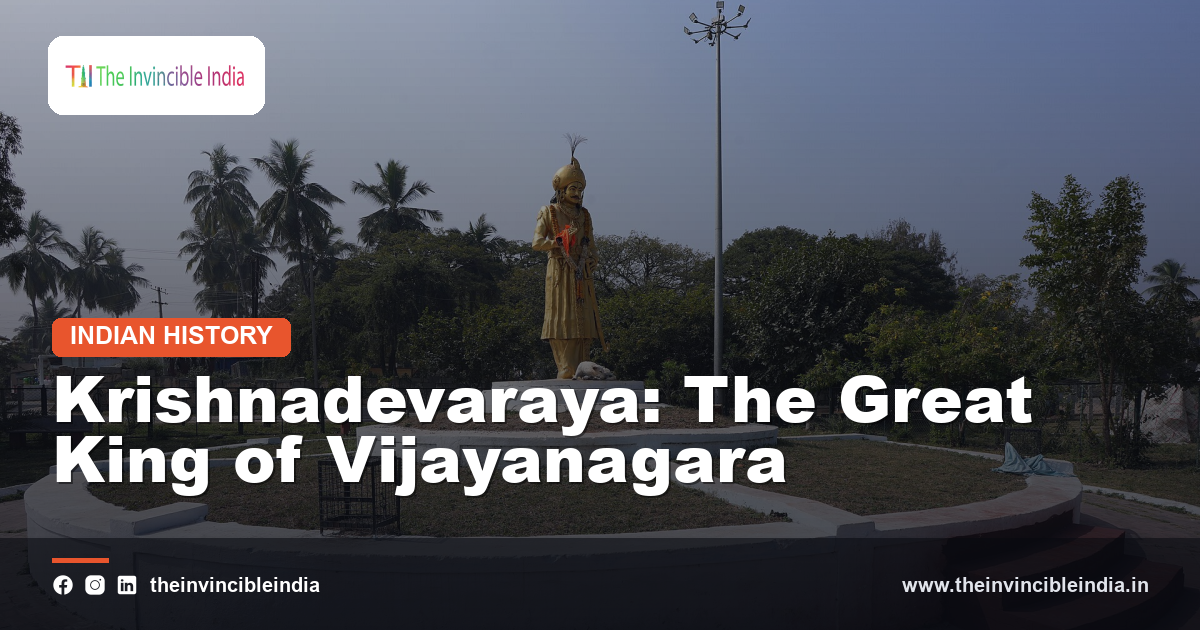
Among the many rulers who governed the great southern kingdoms of medieval India, Krishnadevaraya of the Vijayanagara Empire is remembered as one of the most accomplished, combining military success with an extraordinary flowering of art, literature, and architecture. Under his rule, the empire’s capital at Hampi grew into one of the great urban centers of its age, drawing admiration from foreign travelers who documented its wealth and grandeur. His court became a celebrated hub of Telugu, Sanskrit, and Kannada literary activity, while his patronage funded some of the most impressive temple architecture surviving from the period. This guide surveys his rise, governance, cultural patronage, and lasting legacy within Vijayanagara history.
Quick Facts
| Detail | Information |
|---|---|
| Dynasty | Tuluva dynasty of the Vijayanagara Empire |
| Region | Deccan and South India, capital at Hampi |
| Known For | Territorial expansion and extensive patronage of art and literature |
| Court Poets | Renowned for the Ashtadiggajas, eight celebrated Telugu poets |
| Signature Monuments | The Hazara Rama and Vitthala temple complexes at Hampi |
| Legacy | Widely regarded as Vijayanagara’s greatest ruler |
Background and Rise to the Throne
Krishnadevaraya belonged to the Tuluva dynasty, which had risen to leadership of the Vijayanagara Empire following a period of internal transition within the broader ruling structure of the kingdom. His accession placed him at the head of one of the most powerful states in South India, inheriting both considerable resources and a challenging set of regional rivalries. From early in his reign, he demonstrated a combination of military capability and administrative acumen that would come to define his rule. His rise coincided with an empire well positioned, thanks to earlier consolidation, to pursue an ambitious program of expansion and cultural patronage. This strong foundation allowed Krishnadevaraya to pursue the achievements for which he remains celebrated today.
The Vijayanagara Empire Before Krishnadevaraya
By the time Krishnadevaraya assumed the throne, the Vijayanagara Empire had already established itself as the preeminent power in South India, having emerged generations earlier as a bulwark against the northern Deccan sultanates. Earlier rulers had built a substantial administrative and military structure, along with a flourishing capital at Hampi that combined religious, commercial, and courtly functions. This existing foundation of institutional strength and economic prosperity provided Krishnadevaraya with the resources necessary to pursue further expansion and ambitious cultural projects. The empire’s long-standing role as a protector of South Indian political and cultural traditions against northern incursions also shaped the context in which he ruled. Understanding this inheritance helps explain the scale of what Krishnadevaraya was able to achieve during his reign.
Military Campaigns and Territorial Expansion
Krishnadevaraya is remembered as an especially capable military leader, conducting a series of campaigns that expanded and consolidated Vijayanagara authority across substantial portions of South India. His forces engaged successfully against rival regional powers, including neighboring sultanates and other contemporary kingdoms contesting territory along the empire’s frontiers. These campaigns were generally characterized by careful planning and effective use of the empire’s considerable military and logistical resources. Successful expansion under his leadership significantly strengthened Vijayanagara’s position relative to its regional rivals, securing valuable territory and resources for the empire. This record of military achievement forms an important part of his broader reputation as an exceptionally capable ruler.
Relations with the Deccan Sultanates
Throughout his reign, Krishnadevaraya navigated a complex relationship with the various Deccan sultanates to the north, whose territories bordered Vijayanagara and whose interests frequently conflicted with those of his own kingdom. Relations alternated between military conflict and periods of diplomatic engagement, reflecting the shifting balance of power among the competing states of the wider Deccan region. Krishnadevaraya’s ability to successfully manage this relationship, including periods of effective military resistance, contributed significantly to Vijayanagara’s continued strength during his reign. These interactions also shaped broader patterns of cultural and political exchange across the linguistic and religious boundaries dividing the Deccan sultanates from Vijayanagara. This extended engagement remains an important dimension of understanding his reign within its wider regional context.
Administration and Governance
Krishnadevaraya is credited with maintaining an effective system of administration that balanced central authority with a network of provincial governors and local officials responsible for revenue and order. Attention to agricultural development, including irrigation projects, reflects a broader concern with the practical foundations of prosperity underpinning the empire’s military and cultural achievements. Inscriptions from his reign record numerous grants to temples and institutions, providing valuable evidence of the administrative and fiscal organization of the period. This combination of military strength and attentive governance allowed the empire to sustain an unusually high level of prosperity during his rule. Krishnadevaraya’s reputation for capable administration remains an important complement to his more widely celebrated military and cultural achievements.
Patronage of Telugu Literature
Krishnadevaraya is remembered as a significant patron of Telugu literature, with his own reputed literary interests and the flourishing of Telugu poetry at his court marking a particularly celebrated period in the language’s literary history. Court poets working under his patronage produced works addressing courtly, devotional, and literary themes, contributing to what is often regarded as a golden age of Telugu literary production. This patronage reflected a broader royal interest in supporting scholarship and artistic achievement alongside more conventional forms of statecraft. The literary culture fostered at his court left a lasting influence on subsequent generations of Telugu writers and scholars. This association with literary patronage remains a defining aspect of his broader historical reputation.
The Ashtadiggajas and Court Poets
Tradition remembers Krishnadevaraya’s court as home to a group of eight especially distinguished poets, collectively known as the Ashtadiggajas, whose combined literary output is regarded as a high point of Telugu literary achievement. These poets addressed a wide range of subjects, from devotional and mythological themes to courtly praise and technical literary composition, reflecting considerable diversity within the court’s literary culture. Their presence at court illustrates the scale of royal investment in supporting scholarship and artistic talent during this period. This concentration of literary talent under a single ruler’s patronage remains a notable feature of Vijayanagara cultural history. The legacy of the Ashtadiggajas continues to be studied within the broader history of Telugu literature.
Religious Patronage and Temple Building
Krishnadevaraya was an active patron of Hindu religious institutions, funding the construction and expansion of numerous temples across the Vijayanagara Empire, particularly within and around the capital at Hampi. This patronage reflected both personal devotion and the broader political function of temple building in reinforcing royal legitimacy and public prestige. Endowments recorded in inscriptions supported priests, ritual activity, and the maintenance of temple institutions across the empire. This extensive religious patronage contributed significantly to the architectural and artistic richness for which the Vijayanagara period remains celebrated. Temple building under his rule represents one of the most visible and enduring aspects of his broader legacy.
The Hazara Rama and Vitthala Temples
Among the most celebrated architectural achievements associated with Krishnadevaraya’s reign are the Hazara Rama temple, known for its finely detailed narrative relief carvings, and the Vitthala temple complex, renowned for its elaborate pillared halls and iconic stone chariot structure. These temples exemplify the architectural and sculptural sophistication achieved during the Vijayanagara period, combining structural ambition with intricate decorative detail. Construction and embellishment of these monuments reflect the substantial resources and skilled craftsmanship available to the empire during this prosperous era. Together, these temples remain among the most visited and studied monuments at Hampi today. Their preservation continues to offer valuable insight into the artistic achievements of Krishnadevaraya’s reign.
Hampi as an Imperial Capital
Under Krishnadevaraya, the Vijayanagara capital at Hampi reached a particularly celebrated period of development, combining religious, commercial, and courtly functions within an extensive urban landscape of temples, markets, and royal structures. Foreign visitors who traveled to the city during this period recorded impressions of its wealth, scale, and vibrant commercial activity, providing valuable external perspectives on the empire’s prosperity. The city’s layout reflected careful planning, integrating sacred and secular spaces within a coherent urban design suited to its role as an imperial capital. This flourishing of Hampi under Krishnadevaraya represents one of the high points of urban development in medieval South India. The site’s surviving ruins continue to convey the scale of this remarkable historical achievement.
Trade and the Economy under Krishnadevaraya
The Vijayanagara economy under Krishnadevaraya benefited from extensive agricultural productivity, supported by irrigation projects, alongside significant participation in regional and international trade networks. Goods including textiles, spices, and precious stones moved through markets connected to both overland routes and coastal ports engaged in maritime commerce. This economic prosperity provided the material foundation necessary to sustain the empire’s extensive military campaigns, temple building, and courtly patronage of literature and the arts. Foreign accounts from the period consistently emphasize the wealth and commercial vibrancy of the empire during this era. This robust economic base remains an essential, if sometimes overlooked, dimension of Krishnadevaraya’s broader achievements.
Foreign Travelers' Accounts of Vijayanagara
Several foreign travelers who visited the Vijayanagara Empire during Krishnadevaraya’s reign left written accounts describing the wealth, scale, and organization of the capital and its court, providing valuable external corroboration for later historical study. These visitors, arriving from various parts of Asia and beyond, recorded impressions of the city’s markets, temples, and courtly ceremonies, offering perspectives that complement inscriptional and architectural evidence. Such accounts remain important sources for historians seeking to reconstruct the social and economic conditions of the period. The consistency of admiration expressed across these varied accounts underscores the genuine scale of Vijayanagara’s prosperity during this era. These historical records continue to inform modern scholarly understanding of Krishnadevaraya’s reign.
Art, Sculpture, and Courtly Culture
The artistic culture of Krishnadevaraya’s court extended beyond temple architecture to encompass sculpture, painting, and courtly performance traditions supported by sustained royal patronage. Vijayanagara sculpture from this period is noted for its technical refinement and stylistic distinctiveness, reflecting a mature and confident artistic tradition. Courtly ceremonies and public celebrations, described by foreign visitors, reflected the scale and sophistication of cultural life associated with the imperial court. This broad cultural flourishing, encompassing literature, architecture, and the visual arts together, represents one of the defining features of Krishnadevaraya’s reign. This integrated artistic achievement remains central to the empire’s enduring cultural legacy.
Legacy within the Vijayanagara Empire
Within the broader history of the Vijayanagara Empire, Krishnadevaraya’s reign is generally regarded as its high point, combining military strength, administrative effectiveness, and cultural achievement in a manner not matched by other rulers of the dynasty. Later rulers inherited both the strengths and the challenges of this expanded and prosperous empire, though subsequent history saw a gradual decline from the heights reached under his leadership. His reign set a benchmark against which later Vijayanagara governance and achievement continued to be measured. This position as the empire’s most celebrated ruler secures Krishnadevaraya a central place in the history of the dynasty. His legacy remains closely tied to the broader story of Vijayanagara’s rise and eventual transformation.
Krishnadevaraya in Indian History
Beyond the specific context of Vijayanagara, Krishnadevaraya occupies an important place in the broader narrative of medieval Indian history as an example of a ruler who successfully combined military and administrative achievement with extensive cultural patronage. His reign is frequently cited by historians studying the relationship between political power and cultural flourishing in premodern India. Comparisons with other celebrated patron-rulers across Indian history often highlight the particular scale and diversity of his cultural contributions, spanning literature, architecture, and the arts. This broader historical significance extends his relevance well beyond the regional history of South India alone. Krishnadevaraya’s example continues to inform scholarly discussion of royal patronage across Indian history.
Krishnadevaraya Today
Today, the legacy of Krishnadevaraya is preserved through the ruins of Hampi, recognized as a UNESCO World Heritage Site and a major destination for scholars, pilgrims, and visitors interested in Vijayanagara history and architecture. Conservation authorities continue efforts to protect the site’s temples and structures from the effects of weathering and tourism pressure. His reputation as a patron of Telugu literature and the arts continues to be studied and celebrated within regional cultural and literary circles. Ongoing archaeological and historical research continues to refine understanding of his reign and its broader significance. Through both its monuments and its literary legacy, Krishnadevaraya’s era remains a vivid and celebrated chapter in the history of South India.
Sources & Further Reading
- Archaeological Survey of India (asi.nic.in).
- Ministry of Culture, Government of India (indiaculture.gov.in).
Frequently Asked Questions
Who was Krishnadevaraya?
Krishnadevaraya was a Tuluva dynasty ruler of the Vijayanagara Empire, widely regarded as its greatest emperor for his military success, effective governance, and extensive cultural patronage.
What is Krishnadevaraya famous for?
He is celebrated for expanding Vijayanagara’s territory, patronizing Telugu literature and the Ashtadiggajas poets, and funding major temple construction at Hampi.
What were the Ashtadiggajas?
The Ashtadiggajas were eight celebrated poets associated with Krishnadevaraya’s court, whose combined literary work is regarded as a high point of Telugu literature.
What monuments are associated with Krishnadevaraya?
The Hazara Rama temple and the Vitthala temple complex at Hampi, known for its stone chariot and pillared halls, are closely associated with his reign.
Why is Hampi significant today?
Hampi, the former Vijayanagara capital that flourished under Krishnadevaraya, is a UNESCO World Heritage Site celebrated for its temples and historic urban ruins.


