

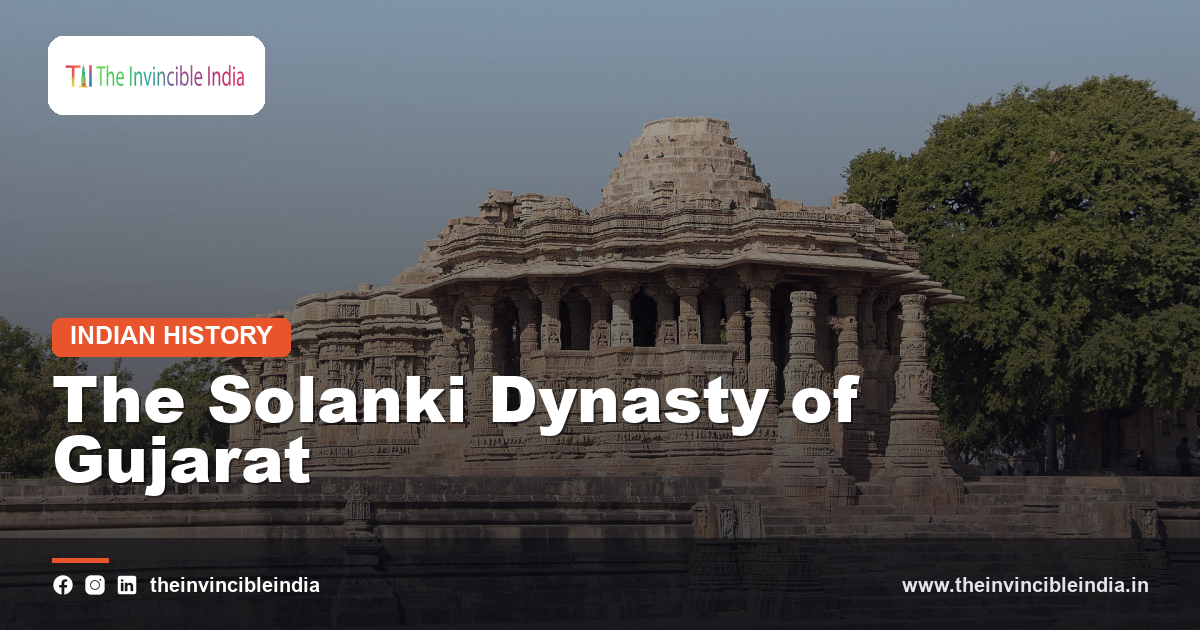
Along the fertile plains of Gujarat, a dynasty known as the Solankis, or Chaulukyas, built one of medieval India’s most prosperous and culturally accomplished regional kingdoms. Ruling during an era when regional powers across the subcontinent were engaged in the kind of architectural and cultural competition also seen among the Cholas in the far south, the Solankis oversaw the construction of some of India’s most exquisite stone monuments, including a magnificent sun temple and an extraordinary stepped well. Their capital at Anhilwara grew into a thriving center of trade, learning, and craftsmanship, drawing merchants and artisans from across western India. This guide explores the Solanki dynasty’s origins, governance, culture, and lasting architectural legacy.
Quick Facts
| Detail | Information |
|---|---|
| Region | Gujarat, western India |
| Approximate Period | Roughly the 10th to the 13th century CE |
| Capital | Anhilwara (present-day Patan) |
| Signature Monuments | The Modhera Sun Temple and the stepwell Rani ki Vav |
| Religions Patronized | Hinduism, particularly Shaivism, alongside Jainism |
| Economic Base | Overland and maritime trade through Gujarat’s ports |
Origins of the Solanki Dynasty
The Solanki, or Chaulukya, dynasty rose to prominence in Gujarat during a period of shifting regional power across western India, as older ruling houses weakened and new dynasties emerged to claim authority over the region’s fertile plains and coastal territories. Dynastic tradition traces the family’s origins to accounts that combine local legend with claims of respectable lineage, a pattern common among medieval Indian ruling houses seeking to establish legitimacy. Emerging from a relatively modest regional base, the Solankis gradually extended their authority across Gujarat, benefiting from the region’s agricultural wealth and strategic coastal position. Their rise coincided with broader political fragmentation across northern and western India, which created opportunities for capable regional powers to assert independence and expand their influence. This foundation set the stage for the flourishing of Solanki rule in the centuries that followed.
Rise to Regional Power
As Solanki strength grew, successive rulers consolidated control over Gujarat through military campaigns, strategic marriage alliances, and careful administrative organization of newly acquired territory. Early rulers are credited with establishing Anhilwara as a capital worthy of an increasingly powerful regional kingdom, transforming it into a thriving center of trade and courtly life. The dynasty’s rise was aided by Gujarat’s advantageous position along both overland trade routes and maritime networks connecting India to the wider Indian Ocean world. This combination of agricultural wealth, commercial opportunity, and effective governance allowed the Solankis to build one of the most prosperous regional kingdoms of medieval India. Their growing power set the stage for an era of extensive temple building and cultural patronage that would define the dynasty’s golden age.
Extent of Solanki Territory
At its height, Solanki authority extended across most of present-day Gujarat and into parts of neighboring regions, encompassing a varied landscape of fertile agricultural plains, coastal ports, and semi-arid frontier zones. Control over this territory brought the dynasty into contact, and at times conflict, with neighboring powers including the Paramaras of Malwa and various Rajput clans along shifting frontiers. Gujarat’s extensive coastline gave the Solankis access to important maritime trade routes, connecting the kingdom to merchants and goods from across the Arabian Sea and beyond. This combination of a productive agrarian interior and a commercially vibrant coastline provided the dynasty with a strong and diversified economic base. The Solanki realm’s territorial extent and strategic position made it one of the most consequential regional powers of medieval western India.
Notable Rulers
Solanki inscriptions preserve the names of a long line of rulers, several of whom are particularly remembered for their contributions to temple building, territorial expansion, or effective administration. Certain rulers are closely associated with the great phase of monument construction that produced the Modhera Sun Temple and the stepwell known as Rani ki Vav, works that reflect the dynasty’s considerable resources and artistic ambition. Other rulers are remembered for military campaigns that extended or defended Solanki territory against rival powers along Gujarat’s various frontiers. The dynasty’s rulers are also credited with fostering a court culture that supported literature, religious scholarship, and craftsmanship, contributing to Gujarat’s broader cultural development during this period. This sequence of capable rulers across many generations illustrates the sustained strength and ambition of Solanki rule.
System of Governance
Solanki administration combined central royal authority with a network of provincial officials and feudatory chiefs who managed local affairs while acknowledging the overlordship of the reigning dynasty. Inscriptions recording land grants and administrative decisions provide much of the surviving evidence for how the kingdom organized its revenue collection and governance structures. This layered system allowed the Solankis to govern a territory encompassing diverse agricultural, coastal, and frontier zones without requiring uniform centralized control. Local customs and existing structures of authority were generally incorporated into the broader administrative framework, a pragmatic approach common among medieval Indian dynasties. This flexible governance system contributed significantly to the kingdom’s ability to sustain stability and prosperity across a lengthy period of rule.
Anhilwara: A Thriving Capital
The Solanki capital of Anhilwara, located at present-day Patan, developed into one of the most important urban centers of medieval western India, combining political administration with vibrant commercial and cultural activity. The city’s markets attracted merchants dealing in textiles, spices, and other goods, reflecting Gujarat’s broader role as a hub of regional and maritime trade. Anhilwara also served as a center of religious and artistic patronage, with royal support funding temples, wells, and other public works that enhanced the city’s civic infrastructure and prestige. Descriptions from later periods continued to reference Anhilwara’s historical importance as a center of trade and culture long after the Solanki dynasty’s political decline. The city’s development under Solanki rule exemplifies the broader prosperity that characterized the dynasty’s realm.
Religious Patronage
Solanki rulers were notable patrons of Hindu religious traditions, particularly Shaivism, while also extending substantial support to the thriving Jain community present throughout Gujarat during this period. This pattern of broad religious patronage reflects the dynasty’s recognition of Jainism’s significant social and economic presence in the region, particularly among merchant communities who were themselves major patrons of Jain institutions. Temple construction and endowment featured prominently among Solanki religious activities, with royal grants supporting the maintenance of shrines and religious personnel across the kingdom. This inclusive approach to religious patronage helped maintain social cohesion across Gujarat’s religiously diverse population. The coexistence of strong Hindu and Jain patronage under Solanki rule remains one of the defining features of the dynasty’s cultural legacy.
The Modhera Sun Temple
Among the most celebrated monuments of Solanki patronage is the sun temple at Modhera, an architecturally sophisticated complex dedicated to the solar deity Surya and designed with careful attention to orientation and symbolic form. The temple complex includes a stepped tank, a pillared hall, and a sanctuary, arranged in a sequence that reflects the ritual and architectural conventions of medieval Hindu temple design. Intricate carvings covering the temple’s surfaces depict deities, mythological scenes, and decorative motifs, executed with the technical refinement characteristic of Solanki-era craftsmanship. The temple’s design reflects broader astronomical and calendrical concerns associated with solar worship, integrating practical and symbolic considerations into its architectural plan. The Modhera Sun Temple remains one of the finest surviving examples of Solanki architectural and artistic achievement.
Rani ki Vav: The Queen's Stepwell
Rani ki Vav, an elaborate stepped well constructed under Solanki patronage, stands as one of the most remarkable examples of stepwell architecture found anywhere in India, combining practical water storage function with extraordinary artistic ambition. Descending through multiple levels lined with intricately carved panels depicting deities and mythological scenes, the stepwell reflects both the engineering skill and the sculptural artistry associated with Solanki-era craftsmanship. Stepwells of this kind served essential practical purposes in Gujarat’s semi-arid climate, providing reliable access to water while also functioning as cool, shaded gathering spaces for local communities. The scale and artistic sophistication of Rani ki Vav distinguish it even among the many stepwells built across medieval Gujarat and Rajasthan. Recognized today as a UNESCO World Heritage Site, Rani ki Vav remains a defining monument of Solanki architectural achievement.
Trade and Maritime Contacts
Gujarat’s extensive coastline gave the Solanki dynasty a uniquely advantageous position within the wider network of Indian Ocean trade, connecting the kingdom to merchants and goods from the Arabian Peninsula, East Africa, and beyond. Coastal towns under Solanki influence grew into bustling centers of exchange, benefiting from the stability and infrastructure that effective regional rule could provide. Goods moving through this trade network included textiles, spices, and other regional products, exchanged for commodities brought by seaborne merchants from across the Indian Ocean world. This maritime trade complemented the kingdom’s substantial agrarian economy, contributing significantly to the prosperity that funded Solanki architectural and religious patronage. The Solanki period thus represents an important chapter in the long history of Gujarat’s engagement with international maritime commerce.
Literature and Court Culture
The Solanki court supported Sanskrit literary and scholarly activity, with court poets and scholars producing works that reflected the courtly conventions and religious themes typical of the period’s literary tradition. Jain scholars, benefiting from royal patronage and the broader prominence of Jain institutions in Gujarat, also made significant contributions to the intellectual and literary life of the kingdom. This combination of Hindu and Jain scholarly activity gave the Solanki court a notably cosmopolitan cultural character. Royal patronage of literature and learning complemented the dynasty’s extensive architectural achievements, reflecting a broader commitment to cultural patronage across multiple domains. This rich court culture contributed to Gujarat’s enduring reputation as a center of learning and artistic achievement during the medieval period.
Society and Craftsmanship
Solanki society combined a prosperous agrarian base with thriving craft and merchant communities, particularly in urban centers like Anhilwara where trade and artisanal production flourished under stable rule. Skilled artisans, including stonemasons, sculptors, and builders, played a crucial role in realizing the kingdom’s ambitious architectural projects, from temples to stepwells to civic infrastructure. Merchant communities, many of them Jain, held considerable social and economic influence, reflected in their significant contributions to religious and public architecture across the kingdom. This layered social structure, combining royal patronage, skilled craftsmanship, and merchant wealth, provided the foundation for the extraordinary artistic achievements associated with Solanki rule. The legacy of this craftsmanship remains visible today in the surviving monuments of Gujarat.
Rivalries with Neighboring Powers
Throughout their history, the Solankis engaged in recurring rivalries with neighboring powers, including the Paramaras of Malwa to the east and various regional and Rajput powers along Gujarat’s other frontiers. Control of contested border territories and access to trade routes fueled much of this competition, with military fortunes shifting according to the relative strength of successive rulers on each side. Periods of Solanki strength allowed the dynasty to extend influence into neighboring regions, while periods of internal difficulty left the kingdom more vulnerable to external pressure. This pattern of shifting rivalry reflects the broader competitive political landscape of medieval western India, in which several ambitious regional powers vied for supremacy. The Solankis’ ability to sustain their kingdom across several centuries despite these pressures reflects considerable political and military resilience.
Decline of Solanki Power
By the early 13th century, internal succession difficulties combined with growing external pressure gradually weakened Solanki authority over Gujarat. As central control loosened, subordinate chiefs and rival regional powers began asserting greater independence, straining the cohesion of the kingdom built up over previous centuries. The broader political transformation of northern and western India during this period, marked by the emergence of new powers, placed additional pressure on established regional dynasties like the Solankis. This gradual erosion of authority, rather than a single decisive defeat, characterized the dynasty’s later political history. The eventual eclipse of Solanki political power nonetheless left behind an architectural and cultural legacy that would long outlast the kingdom’s independent existence.
Legacy in Indian History
The Solanki dynasty is remembered today chiefly for its extraordinary architectural achievements, with the Modhera Sun Temple and Rani ki Vav standing among the finest surviving examples of medieval Indian temple and stepwell architecture. The dynasty’s broader legacy also includes its role in fostering Gujarat’s long tradition of trade, craftsmanship, and religious pluralism, patterns that continued to shape the region long after Solanki political power had faded. Later Gujarati dynasties and sultanates inherited elements of the administrative and commercial infrastructure first developed under Solanki rule. Historians studying medieval western India continue to draw on Solanki inscriptions and monuments to reconstruct the political, economic, and religious life of the period. This layered legacy secures the Solankis an important place within the broader narrative of Indian history.
The Solanki Dynasty Today
Today, the legacy of the Solanki dynasty is preserved through celebrated monuments such as the Modhera Sun Temple and Rani ki Vav, both of which attract scholars, pilgrims, and visitors interested in medieval Indian architecture. Conservation authorities work to protect these delicate stone structures from weathering and the pressures of tourism, ensuring their continued preservation for future generations. Patan, the site of the former Solanki capital, remains an important center of heritage tourism and traditional craftsmanship, including its historic textile traditions. Ongoing scholarship continues to study Solanki inscriptions and monuments to deepen understanding of the dynasty’s political and cultural history. Through its enduring monuments, the Solanki dynasty remains a vivid presence in the historical and cultural memory of Gujarat.
Sources & Further Reading
- Archaeological Survey of India (asi.nic.in).
- Ministry of Culture, Government of India (indiaculture.gov.in).
Frequently Asked Questions
Who were the Solankis?
The Solankis, also known as the Chaulukyas, were a medieval dynasty that ruled Gujarat from roughly the 10th to the 13th century CE, remembered for their architectural and commercial achievements.
What is the Solanki dynasty famous for?
The dynasty is best known for constructing the Modhera Sun Temple and the stepwell Rani ki Vav, both celebrated examples of medieval Indian architecture and sculpture.
Where was the Solanki capital located?
The Solankis ruled from their capital at Anhilwara, present-day Patan, which grew into a major center of trade, administration, and courtly culture.
What religions did the Solankis support?
Solanki rulers primarily patronized Hindu traditions, especially Shaivism, while also extending substantial support to the thriving Jain community present throughout Gujarat.
Why is Rani ki Vav significant?
Rani ki Vav is an elaborately carved stepped well recognized as a UNESCO World Heritage Site, admired for combining practical water infrastructure with extraordinary sculptural artistry.


