

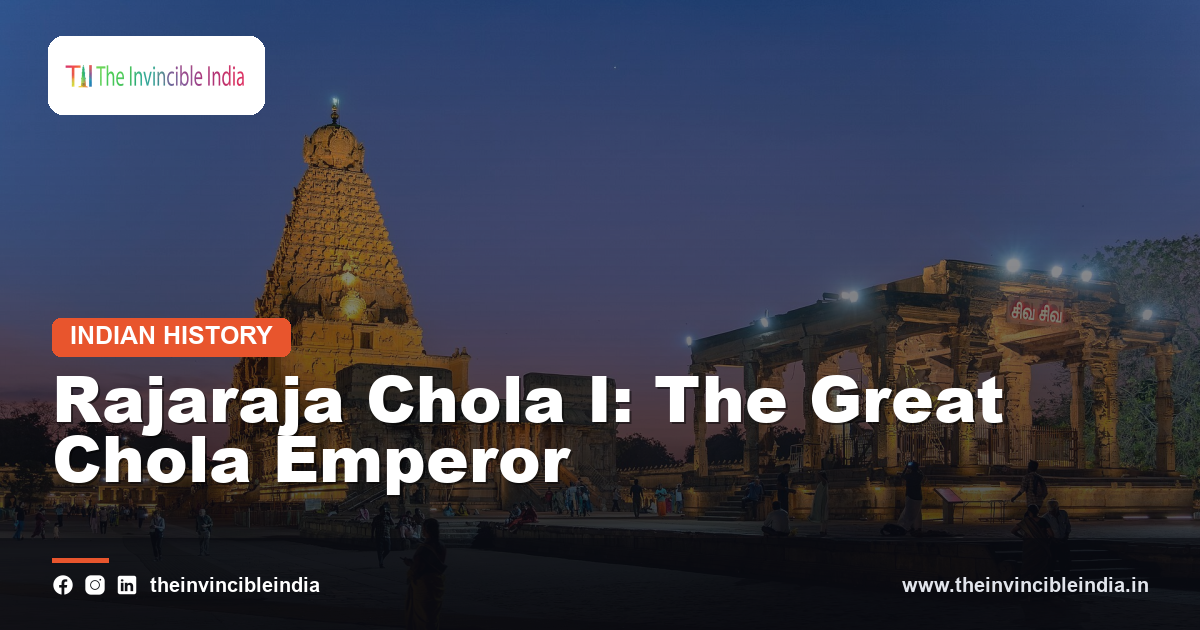
Among the rulers who shaped the long and celebrated history of the Chola dynasty, Rajaraja Chola I stands out as one of the most transformative, remembered for expanding Chola naval power, reorganizing administration, and commissioning one of the great architectural masterpieces of South India. Under his leadership, the Chola kingdom grew into a formidable regional power with influence extending across the seas, while his capital and temple foundations at Thanjavur became enduring symbols of Tamil artistic and engineering achievement. His reign is closely associated with the construction of the towering Brihadisvara Temple, a monument that continues to be studied for its architectural and artistic sophistication. This guide surveys his rise, governance, patronage, and lasting place in South Indian history.
Quick Facts
| Detail | Information |
|---|---|
| Dynasty | Chola dynasty of South India |
| Region | Tamil country, with an expanding maritime sphere of influence |
| Known For | Naval expansion and construction of the Brihadisvara Temple |
| Signature Monument | Brihadisvara Temple at Thanjavur, a UNESCO World Heritage Site |
| Administration | Refined local self-government through village assemblies |
| Legacy | Regarded as one of the greatest emperors of the Chola dynasty |
Background and Accession
Rajaraja Chola I ascended to leadership of the Chola kingdom at a time when the dynasty, though already established in the Tamil country, had further ambitions for expansion and consolidation across South India. His accession placed him at the head of a kingdom with a long tradition of regional influence, along with the resources needed to pursue a more ambitious program of conquest and administrative reform. From the early part of his reign, he demonstrated considerable skill in both military leadership and administrative organization, qualities that would come to define his rule. His accession marked the beginning of what many historians regard as a particularly transformative period in Chola history. This strong foundation allowed him to pursue the far-reaching achievements for which he remains celebrated.
The Chola Kingdom Before Rajaraja
Before Rajaraja’s reign, the Chola dynasty had already reestablished itself as a significant regional power in the Tamil country, having revived earlier traditions of Chola rule after a period of reduced prominence. Earlier rulers had laid groundwork for renewed strength, though the kingdom’s full potential for wider regional and maritime influence remained largely unrealized. This existing foundation of political stability and regional authority provided Rajaraja with the resources and administrative base necessary to pursue further expansion. The kingdom’s position along the fertile Kaveri river region also provided a strong agrarian and economic foundation for his subsequent ambitions. Understanding this inheritance helps explain the scale of transformation achieved during his reign.
Military Campaigns and Naval Power
Rajaraja is remembered as a particularly capable military strategist, overseeing campaigns that expanded Chola authority across South India while also developing a naval capacity notable for its reach across the surrounding seas. Chola naval power under his direction extended influence toward Sri Lanka and other coastal and island territories, reflecting an unusually ambitious maritime vision among contemporary Indian rulers. This combination of land-based military strength and growing naval capability distinguished the Chola kingdom from many other regional powers of the period. Successful campaigns under his leadership significantly expanded the territory and influence controlled by the Chola state. This record of military and naval achievement forms a central part of his broader historical reputation.
Conquest and Consolidation in South India
Beyond his naval ventures, Rajaraja pursued a program of territorial consolidation across South India, bringing neighboring territories and rival regional powers under Chola authority or influence. These campaigns often combined military pressure with strategic alliances, allowing the Chola state to expand its reach without relying solely on prolonged conflict. Conquered and allied territories were integrated into the broader administrative structure of the kingdom, extending Chola governance and cultural influence across a wider area of South India. This process of consolidation strengthened the economic and military resources available to the Chola state during and after his reign. The scale of this territorial expansion represents one of the most significant achievements of his rule.
Administration and Revenue System
Rajaraja is credited with reforming and strengthening the administrative and revenue systems of the Chola kingdom, including detailed land surveys used to assess agricultural productivity and organize taxation more effectively. This attention to systematic administration reflected a broader concern with the practical foundations necessary to sustain an expanding and increasingly complex state. Inscriptions from his reign, recorded extensively on temple walls, provide detailed evidence of these administrative practices and the resulting organization of revenue collection. This combination of military expansion and careful administrative reform allowed the Chola kingdom to sustain its growing scale of governance effectively. His administrative reforms are often cited by historians as a model of medieval Indian statecraft.
Village Assemblies and Local Governance
A distinctive feature of Chola administration under Rajaraja was the continued and refined use of village assemblies, which managed local affairs including irrigation, land records, and minor disputes within their communities. These assemblies operated with a significant degree of local autonomy, functioning as an important intermediate layer of governance between the royal court and the broader population. Inscriptions recording the activities and composition of these assemblies provide valuable evidence of Chola local governance practices during this period. This system of localized self-government is often cited by historians as an unusually sophisticated approach to administration for its time. The strength of this local governance structure contributed significantly to the overall stability of Chola rule.
The Brihadisvara Temple at Thanjavur
The most celebrated monument associated with Rajaraja’s reign is the great Brihadisvara Temple at Thanjavur, an architecturally ambitious structure dedicated to Shiva and renowned for its towering vimana, or temple tower, rising high above the surrounding landscape. The temple’s construction reflects both the substantial resources commanded by the Chola state and the technical sophistication achieved by its architects and craftsmen. Elaborate sculptural programs and inscriptions covering the temple’s surfaces provide detailed information about its construction, endowment, and ritual functions. Recognized today as a UNESCO World Heritage Site, the temple remains one of the most studied and admired monuments of medieval Indian architecture. Its scale and grandeur continue to be regarded as a defining expression of Chola imperial ambition.
Chola Bronze Sculpture
The period of Rajaraja’s reign is closely associated with the flourishing of Chola bronze sculpture, a tradition celebrated for its technical refinement and graceful depiction of Hindu deities using sophisticated casting techniques. These bronze images, created for both temple ritual use and processional purposes, are widely regarded among the finest achievements of medieval Indian metal sculpture. Workshops supported by royal and temple patronage produced these bronzes in significant numbers, reflecting sustained investment in this specialized artistic tradition. The stylistic qualities developed during this period continued to influence South Indian bronze casting for generations afterward. This artistic legacy remains one of the most celebrated aspects of Chola cultural achievement.
Religious Patronage and Shaivism
Rajaraja was a devoted patron of Shaivism, the Hindu tradition centered on the worship of Shiva, and his religious patronage extended well beyond the construction of the Brihadisvara Temple itself. Endowments recorded in inscriptions supported priests, ritual specialists, and temple staff across numerous religious institutions within Chola territory. This extensive religious patronage served both devotional and political purposes, reinforcing royal legitimacy while also supporting the broader religious and cultural life of the kingdom. Temples endowed during his reign often functioned as important economic and social institutions within their local communities. This combination of piety and statecraft characterizes much of Rajaraja’s broader approach to religious patronage.
Maritime and Trade Networks
Rajaraja’s naval initiatives supported and protected extensive maritime trade networks connecting the Chola kingdom to Sri Lanka, Southeast Asia, and other parts of the Indian Ocean world. Goods including textiles, spices, and other regional products moved through these networks, contributing significantly to the kingdom’s economic prosperity. Naval power also served to secure these trade routes against piracy and rival claims, reflecting the practical economic motivations underlying his maritime ambitions. This combination of military and commercial maritime activity distinguished the Chola kingdom among contemporary Indian powers of the period. The resulting prosperity helped fund the kingdom’s extensive temple building and administrative activities.
Relations with Sri Lanka and Southeast Asia
Rajaraja’s naval campaigns extended Chola influence toward Sri Lanka, establishing a Chola presence on the island that would continue to shape regional politics for generations afterward. Contacts and relations with various Southeast Asian kingdoms also developed during this period, reflecting the Chola kingdom’s growing role within the broader Indian Ocean trading and cultural world. These interactions contributed to the exchange of religious, artistic, and commercial influences across the wider region. This extension of Chola influence beyond the Indian mainland represents one of the more distinctive aspects of Rajaraja’s reign. Such maritime reach remained a defining feature of Chola power for generations after his rule.
Society and Economy under Rajaraja
Chola society under Rajaraja was organized around a productive agrarian base, supported by extensive irrigation systems along the Kaveri river, alongside thriving artisan communities and merchant networks engaged in regional and maritime trade. Temples functioned as important economic institutions, employing priests, artisans, and laborers while also serving as centers of education and cultural life. This combination of agricultural productivity, craft specialization, and commercial activity provided the economic foundation necessary to sustain the kingdom’s military campaigns and architectural ambitions. Detailed inscriptions from the period offer valuable insight into the social and economic organization of Chola society. This prosperous and well-organized society underpinned the broader achievements associated with Rajaraja’s reign.
Art and Architecture Beyond Thanjavur
While the Brihadisvara Temple remains the most celebrated architectural achievement of his reign, Rajaraja’s patronage also supported temple construction and renovation at various other sites across Chola territory. These structures generally reflect the Dravidian architectural tradition characteristic of South India, featuring stepped towers and elaborately carved surfaces. This broader pattern of architectural patronage reflects a sustained royal commitment to religious and artistic development across the kingdom, not limited to a single showcase monument. Craftsmen and architects trained during this period of intensive building activity contributed to a lasting tradition of South Indian temple architecture. This wider architectural legacy complements the singular achievement represented by the temple at Thanjavur.
Legacy within the Chola Dynasty
Within the broader history of the Chola dynasty, Rajaraja’s reign is generally regarded as a pivotal turning point, transforming the kingdom into a major regional and maritime power with lasting influence across South India and beyond. His son and successor continued and further expanded upon the naval and administrative foundations he established, extending Chola influence even further across the Indian Ocean world. This continuity between his reign and subsequent Chola achievements underscores the lasting significance of the foundations he laid. His reign set a benchmark for later Chola rulers in terms of both territorial ambition and cultural patronage. This position secures Rajaraja a central place in the broader narrative of Chola history.
Rajaraja Chola in Indian History
Beyond the specific context of the Chola dynasty, Rajaraja occupies an important place in the broader narrative of medieval Indian history as an example of a ruler who successfully combined military expansion, administrative reform, and monumental architectural patronage. His reign is frequently cited by historians studying the relationship between naval power and regional influence in premodern India. Comparisons with other celebrated South Indian rulers often highlight the particular scale and lasting impact of his administrative and architectural achievements. This broader historical significance extends his relevance well beyond the regional history of Tamil country alone. Rajaraja’s example continues to inform scholarly discussion of medieval Indian statecraft and patronage.
Rajaraja Chola's Legacy Today
Today, the legacy of Rajaraja Chola I is preserved through the Brihadisvara Temple at Thanjavur, recognized as a UNESCO World Heritage Site and a major destination for scholars, pilgrims, and visitors interested in South Indian history and architecture. Conservation authorities continue efforts to protect the temple’s structure and inscriptions from the effects of weathering and time. His reputation as a naval strategist and administrative reformer continues to be studied within broader discussions of medieval Indian statecraft. Ongoing archaeological and historical research continues to refine understanding of his reign and its far-reaching significance. Through both its monuments and its administrative legacy, Rajaraja’s era remains a vivid and celebrated chapter in South Indian history.
Sources & Further Reading
- Archaeological Survey of India (asi.nic.in).
- Ministry of Culture, Government of India (indiaculture.gov.in).
Frequently Asked Questions
Who was Rajaraja Chola I?
Rajaraja Chola I was a Chola emperor remembered for expanding Chola naval power, reforming administration, and commissioning the Brihadisvara Temple at Thanjavur.
What is Rajaraja Chola famous for?
He is celebrated for his naval campaigns extending Chola influence toward Sri Lanka, his administrative reforms, and the construction of the Brihadisvara Temple.
Why is the Brihadisvara Temple significant?
The Brihadisvara Temple is a UNESCO World Heritage Site renowned for its towering vimana and sophisticated architecture, reflecting the scale of Chola imperial ambition.
What were Chola village assemblies?
Village assemblies were local governing bodies that managed irrigation, land records, and disputes, forming an important layer of self-government within Chola administration.
How did Rajaraja Chola expand naval power?
He developed Chola naval capacity to extend influence toward Sri Lanka and protect maritime trade routes connecting South India to Southeast Asia and beyond.


