

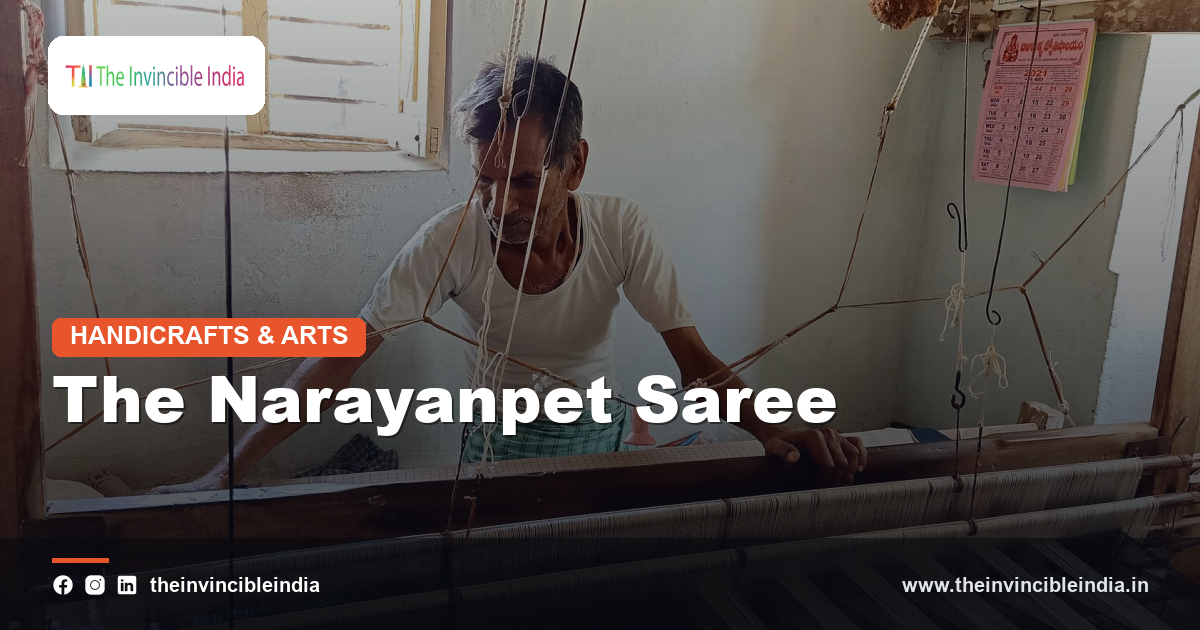
The Narayanpet saree is a handwoven textile associated with the town of Narayanpet in Telangana, a region long known for producing sarees of cotton and silk-cotton that combine comfort, durability, and understated beauty. Woven on traditional looms by households that have practised the craft across generations, these sarees are recognised for their clean colour blocking, temple-inspired borders, and carefully finished pallus. Unlike the highly ornate brocades of northern India, the Narayanpet weave favours a quieter elegance that suits both daily wear and festive occasions. It belongs to the same broad family of Deccan handlooms as the Gadwal saree, sharing a regional weaving heritage while retaining a character of its own. This guide explores the history, materials, techniques, design vocabulary, and living traditions of this admired Telangana textile.
Quick Facts
| Detail | Information |
|---|---|
| Region | Narayanpet, Telangana |
| Fabric | Cotton and silk-cotton |
| Production | Handloom weaving |
| Signature Feature | Bold contrast borders and pallu |
| Common Designs | Checks, stripes, and temple-style borders |
| Best Suited For | Everyday and festive wear |
Origins in Narayanpet
The Narayanpet saree takes its name from the town of Narayanpet, situated in the southern Deccan region of Telangana. The town developed as a centre of handloom weaving over many generations, with families of weavers settling in and around it and passing their craft from parent to child. Like many regional textile traditions, its exact beginnings are difficult to trace, and it is best understood as the outcome of a long, gradual growth of local skill.
Over time the name of the town became a byword for a particular kind of saree, one that was practical, handsome, and affordable. This association between place and cloth is a hallmark of Indian handlooms, and it explains why the Narayanpet saree continues to be identified so closely with the town that gave it its name.
Geography and Weaving Landscape
Narayanpet lies in the southern part of Telangana, in a landscape of dry plains that lies close to the border with Karnataka. This position at a cultural crossroads has long encouraged the exchange of ideas, and the textiles of the wider region show the influence of neighbouring weaving communities while remaining distinct in their finish and character.
The warm and often dry climate is well suited to cotton, the fibre that forms the foundation of many Deccan handlooms. Light and breathable, cotton cloth responds well to the heat of the region, and this practical relationship between climate and clothing helped shape the identity of the local saree as a comfortable garment made for real life rather than for display alone.
A Living Handloom Tradition
Handloom weaving in Narayanpet is a household craft in the truest sense. Looms are commonly set up within or beside the family home, and members of the household share the many tasks that precede and follow the actual weaving, from preparing yarn to finishing the cloth. This close link between home and workshop gives the craft a strong social character.
Skills are traditionally learned by watching and helping from childhood, so that knowledge of pattern, tension, and rhythm passes naturally across generations. Such continuity is one of the most valuable aspects of the tradition, because much of the expertise involved is practical and physical, held in the hands and memory of the weaver rather than recorded in writing, and it survives only as long as it is practised.
Cotton and Silk-Cotton Fabrics
The Narayanpet saree is best known in cotton and silk-cotton forms. Pure cotton versions offer a soft, airy drape that is comfortable across long days, while silk-cotton blends add a subtle sheen and a little extra body to the fabric, making them suitable for festive and ceremonial wear.
In many silk-cotton sarees the body of the cloth is woven in cotton while silk is used to give richness to the border or pallu, allowing weavers to balance cost, comfort, and visual appeal. This thoughtful combination of fibres reflects a practical design philosophy: the saree should look refined without becoming heavy, and it should remain wearable in a warm climate. The result is a textile that is respected for its balance of elegance and everyday usefulness.
Preparing and Dyeing the Yarn
Before any weaving begins, the yarn must be prepared with care. It is cleaned, sized, and arranged so that it can withstand the tension of the loom, and it is dyed in the colours that will define the finished saree. Colour planning is an important skill, as the placement of contrasting shades is central to the appearance of the Narayanpet style.
Weavers commonly work with strong, clear colours, and they pay close attention to how one shade will sit beside another once the cloth is complete. Dyed yarn is dried, wound onto bobbins, and organised for the warp and weft in advance. This preparatory stage is time-consuming, yet it is essential to the quality of the final fabric, since even tension and reliable colour depend upon it.
The Weaving Process
Weaving a Narayanpet saree involves setting up a long warp on the loom and then passing the weft through it, row by row, with the steady rhythm of hand and foot. The weaver controls the pattern by managing the way threads are raised and lowered, and even simple stripes or checks demand concentration to keep the lines straight over many metres of cloth.
Borders and pallus require additional planning, because they are woven to a different scheme from the body of the saree and must join it cleanly. A skilled weaver keeps the edges even and the density consistent throughout, so that the finished fabric hangs correctly when draped. The slow pace of handloom work is precisely what gives each saree its individual character.
Signature Borders and Pallu
The most recognisable feature of the Narayanpet saree is its treatment of the border and pallu. Borders are often broad and boldly coloured, set in clear contrast to the body so that the edges of the saree stand out when it is draped. Some carry a temple-inspired stepped outline, a motif widely used in southern Indian weaving.
The pallu, the decorative end piece that falls over the shoulder, is typically woven with bands or blocks of colour that echo the border, giving the whole garment a unified appearance. This emphasis on strong edges and a well-composed end piece allows the saree to look striking without excessive ornament, and it is one of the principal ways in which admirers recognise the tradition.
Colours, Checks, and Stripes
Narayanpet sarees are often woven in checks and stripes, geometric patterns that are formed simply by alternating coloured threads in warp and weft. These designs may appear plain, but they require precise planning to keep proportions balanced across the width and length of the cloth.
The colour palette ranges from deep and earthy tones to brighter shades, and the interplay between the body colour and the contrasting border is central to the overall effect. A well-judged combination can make a modest cotton saree look distinguished. Because the geometry is woven into the cloth rather than printed upon it, the pattern is visible on both sides and remains crisp through repeated washing, which adds to the long-term value of the garment.
Motifs and Design Vocabulary
The design language of the Narayanpet saree is restrained and geometric rather than densely figurative. Woven motifs, where they appear, tend to be small and arranged with discipline, often forming repeated bands along the border or in the pallu. Stepped outlines, small repeating shapes, and linear divisions make up much of the vocabulary.
This restraint is a deliberate aesthetic rather than a limitation. It allows the colour and the quality of the weave to take centre stage, and it gives the saree a timeless quality that does not depend on passing fashion. Many wearers value precisely this quiet confidence, which makes the garment adaptable to a wide range of occasions and personal tastes.
Neighbouring Deccan Weaves
Narayanpet belongs to a wider cluster of handloom traditions in the Deccan. The Gadwal saree is another well-regarded weave of the region, known for its combination of cotton body and silk border, while the Pochampally ikat tradition of Telangana is celebrated for its resist-dyed geometric patterns.
Each of these traditions has its own techniques and visual identity, yet they share a foundation of skilled household weaving and a preference for durable, comfortable cloth. Comparing them helps to show how a single region can nurture several distinct textile languages, and it places the Narayanpet saree within a rich and varied tradition of Telangana handlooms rather than in isolation.
Weaver Households and Skill Transmission
The strength of the Narayanpet tradition lies in its weaving households. Within these families, work is divided in ways that draw on the abilities of many members, from winding bobbins and preparing the warp to operating the loom and finishing the cloth. Every stage matters to the quality of the outcome.
Learning within the family also passes down a sense of standards, the shared understanding of what a well-made saree should feel and look like. This informal system of training has sustained the craft for generations and continues to be vital today. Supporting weaver households therefore means supporting not only individual livelihoods but also the living transmission of a body of specialised knowledge that would be hard to rebuild once lost.
Draping and Occasions
The Narayanpet saree is admired for the ease with which it drapes. Cotton and silk-cotton fabrics fall softly and hold pleats well, and the firm body of the cloth makes the saree comfortable to wear for long periods. Its contrast border draws attention to the folds and the fall of the pallu.
Simpler cotton versions are popular for daily use, workplaces, and cultural gatherings, while silk-cotton pieces with richer borders are often chosen for festivals and family celebrations. The versatility of the garment is a major part of its appeal, since a single well-chosen saree can move gracefully between quiet everyday settings and more formal events without appearing out of place.
Care and Storage
Handwoven cotton and silk-cotton sarees reward gentle care. Washing them in cool water with a mild detergent helps preserve both the colour and the texture of the yarn, and drying them in shade prevents the fading that strong sunlight can cause. Silk-cotton pieces benefit from particularly careful handling.
When storing the saree, folding it loosely and changing the fold lines from time to time helps to prevent the fabric from weakening along creases. Keeping it wrapped in a breathable cloth protects it from dust and moisture. With this kind of attention, a Narayanpet saree can remain in good condition for many years, and it often grows softer and more comfortable with age.
Identifying an Authentic Handloom Piece
Buyers who wish to choose a genuine handloom saree can look for several general signs. Handwoven cloth often shows small natural variations in the weave that machine-made fabric lacks, and the pattern is woven into the structure of the cloth rather than printed on its surface, so it appears clearly on the reverse side as well.
The feel of the fabric, the neatness of the border join, and the evenness of the edges also offer clues. Purchasing from weaver cooperatives, recognised handloom outlets, or directly from weaving households helps to ensure authenticity and to direct payment to the artisans themselves. Informed buying is one of the most practical ways in which admirers can sustain the tradition.
Challenges Facing Handloom Weavers
Like handloom communities across India, the weavers of Narayanpet face pressure from cheaper machine-made imitations, which can copy the general appearance of a handloom saree at much lower cost. This competition makes it difficult for many weavers to earn a fair return for their time and skill.
Rising costs of yarn and other materials, along with the attraction of other forms of employment for younger family members, add further strain. These challenges do not diminish the value of the craft, but they highlight the importance of public awareness and fair markets. Recognising the difference between handwoven and machine-made cloth is the first step towards ensuring that the tradition is valued appropriately.
Support, Recognition, and Revival
Government bodies, cooperatives, and design organisations have made efforts across India to support handloom communities through training, market access, and awareness campaigns, and the weavers of Telangana have been part of this broader movement. National Handloom Day, observed each year, draws public attention to the role of weavers in India’s cultural life.
Collaborations between designers and artisans have also introduced traditional cloth to new audiences, encouraging fresh colour combinations while respecting established techniques. When such partnerships are fair and respectful, they can strengthen the craft economically without diluting its identity. Sustained interest from informed buyers remains the most dependable foundation for a lasting revival of the Narayanpet weaving tradition.
The Narayanpet Saree Today
Today the Narayanpet saree stands as a quiet but confident representative of Telangana’s handloom heritage. Its honest fabric, bold borders, and balanced colour schemes continue to appeal to those who value comfort and craftsmanship over ornament, and it remains a familiar presence in homes across the region and beyond.
Its survival depends on the continued skill of its weavers and the understanding of those who wear it. Each saree carries within it the patience of a household, the rhythm of a loom, and the cultural memory of a place. Appreciating that story is the surest way to keep the tradition alive for the generations still to come.
Sources & Further Reading
- Ministry of Textiles, Government of India (texmin.nic.in).
- Ministry of Culture, Government of India (indiaculture.gov.in).
Frequently Asked Questions
What is a Narayanpet saree?
A Narayanpet saree is a handwoven saree from the Narayanpet region of Telangana, usually made in cotton or silk-cotton. It is known for bold contrast borders, checks and stripes, and a comfortable, understated look.
What fabrics are used in Narayanpet sarees?
The sarees are commonly woven in pure cotton and in silk-cotton blends. In blended pieces the body is often cotton while silk adds richness to the border or pallu.
How does the Narayanpet saree differ from the Gadwal saree?
Both are Deccan handlooms and share regional weaving traditions, but each has its own visual character. Narayanpet sarees are noted for their strong border colours and simple geometric patterns, while Gadwal sarees are especially known for their distinctive cotton and silk construction.
How should a Narayanpet saree be cared for?
It should be washed gently in cool water with a mild detergent and dried in shade to protect the colour. Storing it loosely folded in a breathable cloth helps preserve the fabric.
How can one identify an authentic handloom Narayanpet saree?
Look for small natural irregularities, a pattern woven into the cloth rather than printed, and a neat border join. Buying from cooperatives or directly from weaving households is the most reliable way to ensure authenticity.


