

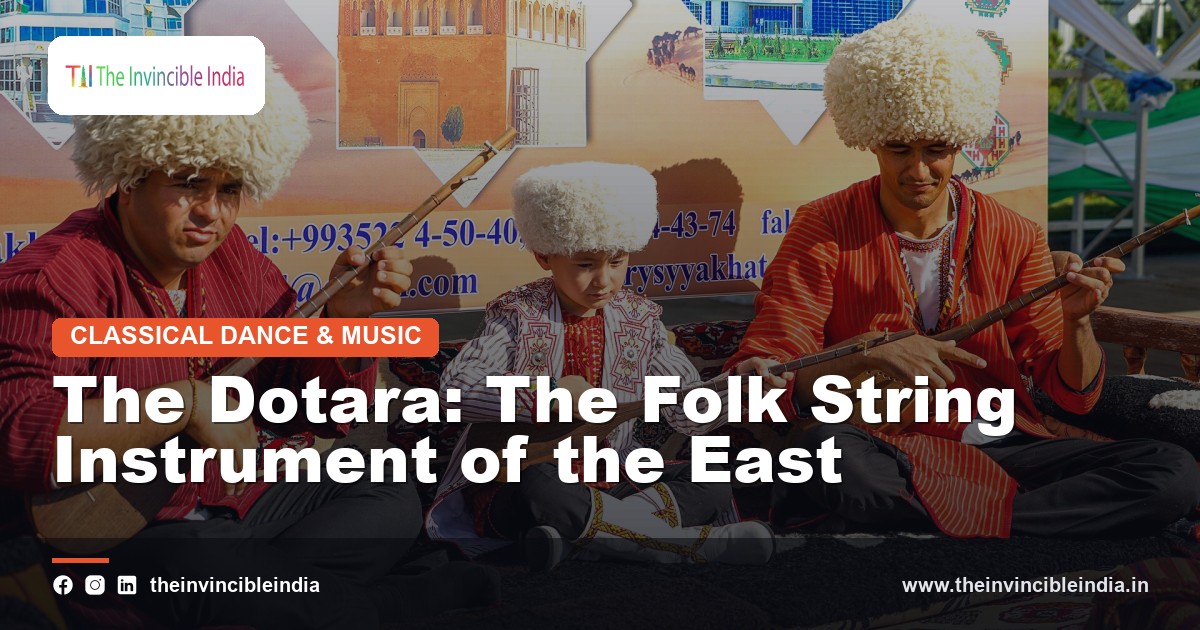
The dotara is one of the most recognisable folk string instruments of eastern India, a plucked lute that has accompanied village singers of Bengal, Assam and the neighbouring regions for generations. Its name is commonly understood to refer to two strings, although the instrument appears in several forms across the region. Closely associated with wandering minstrels and devotional folk song, it carries a warm, earthy voice that supports the singer rather than overshadowing the words. The instrument sits comfortably beside the mystic songs of the Bauls and many other regional traditions, forming a living thread in the musical heritage of the East. This guide explores its structure, playing style, repertoire and lasting cultural meaning.
Quick Facts
| Detail | Information |
|---|---|
| Type | Plucked folk lute |
| Region | Bengal, Assam, eastern India |
| Name meaning | Commonly read as two strings |
| Played with | Fingers or a small plectrum |
| Role | Accompanies folk song |
| Associated with | Baul and regional folk traditions |
What Is the Dotara?
The dotara is a plucked string instrument belonging to the folk traditions of eastern India. It is a long-necked lute, with a resonating body, a neck carrying tuning pegs, and strings stretched along its length. The name is generally explained as a combination of words meaning two and string, although the instrument as actually built and played in different regions may vary in the number and arrangement of its strings. What remains constant is its role as a companion to the human voice.
Unlike concert instruments designed for elaborate solo display, the dotara belongs to the world of village gatherings, pilgrimage routes, fairs and devotional assemblies. Its sound is direct and unadorned, suited to supporting melody and rhythm for songs that carry stories, prayers and reflections. In this sense the dotara is best understood as a voice of the people, rooted in everyday musical life.
Origins and Regional Roots
The precise origins of the dotara are not documented in a way that allows firm claims, and scholars generally describe it as an old folk instrument that developed gradually within the musical life of the eastern plains. Lutes of many kinds have been part of the wider Indian subcontinent for a very long time, and the dotara belongs to this broad family of plucked stringed instruments. Its regional home is the land of the Ganga and Brahmaputra river systems, where folk song has flourished for centuries.
Because it spread through oral tradition rather than written treatises, the dotara developed local variations from one district to another. Craftsmen and musicians adapted its form to the materials at hand and the needs of local singing styles. The result is an instrument that feels both widely shared and intimately local, a hallmark of genuine folk heritage.
Structure and Construction
A traditional dotara has a hollow wooden body, a long neck, and a head that holds the tuning pegs. The belly of the resonator is usually covered with a stretched skin, which helps project the sound of the strings. The neck is fitted with a bridge arrangement and the strings run from the pegs down to an anchoring point near the base of the body. The general layout reflects the simplicity and practicality typical of folk instrument making.
Makers have traditionally worked with locally available woods and materials, shaping the body and neck by hand. Decorative touches, such as carved patterns or painted details, sometimes appear, reflecting the pride of the maker and the preferences of the owner. The construction is sturdy and portable, suited to musicians who travel on foot from village to village, and this practical design is central to the instrument identity.
Strings and Tuning
The strings of the dotara are traditionally of metal, tuned to support the tonal centre of the song being performed. Although the name points to a pair of strings, players and makers have long used different arrangements, and the exact setup depends on regional habit and personal preference. The strings are generally tuned so that they produce a steady drone or a simple melodic support beneath the singing voice.
Tuning on a folk instrument tends to be flexible, adjusted by ear to match the pitch that suits the singer. This practical approach contrasts with the fixed reference pitches sometimes used in concert settings. The instrument thus adapts to the performer rather than the other way round, allowing the voice to lead and the strings to follow, which is exactly what the tradition expects.
How the Dotara Is Played
The dotara is played by plucking or strumming the strings with the fingers or a small plectrum while the other hand frets or presses the strings along the neck. The player often holds the instrument close to the body, sometimes standing, sometimes seated, and sometimes moving in rhythm with the song. The playing style is rhythmic and supportive, alternating between simple melodic phrases and steady strummed patterns.
Much of the skill lies not in technical complexity but in feel, timing and the ability to respond to the singer. A good dotara player understands when to fill a pause, when to hold back, and how to lift the energy of a refrain. The instrument thus teaches a kind of musical listening, where accompaniment serves the meaning of the song above all else.
The Sound and Tonal Character
The sound of the dotara is often described as warm, resonant and slightly rustic. Because the strings are plucked and the body resonates through a skin-covered belly, the tone has a natural, organic quality with a gentle twang. It does not aim for polished brilliance but for directness, a sound that carries across an open courtyard or a river bank without amplification.
This tonal character suits the emotional range of folk song, from joyful celebration to quiet longing. The steady drone-like support of the strings gives the melody a grounded feeling, while rhythmic strumming adds lightness and movement. The result is a sound that listeners immediately recognise as belonging to the countryside of the East, tied to memory, landscape and community.
The Dotara and Baul Music
One of the best known associations of the dotara is with the Bauls of Bengal, the wandering mystic minstrels whose songs express spiritual searching, love and humanity in simple, poetic language. The dotara often appears alongside other humble instruments, such as the single-stringed ektara and small drums, in the solo or small-group performances typical of this tradition. The instrument gives the singer a melodic and rhythmic anchor while leaving the words in the foreground.
This partnership reflects the Baul outlook itself, where the instrument is an extension of the body and the song a form of devotion. The dotara is not treated as an object of display but as a tool for expression, carried from place to place and played wherever listeners gather. In the Baul world, it stands for simplicity, freedom and direct feeling.
Other Folk Traditions Using the Dotara
Beyond Baul song, the dotara features in a wide range of regional folk forms across eastern India. In Bengal, it supports boatmen songs, devotional pieces and village ballads. In Assam and neighbouring areas, instruments of the dotara type accompany local folk songs, including forms associated with the river regions and with rural communities. Each tradition shapes its own repertoire and playing manner while drawing on the shared character of the instrument.
The adaptability of the dotara explains its wide reach. It can accompany solo singers or small groups, blend with drums and percussion, and suit occasions ranging from religious gatherings to seasonal festivities. This flexibility has allowed it to remain a living part of several distinct musical cultures, each of which treats it as its own.
Songs and Repertoire
The repertoire associated with the dotara is broad and varied, reflecting the many communities that have used it. Songs of devotion, philosophical reflection, love, work, rivers and village life all find a place in its accompaniments. The lyrics are typically in regional languages and dialects, expressing ideas in imagery drawn from everyday experience such as boats, fields, birds and the human body.
Many of these songs have been passed down orally, memorised and adapted by successive singers. The melody is often simple and repetitive, which makes it easy for listeners to join in, while the verses carry depth of meaning. The dotara supports this structure with a steady pulse and melodic colour, helping to carry the tradition from one generation to the next.
Rhythm and Accompaniment Style
Rhythm is central to the way the dotara is used. Although it is a stringed instrument, it frequently acts as a rhythmic partner to the voice, marking the beat with strummed patterns and short melodic figures. In ensembles, it works together with hand percussion, small cymbals and drums, each instrument contributing a layer to the overall texture.
The accompaniment style emphasises a clear, lively pulse that invites listeners to sway, clap or sing along. Rather than complex improvisation, the focus is on groove and support. This makes the dotara a community instrument, one that draws people into participation and helps songs feel shared rather than merely performed before an audience.
The Craft of the Instrument Maker
Behind every dotara is the work of a craftsman who understands wood, skin and string. Instrument making in folk traditions is often a family or community skill, learned through watching and practising rather than formal schooling. The maker selects suitable wood, shapes the body and neck, prepares the skin for the resonator, and fits the pegs and strings with care.
The process demands patience and a trained ear, because small differences in shape and thickness influence the sound. Many makers also repair instruments for local musicians, keeping a network of practical knowledge alive. The craft is therefore an important, though often overlooked, part of the heritage, linking the quiet work of the workshop to the public voice of the performer.
Symbolism and Cultural Meaning
In the cultural imagination of eastern India, the dotara represents simplicity, devotion and the voice of the common person. It is associated with wandering singers who own little but carry a rich store of song, and with the idea that wisdom can be expressed in humble language. The instrument has become an emblem of rural creativity and spiritual openness.
This symbolism appears in literature, painting and popular culture, where a figure with a dotara often stands for the folk poet or the seeker. The instrument thus carries meaning beyond sound, evoking a whole way of life centred on song, community and shared feeling. Its image is a reminder of how music can express deep ideas without elaborate means.
The Dotara Compared with Related Instruments
The dotara is best understood in the company of other Indian folk instruments. The single-stringed ektara is simpler still, offering a basic drone, while the dotara allows for slightly richer melodic and rhythmic support. Drums such as the dholak and the khol supply the percussive side of folk ensembles, and together these instruments create the characteristic texture of rural music in the East.
Compared with classical stringed instruments, the dotara is less concerned with elaborate scale exploration and more with direct accompaniment. This difference reflects the distinct purposes of folk and classical traditions rather than any ranking between them. Each has its own standards of excellence, and the dotara meets the standards of the folk world fully.
Learning and Transmission
Traditionally, the dotara is learned through close contact with an experienced musician, often within a family or a community of singers. A learner listens, imitates and gradually absorbs the patterns of accompaniment, along with the songs themselves. This oral method of transmission places great emphasis on memory, ear training and personal relationship between teacher and student.
In recent times, some musicians and cultural organisations have also documented the instrument and offered workshops, helping new learners approach it. Even so, the heart of the tradition remains in listening and practice rather than written notation. This living method of teaching keeps the instrument connected to the communities that created it and maintains the spontaneity of folk performance.
Preservation and Contemporary Relevance
Like many folk traditions, the dotara faces the challenges of a changing world, including shifting tastes, new forms of media and the movement of young people away from villages. At the same time, folk festivals, cultural programmes and the interest of musicians and listeners have kept it visible. Institutions devoted to the arts and heritage of India work to recognise and support such living traditions.
Contemporary artists have also brought the dotara into new settings, using it alongside other instruments in fusion and stage performances while respecting its folk character. This renewed attention shows that the instrument still speaks to modern audiences. Preservation, in this sense, means both honouring the old ways and allowing the tradition room to breathe.
The Dotara Today
The dotara continues to be played in villages, at fairs, in devotional gatherings and on cultural stages across eastern India. Its gentle, earthy sound remains a recognisable marker of regional identity, and its place beside the voice of the folk singer is as natural today as it has long been. For many listeners, hearing the dotara is an immediate link to the landscape and song of Bengal, Assam and the wider region.
As an emblem of simplicity and expressive depth, the instrument offers a useful lesson in how heritage survives, not through grand monuments but through ordinary hands and voices. The dotara endures because people still sing, and as long as songs are shared, this modest string instrument will remain a cherished part of the living culture of the East.
Sources & Further Reading
- Sangeet Natak Akademi, Government of India (sangeetnatak.gov.in).
- Ministry of Culture, Government of India (indiaculture.gov.in).
Frequently Asked Questions
What is a dotara?
The dotara is a plucked folk string instrument of eastern India, with a long neck and a hollow resonating body. It is used mainly to accompany folk and devotional songs in Bengal, Assam and nearby regions.
What does the name dotara mean?
The name is commonly understood as a combination of words for two and string. However, the instrument appears in different forms across regions, and the exact number and arrangement of strings can vary.
How is the dotara played?
It is played by plucking or strumming the strings with the fingers or a small plectrum while the other hand presses the strings along the neck. The style is rhythmic and supportive, designed to follow the singer.
Which music traditions use the dotara?
The dotara is associated with Baul music and with many regional folk forms of Bengal, Assam and neighbouring areas. It accompanies devotional songs, village ballads and other community music.
How does the dotara differ from the ektara?
The ektara is a single-stringed instrument that mainly provides a drone. The dotara allows somewhat richer melodic and rhythmic accompaniment, although both are humble folk instruments closely tied to song.


