

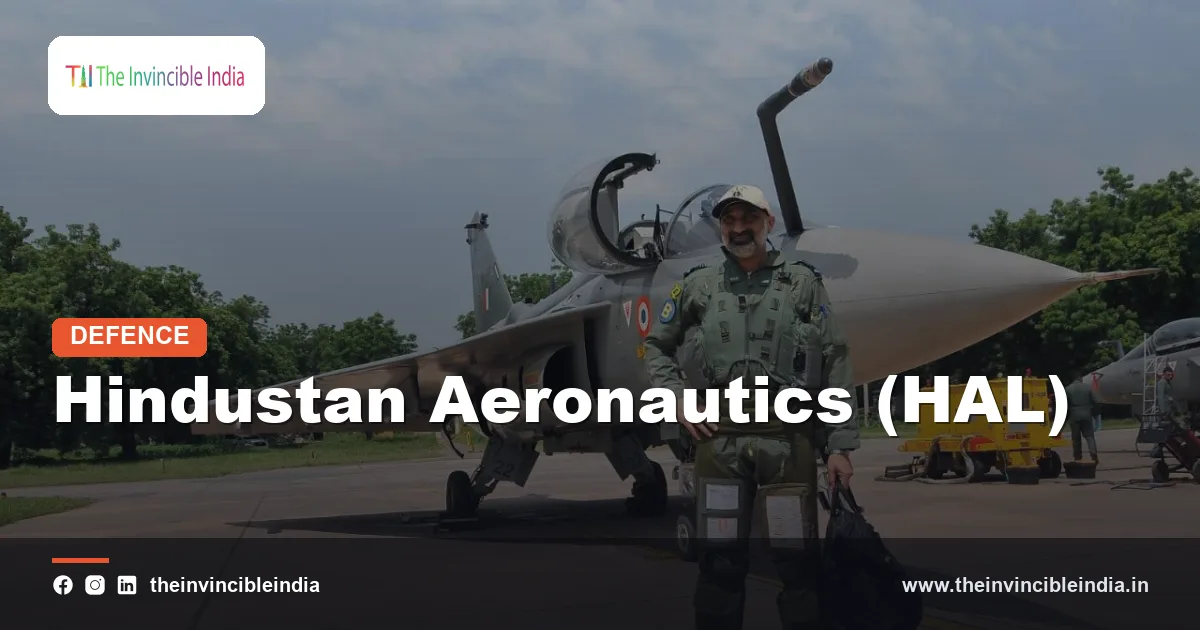
Hindustan Aeronautics Limited, universally shortened to HAL, is India’s flagship state-owned aerospace and defence company. Headquartered in Bengaluru, it designs, builds, repairs and upgrades the fighter jets, helicopters, trainers, engines and avionics that keep the Indian armed forces in the air. For more than eight decades, the story of Hindustan Aeronautics has run in parallel with the story of Indian military aviation itself.
From assembling American and British aircraft during the Second World War to rolling out the indigenous Tejas fighter and the Prachand combat helicopter, HAL has travelled from a small workshop idea to a sprawling industrial network. This explainer covers its history, what it does, the aircraft it builds, its corporate status, the criticisms it faces and its role in the drive for self-reliance in defence.
Quick Facts
| Fact | Detail |
|---|---|
| Founded | 23 December 1940, as Hindustan Aircraft Limited, Bengaluru |
| Founder | Industrialist Walchand Hirachand, with the support of the Mysore government |
| Present name | Hindustan Aeronautics Limited, since 1964 |
| Headquarters | Bengaluru, Karnataka |
| Ownership | Government of India, under the Ministry of Defence |
| Corporate status | Maharatna central public sector enterprise (CPSE) |
| Stock market listing | Initial public offering in 2018 (NSE and BSE) |
| Signature products | Tejas, Dhruv, Prachand, Su-30MKI (under licence), Dornier 228, HTT-40 |
| Operations | Manufacturing and overhaul divisions across several Indian states |
History: From Hindustan Aircraft to HAL
The 1940 founding
The company began as Hindustan Aircraft Limited, set up on 23 December 1940 in Bangalore (now Bengaluru) by the industrialist Walchand Hirachand. Walchand, who had already built ventures in shipping and construction, believed that India needed its own aircraft industry. The princely state of Mysore backed the project by supporting the choice of Bangalore and helping with land and facilities. Within a short time the Government of India became a shareholder, and in the early 1940s it took over the company as the war made aviation capacity strategically vital.
The Second World War years
During the war, the Bangalore factory assembled and repaired aircraft for the Allied effort in the region. It handled types such as the Harlow trainer, the Curtiss Hawk and the Vultee Vengeance, and carried out overhaul work on American aircraft operating in the theatre. This gave the young company a base of skilled workers, tooling and discipline that would shape its later growth.
Independence and consolidation
After 1947, Hindustan Aircraft became a key supplier to the new Indian Air Force. It started licence production of the de Havilland Vampire jet, built the HT-2 basic trainer (an early indigenous design), and later developed light aircraft such as the Pushpak and the Krishak. In 1964, Hindustan Aircraft merged with Aeronautics India Limited and the Aircraft Manufacturing Depot at Kanpur, and the combined entity took the name Hindustan Aeronautics Limited.
Milestones at a glance
| Period | Milestone |
|---|---|
| 1940 | Hindustan Aircraft Limited founded in Bangalore |
| Early 1940s | Government of India becomes shareholder and then takes control |
| 1950s | Licence production of Vampire jets; HT-2 trainer |
| 1961 onwards | HF-24 Marut, India’s first indigenous fighter, flies and enters service later in the decade |
| 1964 | Merger creates Hindustan Aeronautics Limited |
| 1960s-80s | Licence production of MiG series aircraft and the Jaguar |
| 1990s | Dhruv helicopter and early Tejas development |
| 2000s | Su-30MKI licence production begins at Nashik |
| 2018 | Stock market listing through an IPO |
| 2022 | Light Combat Helicopter Prachand inducted into the IAF |
What Hindustan Aeronautics Does
HAL is best understood as an integrated aerospace company with four broad activities. Each draws on a different set of skills, and together they explain why the company employs a large workforce of engineers and technicians across the country.
- Design and development: HAL has its own design centres and research units, including a dedicated aircraft design bureau and a rotary wing research and design centre in Bengaluru.
- Manufacture: It builds aircraft, helicopters, aero-engines, avionics, accessories and structures, both under licence and to indigenous designs.
- Maintenance, repair and overhaul (MRO): Much of India’s military fleet, from fighters to transport aircraft and helicopters, is serviced and overhauled at HAL facilities.
- Upgrades: HAL modernises older aircraft with new radars, mission computers and weapons, extending their service lives.
A network of divisions
The company runs separate divisions, each with its own specialisation. Bengaluru hosts the aircraft, helicopter, engine and overhaul divisions, while Nashik is associated with MiG and Sukhoi production. Kanpur has long been linked with transport aircraft such as the Dornier, Koraput with engine manufacture, and Hyderabad, Korwa and Lucknow with avionics and accessories. Barrackpore handles repair and overhaul work in the east. This spread also makes HAL an important industrial presence in several regions.
Customers
The Indian Air Force, Army, Navy and Coast Guard are the main customers, along with paramilitary and state police forces that use helicopters. HAL also serves civil operators and a limited number of foreign buyers.
Licence-Built Aircraft: Learning by Building
For decades, the most reliable route for India to acquire advanced aircraft was licence production. Under such agreements, a foreign designer transfers drawings, tooling and training, and HAL assembles and eventually manufactures the aircraft locally. This approach gave India’s engineers a deep grounding in modern manufacturing.
The MiG series
From the 1960s, HAL produced several MiG types under licence from the Soviet Union, including the MiG-21 in its various versions and later the MiG-27. The MiG-21 line in particular became one of the longest-running production programmes in Indian aviation and trained generations of workers. HAL also carried out major upgrade programmes on the MiG-21, extending its relevance well beyond its original expected life.
Jaguar, Hawk and Dornier
The Anglo-French Jaguar strike aircraft was assembled and later built in India under licence, and HAL continues to support it with upgrades. The BAE Hawk advanced jet trainer, produced under licence at Bengaluru, became the backbone of IAF advanced pilot training. The German-designed Dornier 228 light transport, built at Kanpur, serves the armed forces and some civil and foreign users.
The Su-30MKI
Perhaps the most significant licence programme is the Sukhoi Su-30MKI, a heavy twin-engine multirole fighter developed by Russia with Indian specifications. Under an agreement signed around 2000, HAL began licensed production at Nashik in the early 2000s. The Su-30MKI has since become the mainstay of the IAF’s fighter fleet, and HAL has progressively raised the share of locally made components in it.
Indigenous Fixed-Wing Designs: From Marut to Tejas
The HF-24 Marut
The HF-24 Marut was India’s first indigenously produced fighter-bomber. Designed under the leadership of the German aerodynamicist Kurt Tank, who had come to India to lead the project, it first flew in 1961 and entered service in the late 1960s. Held back by the lack of a suitably powerful engine, it was not a large commercial success, yet it proved that India could design and build a supersonic combat aircraft. It remains an important symbol of early self-reliance.
The Tejas Light Combat Aircraft
The Tejas Light Combat Aircraft (LCA) is the best-known modern indigenous programme. Its design and development is led by the Aeronautical Development Agency (ADA) with HAL as the principal production partner. The first technology demonstrator flew in January 2001, and the IAF inducted its first Tejas aircraft in 2016. The aircraft is a lightweight, single-engine, delta-wing fighter built with extensive use of composite materials, a fly-by-wire flight control system and modern avionics.
- The Tejas Mk1 achieved operational clearance after a long testing period.
- The upgraded Tejas Mk1A, with improved radar, electronic warfare and maintainability, forms the bulk of current orders.
- A Navy variant and trainer versions have also been developed.
HAL has expanded its production lines in Bengaluru and Nashik to raise output, though the pace of deliveries has remained a subject of public discussion.
Helicopters: Dhruv, Prachand and Beyond
Helicopters are arguably the area where HAL has made its strongest indigenous mark. The company has built helicopters since the 1960s, starting with licensed versions of the French Alouette III, which became the Chetak and the Cheetah, and the Lancer variants.
Dhruv Advanced Light Helicopter
The Dhruv, a twin-engine multirole helicopter of about 5.5 tonnes, first flew in the early 1990s and entered service in the early 2000s. It serves the Army, Air Force, Navy and Coast Guard in transport, utility, search and rescue and armed roles. A civil version operates with state governments and commercial users, and some units have been exported to friendly countries. The Sarang helicopter display team, flying Dhruv helicopters, is a familiar sight at air shows.
Light Combat Helicopter Prachand
The Light Combat Helicopter (LCH), named Prachand, is a dedicated attack helicopter designed to operate at high altitudes, a capability prized on the northern borders. It was formally inducted into the IAF in October 2022 at Jodhpur. It carries a gun, rockets and air-to-air and anti-tank missiles, and has an armoured, stealth-conscious design.
Light Utility Helicopter
The single-engine Light Utility Helicopter (LUH) is meant to replace the ageing Chetak and Cheetah fleets, particularly for high-altitude reconnaissance, rescue and casualty evacuation. Together with the Indian Multi-Role Helicopter plans and the Dhruv family, it shows HAL’s aim to cover most helicopter classes from within India.
Trainers and Future Programmes
HTT-40 basic trainer
The HTT-40 is a turboprop basic trainer designed to replace the ageing HPT-32 Deepak, whose training role ended after safety concerns. Pilots take their first steps on such an aircraft before progressing to jet trainers. The HTT-40 represents a rare case of HAL designing a trainer from scratch in the modern era and has been ordered for the IAF.
HLFT-42 and advanced projects
HAL has worked on the HLFT-42, a concept for a Hindustan Lead-in Fighter Trainer, aimed at bridging the gap between trainers and frontline fighters. It has also been deeply involved in the broader push towards next-generation platforms, including a role in the Advanced Medium Combat Aircraft (AMCA), a fifth-generation stealth fighter programme led by the ADA. The final production arrangements for AMCA, including how industry partners are chosen, have been a subject of policy evolution.
Other efforts
The company has also developed the Intermediate Jet Trainer concept, the HJT-36 Sitara, and has explored unmanned and combat support platforms. Such programmes show a strategy of building capability across the entire pilot and aircraft pipeline.
Engines, Avionics and Space
Aero-engines
Engines are the hardest part of any aviation industry. HAL manufactures engines under licence, such as the Adour for the Jaguar and Hawk, and the AL-31FP for the Su-30MKI, at its engine facilities. It has also co-developed the Shakti engine with the French firm Safran for the Dhruv. For fighters, the picture is more challenging: the indigenous Kaveri engine, developed by the Gas Turbine Research Establishment (GTRE) of the DRDO, struggled to reach the thrust needed for the Tejas. The Tejas therefore flies on General Electric engines, and the Kaveri’s technology has been explored for other uses, including derivative variants for unmanned platforms. Efforts to partner foreign engine makers continue.
Avionics and accessories
HAL’s avionics divisions in Hyderabad and Korwa produce mission computers, radars, communication gear, navigation equipment and electronic warfare systems. Accessories complexes make hydraulic, mechanical and electrical components. These form a crucial but less visible part of its work.
Space structures
HAL has contributed to the Indian space programme for decades. It has fabricated structures for launch vehicles of the Indian Space Research Organisation (ISRO), including propellant tanks and other airframe-like assemblies, and has built satellite structural components. This link shows how aerospace manufacturing skills carry over between aircraft and rockets.
Civil Aviation, MRO and Services
Although HAL is mainly known for military work, it also has a civil footprint. The Dornier 228 and Dhruv have civil versions, and HAL supports regional connectivity ideas through small transport aircraft. It also provides MRO for a variety of aircraft and helicopters used by public and private operators.
Why MRO matters
A fighter jet spends a significant part of its life in scheduled servicing. MRO ensures that aircraft stay airworthy, that spare parts are available and that fleets can be kept ready. In-country MRO saves foreign exchange and avoids dependence on overseas workshops during crises. HAL’s overhaul divisions handle airframes, engines and components of Russian, British, French and indigenous origin.
Training and support
HAL also offers technical training, simulators and product support. Such after-sales services make up a steady part of its revenue and are especially important for long-lived platforms like the Su-30MKI.
Maharatna Status, IPO and Corporate Structure
HAL is a central public sector enterprise under the Ministry of Defence. It was granted Navratna status in the mid-2000s, and it has since been elevated to the higher Maharatna category, which gives a company greater financial autonomy to invest and form joint ventures. Maharatna status is reserved for a small group of large and profitable public sector firms.
The 2018 IPO
In March 2018, the Government of India took HAL public through an initial public offering, with shares listed on the National Stock Exchange and the Bombay Stock Exchange. The government retained a large majority holding, so HAL remains firmly under public control. The listing increased transparency and subjected the company to market disclosure norms.
Order book and finances
HAL’s finances are typically described as healthy, supported by a large and long-term order book from the armed forces. Because a large portion of its business is repeat servicing and long production runs, its revenue is fairly stable year to year. Exact figures change annually and are best checked in the company’s latest annual report.
Key HAL Products at a Glance
| Product | Type | Origin | Main user |
|---|---|---|---|
| Tejas (Mk1, Mk1A) | Light combat aircraft | Indigenous (ADA-HAL) | Indian Air Force |
| Su-30MKI | Heavy multirole fighter | Licence from Russia | Indian Air Force |
| Jaguar | Deep-strike aircraft | Licence (UK-France) | Indian Air Force |
| Hawk Mk132 | Advanced jet trainer | Licence from the UK | IAF and Navy |
| Dornier 228 | Light transport | Licence from Germany | Armed forces and civil users |
| HTT-40 | Basic trainer | Indigenous | Indian Air Force |
| Dhruv ALH | Multirole helicopter | Indigenous | Army, Air Force, Navy, Coast Guard |
| LCH Prachand | Attack helicopter | Indigenous | Air Force and Army |
| LUH | Light utility helicopter | Indigenous | Army and Air Force |
| HF-24 Marut | Fighter-bomber (retired) | Indigenous, historical | Formerly the IAF |
Criticisms and Challenges
Like many large public sector enterprises, HAL has drawn both pride and criticism. Understanding these concerns is part of understanding its role.
Delays and capacity
The most common criticism concerns timelines. Development of programmes such as the Tejas took many years, and delivery schedules for new aircraft have at times slipped. Senior air force officials have publicly voiced concern over the pace of deliveries and the need for greater production capacity, which has also been raised in reports by audit and parliamentary bodies. HAL has responded by expanding production lines, adding a second Tejas line and increasing reliance on supply chain partners.
Quality and dependence
Questions have occasionally been raised about quality assurance, and about the share of imported components in some indigenous designs. Dependence on foreign engines is the best-known example. Supporters note that complex aircraft always involve global supply chains and that HAL’s indigenous content has been growing.
The Rafale offset debate
HAL features in a long-running discussion over the Rafale fighter acquisition. Under the original plan to buy 126 medium multirole combat aircraft, HAL was expected to build most of them under licence, but negotiations with the manufacturer, Dassault Aviation, did not conclude. Later, India signed a government-to-government agreement for 36 Rafale jets in flyaway condition, with offset obligations to be discharged through Indian partners. Political parties and commentators differed on the role given to HAL versus private firms, and the matter was examined by the Supreme Court. This article presents the issue only as part of HAL’s history and takes no side.
Private Sector, Exports and Aatmanirbhar Bharat
Opening the sector
Defence aerospace in India was long dominated by public sector units. In recent years, policy has shifted to involve private companies and start-ups through measures such as raising foreign direct investment limits, publishing lists of items to be sourced domestically, creating defence industrial corridors and supporting innovation through schemes like iDEX. Private firms now build airframe parts, sub-assemblies and entire programmes, such as the C-295 transport aircraft assembly line announced with Airbus in Vadodara. HAL increasingly acts as an anchor and integrator, working with hundreds of small and medium suppliers.
Exports
HAL has exported helicopters, Dornier aircraft, spares and services to a number of friendly nations, and the government has set ambitious export targets for the defence sector. Tejas has attracted interest from several countries, and HAL promotes its helicopters for roles such as disaster relief and coastal patrol.
Why it matters
Under the national vision of Aatmanirbhar Bharat (self-reliant India), defence production is a pillar. HAL’s ability to design, produce and sustain combat aircraft reduces import dependence, protects supply during conflicts and builds high-technology jobs. For this reason, HAL is seen not just as a company but as a strategic asset.
Conclusion
Hindustan Aeronautics has grown from a wartime assembly workshop into the centre of India’s military aviation ecosystem. Its record includes licensed production of foreign aircraft, early indigenous designs like the Marut and modern achievements such as the Tejas, Dhruv and Prachand. Challenges remain in speed, engine technology and competition from a rising private sector, but its scale, skills and institutional memory are hard to replace. How well HAL adapts will shape the future of Indian aviation.
Frequently Asked Questions
When was HAL founded and by whom?
HAL began as Hindustan Aircraft Limited on 23 December 1940 in Bangalore, founded by the industrialist Walchand Hirachand with support from the Mysore government. The Government of India soon became a shareholder and then took control. The company was renamed Hindustan Aeronautics Limited in 1964 after a merger with other aviation entities.
What does Hindustan Aeronautics Limited make?
HAL makes and maintains fighter aircraft, trainers, transport aircraft, helicopters, aero-engines, avionics and aircraft accessories. Its best-known products include the Tejas fighter, the Dhruv and Prachand helicopters, and Su-30MKI jets built under licence. It also makes structures for the space programme and offers MRO services.
Is HAL a government company?
Yes. HAL is a central public sector enterprise under the Ministry of Defence and holds Maharatna status. It was listed on stock exchanges through an IPO in 2018, but the Government of India retains a large majority stake.
Is the Tejas made entirely by HAL?
No. The Tejas was designed and developed under the Aeronautical Development Agency, with HAL as the main production partner and many other laboratories and companies contributing. It uses a foreign-made engine, though a large share of its systems are domestic.
What is the Kaveri engine and what is HAL’s role?
The Kaveri is an indigenous jet engine developed by the DRDO’s Gas Turbine Research Establishment. It did not reach the thrust required for the Tejas, so imported engines are used instead. HAL builds engines under licence and helps with engine manufacture and support in India.
Why is HAL important for Aatmanirbhar Bharat?
HAL is the main Indian company able to produce and sustain complex combat aircraft and helicopters. This reduces import dependence and builds domestic skills and supply chains. It also works with private firms to widen the national defence industrial base.
{“@context”:”https://schema.org”,”@graph”:[{“@type”:”FAQPage”,”mainEntity”:[{“@type”:”Question”,”name”:”When was HAL founded and by whom?”,”acceptedAnswer”:{“@type”:”Answer”,”text”:”HAL began as Hindustan Aircraft Limited on 23 December 1940 in Bangalore, founded by the industrialist Walchand Hirachand with support from the Mysore government. The Government of India soon became a shareholder and then took control. The company was renamed Hindustan Aeronautics Limited in 1964 after a merger with other aviation entities.”}},{“@type”:”Question”,”name”:”What does Hindustan Aeronautics Limited make?”,”acceptedAnswer”:{“@type”:”Answer”,”text”:”HAL makes and maintains fighter aircraft, trainers, transport aircraft, helicopters, aero-engines, avionics and aircraft accessories. Its best-known products include the Tejas fighter, the Dhruv and Prachand helicopters, and Su-30MKI jets built under licence. It also makes structures for the space programme and offers MRO services.”}},{“@type”:”Question”,”name”:”Is HAL a government company?”,”acceptedAnswer”:{“@type”:”Answer”,”text”:”Yes. HAL is a central public sector enterprise under the Ministry of Defence and holds Maharatna status. It was listed on stock exchanges through an IPO in 2018, but the Government of India retains a large majority stake.”}},{“@type”:”Question”,”name”:”Is the Tejas made entirely by HAL?”,”acceptedAnswer”:{“@type”:”Answer”,”text”:”No. The Tejas was designed and developed under the Aeronautical Development Agency, with HAL as the main production partner and many other laboratories and companies contributing. It uses a foreign-made engine, though a large share of its systems are domestic.”}},{“@type”:”Question”,”name”:”What is the Kaveri engine and what is HAL’s role?”,”acceptedAnswer”:{“@type”:”Answer”,”text”:”The Kaveri is an indigenous jet engine developed by the DRDO’s Gas Turbine Research Establishment. It did not reach the thrust required for the Tejas, so imported engines are used instead. HAL builds engines under licence and helps with engine manufacture and support in India.”}},{“@type”:”Question”,”name”:”Why is HAL important for Aatmanirbhar Bharat?”,”acceptedAnswer”:{“@type”:”Answer”,”text”:”HAL is the main Indian company able to produce and sustain complex combat aircraft and helicopters. This reduces import dependence and builds domestic skills and supply chains. It also works with private firms to widen the national defence industrial base.”}}]}]}


