

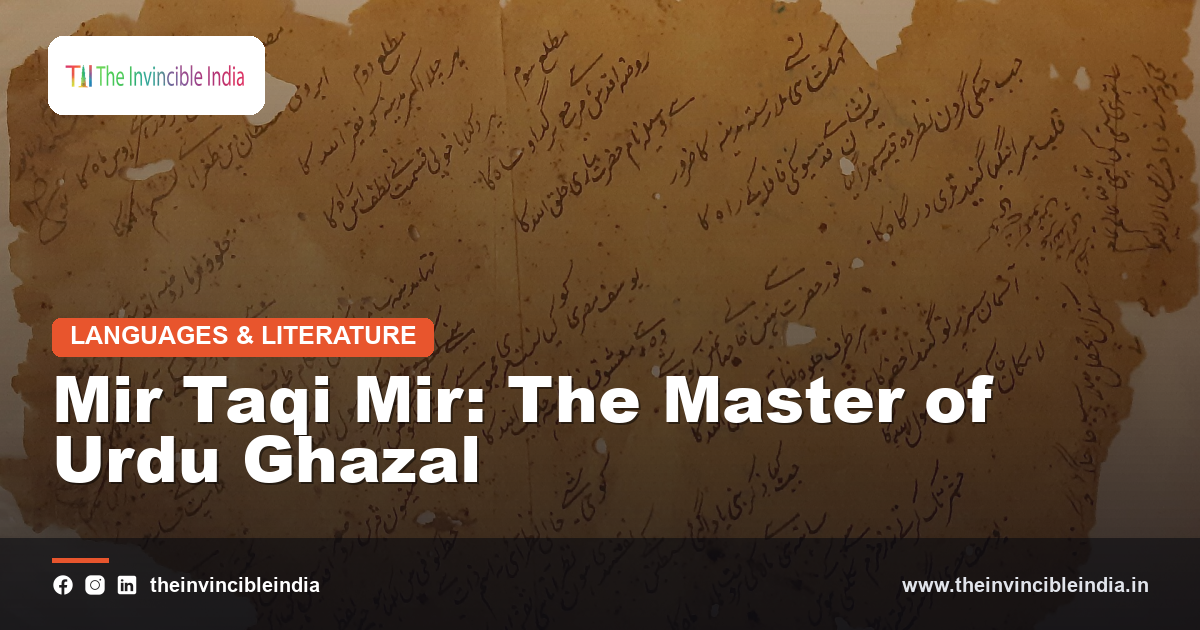
Mir Taqi Mir is widely regarded as one of the towering figures of classical Urdu poetry, a master whose ghazals gave the young language a voice of unmatched tenderness and depth. Living in the eighteenth century, a period of great political upheaval in northern India, he turned personal grief and the sorrows of a changing world into verse of striking simplicity. Admired by later poets and critics alike, he is often honoured with the title Khuda-e-Sukhan, the god of poetry. His work forms a cornerstone of Urdu literature, and his couplets continue to be recited, studied, and loved across the subcontinent today.
Quick Facts
| Detail | Information |
|---|---|
| Known As | Mir Taqi Mir, master of the Urdu ghazal |
| Era | Eighteenth century |
| Cities Associated | Agra, Delhi, and Lucknow |
| Honorific | Khuda-e-Sukhan (god of poetry) |
| Major Work | Six collected volumes of poetry |
| Signature Quality | Plain language, deep sorrow, musical rhythm |
Who Was Mir Taqi Mir?
Mir Taqi Mir was an eighteenth-century poet who is celebrated as one of the greatest masters of the Urdu ghazal. He belonged to the formative age of the language, when Urdu, then often called Rekhta, was still finding its literary form and gaining acceptance as a medium worthy of serious poetry.
Mir played a decisive part in that process. His verse showed that everyday speech, handled with sensitivity and discipline, could carry the weight of profound emotion and philosophical reflection. Because of this achievement, later generations came to see him as a founding presence in Urdu poetry, a poet against whom subsequent masters measured their own work. His name remains synonymous with the ghazal at its most intimate and moving.
The World of Eighteenth-Century North India
Mir lived through a turbulent era in northern India, when the authority of the Mughal court weakened and cities such as Delhi suffered repeated disruption. The old political order was visibly fading, and with it the settled life of many noble families, scholars, and artists who had depended on court patronage.
This atmosphere of loss and uncertainty shaped the mood of much poetry composed in the period, and Mir’s work is often read as an expression of it. The sense of a world slipping away gives his verse an emotional undertone that readers still recognise. His poems therefore speak at once of private heartbreak and of a wider civilisation passing through a time of profound change.
Early Life and Poetic Beginnings
Mir is traditionally said to have been born in Agra and to have received his early education in a household where religious and spiritual ideas were taken seriously. Accounts of his childhood describe a sensitive young man shaped by loss and by exposure to Sufi thought, themes that would colour his poetry throughout his life.
He later made his way to Delhi, then the great centre of literary activity, where he entered the circle of poets who were developing Rekhta as a refined literary language. There he learned the craft of the ghazal and began to compose the verse that would establish his reputation. His formative years thus combined personal sorrow, spiritual influence, and immersion in a thriving literary culture.
Delhi and the Literary Circles of the Age
Delhi in Mir’s time was a city of poetic gatherings, where poets read their verses before appreciative audiences and where reputations were made through the quality of a single couplet. The practice of mushaira, the formal poetic assembly, was already an important part of literary life.
Within this lively environment, Mir came into contact with contemporaries who were refining the language and debating questions of style and idiom. He absorbed the best of this tradition while developing a voice that remained unmistakably his own. The literary culture of Delhi gave him an audience, a community of fellow poets, and a standard of excellence that sharpened his art, even as the city itself faced mounting hardship.
Move to Lucknow and Nawabi Patronage
As conditions in Delhi worsened, many poets and scholars sought refuge and support elsewhere, and Mir eventually moved to Lucknow, the cultured capital of the Nawabs of Awadh. Lucknow had become a flourishing centre of the arts, offering patronage to poets, musicians, and craftsmen.
Mir received support in this new setting and spent the later part of his life there. Accounts suggest that he sometimes felt out of place amid the more ornate and fashionable literary taste of Lucknow, and his manner remained rooted in the simplicity of Delhi. Even so, his years in Lucknow were productive, and the city holds an honoured place in the story of his life and legacy.
The Ghazal and Its Traditions
The ghazal is a poetic form made up of independent couplets, each of which usually expresses a complete thought, bound together by a shared rhyme scheme and refrain. It developed within the wider Persianate literary world and became the most beloved form of Urdu poetry.
Traditionally the ghazal explores love, longing, separation, and the mystery of existence, often through a rich set of conventional images such as the beloved, the lover, the nightingale, and the wine cup. Within this framework, poets achieve distinction through freshness of thought and perfection of expression. Mir mastered the form so completely that his name became inseparable from its highest aspirations, and his ghazals set a standard for the genre.
Language, Simplicity, and Musical Quality
One of the most admired features of Mir’s poetry is its plain, natural language. Rather than relying on elaborate ornamentation or heavy Persian vocabulary, he drew on the speech of ordinary conversation and shaped it with extraordinary delicacy.
This simplicity is deceptive, for behind the apparently effortless lines lie careful control of rhythm and a keen ear for sound. Many of his couplets move with a natural musicality that makes them easy to remember and recite. He favoured shorter metres that lend his verse a flowing, conversational quality. The result is poetry that feels immediate and personal, speaking directly to the reader while carrying considerable emotional and intellectual depth.
Sorrow, Love, and Emotional Depth
Mir is often called the poet of sorrow, and a deep sense of pain and melancholy runs through his work. His verse speaks of unfulfilled love, the transience of life, and the loneliness of the human heart with remarkable honesty.
Yet his sadness is not merely despair. It carries dignity, self-awareness, and at times a quiet irony, as though the poet were observing his own suffering with gentle detachment. This blend of feeling and restraint gives his ghazals a universal quality that has allowed readers of many generations to find their own experiences reflected in his lines. His mastery lies in making private grief resonate as shared human emotion.
Sufi Influences and Philosophical Reflection
Alongside human love, Mir’s poetry often hints at spiritual themes shaped by the Sufi tradition, in which earthly longing can point toward a deeper yearning for the divine. The language of the ghazal naturally allows such double meanings, and Mir used them with subtlety.
His verses reflect on the fragility of worldly ambition, the impermanence of beauty, and the search for meaning in a changing world. These reflections are woven into the fabric of his couplets rather than stated as doctrine, so that spiritual and emotional experience seem to flow together. This layered quality is part of why his poetry rewards repeated reading and has been interpreted in many ways over the centuries.
The Six Divans and His Collected Poetry
Mir’s poetry has come down to us in a substantial body of work gathered into six volumes, known as divans, which together are often referred to as his collected poetry. These volumes contain ghazals along with poems in other traditional forms.
The scale of this output is itself a measure of his dedication to his art, and the collection offers readers a broad view of his imagination across different stages of life. Scholars and lovers of poetry have long treated the six divans as a central text of classical Urdu literature. Through them, the full range of Mir’s voice, from tender lyricism to bitter reflection, has been preserved for later generations to study and enjoy.
Prose Works and the Autobiography
Besides his poetry, Mir is known for prose writings composed in Persian, the learned language of the time. These include a biographical anthology of poets, which records the work and character of the Urdu poets of his era, and an autobiographical account of his own life.
The anthology is valued by historians of literature as a contemporary record of the poetic world in which Mir moved, preserving judgments and impressions of fellow poets. The autobiography offers glimpses of the personality behind the verse, revealing a proud and sensitive man. Together, these prose works complement his poetry and give scholars a fuller understanding of both the poet and the literary culture of his age.
Personality and Reputation
Traditional accounts describe Mir as a man of great pride and a fiercely guarded sense of dignity, qualities that sometimes made his relations with patrons and fellow poets difficult. Many anecdotes, passed down through the literary tradition, portray him as sensitive and unwilling to compromise his self-respect.
While some of these stories may have been embellished over time, they contribute to the enduring image of Mir as a poet of uncompromising integrity, devoted to his art above worldly advantage. This reputation for independence and seriousness has become part of his legend, shaping how readers imagine the person behind the poetry and adding human colour to the study of his work.
Influence on Later Poets
Mir’s impact on subsequent Urdu poetry has been immense. Later masters, including some of the most celebrated names of the nineteenth century, openly acknowledged his greatness and treated his achievement as a benchmark for the ghazal.
His emphasis on emotional truth, natural diction, and musical flow shaped the expectations of generations of poets who followed. Even poets who developed very different styles, more intellectual or more ornate, remained conscious of the standard he had set. In this way Mir functioned as a kind of foundation stone for the tradition, and the respect shown to him by other poets is itself a testament to his lasting authority in Urdu letters.
Mir in Relation to Ghalib and the Classical Canon
Mir is frequently discussed alongside Mirza Ghalib, who lived in a later generation and is another giant of Urdu poetry. The two are often contrasted, Mir for his emotional directness and simplicity, Ghalib for his intellectual complexity and philosophical daring.
Ghalib himself is known to have paid tribute to Mir, an acknowledgment that illustrates the esteem in which the older poet was held. Together with other major figures, they form the core of the classical Urdu canon. Studying Mir alongside Ghalib reveals the remarkable range of the ghazal tradition, which could accommodate both the plain-spoken lyric and the richly layered meditation within a single literary heritage.
Mir in Music, Recitation, and Performance
The ghazal has always been a form meant for the ear as much as the page, and Mir’s naturally musical couplets have long been recited at gatherings and sung by accomplished vocalists. The tradition of ghazal singing in India and Pakistan has frequently turned to the classical poets for its texts.
His lines have been set to music in various styles, and their simple diction makes them especially suited to performance, since audiences can follow the words easily and feel the emotion immediately. Through recitation and song, Mir’s poetry has reached listeners far beyond the circle of scholars, ensuring that his voice remains a living presence in the shared musical and literary life of the subcontinent.
Reading Mir in Translation and Today
Because Mir’s verse depends so heavily on sound, idiom, and the conventions of the ghazal, it poses real challenges for translators. Nevertheless, many readers first encounter him through translations into English and other languages, which can convey the clarity of his imagery even if the music is partly lost.
For those new to classical Urdu poetry, Mir offers an accessible starting point, since his language is direct and his emotions are universal. Reading him in the original, or alongside a careful translation with explanatory notes, allows a fuller appreciation of his craft. His poetry rewards patience and returns generous insight to readers willing to approach it with attention to its context.
Mir Taqi Mir in Indian Culture
Mir occupies an important place in the cultural memory of the subcontinent, representing the moment when Urdu poetry first reached full maturity. His work is a reminder of the shared literary heritage that grew from the meeting of Persian, Indian, and regional linguistic traditions in northern India.
Within India’s many languages, Urdu stands out for its lyrical richness, and Mir is one of the central figures through whom that richness is understood. His verse is studied in schools and universities, quoted in everyday speech, and honoured in literary events, showing how deeply a poet of the eighteenth century continues to shape the cultural imagination.
Mir Taqi Mir Today
More than two centuries after his time, Mir Taqi Mir remains one of the most respected names in Urdu poetry. His ghazals continue to be read, recited, sung, and studied, and his title as the god of poetry reflects the reverence in which he is held.
His enduring appeal lies in the union of simplicity and depth, of personal sorrow and universal feeling, that he achieved so naturally. For readers, students, and lovers of language, Mir offers both a window into a vanished age and a companion for the emotions that every generation experiences. His poetry stands as a lasting monument within the rich literary heritage of India.
Sources & Further Reading
- Sahitya Akademi (sahitya-akademi.gov.in).
- Ministry of Culture, Government of India (indiaculture.gov.in).
Frequently Asked Questions
Who was Mir Taqi Mir?
Mir Taqi Mir was an eighteenth-century Urdu poet regarded as one of the greatest masters of the ghazal. He is often called Khuda-e-Sukhan, meaning the god of poetry, in recognition of his towering reputation.
What is Mir Taqi Mir best known for?
He is best known for his ghazals, which express love, sorrow, and loneliness in plain, musical language. His poetry is gathered in six volumes known as divans, and it set a standard for later Urdu poets.
Which cities were important in Mir's life?
Mir is traditionally associated with Agra, where he was born, Delhi, where he developed as a poet, and Lucknow, where he found patronage in his later years. Each city shaped a different stage of his life and work.
Why is Mir called the poet of sorrow?
A deep sense of pain, loss, and melancholy runs through much of his verse, reflecting both personal grief and the turbulence of his age. His sadness is expressed with dignity and restraint, which gives it lasting emotional power.
How is Mir related to Ghalib?
Ghalib belonged to a later generation and is another major Urdu poet. He is known to have acknowledged Mir’s greatness, and the two are often compared as masters of different styles within the classical ghazal tradition.


