

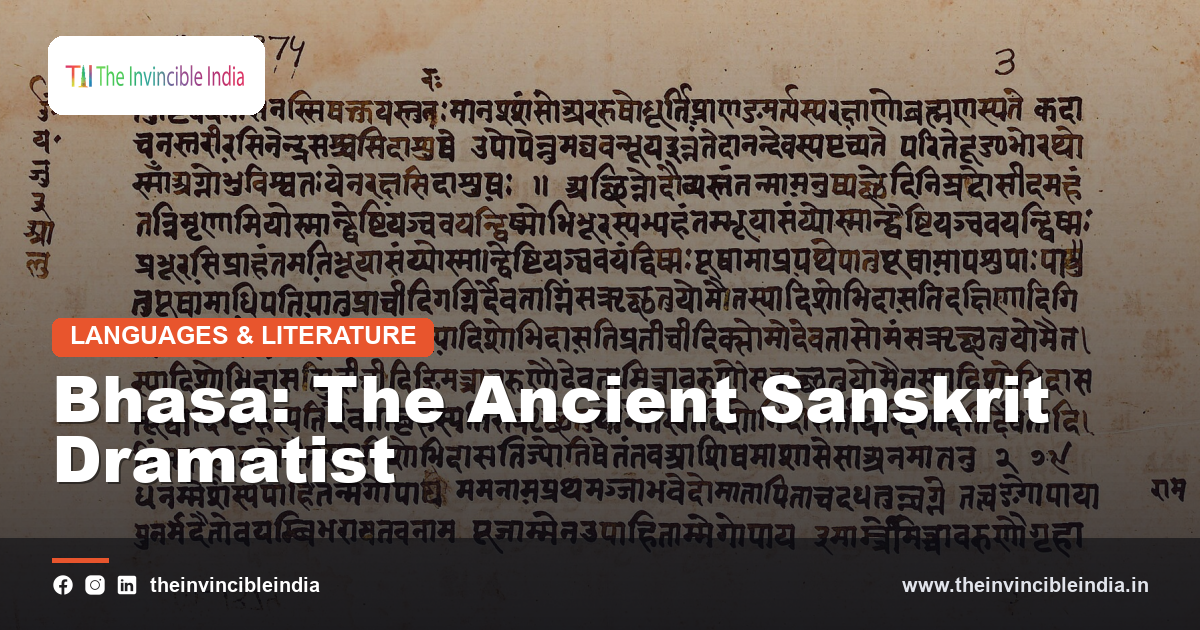
Bhasa is one of the earliest and most celebrated dramatists of classical Sanskrit literature, a playwright whose works stand near the origins of the Indian theatrical tradition. Although much about his life remains uncertain, later poets spoke of him with deep respect, and a remarkable collection of plays attributed to him came to light in the early twentieth century. His dramas draw on the great epics and on legends of kings, blending heroic themes with human feeling and dramatic economy. Bhasa stands beside Kalidasa as a pillar of Sanskrit theatre, and his legacy continues to live on in the stage traditions of Kerala.
Quick Facts
| Detail | Information |
|---|---|
| Known As | Bhasa, ancient Sanskrit dramatist |
| Period | Ancient era, placed before Kalidasa |
| Plays Attributed | Thirteen plays |
| Best-Known Work | Svapnavasavadatta |
| Rediscovery | Manuscripts found in Kerala, early twentieth century |
| Living Legacy | Kutiyattam performance tradition |
Who Was Bhasa?
Bhasa was an ancient Indian playwright who wrote in Sanskrit and is counted among the earliest great dramatists of that tradition. He belongs to an era so distant that reliable personal details are scarce, and much of what is said about him rests on tradition, on references by later authors, and on the plays themselves.
What is clear is that later writers regarded him as a master worthy of lasting honour. His dramas are valued for their clarity, their strong storytelling, and their skilful handling of emotion. Although his biography remains largely hidden, his body of work offers a vivid portrait of the dramatic imagination of ancient India and of its enduring artistic ambitions.
Dating and the Question of Antiquity
Scholars generally place Bhasa earlier than Kalidasa, which makes him one of the oldest known authors of Sanskrit drama. However, assigning a precise date has proved difficult, and opinions differ about exactly when he lived, so it is wiser to speak of his period in broad terms.
This uncertainty is common for ancient Indian authors, whose lives were seldom recorded in the manner of later historical writing. The antiquity of Bhasa’s language, the simplicity of his dramatic construction, and the way later poets praised him all support the view that he belongs to an early stage of the tradition. His place near the beginning of classical Sanskrit theatre is therefore widely accepted, even if the exact date remains open.
Praise from Kalidasa and Later Poets
One of the most important pieces of evidence for Bhasa’s reputation is the respect shown to him by later Sanskrit writers. Kalidasa, in one of his own plays, refers to Bhasa among distinguished earlier dramatists, a recognition that places him firmly in the honoured lineage of the stage.
Other classical authors and critics also spoke of Bhasa admiringly, and for many centuries his name survived in literary memory even though his works were thought lost. This long afterlife of praise shows how highly he was valued by the cultured audiences of ancient and medieval India. The esteem of such poets remains among the strongest testimonies to his stature as a founder of Sanskrit drama.
Lost and Found: The Trivandrum Discovery
For a long period Bhasa was known chiefly by reputation, since his plays were not available to readers. This changed in the early twentieth century, when a scholar working in Kerala identified a group of palm-leaf manuscripts containing Sanskrit plays that had previously been unknown.
The manuscripts included a series of dramas that were later attributed to Bhasa, and the find, associated with the region around Trivandrum, caused great excitement among students of Sanskrit. It restored to the literary world a body of work that had been lost for centuries. The discovery stands as one of the notable events in the modern study of Sanskrit literature and renewed interest in ancient Indian drama.
The Thirteen Plays
The plays discovered in Kerala number thirteen, and they are commonly grouped under Bhasa’s name. They include dramas based on the Ramayana, the Mahabharata, and the legends of the royal houses, as well as plays that appear to draw on popular tales and on stories about the young Krishna.
Among the titles usually mentioned are Svapnavasavadatta, Pratijnayaugandharayana, Charudatta, Avimaraka, Balacharita, Urubhanga, and Karnabhara. Although they differ in subject, the plays share a recognisable style, marked by directness and dramatic concentration. Together they form a remarkable group, offering a rare opportunity to see how Sanskrit drama looked in its early stages.
Svapnavasavadatta: His Most Admired Play
Svapnavasavadatta, whose title is usually rendered as the dream of Vasavadatta, is generally considered Bhasa’s most admired play. It concerns King Udayana, his beloved queen Vasavadatta, and the political circumstances that separate them, and it unfolds with a gentle blend of romance, loyalty, and statecraft.
The play is celebrated for its tender emotion and its carefully shaped scenes, including a moment of dreamlike encounter that gives the drama its name. Critics have long praised its balance of feeling and restraint. As a result, Svapnavasavadatta is often the first work recommended to those who wish to understand Bhasa’s artistry, and it is frequently cited as a high point of early Sanskrit theatre.
Plays from the Ramayana
Several of Bhasa’s plays take their stories from the Ramayana, the great epic of Rama, one of the most beloved narratives in Indian culture. Works such as Pratima and Abhisheka retell episodes from the epic in dramatic form, giving the familiar tale new theatrical life.
By adapting the epic for the stage, Bhasa selected key moments and shaped them for performance, emphasising loyalty, duty, and the conflicts of the characters. This treatment shows how Sanskrit dramatists drew on shared cultural stories while exercising creative choices. Readers interested in the larger tradition can explore the Ramayana to see the source from which these dramas grew.
Plays from the Mahabharata
Bhasa also drew inspiration from the Mahabharata, the vast epic of the Kuru dynasty. Plays such as Madhyamavyayoga, Dutavakya, Dutaghatotkacha, Karnabhara, Urubhanga, and Pancharatra present episodes and characters from this epic in compact, powerful dramatic form.
Many of these works are short, concentrating on a single moment of crisis or decision rather than on the whole sweep of the story. This approach allows deep exploration of character, whether a warrior facing duty, a father meeting a son, or a hero confronting fate. The Mahabharata plays demonstrate Bhasa’s ability to find intense human drama within epic material and to present it with striking economy.
Dramatic Technique and Style
Bhasa’s style is often described as simple, vigorous, and direct. His language avoids excessive ornament, and his plots move with clarity, giving his plays a freshness that distinguishes them from the more elaborate manner of later Sanskrit drama.
He shows a sure sense of stagecraft, shaping scenes for effective performance and building emotion through dialogue and situation rather than through lengthy description. His verses are graceful but unforced. These qualities make his plays accessible to modern readers and have led many scholars to admire his command of the theatre. His technique reveals an early dramatic art that was already confident, balanced, and attentive to the needs of the stage.
Characters and Human Emotion
A distinctive strength of Bhasa’s drama is its sympathy for human feeling. Kings, queens, warriors, and ordinary people appear in his plays as figures with real emotions, torn between love and duty, loyalty and ambition, honour and sorrow.
Even characters who might be seen as villains in the epic tradition are sometimes treated with understanding, and heroes are shown in moments of vulnerability. This humane vision gives the plays a depth that goes beyond simple retelling of legend. The balance of heroic action and personal emotion is one of the qualities that has secured Bhasa’s reputation and made his work resonate across the centuries.
The Question of Authorship
Because the Trivandrum manuscripts did not name their author in a straightforward way, scholars have debated whether all thirteen plays truly come from a single hand. Many accept that they are the work of Bhasa, noticing common features of style, structure, and dramatic convention across the group.
Others have raised questions about attribution, and the discussion has continued in academic circles for many years. Such debates are normal in the study of ancient texts, and they do not diminish the value of the plays themselves. Whatever conclusions scholars reach, the thirteen dramas remain an invaluable body of early Sanskrit theatre that deserves careful study and appreciation.
Bhasa and the Sanskrit Theatre Tradition
Sanskrit drama developed within a rich theoretical framework, with classical treatises describing the structure of plays, the art of acting, and the aesthetic experience known as rasa. Bhasa’s works are valuable because they show practical dramatic art in an early form.
His plays sometimes depart from the later conventions codified by theorists, which suggests that the rules of Sanskrit drama were still developing in his time. They therefore help scholars understand how the tradition evolved. Studying Bhasa alongside the later masters provides a fuller picture of Sanskrit theatre, from its early directness to its more refined and ornate expressions in the works of later dramatists.
Kutiyattam and the Living Legacy in Kerala
Bhasa’s plays are not only objects of scholarly study but also part of a living performance tradition. In Kerala, the ancient Sanskrit theatre form known as Kutiyattam has long presented his works, preserved by hereditary performing communities who carry forward the art through generations.
Kutiyattam is recognised as one of the oldest continuing theatrical traditions, performed in temple theatres with elaborate gesture, expressive facial acting, and slow, deliberate pacing. Its association with Bhasa’s dramas helps explain why his works survived in the region and why the manuscripts were found there. This performance heritage keeps the ancient plays alive on the stage rather than only on the page.
Why Bhasa Matters in Indian Literature
Bhasa matters because he connects the modern reader directly to the earliest phase of Sanskrit drama, a period otherwise known mainly through theory and later examples. His plays show how the great epics were transformed into theatre and how dramatists balanced story, emotion, and spectacle.
They also reveal the breadth of the ancient literary imagination, which could treat heroic myth, courtly romance, and popular legend with equal skill. By restoring Bhasa’s work to view, the discovery of his plays enriched the understanding of Sanskrit literature as a whole. His writing remains a vital link in the long chain of Indian dramatic creativity.
Reading and Studying Bhasa Today
Students and general readers can approach Bhasa through translations and commentaries, which make the plays accessible without requiring knowledge of Sanskrit. Short plays such as those drawn from the Mahabharata are often good starting points, since their concentrated form is easy to follow.
Universities and cultural institutions in India and abroad include his works in the study of classical literature and theatre, and directors have occasionally staged adaptations for contemporary audiences. Engaging with Bhasa, whether through reading or performance, offers insight into the foundations of Indian drama and the enduring power of stories that have been told and retold across many centuries.
Bhasa Today
Today Bhasa is remembered as a founding figure of Sanskrit drama, a playwright whose works were lost for centuries and then restored to the world. His thirteen plays, drawn from epic and legend, continue to be read, translated, and performed.
His influence lives on in scholarship, in the classical literary canon, and above all in the Kutiyattam tradition of Kerala, where his dramas still find an audience. For anyone exploring the literary heritage of India, Bhasa offers a rewarding encounter with the earliest voices of the Indian stage, and his legacy stands as an enduring tribute to the creativity of the ancient world.
Sources & Further Reading
- Ministry of Culture, Government of India (indiaculture.gov.in).
- Sangeet Natak Akademi (sangeetnatak.gov.in).
Frequently Asked Questions
Who was Bhasa?
Bhasa was an ancient Indian playwright who wrote in Sanskrit and is counted among the earliest great dramatists of the tradition. Little is known about his life, but later poets such as Kalidasa spoke of him with respect.
How many plays are attributed to Bhasa?
Thirteen plays are commonly attributed to Bhasa. They were identified in manuscripts found in Kerala in the early twentieth century, and they draw on the Ramayana, the Mahabharata, and popular legends.
What is Bhasa's best-known play?
Svapnavasavadatta is generally regarded as his most admired work. It tells of King Udayana and Queen Vasavadatta and is praised for its tender emotion and graceful construction.
When did Bhasa live?
Scholars place Bhasa earlier than Kalidasa, but the exact period remains uncertain, as is common for ancient Indian authors. It is therefore safest to describe him as belonging to the early phase of Sanskrit drama.
How is Bhasa connected to Kutiyattam?
Kutiyattam is a traditional Sanskrit theatre form of Kerala that has long presented plays attributed to Bhasa. This performance tradition helped preserve his works and keeps them alive on the stage today.


