

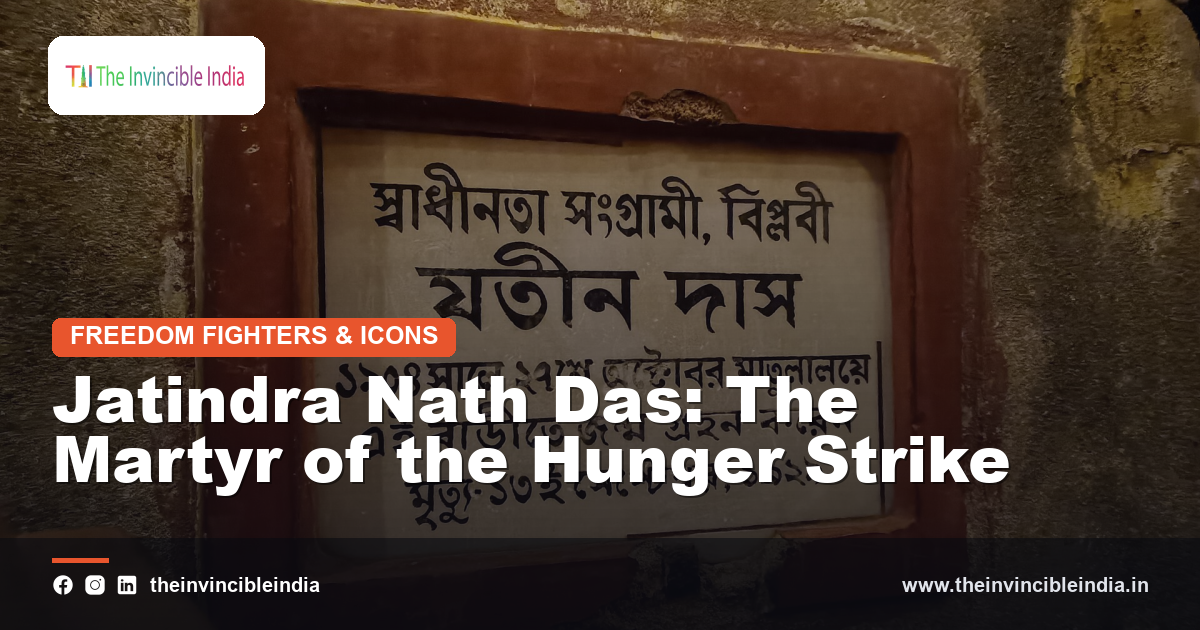
Jatindra Nath Das, affectionately remembered as Jatin Das, occupies a unique place among the martyrs of India’s freedom movement because he gave his life not in an act of violence but through an extraordinary test of endurance. A young revolutionary from Bengal, he was imprisoned in Lahore in connection with the conspiracy case that also involved Bhagat Singh and his comrades, and he joined the prisoners’ fast to demand humane treatment for political detainees. His refusal to yield, even as his body weakened over a very long period, moved the entire country and exposed the harshness of colonial prison conditions. His story remains a powerful lesson in moral courage and sacrifice.
Quick Facts
| Detail | Information |
|---|---|
| Known As | Jatin Das |
| Region | Bengal |
| Movement | Revolutionary nationalism |
| Associated Group | Hindustan Socialist Republican Association |
| Defining Act | Fast unto death in Lahore jail |
| Legacy | Symbol of prisoners’ rights and endurance |
Early Life in Bengal
Jatindra Nath Das was born in Calcutta into a middle-class Bengali family, in a city that was then the intellectual and political heart of colonial India. The atmosphere of Bengal in those years was charged with discussions of reform, patriotism, and resistance to foreign rule, and young people grew up hearing stories of earlier revolutionaries and nationalist thinkers. This environment gave him an early sense of belonging to a larger national cause.
He was known among those who knew him as a quiet, serious, and gentle young man, qualities that stood in striking contrast to the fierce endurance he later displayed. His childhood and schooling laid down habits of discipline and sincerity, and the cultural richness of Bengal nurtured his sensitivity toward the sufferings of ordinary people, a sensitivity that would later translate into sacrifice for the cause of freedom.
Student Days and the Non-Cooperation Call
As a student, Jatin Das responded to the national awakening created by Mahatma Gandhi’s call for non-cooperation with British institutions. Like many young Indians of his generation, he left the comfort of the classroom to take part in political activity, and this early involvement led to his first encounter with imprisonment. The experience of jail at a young age exposed him to the realities of colonial justice and the treatment meted out to those who challenged it.
Although he took part in a mass movement based on nonviolence, the disappointment felt by many young nationalists when the movement was later withdrawn pushed some of them toward more radical paths. For Jatin Das, this period was formative, teaching him resolve and widening his political outlook, and preparing him for the revolutionary associations that would define the next phase of his life.
Turn Toward Revolutionary Organisations
After his early experience of mass politics, Jatin Das gravitated toward the revolutionary groups that were active in Bengal and elsewhere in northern India. These organisations believed that determined action and personal sacrifice could awaken the nation and challenge the confidence of the colonial state. Bengal had a long tradition of such secret societies, and he found among them a spirit of discipline and brotherhood.
Through these connections he came into contact with senior revolutionaries, including Sachindra Nath Sanyal, who played a major role in organising revolutionary activity across provinces. His reliability, calm temperament, and technical aptitude made him a valued member of the network, and he gradually became part of the circle of young men who were rethinking how India’s freedom might be won.
The Hindustan Socialist Republican Association
The Hindustan Socialist Republican Association was a revolutionary body that brought together activists from several regions, and it reflected a new strand of thinking that combined the demand for national freedom with ideas of social and economic justice. Its members included figures such as Bhagat Singh and Chandrashekhar Azad, and it sought to build a secular, egalitarian vision of the future republic.
Jatin Das became associated with this organisation and was regarded as one of its capable workers. His contribution lay less in public speeches than in quiet, practical support, and he was trusted with responsibilities that required skill and reliability. His involvement placed him within a wider generation of revolutionaries who saw freedom as inseparable from dignity and equality for all Indians.
Contribution Behind the Scenes
Historical accounts remember Jatin Das as someone who assisted his comrades with technical and organisational work during the late 1920s. He was asked to help prepare for actions that the organisation considered necessary to draw attention to the nationalist cause, and he carried out this responsibility with seriousness. Such tasks demanded secrecy, trust, and nerve, and the revolutionaries relied on individuals who possessed all three.
His role shows that revolutionary movements depended not only on the figures who became famous for dramatic actions but also on dedicated colleagues who worked patiently in the background. Jatin Das exemplified this kind of selfless service, accepting danger without seeking recognition, and it was this quiet reliability that later made his public sacrifice all the more moving to those who knew him.
Arrest and the Lahore Conspiracy Case
Jatin Das was arrested in connection with the Lahore Conspiracy Case, a major legal proceeding in which the colonial government prosecuted a group of revolutionaries accused of serious offences against the state. The case drew intense public attention because it involved popular young figures whose courage had already captured the imagination of the country.
Following his arrest he was taken to Lahore, far from his home in Bengal, and held as an undertrial prisoner. He had never expected leniency from the authorities, and he faced his confinement with composure. The trial and the conditions of detention soon became intertwined, since the revolutionaries decided to use their imprisonment as an occasion to challenge the way political prisoners were treated, a decision that would set the stage for the hunger strike.
Conditions Faced by Political Prisoners
Under colonial administration, prisoners accused of political offences were often subjected to the same harsh regime as ordinary criminals, while European prisoners received markedly better food, clothing, and facilities. The disparity was both a practical hardship and a deep insult, since it implied that Indian detainees, however principled their motives, were lesser in the eyes of the law.
The revolutionaries in Lahore jail objected to this unequal treatment, which included poor food, inadequate hygiene, and a lack of access to reading material and writing facilities. They argued that those imprisoned for political reasons deserved recognition as a distinct category with basic dignity. These grievances formed the moral core of the protest that followed, and they remain central to how the hunger strike is remembered.
The Decision to Fast
When appeals and complaints to the jail authorities produced no meaningful change, the prisoners resolved to launch a hunger strike. This was a deliberate act of nonviolent resistance, using the body itself as an instrument of protest when every other avenue had been closed. The fast was not undertaken lightly, since all involved understood the physical danger.
Jatin Das joined the strike with characteristic calm and determination. Those around him recalled that he took the decision with full awareness of its consequences and that he did not seek to be seen as a hero. His commitment to the principle at stake, that political prisoners must be treated with respect, was absolute, and it quietly strengthened the resolve of his fellow prisoners throughout the long weeks that followed.
Demands and Principles of the Strike
The demands of the hunger strike were clear and modest in their substance. The prisoners asked for better food and sanitary conditions, access to books and newspapers, freedom from degrading labour, and recognition as political prisoners rather than common criminals. These were requests for basic humanity, not privileges, and they gave the protest wide moral appeal.
By framing the struggle around principles of equality and dignity, the strikers connected their cause to the larger national demand for fair treatment under the law. Ordinary Indians who knew little of revolutionary politics could still understand and sympathise with the call for decent treatment of prisoners, and this clarity of purpose helped transform a jail protest into a matter of national concern.
Resistance to Forced Feeding
The jail authorities attempted various methods to break the fast, including forced feeding, a painful and humiliating procedure that many prisoners resisted. Jatin Das opposed these attempts firmly, and accounts of his determination became part of the lore of the strike. Resisting such measures took extraordinary willpower and added to his physical suffering.
His refusal to compromise even as his strength ebbed away demonstrated a quiet but unbending form of courage. The authorities, unable to force an end to the protest without risking public outrage, found themselves in an increasingly awkward position. The episode revealed how moral resistance could place a powerful administration on the defensive, and it highlighted the contrast between brute authority and principled endurance.
Weeks of Endurance
As the fast stretched over many weeks, news of Jatin Das’s deteriorating condition spread beyond the prison walls through newspapers and political leaders. His body grew weaker steadily, yet his spirit remained composed, and those who visited or observed him spoke of his serene resolve. The sheer length of his endurance astonished the public and drew constant attention to the strike.
Offers were reportedly made that would have allowed him to leave jail on terms, but he declined any arrangement that would have compromised the principle he was fighting for. His refusal to accept relief while his comrades remained in difficulty reflected a deep sense of solidarity, and it transformed his personal ordeal into a collective symbol of resistance to unjust treatment.
Death and National Mourning
Jatin Das eventually died in custody after more than two months of fasting, a martyr to the cause of prisoners’ rights. His death shocked the nation and produced an outpouring of grief that crossed regional and political boundaries. Newspapers carried tributes, and leaders of different persuasions expressed sorrow and admiration.
His body was carried by train from Lahore toward Bengal, and crowds gathered at stations along the route to pay their respects, with enormous gatherings greeting the cortege in Calcutta. The scenes of mourning showed how deeply his sacrifice had touched ordinary people. His death turned a prison protest into a national moment of reflection, reminding the country of the human cost of the struggle for freedom.
Impact on the Freedom Movement
The death of Jatin Das had a profound influence on public opinion and on the revolutionary movement itself. It forced greater attention onto the treatment of political prisoners and strengthened criticism of the colonial prison system. The authorities, facing mounting public anger, were compelled to reconsider aspects of their handling of such detainees.
For his surviving comrades, his sacrifice was both a grief and an inspiration. The remaining strikers were eventually persuaded to end their fast after appeals from respected leaders, and the memory of Jatin Das continued to shape the moral language of the movement. His example showed that resistance could take the form of suffering endured with dignity, and this lesson resonated across ideological lines.
Character and Personal Qualities
Those who knew Jatin Das described him as soft-spoken, thoughtful, and free of showy ambition. He did not court attention, and his strength lay in inner conviction rather than rhetoric. This temperament made his final ordeal all the more striking, since it showed that gentleness and steel can coexist in the same person.
He combined practical skill with a deep sense of loyalty to friends and to principle. Colleagues trusted him because he kept his word and faced hardship without complaint. These qualities explain why his name is remembered with such affection, not only as a martyr but as an example of personal integrity in the face of extreme pressure.
Remembered in Memorials and Public Life
The memory of Jatin Das has been preserved through memorials, public tributes, and the naming of places in his honour, particularly in Kolkata, the city of his birth. Commemorations on anniversaries recall the sacrifice he made and the principle for which he fasted. Such acts of remembrance keep alive the awareness of how freedom was won through ordinary people willing to endure extraordinary hardship.
His name also appears in school textbooks, public lectures, and cultural programmes that retell the story of the revolutionary generation. By appearing in these varied spaces, he continues to speak to new audiences about courage, sacrifice, and the dignity of every human being, whatever their circumstances.
Jatin Das and the Idea of Prisoners' Rights
Jatin Das’s fast helped place the question of prisoners’ rights firmly within public discussion in India. His protest argued that imprisonment should not strip a person of basic dignity and that those detained for political beliefs deserve fair treatment. These ideas have since become part of broader debates on justice and humane administration.
The principle he defended resonates well beyond his time, informing later conversations about prison reform, civil liberties, and the responsibilities of the state toward those in its custody. Remembering his sacrifice therefore connects the freedom struggle to enduring questions of human rights, showing that his legacy extends beyond a single historical event to the values of a modern democratic society.
Jatindra Nath Das Today
Today Jatindra Nath Das is remembered as one of the most poignant martyrs of the freedom struggle, a young man who proved that moral courage can be as powerful as any weapon. His name is invoked on commemorative occasions and in discussions of the revolutionary generation, and his story continues to move readers who encounter it for the first time.
For students of Indian heritage, his life offers a lesson in dignity, endurance, and loyalty to principle. The hunger strike he undertook remains a vivid chapter in the national memory, reminding every generation that the freedom enjoyed today was secured by individuals who were willing to give everything, quietly and without hesitation, for the sake of justice and the self-respect of their countrymen.
Sources & Further Reading
- Ministry of Culture, Government of India (indiaculture.gov.in).
- National Archives of India (nationalarchives.nic.in).
Frequently Asked Questions
Who was Jatindra Nath Das?
Jatindra Nath Das, also known as Jatin Das, was a Bengal revolutionary associated with the Hindustan Socialist Republican Association. He is remembered for dying during a long hunger strike in Lahore jail.
Why did Jatin Das go on hunger strike?
He joined fellow prisoners in demanding that political detainees be treated with dignity and not like common criminals. The demands included better food, hygiene, and access to books and newspapers.
How did Jatin Das die?
He died in custody after more than two months of fasting while resisting attempts at forced feeding. His death caused widespread mourning across the country.
What was the Lahore Conspiracy Case?
It was a major trial in which the colonial government prosecuted a group of revolutionaries, including Bhagat Singh and his comrades. Jatin Das was arrested in connection with this case.
How is Jatin Das remembered today?
He is remembered through memorials, commemorations, and places named in his honour, especially in Kolkata. His sacrifice is regarded as a symbol of moral courage and the fight for prisoners’ rights.


