

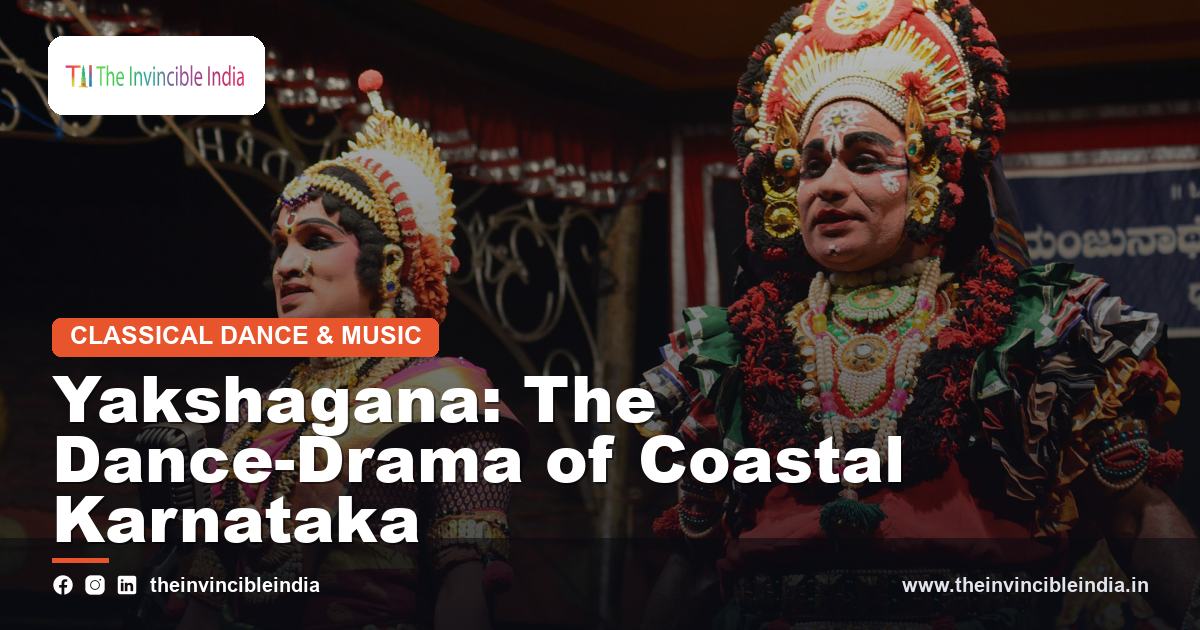
After the monsoon each year, as night falls over the villages and temple grounds of coastal Karnataka, the thunder of the chende drum announces the arrival of Yakshagana, one of India’s most spectacular traditional theatre forms. Combining dance, song, spoken dialogue, music and extraordinary costume, it retells episodes from the epics and the Puranas through performances that traditionally last until dawn. Unlike the codified classical dance forms of India, Yakshagana grew out of regional village and temple culture, yet it displays a remarkable discipline of its own. This guide explores its stories, musicians, characters, costumes, styles and the communities that keep it alive.
Quick Facts
| Detail | Information |
|---|---|
| Type | A dance-drama combining song, dance, dialogue and music |
| Region | Coastal and malnad Karnataka, with presence in northern Kerala |
| Stories | Episodes from the Ramayana, Mahabharata and Puranas |
| Instruments | Chende, maddale and cymbals, with a lead singer |
| Styles | Tenku Thittu and Badagu Thittu |
| Season | Traditionally performed through the nights after the monsoon |
What Is Yakshagana
Yakshagana is a traditional theatre form of coastal Karnataka that fuses dance, music, song, spoken word and elaborate costume into a single dramatic spectacle. Its performers retell stories drawn from the great epics and the Puranas, bringing gods, demons, kings and sages to life in the open air before audiences that may sit through the whole night. The form is neither purely dance nor purely drama; it is a total theatre in which a narrator-singer, musicians and masked-by-makeup actors work together in constant interplay. Rooted in the devotional and agricultural life of the region, Yakshagana belongs to a living theatre tradition that has been passed from teacher to student for generations, and it remains among the most vivid expressions of Karnataka’s cultural identity.
The Meaning of the Name
The name Yakshagana is commonly understood to mean the song of the Yakshas, linking the form to an old tradition of music associated with these semi-divine beings of Indian lore. The term points toward a musical and literary heritage that predates the modern theatre, in which songs composed in a distinct poetic style carried the narrative. In coastal Karnataka the form is also known by other regional names, and its older relatives are found in neighbouring parts of southern India, where related dance-drama traditions developed under different local influences. Whatever the exact etymology, the name captures the central truth of the art: that music and song, not scenery or machinery, form the backbone on which the entire performance is built and sustained.
Geography and Home Regions
Yakshagana is most strongly associated with the coastal districts of Karnataka, including Udupi and Dakshina Kannada, together with Uttara Kannada and the neighbouring hill country, and its influence extends into the northern edge of Kerala. In these regions the art is woven into the rhythm of community life, with troupes attached to temples and local patrons who sponsor performances during festivals and vows. The landscape of rice fields, coconut groves and temple tanks provides the setting in which the art has long been nurtured. Because it grew in a relatively compact region with strong local patronage, the form developed distinctive local variations while retaining a shared body of stories, music and conventions recognised across the whole coast.
Stories from the Epics and Puranas
The repertoire of Yakshagana is built on episodes, called prasangas, drawn from the Ramayana, the Mahabharata, the Bhagavata and other Puranic sources. Rather than staging an entire epic, a troupe selects a single episode, such as a famous battle, a divine encounter or a test of devotion, and builds a full night’s performance around it. These stories are known to nearly every member of the audience, so interest lies not in suspense but in the artistry of telling: the poetry of the songs, the force of the dialogue and the power of the dance. Familiar narratives thus become fresh again each night, and the moral and spiritual themes of the epics are reaffirmed through the living medium of theatre.
The Bhagavata and the Himmela
The musical heart of Yakshagana is the ensemble known as the himmela, led by the singer called the Bhagavata. The Bhagavata narrates the story in verse, sets the pace, cues the dancers and acts as a kind of conductor and storyteller combined, holding the entire performance together from his place at the rear of the stage. Beside him sit the drummers and the cymbal player, who respond closely to his singing and to the movements of the actors. The relationship between singer and performers is one of continuous conversation: the verses prompt the dance, the dancers’ steps shape the rhythm and the dialogue grows out of the song. This partnership defines the unique character of the form and distinguishes it from many other theatre traditions.
Chende, Maddale and Taala
Percussion gives Yakshagana its driving energy, and two instruments dominate the sound. The chende is a tall cylindrical drum played with sticks, producing a loud, ringing rhythm that carries across open ground and signals the start of the performance, while the maddale is a horizontal barrel drum played with the hands, offering a deeper and more varied tone. A small pair of cymbals, called the taala, keeps the beat and marks the rhythmic cycle. Together these instruments accompany every entry, battle and dance, rising and falling with the mood of the scene. In earlier times the melodic line was carried largely by the singer’s voice, with a drone supplied by a simple instrument, and the vocal tradition remains central to the form.
Characters and Role Types
Yakshagana presents a broad cast drawn from the stories it tells, and the characters fall into recognisable types that the audience reads at a glance. Heroic kings and princes, divine figures, noble sages, demons, comic attendants and graceful female roles all appear, each with a distinct costume, gait and manner of speaking. Demon kings are marked by fierce makeup and imposing headgear, while gentler characters are presented with softer colouring and more restrained movement. Female roles have traditionally been performed by men, who study a refined style of movement and expression for the purpose, although women now perform as well. The clear grammar of these character types allows the story to be understood instantly, even by newcomers to the art.
Costume and Headgear
The costume of Yakshagana is among the most striking in all Indian theatre. Principal characters wear towering headgear, built up in layers and decorated with glittering ornaments, along with ornamented shoulder pieces, chest plates, arm bands and a full, pleated lower garment worn with a heavy waist belt. Bells tied at the ankles sound with every step, adding a rhythmic layer to the dance. Fabric, colour and decoration are chosen to distinguish heroes from demons and divine beings from mortals. Preparing and wearing the costume is itself a skilled craft, and a full-dress performer carries considerable weight while moving vigorously through hours of dance. The result is a theatrical image of unmistakable grandeur that has become closely identified with the entire art form.
Makeup and Face Painting
Yakshagana makeup, known in the tradition as barnaveshe, is applied directly to the face in bold colours and patterns that identify the character before a single word is spoken. Different characters carry different colour schemes and facial markings, with fierce and royal figures presented in strong, dramatic designs and gentler roles in lighter tones. Artists often prepare for hours before a performance, and the shaping of eyes, eyebrows and forehead markings helps to project the character’s expression to a distant audience seated in the open. Makeup and headgear together create a larger-than-life presence suited to night-time performance by lamplight and later by electric light. The face thus becomes a painted mask that remains mobile and expressive, allowing subtle emotion to coexist with bold visual impact.
Dance and Movement Style
The dance of Yakshagana is vigorous, rhythmic and highly theatrical, using strong footwork, rapid spins, leaps and dramatic poses that suit the epic scale of the stories. Movement follows the beat of the drums closely, and the dancers respond to the singer’s verses with gestures and expressions that convey the meaning of the text. Entry scenes, battles and confrontations are especially energetic, showing the physical stamina required of the performers, while quieter scenes rely on more restrained steps and expressive acting. Unlike the sculpted stillness of many classical forms, Yakshagana celebrates dynamic, expansive action performed at close quarters with the audience. Its dance vocabulary has been shaped by long practice in the village theatre, making it both athletic and finely disciplined.
Spoken Dialogue and Improvisation
A distinctive feature of Yakshagana is the place it gives to spoken dialogue. Besides dancing and miming the verses sung by the Bhagavata, the actors speak extended passages of their own, elaborating the meaning of the song, debating with other characters and expanding on the moral and philosophical themes of the story. These speeches are not fixed in advance; they are improvised on the spot within the framework of the episode, and the skill of a performer is judged partly by the eloquence, wit and knowledge shown in speech. Such improvisation demands deep familiarity with the epics and their commentaries, and it keeps the performance fresh and responsive to the audience. The balance between song, dance and spontaneous speech is a defining mark of the art.
Tenku Thittu and Badagu Thittu
Yakshagana is commonly described in terms of two broad regional styles, known as Tenku Thittu, the southern style, and Badagu Thittu, the northern style. They differ in aspects of costume, dance movement, rhythm and the manner of presentation, reflecting the separate histories of the districts in which they developed. Troupes and artists are often identified with one of these styles, and audiences in each region have their own preferences and standards of judgement. Despite their differences, both share the same fundamental structure of narrator, musicians and actors, as well as the same body of stories and the same devotional purpose. The existence of two styles shows how a single art can develop rich local variation within a shared cultural framework that remains recognisable throughout the coast.
Troupes, Temples and Patronage
Yakshagana has traditionally been sustained by professional and semi-professional troupes, called melas, many of them linked to local temples. After the rains, the troupes set out on tour, travelling from village to village to give performances in temple precincts and open fields, often funded by devotees, local patrons or community committees. A performance may be offered as a vow, a festival offering or simply as a community celebration. This system of patronage kept the art economically viable for generations and gave it a strong religious character, with prayers and rituals preceding the opening of the show. Even today, the link between troupe and temple remains an important part of how the tradition is organised and how its performers earn their livelihood.
Training and Lineages of Artists
Becoming a Yakshagana artist has traditionally meant years of apprenticeship, learning footwork, rhythm, singing, speech and the memorised repertoire from experienced teachers. Young performers often begin by taking minor roles and gradually progress to principal characters as they gain stamina, technique and knowledge of the stories. Training institutions and dedicated centres in the region now supplement this older method, offering structured instruction to students of different backgrounds. The passing of skill from one generation to the next remains the lifeline of the art, since so much of its knowledge, including improvisation, character study and musical timing, lives in practice rather than in written manuals. Respect for the guru and the lineage continues to shape the discipline of those who dedicate themselves to the stage.
Tala Maddale: The Seated Discussion
Alongside the full costumed performance, Yakshagana has a related form known as Tala Maddale, a seated presentation in which the artists perform without costume or dance. The singer narrates an episode while the participants, seated in a row, take the roles of characters and debate the meaning of the story in speech. The emphasis falls entirely on the poetry, argument and knowledge of the performers, and the form is cherished by listeners who enjoy a more intellectual engagement with the epics. Tala Maddale shows how the art values the spoken word and scholarship as much as spectacle. It also offers artists a space for the display of learning and wit, and it has attracted a devoted following of its own.
Innovation and Modern Experiments
Though deeply traditional, Yakshagana has not stood still. Writers and directors in the twentieth century experimented with shorter performances, new stories and fresh stagecraft, and the celebrated Kannada novelist Shivarama Karanth is widely remembered for his efforts to adapt the form for new audiences. Contemporary troupes present Yakshagana in cities and abroad, sometimes in condensed versions suited to indoor stages, and women now take part both as musicians and as lead performers. Artists have also used the form to retell modern and social themes alongside the old epics. These experiments have sparked lively debate about authenticity, yet they show the vitality of an art whose grammar is flexible enough to meet changing audiences without losing its distinctive identity.
Yakshagana Today
Today Yakshagana remains a vibrant living tradition. Troupes continue to tour the villages and towns of coastal Karnataka each season, while festivals, training centres and cultural institutions help to document and promote the art. Audiences still gather through the night to hear the Bhagavata sing and to watch the dazzling headgear sweep across the stage, and younger artists are taking up the craft with enthusiasm. The challenge for the future lies in preserving the depth of the older practice, including improvisation and rigorous training, while adapting to changing lifestyles and tastes. As a complete theatre that unites music, dance, speech and devotion, Yakshagana stands as a treasured part of India’s regional heritage and a fine example of how a village art can attain great artistic sophistication.
Sources & Further Reading
- Sangeet Natak Akademi, Government of India (sangeetnatak.gov.in).
- Ministry of Culture, Government of India (indiaculture.gov.in).
Frequently Asked Questions
What is Yakshagana?
Yakshagana is a traditional dance-drama of coastal Karnataka that combines song, dance, spoken dialogue, music and elaborate costume. It retells episodes from the epics and the Puranas, often in performances that continue through the night.
Which instruments are used in Yakshagana?
The main instruments are the chende, a tall stick-played drum, the maddale, a horizontal hand-played drum, and a pair of cymbals called the taala. The lead singer, known as the Bhagavata, directs the ensemble and narrates the story in verse.
What are Tenku Thittu and Badagu Thittu?
They are the two broad regional styles of Yakshagana, the southern and the northern. They differ in aspects of costume, movement and presentation but share the same basic structure and body of stories.
Is Yakshagana performed only by men?
Traditionally the troupes were made up of men, who also played the female roles. In recent decades women have taken up Yakshagana as performers and musicians, and troupes featuring women are now an accepted part of the stage.
How is Yakshagana different from classical dance?
Yakshagana is a regional theatre form that includes extended spoken dialogue, improvisation and a narrator-singer, while classical dances follow codified technique and are largely wordless in their gesture. Both draw on devotional themes and rich traditions, but their structure and style differ.


