

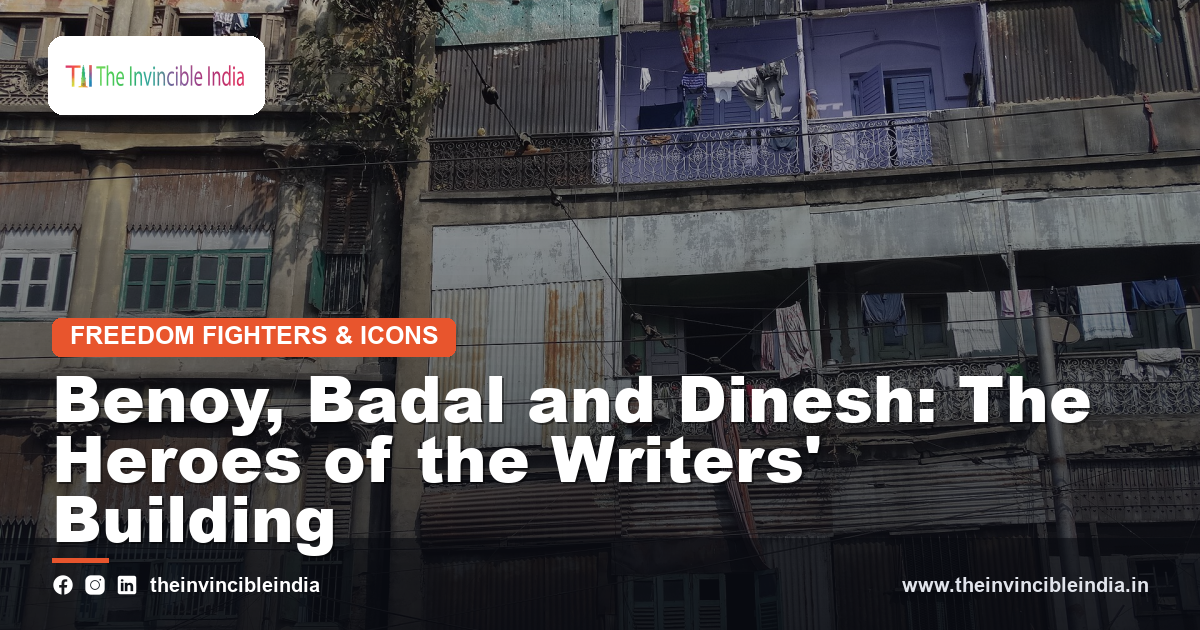
Few place names in India carry as much historical meaning as BBD Bagh, the central square of Kolkata that takes its name from three young revolutionaries: Benoy Basu, Badal Gupta, and Dinesh Gupta. In December 1930, these members of the Bengal Volunteers carried out a bold action inside the Writers’ Building, the seat of the provincial administration, in protest against the harsh treatment of political prisoners. Their act took place in the same turbulent period that saw the Chittagong armoury raid and a wave of fearless activism across Bengal. The renaming of the old Dalhousie Square honours their memory in the very heart of the city.
Quick Facts
| Detail | Information |
|---|---|
| Revolutionaries | Benoy Basu, Badal Gupta, Dinesh Gupta |
| Organisation | Bengal Volunteers |
| Location | Writers’ Building, Calcutta |
| Period | December 1930 |
| Purpose | Protest against prison brutality |
| Memorial | BBD Bagh, Kolkata |
Bengal in the Early 1930s
The early 1930s were a period of intense political activity across India, and Bengal stood at the centre of many of its currents. The Civil Disobedience Movement had begun, the memory of earlier revolutionary activity remained strong, and young people in Calcutta and across the province were deeply restless about the pace of change and the severity of colonial rule.
It was against this charged background that a new generation of activists emerged, convinced that bold action was needed to awaken public opinion and challenge the authority of the state. The atmosphere of those years explains the readiness of three young men to undertake a mission of extreme danger, and it places their action within a broader pattern of defiance spreading through the province.
The Bengal Volunteers
The Bengal Volunteers was an organisation that trained young men and women in discipline, physical fitness, and the ideals of national service. Founded in the years surrounding a major gathering of the Indian National Congress in Calcutta, it began as a volunteer corps and gradually developed a more radical edge as its members grew impatient with the limits of conventional politics.
The group sought to prepare its recruits for courage and sacrifice, and it drew young people from many backgrounds. Its structure combined public activity with secret planning, and it became one of the notable revolutionary bodies of its time. The three heroes of this story were all members, and their actions cannot be understood apart from the culture of dedication that the organisation fostered.
Benoy Basu: A Student of Medicine
Benoy Basu came from a family in the Dhaka region of eastern Bengal, and he was studying medicine when he became deeply involved in revolutionary work. Those who remembered him described a thoughtful, resolute young man, whose commitment to the cause grew as he witnessed the injustices of the colonial system around him.
As a leading member of the Bengal Volunteers, he was entrusted with serious responsibilities and soon became one of the group’s most determined activists. His medical education, which might have led to a comfortable career, was set aside in favour of the national cause. His decision shows how many talented young people of the time chose service and sacrifice over personal advancement.
Badal Gupta: Quiet Resolve
Badal Gupta, whose given name was Sudhir, was a young member of the Bengal Volunteers known for his gentle manner and unwavering sincerity. Like many of his companions, he had grown up in an environment saturated with patriotic feeling and came to believe that the moment demanded personal sacrifice for the sake of the country.
Friends recalled his calm temperament, which concealed a deep inner determination. He was among the youngest of the trio, yet he approached the mission with the same seriousness as his older comrades. His story is a reminder that the revolutionary movement drew not only on celebrated leaders but also on quiet, devoted young people prepared to give everything.
Dinesh Gupta: Education and Conviction
Dinesh Gupta was a young man from the Dhaka region who, like Benoy, was drawn into revolutionary work through the Bengal Volunteers. Educated and thoughtful, he developed a firm belief that action rather than petition was needed to bring about change, and he put himself at the service of the organisation with total commitment.
He formed a close bond with his two companions, and the three came to share a common sense of purpose. Dinesh Gupta’s later conduct, during his trial and imprisonment, showed the depth of his conviction and his remarkable composure under pressure. His character, marked by loyalty and courage, made him an essential member of the group that carried out the Writers’ Building action.
Grievance Against Prison Brutality
The immediate cause of the planned action was widespread anger over the treatment of political prisoners in Bengal’s jails. Reports of harsh conditions, mistreatment, and humiliation of detainees had circulated among nationalists, and the officer responsible for prisons in the province was seen as symbolising this severity.
For the Bengal Volunteers, striking a blow against this system was a matter of conscience as well as politics. They believed that those who enforced oppressive practices should be made accountable, and that dramatic action might draw national attention to the plight of prisoners. This sense of moral outrage provided the emotional engine behind the entire mission.
Planning the Action
The plan involved entering the Writers’ Building, the administrative nerve centre of the provincial government, and confronting the targeted official in his own office. It was an audacious scheme, because the building was a symbol of colonial power and housed many senior officials, and security around it was considerable.
The three young men prepared carefully, studying the layout and routines of the building and arranging the means to enter without immediate suspicion. Their planning demonstrated both nerve and discipline, since any mistake could cost them their lives. The sheer boldness of the idea reflected the spirit of defiance that had taken hold of the younger generation of Bengal revolutionaries.
The Writers' Building as a Symbol
The Writers’ Building in Calcutta took its name from the clerks, then called writers, who had once worked there for the East India Company. Over time it grew into the principal secretariat of the Bengal government, a large red building with a distinctive colonial style that dominated the area around Dalhousie Square.
For nationalists, it was the physical embodiment of administrative authority, the place from which orders affecting millions were issued. To act inside its walls was therefore to challenge the colonial state at its very centre. The choice of location gave the action an unmistakable symbolic power, and it explains why the event is remembered so vividly in the story of Kolkata.
December 1930: The Day of the Action
In December 1930, the three young men entered the Writers’ Building and made their way to the office of the official they had targeted. The action was swift and dramatic, and it threw the building into confusion as staff and guards realised what had occurred. The target was killed, and the alarm quickly spread through the entire complex.
The event took place in broad daylight in the heart of the city, and its audacity stunned Calcutta. It showed that the revolutionary movement was prepared to carry its struggle directly into the offices of the government. For the three participants, the act marked the culmination of months of preparation and the beginning of an exchange of fire with the police.
The Confrontation with the Police
After the initial action, armed police and officials rushed to the scene, and an exchange of fire took place within the building. The three young men found themselves outnumbered and trapped, yet they continued to resist until it became clear that escape was impossible. Several officials were wounded in the confusion.
The standoff demonstrated the determination of the young revolutionaries, who had never expected to leave the building alive. Their conduct during these tense moments, calm and focused despite overwhelming odds, became part of the legend that grew around the event. The confrontation ended only when they decided to take the final steps they had resolved upon beforehand.
Sacrifice and Survival
Faced with certain capture, Badal Gupta took poison and died, while Benoy Basu and Dinesh Gupta turned their weapons on themselves. Benoy Basu was gravely wounded and was taken to hospital, where he later died of his injuries, while Dinesh Gupta survived and was taken into custody.
This outcome shaped the later memory of the event. Two of the three gave their lives within the immediate aftermath, while the third faced the long process of trial and imprisonment. Together, their choices reflected a shared resolve not to surrender, and they ensured that the three names would always be linked in the story of the freedom movement.
Trial and Execution of Dinesh Gupta
Dinesh Gupta, having survived the action, was tried by the colonial authorities, and the proceedings attracted wide public interest. Throughout the trial and his time in jail, he remained composed and steadfast, expressing no regret for the cause he had served. His letters from prison, as remembered by those who read them, spoke of calm acceptance and faith in the future of the nation.
He was eventually sentenced to death and executed in 1931. His final days, marked by dignity and serenity, deepened the public admiration for the trio. The sacrifice of Dinesh Gupta completed the tragic arc of the three young men, whose collective story became one of the most affecting episodes of Bengal’s revolutionary history.
Reaction Across Bengal and India
News of the Writers’ Building action travelled quickly and provoked strong reactions. Many Bengalis felt deep sympathy and pride in the courage of the three young men, while others were troubled by the use of violence. The event added to the atmosphere of tension that surrounded British rule in the province during this period.
The authorities responded with stricter security and intensified efforts to suppress revolutionary organisations. At the same time, the story entered popular memory, inspiring songs, poems, and speeches. The reaction illustrated how a single bold episode could capture the imagination of a whole society, shaping the emotional landscape of the national movement.
From Dalhousie Square to BBD Bagh
The great square in central Kolkata was long known as Dalhousie Square, named after a nineteenth-century British Governor-General. In independent India, the area was renamed BBD Bagh in honour of Benoy, Badal, and Dinesh, a change that replaced a colonial name with the memory of three young Indian patriots.
The renaming is deeply symbolic. It transformed the geography of the city’s historic core into a memorial, so that every resident and visitor who refers to the area recalls the three revolutionaries. Few cities in India have so directly woven the names of freedom fighters into their everyday vocabulary, and BBD Bagh stands as a living tribute to their courage.
The Heritage Landscape Around BBD Bagh
The area around BBD Bagh is among the richest heritage precincts in Kolkata, with grand colonial buildings, a central tank, and historic offices that recall the city’s days as a capital of British India. The Writers’ Building itself, with its long facade and ornate details, remains one of the most recognisable landmarks of the area.
Visitors walking through the precinct encounter layers of history, from the age of empire to the freedom movement and beyond. The memory of Benoy, Badal, and Dinesh adds a human dimension to this architectural setting, reminding observers that the stones of these buildings witnessed moments of bold resistance, and that heritage encompasses both monuments and the stories attached to them.
Benoy, Badal and Dinesh Today
Today Benoy Basu, Badal Gupta, and Dinesh Gupta are remembered as symbols of youthful patriotism and fearless sacrifice. Their names are spoken daily by commuters, taxi drivers, and officials who refer to BBD Bagh, a quiet and constant homage that keeps their memory alive without the need for ceremony.
For students of Indian heritage, their story offers a powerful lesson in courage and conviction, along with an invitation to reflect on the complexities of revolutionary action. The three young men gave their lives for a cause they believed in, and their legacy endures in the very name of the city’s central square, a lasting reminder that the freedom of India was shaped by the devotion of its young.
Sources & Further Reading
- Ministry of Culture, Government of India (indiaculture.gov.in).
- Archaeological Survey of India (asi.nic.in).
Frequently Asked Questions
Who were Benoy, Badal and Dinesh?
They were Benoy Basu, Badal Gupta, and Dinesh Gupta, young members of the Bengal Volunteers. They are remembered for their action at the Writers’ Building in Calcutta in December 1930.
Why did they attack the Writers' Building?
They acted to protest the harsh treatment of political prisoners in Bengal’s jails. The target was the senior official responsible for the prison administration.
What happened to the three revolutionaries?
Badal Gupta took poison and died, Benoy Basu was wounded and died in hospital, and Dinesh Gupta survived to be tried and executed in 1931. All three are honoured as martyrs.
What does BBD Bagh stand for?
BBD Bagh takes its name from Benoy, Badal, and Dinesh. It is the new name given to the old Dalhousie Square in central Kolkata.
What was the Bengal Volunteers?
It was a Bengal-based organisation that trained young people in discipline and national service. It later developed a radical wing that produced several notable revolutionaries.


