

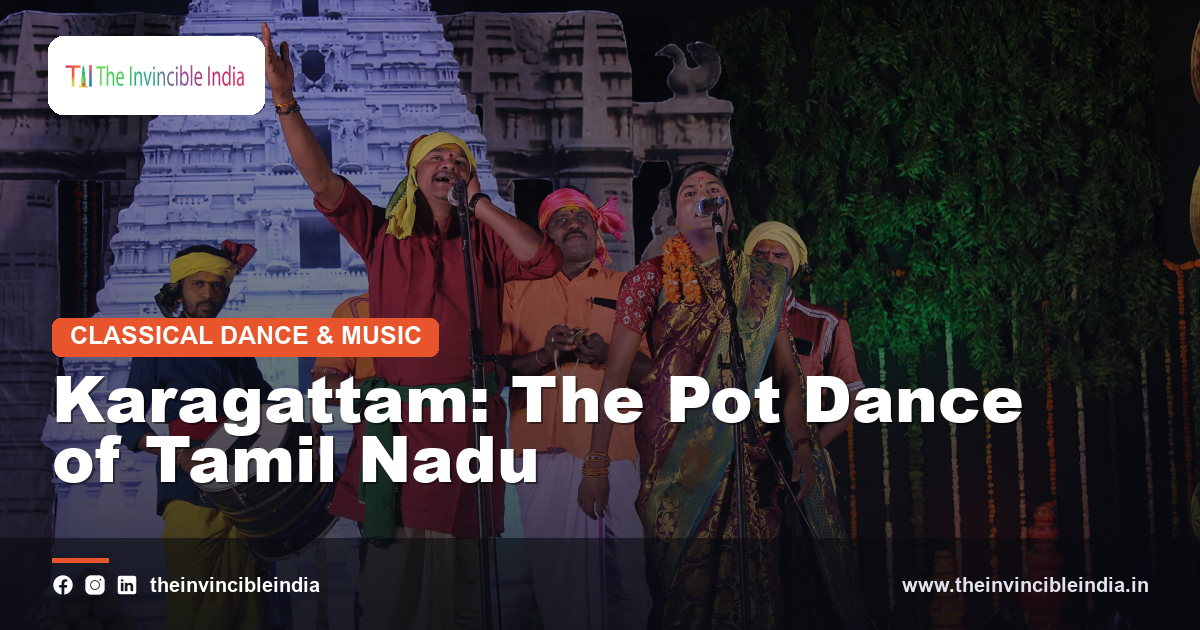
Few sights in Tamil Nadu’s festival season are as captivating as a dancer moving gracefully to the beat of drums with a brightly decorated pot balanced steadily on the head. This is Karagattam, the pot dance, one of the best-loved folk dances of India. Rooted in village worship, especially of the goddess Mariamman, it also developed a lively entertainment form that showcases the dancer’s skill, balance and humour. The dance requires years of practice, for the performer must keep the vessel in place through spins, bends and rapid footwork. This guide explores the history, forms, music, costume and cultural importance of Karagattam.
Quick Facts
| Detail | Information |
|---|---|
| Type | A folk dance with a pot balanced on the head |
| Region | Tamil Nadu, with related forms in neighbouring states |
| Two forms | Sakthi Karagam (ritual) and Aatta Karagam (entertainment) |
| Deity link | Associated with worship of the goddess Mariamman |
| Music | Nadaswaram, thavil and other folk percussion |
| Skill | Balance, rhythm and controlled footwork |
What Is Karagattam
Karagattam, also called Karagam, is a traditional folk dance of Tamil Nadu in which the performer balances a decorated pot on the head while dancing to the rhythm of music. The word combines karagam, meaning the pot, with attam, meaning dance, and it describes both the object and the art. The pot, usually of brass or clay and often filled with grain or sand, is adorned with flowers and a decorative top, becoming a vivid emblem of the performance. Mastery lies in keeping the vessel steady through lively footwork, turns and acrobatic movements. The dance blends devotion, athletic skill and entertainment, and it remains one of the most recognisable and widely enjoyed expressions of Tamil folk culture.
Origins and Historical Background
Karagattam is generally regarded as a very old village tradition, performed for generations in connection with rural worship and community celebration. Its exact beginnings are not documented, and like many folk arts it passed from teacher to student by practice rather than by written text. The dance is linked in popular tradition with the worship of the rain and village goddesses, to whom the vessel is dedicated, and with the agricultural cycle in which rainfall is a matter of survival. Over time the dance found a place in temple festivals, processions and public entertainments across Tamil Nadu. Its long continuity illustrates how deeply village rituals have shaped the performing arts of the Tamil country.
Sakthi Karagam: The Ritual Form
The ritual form of the dance is known as Sakthi Karagam, and it is performed as an act of worship in honour of the goddess. The pot is regarded as a sacred vessel that embodies divine energy, and the dancer who carries it is treated with reverence during the ceremony. Preparation often involves fasting, prayer and ritual purification, and the dance may be offered at festivals dedicated to the village goddess. In this form the movements tend to be slower and more solemn, and the focus is on devotion rather than display. Sakthi Karagam connects the dance directly with the spiritual life of the community and shows how a performing art can serve as a vehicle for faith and communal thanksgiving.
Aatta Karagam: The Entertainment Form
The second form, known as Aatta Karagam, is performed for entertainment at festivals, fairs, weddings and public gatherings. Here the emphasis falls on skill and spectacle, with dancers showing off rapid footwork, lively spins and remarkable feats of balance while the pot remains on the head. The mood is playful and energetic, and performers may add humorous touches and interact with the audience. This form is more elaborate in technique and often more athletic, demanding great control. Aatta Karagam gave the dance a wider public life beyond the temple, turning it into a popular stage art. The two forms together show how a single tradition can serve both sacred and festive purposes within the same community.
The Karagam Vessel
The pot at the centre of the dance is more than a prop. Traditionally a vessel of brass or clay, it is carefully prepared and decorated before the performance, filled with rice, grain or sand to add stability, and topped with an elaborate arrangement of flowers and often a decorative cone or small ornament. Its shape and decoration vary between regions, but its role as the focal point of the dance is constant. In ritual settings the pot is treated as an embodiment of the goddess herself, and handling it follows established customs. The combined image of vessel, flowers and dancer has become a symbol of Tamil folk art, instantly recognised in festival decorations, cultural programmes and artistic imagery throughout the state.
Balance and Technique
The central challenge of Karagattam is balance. The dancer must keep a vessel steady on the head while performing rhythmic steps, bending the body, turning in place and sometimes moving at speed. This requires a strong sense of posture, a controlled neck and shoulders, and a feeling for the weight and centre of the pot. Dancers often begin by practising with lighter vessels, gradually increasing difficulty as their control improves. The feet follow the beat of the drums with quick, patterned steps, while the arms move in flowing gestures that add grace and character. The technique looks effortless when mastered, yet it is the product of long, disciplined training that develops concentration, strength and a remarkable bodily poise.
Acrobatic Skills
In the entertainment form, dancers often extend the basic technique into acrobatic displays. They may bend far backwards, lower the body towards the ground, balance on unusual surfaces or perform complex sequences of turns, all while the pot remains in place. Some performances include feats such as dancing on the edge of an object, picking up small items from the floor or performing with additional vessels. These feats are meant to astonish the audience and to show the dancer’s mastery of equilibrium. The best performers combine such skill with grace, ensuring that the display remains elegant rather than merely daring. This blend of athleticism and artistry has made Karagattam a favourite at festivals and cultural shows.
Music and Instruments
Music provides the heartbeat of Karagattam. The dance is usually accompanied by the nadaswaram, a loud double-reed wind instrument, together with the thavil and other drums that set a lively, steady rhythm. Folk instruments such as the urumi melam, with its distinctive sound, may also be used in village settings. The musicians watch the dancer closely and adjust the tempo, increasing the speed to challenge the performer and slowing it to allow graceful movement. Songs in Tamil, often in praise of the goddess or recounting stories, may be sung during the performance. The close partnership between musician and dancer is essential, and the combined effect of piercing wind instruments and pounding drums creates an atmosphere charged with festivity.
Costume and Adornment
The costume of Karagattam is colourful, festive and designed to allow free movement. Women dancers typically wear bright sarees or long skirts, often tied so that the legs can move freely, together with jewellery, flower garlands in the hair and anklets that ring with each step. Male performers wear dhotis and shirts or other traditional attire, sometimes with a decorative cloth tied at the waist. Colour and decoration are chosen to complement the vivid pot atop the head. In ritual settings the dress may be simpler and more austere, in keeping with the solemn mood. Whatever the style, the costume contributes to the visual joy of the dance and links it with the broader aesthetics of Tamil festival life.
Festivals and Mariamman Worship
Karagattam is most closely tied to the festivals of Mariamman, the goddess honoured across Tamil Nadu as a protector against disease and a giver of rain and well-being. During her festivals, devotees carry sacred pots in procession, and the dance forms part of the ceremonial atmosphere alongside music, offerings and communal feasting. The dancer who carries the karagam in ritual settings may be regarded as bearing the goddess’s presence, and the community responds with devotion. Temple processions, village fairs and special vows often include the dance. Through such occasions Karagattam continues to anchor itself in the religious calendar of the Tamil country, remaining one of the most visible expressions of folk faith and communal solidarity.
Related Traditions Across South India
Pot-balancing dances are found in several parts of southern India, and Karagattam is part of this larger family. In Karnataka, a famous pot-bearing procession known as the Karaga is celebrated in Bengaluru and other places, and in Andhra Pradesh related pot dances form part of folk festivals. These traditions share the image of a sacred vessel carried on the head and linked with goddess worship, but each has its own rituals, costume and music. Studying them together shows how a single devotional idea spread and took different local shapes. Karagattam, with its dual ritual and entertainment forms, is among the best-known members of this wider group of southern pot traditions.
Performers and Community Life
Karagattam has traditionally been practised by village artists, with skills handed down within families and communities. Performers often work as part of troupes that travel to festivals and events, and the art has provided a livelihood for many folk artists across Tamil Nadu. Both men and women take part, and women have long held an important place in the dance. The troupe usually includes musicians who travel with the dancers, forming a close working unit. Local patrons, temple committees and festival organisers support these groups, and the performers are often central figures in the festive life of the village. This community base has been the foundation of the dance’s survival through many generations.
Training and Transmission
Learning Karagattam is a gradual process that begins in childhood for many artists. Beginners practise posture, footwork and rhythm without the pot, then start with a light vessel and increase the load and difficulty over time. Teachers emphasise concentration, breath control and a relaxed but firm posture of the neck and shoulders. Young dancers learn the songs and rhythms of the dance alongside the movements, absorbing the social and devotional meaning of the art. Cultural institutions in Tamil Nadu have supported training programmes and competitions that encourage new dancers. The method remains largely one of practice and imitation, and the personal guidance of an experienced teacher is the surest route to mastery of this demanding folk art.
Karagattam in Cinema and Stage
The visual appeal of Karagattam has made it a favourite subject in popular culture. Tamil cinema has often featured the dance in festival scenes and songs, introducing it to audiences far beyond the villages, and stage shows and television programmes have done the same. This exposure has brought both recognition and change, with performances sometimes adapted to suit the demands of screen and spectacle. While some traditionalists worry that the ritual meaning may be diluted, the wider visibility has also created new opportunities and respect for folk artists. The dance has proven adaptable, thriving in village temple grounds and on modern stages alike while keeping its essential character of balance, rhythm and festive joy.
Challenges and Preservation
Like many folk arts, Karagattam faces pressures from changing lifestyles, shifting patronage and competition from mass entertainment. Many village artists struggle to earn a steady income, and younger people may be drawn to other occupations. At the same time, there are risks that commercial adaptation may weaken the ritual dimension of the dance. Cultural institutions, state academies and community groups have tried to meet these challenges through awards, festivals, training workshops and documentation. Support for artists, respect for their livelihood and recognition of their skill are all essential to sustaining the art. Protecting the knowledge held by senior performers and encouraging younger dancers to continue are the most important steps for the future.
Karagattam Today
Today Karagattam remains one of the most vibrant folk traditions of Tamil Nadu. It continues to be performed at temple festivals, weddings, fairs and cultural programmes, and it is taught by dedicated artists and institutions. The sight of a dancer balancing a flower-crowned pot while moving to the beat of the drums still draws crowds and admiration. The art has adapted to new settings while retaining its link with village worship and community celebration. As a dance that joins devotion, skill and joy, Karagattam holds a cherished place in the cultural life of the state and stands as a fine example of how a humble village tradition can attain real artistry and enduring appeal.
Sources & Further Reading
- Sangeet Natak Akademi, Government of India (sangeetnatak.gov.in).
- Ministry of Culture, Government of India (indiaculture.gov.in).
Frequently Asked Questions
What is Karagattam?
Karagattam is a folk dance of Tamil Nadu in which the performer balances a decorated pot on the head while dancing to music. It exists in a ritual form and an entertainment form.
What is the difference between Sakthi Karagam and Aatta Karagam?
Sakthi Karagam is the ritual form, performed as worship of the goddess with a sacred pot. Aatta Karagam is the entertainment form, which emphasises skill, spectacle and acrobatic balance.
What instruments accompany Karagattam?
The dance is usually accompanied by the nadaswaram, a loud wind instrument, along with the thavil and other drums. Folk instruments such as the urumi melam may also be used in village settings.
What is the pot filled with?
The pot is commonly filled with rice, grain or sand to give it weight and stability, and it is decorated with flowers and a decorative top. The exact preparation varies by region and occasion.
Which goddess is associated with Karagattam?
The dance is closely linked with the worship of Mariamman, the village goddess honoured across Tamil Nadu. Her festivals are among the most important occasions for the dance.


