

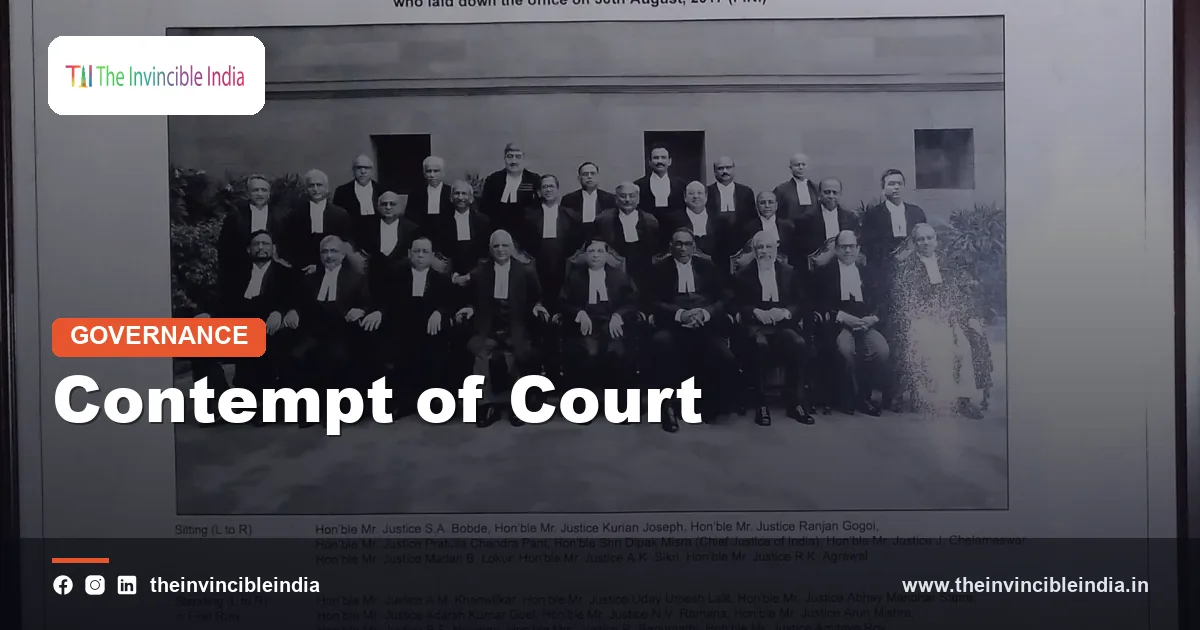
Contempt of court is the legal concept that protects the authority and dignity of the courts and ensures that their orders are obeyed. In India, a person can be held in contempt for wilfully disobeying a court’s order, or for words and acts that scandalise a court, interfere with a pending case or obstruct the administration of justice. The power to punish it is both statutory and constitutional.
The subject is often in the news because it sits at the meeting point of two values that matter greatly in a democracy: the need for courts to function without intimidation or abuse, and the freedom of citizens to speak, write and criticise. This explainer covers the legal framework under the Contempt of Courts Act 1971, the constitutional powers in Articles 129 and 215, the difference between civil and criminal contempt, the available defences, the punishments, and the continuing debate over how far the law should go.
Quick Facts
| Aspect | Detail |
|---|---|
| Main statute | Contempt of Courts Act, 1971 |
| Predecessors | Contempt of Courts Acts of 1926 and 1952 |
| Recommending committee | Sanyal Committee (1961 to 1963) |
| Constitutional power | Article 129 (Supreme Court) and Article 215 (High Courts) as courts of record |
| Two kinds | Civil contempt and criminal contempt |
| Maximum punishment under the Act | Simple imprisonment up to six months, fine up to Rs 2,000, or both |
| Limitation period | One year from the date of the alleged contempt (Section 20) |
| Free speech link | Article 19(2) lists contempt of court as a ground for reasonable restriction |
What Does Contempt of Court Mean?
The word “contempt” in this context does not mean disliking a judge. It means conduct that undermines the working of the justice system. The underlying idea, inherited from English common law, is that courts decide disputes on behalf of the State and the public, and that if their orders can be ignored or their proceedings obstructed, the rule of law itself is weakened.
The law does not exist to protect the personal feelings of individual judges. The Supreme Court has repeatedly said that the power exists for the benefit of the public, to ensure that people retain confidence in the administration of justice and that litigants are not deterred from approaching the courts. For this reason, contempt is understood as a power to be used with caution, and judges have often observed that courts should not act merely because a remark is uncomfortable.
Before Independence, the Contempt of Courts Act 1926 and later the 1952 Act dealt with the subject. The present law was enacted in 1971 after the Sanyal Committee, headed by H. N. Sanyal, studied the issue and recommended a clearer statutory framework that defined the offence and listed defences.
Constitutional Foundations: Articles 129, 215 and 19(2)
Contempt of court has a direct constitutional basis, apart from the 1971 Act.
Article 129
Article 129 declares the Supreme Court a “court of record”, with all the powers of such a court, including the power to punish for contempt of itself. A court of record is one whose proceedings and judgments are preserved as a permanent record and are accepted as evidence of their contents, and which has inherent power to punish contempt.
Article 215
Article 215 gives the same status and power to every High Court. Since these are constitutional powers, ordinary legislation cannot take them away, although Parliament can regulate the procedure and prescribe punishments. The Supreme Court has held in several cases that it can punish the contempt of subordinate courts too, and the 1971 Act separately lets High Courts act in respect of contempt of courts subordinate to them.
Article 19(2) and the legislative lists
Article 19(1)(a) guarantees freedom of speech and expression, but Article 19(2) allows reasonable restrictions in relation to, among other grounds, contempt of court. This is how the law reconciles the two. Legislative competence over the subject lies with Parliament: contempt of the Supreme Court appears in the Union List, while contempt of other courts is in the Concurrent List.
The Contempt of Courts Act, 1971
The Act is a compact statute that defines contempt, lists exceptions, prescribes punishment and lays down procedure. Its main features are summarised below.
- Section 2: definitions, including civil contempt and criminal contempt.
- Sections 3 to 7: acts that do not amount to contempt, including innocent publication, fair reports and fair criticism.
- Section 10: power of High Courts to punish contempt of subordinate courts.
- Section 12: punishment for contempt, including the provision allowing discharge on apology.
- Section 13: contempts not punishable in certain cases, with the truth defence added in 2006.
- Section 14: procedure where contempt is committed in the face of the Supreme Court or a High Court.
- Section 15: cognizance of criminal contempt in other cases.
- Section 19: appeals.
- Section 20: limitation of one year.
The Act was amended in 2006 to bring in a significant safeguard. It now provides that the court may permit justification by truth as a valid defence in a contempt proceeding if it is satisfied that the justification is in the public interest and that the request is made in good faith. It also states that contempt is punishable only if it substantially interferes, or tends to substantially interfere, with the due course of justice.
Civil Contempt
Civil contempt, defined in Section 2(b), refers to the wilful disobedience of any judgment, decree, direction, order, writ or other process of a court, or the wilful breach of an undertaking given to a court. The key word is “wilful”. A person who fails to comply because it is genuinely impossible, or because the order is ambiguous, is not usually treated as having committed contempt.
Typical examples
- A government department ignoring a direction to pay compensation or reinstate an employee.
- A party refusing to vacate property despite a decree or an injunction.
- Violating an undertaking filed in court, such as an assurance not to demolish a structure.
- Failing to file a required report or compliance affidavit within the time given.
Civil contempt is primarily about securing compliance with the court’s order, so it is a remedy that serves the aggrieved party. Courts often use the threat of contempt to nudge officials into acting, and many matters end when the order is complied with and the respondent tenders an unconditional apology. Even a government official can be summoned for non-compliance, which shows that the law applies to the State as well as to private persons.
Criminal Contempt
Criminal contempt, defined in Section 2(c), covers the publication, by words, signs, visible representation or otherwise, of any matter, or the doing of any other act, which does one of three things.
- Scandalises or lowers the authority of a court: sometimes called “scandalising the court”, this includes allegations that tend to undermine public confidence in the judiciary.
- Prejudices or interferes with a judicial proceeding: for example, publications that could influence a pending trial, or intimidation of witnesses.
- Interferes with or obstructs the administration of justice: in any other manner, such as disrupting court proceedings or threatening judges.
Criminal contempt is concerned with the harm done to the justice system as a whole, not just to an individual litigant. It can be committed “in the face of the court”, for example by shouting at a judge during a hearing, or outside it, through a speech, article or social media post.
Civil versus criminal contempt
| Feature | Civil contempt | Criminal contempt |
|---|---|---|
| Nature of act | Wilful disobedience of orders or breach of undertaking | Scandalising, prejudicing proceedings or obstructing justice |
| Main purpose | Enforcement of the court’s order | Protection of the administration of justice |
| Section | 2(b) | 2(c) |
| Who is primarily affected | A litigant or party | The public interest in justice |
| Typical outcome | Compliance, apology, sometimes punishment | Apology, fine or imprisonment |
Punishments and Procedure
Under Section 12 of the Act, contempt of court may be punished with simple imprisonment for up to six months, or with a fine up to Rs 2,000, or with both. The Act also says that an accused person may be discharged, or the punishment remitted, if an apology is made and the court is satisfied that it is bona fide. An apology that is not genuine, or that is offered merely as a tactic, may be rejected.
The Supreme Court has also held that its power under Article 129 is not confined by the limits of the Act. In practice, that means that the Court has treated its constitutional power as a separate source of authority, but it has said that it ordinarily follows the procedure of the Act and does not use the power to impose penalties unconnected to contempt. In Supreme Court Bar Association v. Union of India (1998), for instance, the Court held that it could not use its contempt jurisdiction to suspend an advocate’s licence, which is a matter for disciplinary bodies.
How a case starts
- For criminal contempt, a court may take cognizance suo motu, or on a motion by the Attorney General or Solicitor General for the Supreme Court, or by the Advocate General for a High Court.
- Any other person may bring a motion with the written consent of the law officer.
- For civil contempt, an aggrieved party generally files a petition before the court whose order has allegedly been disobeyed.
- The alleged contemnor must be given notice and an opportunity to be heard.
- Limitation is one year from the date of the alleged contempt.
Section 19 provides a statutory right of appeal against an order punishing for contempt. Where a single judge of a High Court has punished a person, the appeal lies to a Division Bench, and where a Bench of the High Court has done so, the appeal lies to the Supreme Court.
Defences Available
The Act recognises that certain acts, however much they may touch on the courts, are not contempt. Understanding these defences is central to understanding the free-speech boundary.
- Innocent publication (Section 3): publishing material that interferes with a pending proceeding is not contempt if the publisher had no reasonable grounds to believe the proceeding was pending, and innocent distribution is similarly protected.
- Fair and accurate report (Section 4): a fair and accurate report of a judicial proceeding, or any stage of it, is not contempt.
- Fair criticism of a judicial act (Section 5): a fair comment on the merits of a case that has been finally decided is not contempt.
- Complaints against presiding officers (Section 6): statements made in good faith to the proper authority about a subordinate judge are protected.
- Proceedings in chambers or in camera (Section 7): certain publications about such proceedings are protected unless a court has prohibited them.
- Truth in the public interest (Section 13): truth may be a defence if justified by public interest and made in good faith.
Fair criticism has been described by courts as the lifeblood of a healthy system. Judgments can be analysed, their reasoning questioned, and their consequences debated, as long as the criticism does not impute improper motives to judges or attack their integrity without foundation.
Landmark Cases
A number of well-known decisions show how courts have approached the subject.
- E. M. S. Namboodiripad (1970): remarks by the Kerala Chief Minister about the judiciary were held to be contempt, with the Court underlining that the standard applies to everyone, including high officeholders.
- Re: Arundhati Roy (2002): the Supreme Court held the writer guilty of criminal contempt for statements made about a pending matter, and imposed a symbolic term of one day and a fine.
- C. S. Karnan (2017): a seven-judge Bench of the Supreme Court sentenced a sitting High Court judge to six months’ imprisonment, a rare instance involving a member of the judiciary.
- Prashant Bhushan (2020): the Court held an advocate guilty of criminal contempt over social media posts about the judiciary and imposed a fine of Re 1, with a default sentence.
- Delhi Judicial Service Association v. State of Gujarat (1991): confirmed the Supreme Court’s power to deal with contempt of subordinate courts under Article 129.
These cases reveal two patterns. First, courts frequently prefer a modest sentence or an apology to severe punishment. Second, the question of where criticism ends and contempt begins is highly fact-specific.
Free Speech versus the Dignity of Courts
The central debate about contempt of court is the tension between Article 19(1)(a) and the need to protect the judiciary. Supporters of the law argue that courts have no army or purse and depend on public confidence and compliance. Without the power to punish defiance, they argue, their orders could be treated as optional.
Critics argue that “scandalising the court” is a vague and broad head of contempt, that judges are deciding on their own cause when they punish remarks about themselves, and that open criticism is essential to accountability. They note that several democracies have narrowed or abolished the offence. The United Kingdom, for example, abolished the common-law offence of scandalising the court in 2013, and the Law Commission and various committees in India have discussed reforms from time to time.
The Indian response has been a calibrated one. The 2006 amendment inserted the truth defence and the “substantial interference” standard, which aim to ensure that only serious cases are punished. Courts have also said that the test is whether a statement poses a real threat to the administration of justice, not whether it merely offends.
Related concepts
- Contempt of court is different from breach of parliamentary privilege, which is about the dignity of a legislature.
- It is distinct from defamation, which protects the reputation of an individual and is pursued separately.
- It differs from perjury, which involves giving false evidence and is dealt with under criminal law.
Conclusion
Contempt of court in India is a tool with a clear purpose and a clear risk. Used with restraint, it protects the integrity of court proceedings and ensures that orders are obeyed. Used too broadly, it could chill legitimate speech. The legal framework, built on Articles 129 and 215, the 1971 Act and a body of judicial decisions, tries to hold both values in balance, and its future shape will depend on how courts and legislatures continue to define that balance.
Frequently Asked Questions
What is the difference between civil and criminal contempt of court?
Civil contempt means wilful disobedience of a court’s order or breach of an undertaking given to the court. Criminal contempt covers acts that scandalise or lower the authority of the court, interfere with judicial proceedings, or obstruct the administration of justice. The first mainly secures compliance, while the second protects the justice system as a whole.
What is the maximum punishment for contempt under the Contempt of Courts Act 1971?
Section 12 provides for simple imprisonment up to six months, a fine up to Rs 2,000, or both. The court may discharge the accused or remit the punishment if a satisfactory apology is made. Courts have also treated Articles 129 and 215 as independent constitutional sources of power.
Which Articles give courts the power to punish for contempt?
Article 129 makes the Supreme Court a court of record with the power to punish contempt of itself, and Article 215 gives the same power to High Courts. Article 19(2) allows contempt of court as a ground for reasonable restrictions on free speech.
Is truth a defence in a contempt case?
Yes, since the 2006 amendment. The court may allow justification by truth as a defence if it is satisfied that the justification is in the public interest and that the request to invoke it is made in good faith.
Is fair criticism of a judgment contempt of court?
No. Section 5 of the Act states that fair criticism of the merits of a finally decided case is not contempt. Criticism becomes risky when it attributes improper motives to judges or tends to undermine public confidence in the courts without basis.
Can an apology end a contempt case?
An apology can lead to discharge or a lighter punishment if the court is satisfied that it is genuine and made in good faith. The court may reject an apology that appears to be a mere tactic or that is offered without real remorse.


