

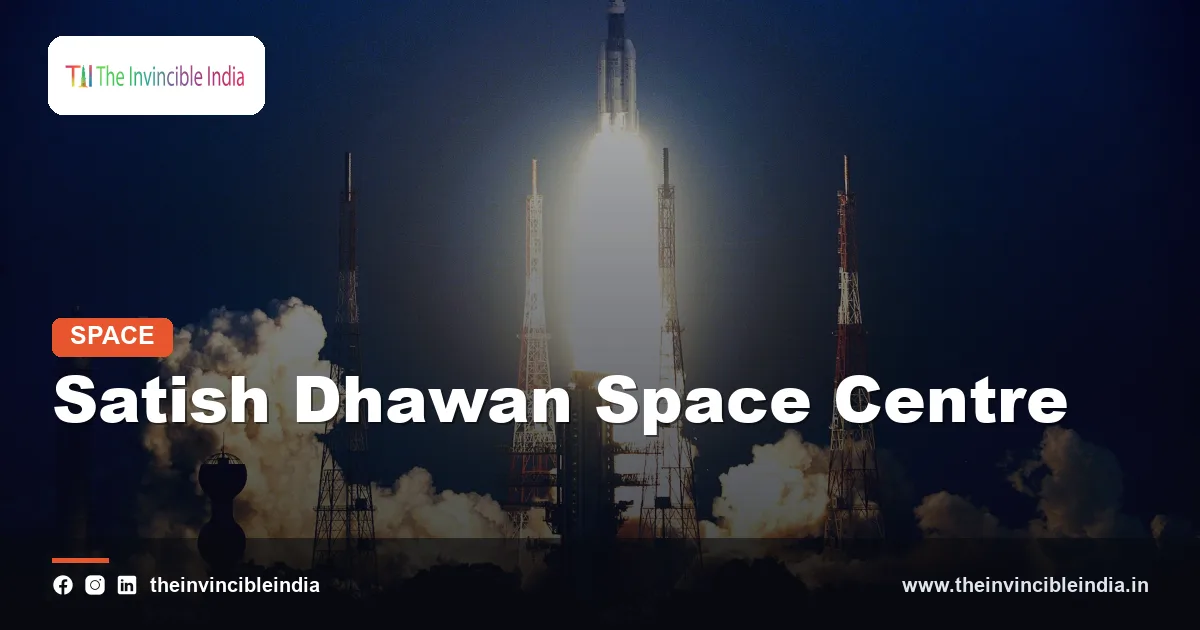
The Satish Dhawan Space Centre, popularly known by its older acronym SHAR, is India’s primary spaceport. It sits on Sriharikota, a long barrier island on the coast of Andhra Pradesh, about 80 km north of Chennai. Almost every major Indian orbital launch has lifted off from here, from the first Rohini satellite of 1980 to the lunar and interplanetary missions that placed India on the global space map.
The centre is operated by the Indian Space Research Organisation (ISRO) and is both a launch range and an industrial campus. It houses rocket-motor casting plants, vehicle assembly buildings, tracking radars and the mission control rooms from which launch directors send rockets to space. This article explains why Sriharikota was chosen, how the centre is organised, which launches made it famous, and where it is heading next.
| Fact | Detail |
|---|---|
| Location | Sriharikota island, Andhra Pradesh, on the Bay of Bengal coast |
| Operator | Indian Space Research Organisation (ISRO) |
| Earlier name | Sriharikota High Altitude Range (SHAR) |
| Renamed | 2002, in memory of Prof. Satish Dhawan |
| First rocket launched | Rohini RH-125 sounding rocket, October 1971 |
| Launch pads | First Launch Pad and Second Launch Pad; a Third Launch Pad has been planned |
| Vehicles launched | SLV, ASLV, PSLV, GSLV, LVM3 and SSLV |
| Famous missions | Chandrayaan-1, Mangalyaan, Chandrayaan-3, Aditya-L1 |
Where Is Sriharikota?
Sriharikota is a low, sandy island separating the Bay of Bengal from the Pulicat Lake, one of the largest brackish-water lagoons in India. The island lies in the Tirupati district of Andhra Pradesh, which was earlier part of Nellore district. It is roughly 100 km from Chennai by road and is reached through a causeway from the mainland. Much of the island is covered by scrub forest, coastal sands and casuarina plantations, and a large share of it is a restricted area under ISRO’s control.
The island has an unusually quiet character. A few fishing hamlets stand around its edges, and the rest is occupied by the space centre, its township and the buffer zones that surround the launch pads. The adjoining Pulicat Lake and its bird sanctuary attract flamingos and other migratory birds every winter, which makes Sriharikota a rare place where wetland ecology and launch infrastructure sit close together.
A Short Geography Note
- Latitude is about 13.7 degrees north, close to the equator by the standards of the Indian mainland.
- The eastern side opens onto the Bay of Bengal, giving an unobstructed ocean path for launches.
- The western side faces the Pulicat Lake, which helps keep the site isolated from dense settlements.
Why Sriharikota Was Chosen
The choice of Sriharikota in the 1960s was shaped by simple physical reasoning. A rocket launched toward the east benefits from the Earth’s rotation, which carries the surface eastward at a high speed near the equator. A launch site closer to the equator gains more of this free velocity, which reduces the fuel needed to reach orbit. It is also easier to place satellites into geostationary orbit from low latitudes, because less manoeuvring is needed to align the orbit with the equator.
The Advantages
- East-coast access: Rockets launched eastward fly over the open sea, so any falling stages or debris land far from habitation.
- Low latitude: The site benefits from the Earth’s rotational boost and is suited to equatorial and geostationary missions.
- Large, sparsely populated land: The island provides generous safety zones.
- Proximity to infrastructure: Chennai, with its port, airport and industry, is within reach.
Polar Launches
Polar and sun-synchronous satellites must travel southward. Launching them directly south from Sriharikota would pass over Sri Lanka, so rockets such as the PSLV fly a dog-leg manoeuvre, first moving east and then turning south after clearing the island’s coast. This is a trade-off accepted for the benefits of the location.
History and the Early Years
ISRO’s early rocket work was based at the Thumba Equatorial Rocket Launching Station in Kerala, which was suited to small sounding rockets but not to large satellite launchers. By the late 1960s, ISRO and the Department of Atomic Energy were looking for a larger site that could support heavy rockets. Sriharikota was identified for this purpose, and the Government of India acquired land on the island.
The new range, called the Sriharikota High Altitude Range (SHAR), came into operation in the early 1970s. Its first launch was a Rohini RH-125 sounding rocket in October 1971, marking the beginning of operations. Over the following years, the range developed the facilities needed for orbital launches. The country’s first satellite launch vehicle, SLV-3, flew from here in 1979 and placed the Rohini satellite RS-1 into orbit in July 1980, making India one of the small group of nations with an indigenous orbital launch capability.
Key Early Milestones
- 1971: First sounding rocket launched from the range.
- 1979: First experimental flight of the SLV-3, which did not reach orbit.
- 1980: Second SLV-3 flight places the Rohini satellite into orbit.
- 1990s: The Polar Satellite Launch Vehicle begins operations, followed by the GSLV.
Who Was Satish Dhawan?
The centre is named after Professor Satish Dhawan, an aerospace engineer and one of the most respected scientists in India’s space history. Born in 1920 in Srinagar, he studied in India and then in the United States, where he earned a doctorate in aeronautics at the California Institute of Technology. He returned to join the Indian Institute of Science in Bengaluru, and later served as its director.
Dhawan became chairman of ISRO in 1972, following the death of Vikram Sarabhai, and led the organisation until 1984. During these years, the space programme moved from experimental sounding rockets to operational satellites and indigenous launch vehicles. He is remembered not only for his technical contributions but also for his leadership style, which allowed younger scientists, including A. P. J. Abdul Kalam, to take responsibility and learn from failure.
After Dhawan passed away in January 2002, the Government of India renamed the Sriharikota range as the Satish Dhawan Space Centre, SHAR, in his honour.
The Launch Pads
The centre has two operational launch complexes, each designed for particular classes of vehicle. A third pad has been planned to support future requirements.
First Launch Pad
The First Launch Pad (FLP) was the original orbital launch complex. It was used for the SLV-3 and the Augmented Satellite Launch Vehicle (ASLV), and it later became a base for the Polar Satellite Launch Vehicle (PSLV). The FLP is built around a fixed launch pedestal and a mobile service tower on rails, in which the rocket is assembled and checked before launch.
Second Launch Pad
The Second Launch Pad (SLP) was commissioned in the first decade of the twenty-first century and was designed to handle both the PSLV and the larger GSLV family. Its principal feature is that the launch vehicle is assembled in a separate Vehicle Assembly Building and then transported on a mobile launch pedestal to the pad. This allows several vehicles to be prepared in parallel and reduces the time spent on the pad. The SLP has hosted the heavy-lift launches of the GSLV Mk III, now called LVM3, including the lunar missions Chandrayaan-2 and Chandrayaan-3.
Third Launch Pad
As ISRO plans larger rockets, including next-generation launchers and human-rated vehicles, the existing pads are expected to be stretched. A Third Launch Pad has therefore been planned to serve future heavy launchers and to add flexibility to the launch schedule.
Assembly, Integration and Propellant Facilities
A spaceport is much more than a pad. At Sriharikota, a series of facilities handle the manufacture, assembly and testing of rocket components before they reach the pad.
- Solid Propellant Space Booster Plant (SPROB): This plant casts large solid-propellant motors, such as the boosters used by the PSLV and GSLV Mk III. Casting involves filling huge steel motor cases with a rubbery fuel mix that hardens into a solid block.
- Vehicle Assembly Buildings: These tall halls are used for stacking stages, attaching boosters and fitting the payload. Integrating the rocket indoors protects it from wind and weather.
- Mobile Service Tower: A movable gantry that provides access to the rocket while it is on the pad.
- Static test facilities: Rocket motors are fired on the ground to verify performance before flight.
- Propellant storage and processing: Liquid propellants and cryogenic fuels are stored and handled in specialised areas.
Why Solid Motors Matter
Solid boosters supply the huge thrust needed in the first moments of flight, and India has gradually built strong expertise in casting and testing them. Their manufacture on the island itself reduces transport risks, since large motors are difficult to move over long distances.
Mission Control and Range Operations
When a rocket is being prepared for launch, the centre’s control rooms become the focus of activity. The Launch Control Centre sits a safe distance from the pad, and from here the launch director and a team of engineers monitor a long countdown. Every subsystem, from propellant loading to avionics checks, is tracked on screens. Automated sequences take over in the last minutes, with human operators ready to hold or abort if a parameter drifts.
Tracking and Safety
- Radars on the island follow the rocket’s flight path in the early minutes.
- Telemetry stations collect data on the rocket’s health and trajectory.
- Range safety officers can terminate a flight that strays from its safe corridor.
- Ships and ground stations downrange extend coverage for later flight phases.
After separation, the satellite’s control is handed to ISRO’s Telemetry, Tracking and Command Network, and the Mission Operations Complex takes over for the remainder of the mission. The centre also provides a viewing gallery, so that visitors can watch launches from a safe distance.
Famous Launches from Sriharikota
Many of the milestones in India’s space story were achieved at this island. A selection of significant launches is listed below.
| Mission | Vehicle | Date | Significance |
|---|---|---|---|
| Rohini RS-1 | SLV-3 | July 1980 | First Indian satellite launched by an Indian rocket |
| Chandrayaan-1 | PSLV-C11 | 22 October 2008 | India’s first lunar probe |
| Mangalyaan (Mars Orbiter Mission) | PSLV-C25 | 5 November 2013 | India’s first interplanetary mission |
| 104 satellites | PSLV-C37 | 15 February 2017 | Record multi-satellite launch at the time |
| Chandrayaan-2 | GSLV Mk III-M1 | 22 July 2019 | Lunar orbiter, lander and rover |
| Chandrayaan-3 | LVM3-M4 | 14 July 2023 | Landed near the lunar south pole region on 23 August 2023 |
| Aditya-L1 | PSLV-C57 | 2 September 2023 | India’s first dedicated solar mission |
The Vehicles That Fly from Here
Different launchers serve different needs, and Sriharikota has been the home base for all of them.
PSLV
The Polar Satellite Launch Vehicle is ISRO’s reliable workhorse. It uses alternating solid and liquid stages and is used for Earth-observation satellites, small satellites and deep-space probes such as Chandrayaan-1 and Mangalyaan.
GSLV and LVM3
The Geosynchronous Satellite Launch Vehicle uses a cryogenic upper stage for communication and navigation satellites. The heavier LVM3 can lift larger payloads and is also planned as the launcher for India’s human spaceflight programme, Gaganyaan.
SSLV
The Small Satellite Launch Vehicle is a newer, compact rocket meant for small payloads at short notice. It has launched from the same island, though India is also developing a dedicated spaceport for small launchers elsewhere in the country.
The Centre and the Wider Space Ecosystem
In recent years, space policy reform has opened the sector to private companies, and the launch range has adapted. Startups use the range’s facilities to test and fly their vehicles, and ISRO’s commercial arm, NewSpace India Limited, coordinates commercial launches. The first privately developed Indian rocket to reach space, Skyroot Aerospace’s Vikram-S, flew from Sriharikota in November 2022 on a sub-orbital test.
The centre is also at the heart of preparations for crewed flights. Test flights for the Gaganyaan crew escape system have been conducted from the range, and further infrastructure is being built to support human-rated launches. The range’s capacity has to grow so that more launches can be handled each year, which is one reason for the Third Launch Pad.
A Local Impact
The centre influences the region around it, giving employment to thousands of people and sustaining a township with schools and hospitals. Nearby fishing communities coexist with the range, and launch days draw crowds of spectators on the mainland shore.
Conclusion
The Satish Dhawan Space Centre has grown from a modest rocket range in the early 1970s into a complex that supports some of the world’s most cost-effective launches. Its favourable location, sound infrastructure and skilled workforce give India reliable access to space. As new rockets, a third launch pad and private-sector participation arrive, the island is likely to remain the heart of India’s space activity, last reviewed in 2 October 2026.
Frequently Asked Questions
Where is the Satish Dhawan Space Centre located?
It is located on Sriharikota island on the coast of Andhra Pradesh, between the Bay of Bengal and Pulicat Lake, roughly 80 km north of Chennai. It is ISRO’s main launch centre.
Why was Sriharikota chosen as the spaceport?
Its low latitude gives rockets a helpful boost from the Earth’s eastward rotation, and the east coast allows launches over open sea, keeping populated areas safe. The island also offers large, sparsely inhabited land and is close to Chennai.
Who was Satish Dhawan?
Satish Dhawan was an eminent aerospace engineer who served as ISRO chairman from 1972 to 1984 and earlier directed the Indian Institute of Science. The Sriharikota range was renamed after him in 2002, following his death.
How many launch pads does the centre have?
There are two operational launch pads, the First Launch Pad and the Second Launch Pad. A third pad has been planned to support future heavy and human-rated launchers and to increase launch frequency.
Which famous missions were launched from here?
Many of India’s best-known missions lifted off from Sriharikota, including Chandrayaan-1 in 2008, the Mars Orbiter Mission in 2013, Chandrayaan-2 in 2019, Chandrayaan-3 in 2023 and the solar mission Aditya-L1 in 2023.
Can the public watch a launch at Sriharikota?
Yes. The centre has a viewing gallery from which registered visitors can watch launches at a safe distance. Access is usually arranged in advance through ISRO’s official registration process, and the number of seats is limited.


