

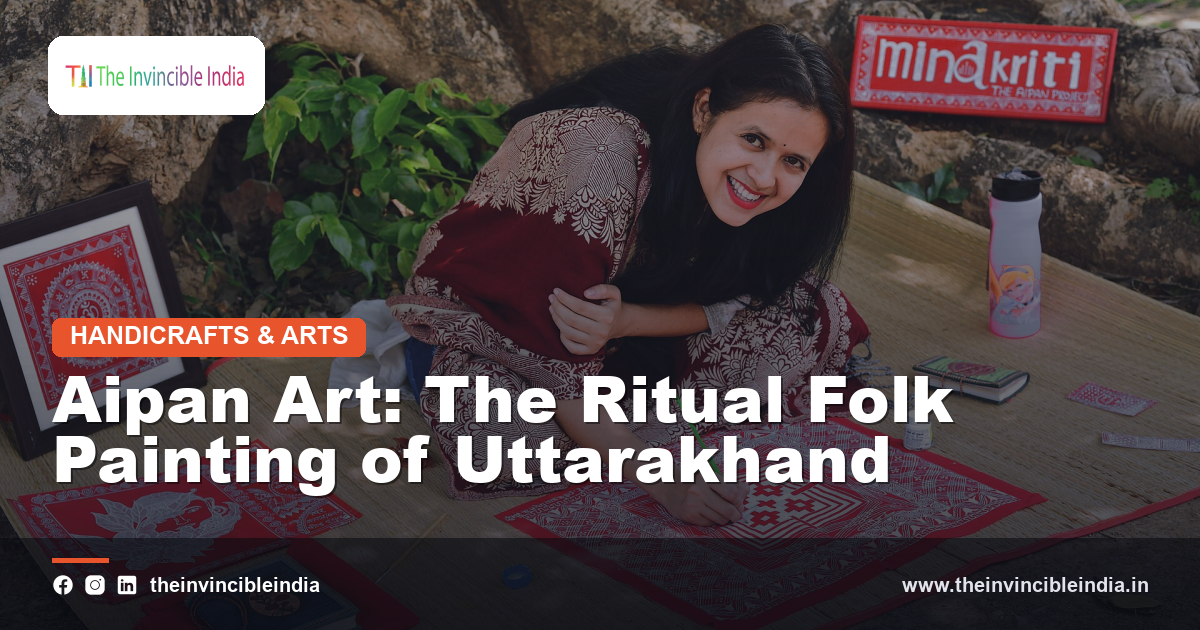
Aipan art is the ritual folk painting of the Kumaon region of Uttarakhand, created on floors, walls, doorsteps and wooden seats in a pattern of white lines on a deep red ground. Drawn almost entirely by women, it marks births, festivals, thread ceremonies, weddings and daily worship, turning ordinary household surfaces into sacred space. Like the village traditions described in the guide to Madhubani painting, Aipan belongs to a household tradition in which art and devotion are one act. This guide explains its materials, motifs, ritual calendar, regional character and the efforts that keep it alive.
Quick Facts
| Detail | Information |
|---|---|
| Art form | Ritual floor and wall folk painting |
| Region | Kumaon, Uttarakhand |
| Main artists | Women of the household |
| Base colour | Geru (red ochre) |
| Drawing medium | Rice paste (biswar), applied by fingers |
| Purpose | Festivals, life events and daily worship |
What Is Aipan Art
Aipan is a traditional ritual art of the Kumaon hills in Uttarakhand, practised on the floors, steps, walls and wooden seats of homes and temples. The designs are drawn in white on a red base, producing a bold contrast that is instantly recognisable. Unlike a painting made to be hung and admired, Aipan is made to be used. It prepares a space for a deity, a guest or a life event, and it is often allowed to fade with footfall and weather.
The art is passed from mothers and grandmothers to daughters, and every household keeps its own memory of patterns. This continuity gives Aipan its character as a living domestic tradition rather than a museum craft, and it explains why the form remains closely tied to ritual rather than to decoration alone.
Origins in the Kumaon Hills
Aipan developed in the hill communities of Kumaon, where seasonal festivals, agricultural life and temple worship shaped household practice. Its exact origins are not recorded in any single source, and scholars generally describe it as an old oral and visual tradition handed down within families. The art is often linked with the cultural world of the Kumaoni Brahmin and other hill households, although many communities across the region have practised their own versions.
The name is sometimes connected by tradition with words associated with offering or decoration, but such explanations vary and are best treated as local understanding rather than settled etymology. What is clear is that Aipan grew out of the hills themselves, using materials from the immediate landscape, and that its roots lie in everyday devotion rather than in court or commercial patronage.
Materials and Natural Colours
The traditional palette of Aipan is deliberately simple. The red ground comes from geru, an earthy red ochre mixed with water, while the white of the designs comes from a paste of soaked and ground rice, often called biswar. Because both materials are natural and local, the art is inexpensive, renewable and entirely biodegradable, which suits a tradition meant to be refreshed repeatedly.
Some households have also used a pinch of other natural pigments for small accents, but the central identity of Aipan remains the pairing of ochre and rice paste. This minimal palette is part of the strength of the form, since all of the variety comes from line, rhythm and symmetry rather than from a range of colours. The materials themselves carry meaning, as rice signifies abundance and the red earth signifies the ground of home.
Preparing the Surface
Aipan begins with preparation of the surface. The floor, wall or wooden board is first cleaned, and the red ochre is applied evenly to create a uniform background. In many homes the surface is also treated with a coating that gives it a smooth finish, and the ochre is allowed to dry before any pattern is attempted.
This stage is regarded as part of the ritual itself rather than a mere technical step. Cleaning and colouring the ground purifies the area, and the rhythm of the work sets a calm and focused mood for the drawing that follows. Because the base coat establishes the visual depth of the finished piece, careful preparation is considered essential, and an unevenly coloured ground is seen as a weakness in the final design.
Drawing with the Fingers
The most distinctive feature of Aipan technique is that the designs are drawn directly with the fingers. The artist dips the middle fingers or a combination of fingers into the rice paste and draws continuous lines, dots and curves onto the dry red surface. The pressure and spacing of the fingers shape the width and character of the line, so the hand itself becomes the principal tool.
Outlines are often drawn first, followed by repeated parallel lines, small dots and filling patterns that build up the composition. Because there are no brushes or stencils, the work depends on trained muscle memory and a sure sense of symmetry. This direct contact between hand and surface gives Aipan its warm, slightly irregular beauty, and it is one reason the art is so closely tied to the identity of the women who make it.
Geometry and Symmetry
Aipan compositions are built on geometry. Squares, circles, triangles, stars, lotus forms and interlocking diamonds are arranged within borders that repeat in measured patterns. Most designs are carefully symmetrical, with a central element surrounded by concentric or mirrored bands, giving each piece a sense of order and completeness.
This emphasis on structure reflects a broader Indian tradition of ritual diagrams such as the yantra and the mandala, in which geometry expresses cosmic order. In Aipan the effect is achieved by hand, without measuring tools, which makes the regularity of the patterns a sign of the skill of the artist. The geometry also serves a practical role, since a well-organised border keeps the composition stable and readable even on large floor surfaces, and it frames the sacred centre of the design.
Sacred Motifs and Their Meanings
The motifs of Aipan draw on religious symbols, nature and household life. Common elements include the swastika, the lotus, the sun and moon, footprints of the goddess, conch shells, bells, creepers, fish, peacocks and the sacred seat of a deity. Each is used with a purpose, and the choice of motif often depends on the ritual being performed.
Footprints, for example, welcome the goddess of prosperity into the home, while the lotus signifies purity and the swastika signifies auspiciousness. The vine and flower borders suggest growth and continuity. Although individual families add their own variations, the vocabulary of motifs is widely shared across Kumaon. Understanding these symbols allows a viewer to read an Aipan piece as a statement of blessing, welcome and gratitude rather than as a pattern alone.
Chowkis and Ritual Seats
A chowki is a square or rectangular ritual seat or platform on which a deity or offering is placed, and several of the best known Aipan designs are chowkis. These are drawn on the floor or on a wooden board and named according to the divinity or purpose they serve, such as those associated with Lakshmi, Saraswati, Shiva or the nine forms of the goddess.
Each chowki has its own arrangement of lines, squares and symbolic figures, and it is drawn fresh for the particular worship. The practice shows how Aipan functions as a form of sacred architecture, creating a temporary shrine within the home. Because every chowki must be prepared with accuracy and devotion, knowledge of these designs is among the most valued parts of the inheritance passed between generations of women.
Festivals and Life Events
Aipan appears at the major moments of Kumaoni life. It is drawn for festivals such as Diwali and other seasonal observances, at the thread ceremony, at weddings and at naming and birth rituals. A doorstep may be decorated to welcome a bride or a visiting priest, and the worship room is decorated before household prayers.
Different occasions call for different compositions, and the choice reflects both custom and the preferences of the family. By marking these moments with fresh painting, the household acknowledges the passage of time and invites blessing into it. In this way Aipan links the calendar of the Hindu year with the personal calendar of the family, and its presence signals that an ordinary day has become a special one.
The Role of Women as Custodians
Women are the traditional custodians of Aipan. Girls learn by watching and joining in, first with simple lines and borders and later with complete chowkis and festival designs. Knowledge is rarely written down, and it is stored in memory, practice and shared work at the times of preparation for festivals.
This transmission has made Aipan one of the important expressions of the cultural authority of women in the hills. It gives women a recognised role in sacred life, and it provides a creative language that belongs to them. Community gatherings around painting also strengthen social bonds, as neighbours help one another and exchange patterns. The art therefore sustains not only a visual tradition but also a web of relationships among women across households and generations.
Regional Variations and Style
While the vocabulary of Aipan is shared across Kumaon, the style differs in detail from village to village and from family to family. Some households favour dense, finely drawn borders, while others prefer bolder, more open compositions. The same subject, such as the seat of a goddess, may be drawn with different proportions and decorative flourishes depending on local habit.
These variations are not regarded as errors but as signs of a living tradition. They show how each community has absorbed the art into its own habits of observation and taste. Related ritual floor traditions exist elsewhere in India, such as rangoli and alpana, and comparing them reveals both common ideas and distinct local forms. Aipan stands out for its ochre ground and finger-drawn rice paste technique.
Aipan Beyond the Floor
In recent decades Aipan has moved from floors and walls onto other surfaces. Artists and women self-help groups have adapted its patterns for wooden boards, paper, notebooks, cloth, cushion covers, wall hangings, lamp stands and decorative panels. These new forms allow the art to be carried outside the home and to reach buyers who may never witness a household ritual.
The adaptations often keep the traditional ochre and white colour logic while using acrylic or fabric paints for durability. Many practitioners consider this a practical way to protect the tradition, since it creates income and encourages younger people to learn. At the same time, there is a continuing discussion about keeping the sacred floor ritual distinct from the commercial product, so that the original meaning is not lost.
Preservation and Revival Efforts
Like many household arts, Aipan faces pressure from changing lifestyles. Cement floors, migration from hill villages and the use of ready-made decorations have reduced the occasions on which it is drawn. In response, cultural organisations, craftspeople and educators have organised workshops, exhibitions and training programmes to teach the art to new learners.
Schools and colleges in the region have sometimes included Aipan in cultural activities, and artisans have created teaching materials so that younger people can understand both the technique and the symbolism. These efforts help ensure that the knowledge held by older women is recorded and shared. The aim of preservation is not to freeze the art but to keep the chain of learning unbroken so that the tradition can adapt without losing its roots.
Aipan and Other Indian Folk Traditions
Aipan belongs to the wider family of Indian folk painting traditions that arise from household ritual. Like Madhubani in Bihar, Warli in Maharashtra and Saura in Odisha, it uses natural pigments, bold line and a symbolic vocabulary drawn from daily life. Like them, it is practised largely within the community rather than in professional studios.
What distinguishes Aipan is its focus on the floor as a sacred canvas and its restricted colour scheme of ochre and rice white. Where some traditions favour narrative scenes of people and animals, Aipan leans toward geometry and ritual diagrams. Placing it beside other folk arts shows how India has produced many different answers to the shared desire to bring beauty and blessing into the home.
Learning and Appreciating Aipan
Those who wish to learn Aipan can begin by observing the basic grammar of line and symmetry. Beginners usually practise borders, dots and simple floral patterns before attempting a full chowki. Learning from an experienced practitioner remains the best route, since many subtleties of pressure, spacing and proportion are difficult to convey in writing.
For visitors and enthusiasts, appreciation begins with understanding that each piece is part of a ritual and not simply a decorative design. When Aipan is seen in a home or at a cultural event, it is respectful to ask about the occasion and the meaning of the motifs. This attitude honours the women who keep the tradition alive and helps ensure that interest in the art leads to genuine support for its makers.
Aipan Art Today
Aipan art today stands between household ritual and wider cultural recognition. It continues to appear in Kumaoni homes at festivals and ceremonies, and it is also displayed in exhibitions, craft fairs and cultural programmes where its distinctive ochre and white identity attracts attention. New products and teaching initiatives have expanded the circle of people who know and value the form.
The future of the tradition depends on the same thing that has always sustained it, which is the willingness of each generation to learn the patterns and to give them meaning. As long as families continue to draw the footprints of the goddess at the doorstep and the chowki in the worship room, Aipan will remain one of the most expressive voices of the Uttarakhand hills.
Sources & Further Reading
- Ministry of Culture, Government of India (indiaculture.gov.in).
- Sangeet Natak Akademi and Lalit Kala Akademi, Government of India resources on folk and tribal art.
Frequently Asked Questions
What is Aipan art?
Aipan is a ritual folk painting of the Kumaon region of Uttarakhand, drawn on floors, walls and wooden seats. It uses white rice paste on a red ochre ground and is made mainly by women for festivals and worship.
What materials are used in Aipan?
The traditional materials are geru, a red ochre, for the background and a paste of ground rice for the white designs. The paste is applied with the fingers rather than with brushes.
When is Aipan drawn?
Aipan is drawn at festivals, weddings, thread ceremonies, birth rituals and for regular household worship. The design chosen depends on the deity or occasion being honoured.
What are chowkis in Aipan?
A chowki is a ritual seat or platform design on which a deity or offering is placed. Several Aipan chowkis are named for the deity they serve, and each has its own arrangement of lines and symbols.
Is Aipan still practised today?
Yes, Aipan is still drawn in many Kumaoni homes and has also been adapted to paper, wood and fabric. Workshops and cultural organisations are helping new learners continue the tradition.


