

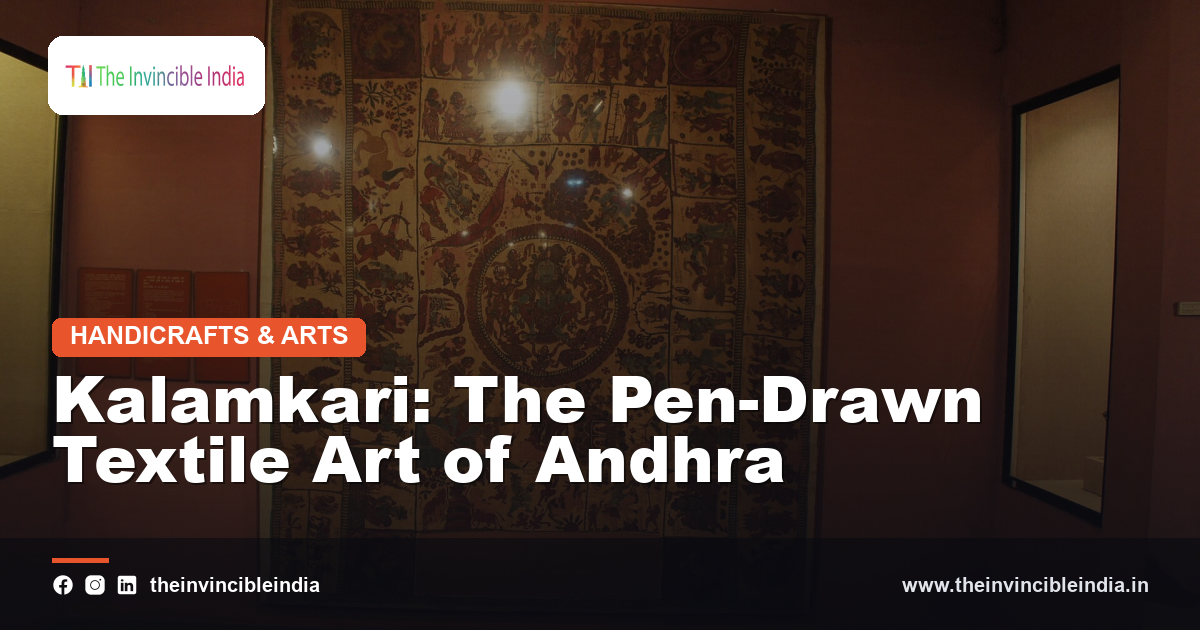
Kalamkari is the textile art of Andhra Pradesh in which patterns and stories are drawn or printed on cotton cloth using natural dyes. The name combines the words for pen and craft, and it describes the central tool of the form, a pointed bamboo pen that carries dye onto fabric. Two great centres, Srikalahasti and Machilipatnam, developed distinct styles, one painted freehand with sacred narratives and the other printed with carved wooden blocks. Like the weaving traditions covered in the guide to Pochampally ikat, Kalamkari shows how Telugu craft communities turned cloth into a language of colour, devotion and design.
Quick Facts
| Detail | Information |
|---|---|
| Art form | Pen-drawn and block-printed textile painting |
| Region | Andhra Pradesh and Telangana |
| Major styles | Srikalahasti (freehand) and Machilipatnam (block print) |
| Fabric | Cotton, and also silk |
| Colours | Natural dyes such as indigo, madder and myrobalan |
| Typical themes | Epics, temple stories, trees of life, floral borders |
What Is Kalamkari
Kalamkari is a family of hand decorated textile techniques from the Telugu-speaking region of south India. The word is generally understood to come from the words kalam, meaning pen, and kari, meaning craftsmanship or work. In its fullest form the craft involves drawing, colouring and dyeing cotton fabric by hand, using only natural materials from plants, minerals and metals.
The result is a durable cloth with rich earthy tones, with deep reds, indigo blues, mustard yellows, greens and blacks arranged in dense compositions. Kalamkari textiles have been used as temple hangings, canopies, wall panels, garments and household furnishings. Today the term covers both freehand painted and block printed work, and it remains one of the best known examples of the natural dye heritage of India.
Historical Background
Painted and printed cotton has a long history on the Indian subcontinent, and the Coromandel coast of south-eastern India became famed for its dyed textiles. Cloth from this coast travelled through trading networks to many parts of Asia and Europe, where it was admired for colourfast, brilliant patterns. Kalamkari developed within this larger world of cotton painting and dyeing.
Over time, patronage from temples, local rulers and merchants supported distinct workshops. Some centres focused on religious narrative cloth for temples, while others produced cloth suited to court taste and to export. The exact chronology of each centre is not simple to state, but the overall picture is clear. Kalamkari grew out of a mature textile culture that valued skill, chemistry and artistry together.
The Srikalahasti Style
The Srikalahasti style is the freehand tradition. Here the artist draws every line with the kalam, a bamboo pen, and fills the forms with colour by hand. The work is closely associated with temple life, and its compositions depict gods, goddesses and stories drawn from sacred literature in vivid narrative panels.
Because no blocks are used for the main figures, each piece reflects the individual skill of the painter. Lines flow with a confident rhythm, faces and ornaments are carefully detailed, and large scenes are organised into bands and frames that guide the viewer through the story. The Srikalahasti approach is slow and demanding, and it has often been practised by families that have trained successive generations in the same workshop.
The Machilipatnam Style
The Machilipatnam style, associated with the port town on the eastern coast, is built around carved wooden blocks. Artisans print outlines and repeating motifs using blocks dipped in dye and then add colours using mordants and further printing or brushwork. The patterns often feature flowering plants, creepers, the tree of life and intricate borders.
This tradition reflects a long encounter with trade and with the decorative tastes of different markets, including influences from Persian design in its floral and arabesque vocabulary. Block printing allows consistent repetition and makes larger quantities of cloth possible, yet each piece still depends on exact registration and a skilled hand. Machilipatnam Kalamkari therefore shows how a craft can combine precision with elegance in a different way from the freehand style.
Preparing the Cloth
Kalamkari starts long before any drawing begins. The cotton fabric is first washed to remove starch and impurities, and it is then treated so that it will absorb the dyes evenly. A traditional treatment involves soaking the cloth in a mixture containing myrobalan and milk, which conditions the fibre and helps the colours to hold.
The cloth is dried in sunlight and washed again several times, which gives it a soft, creamy tone and a suitable texture for painting. This preparation is demanding and affects the final brightness and longevity of the colours. Craftspeople regard it as the foundation of good Kalamkari, since a poorly prepared fabric will not take dye well, and no later skill can fully compensate for it.
The Kalam and the Drawing Process
The kalam is a pointed bamboo or date palm stick, with a bundle of fine cloth or hair tied near the tip that holds liquid dye and releases it in a controlled flow. The artist first sketches the composition in charcoal and then redraws the outlines with the kalam using a dark dye, usually a black made from fermented iron and jaggery.
Controlling the pen takes years of practice, since the flow of dye must be steady and the line unbroken. The outlines define figures, patterns and frames and give the work its characteristic clarity. Even where later colours are added, the drawn line remains the backbone of the design, and the quality of that line is often the first mark by which connoisseurs judge a piece.
Natural Dyes and Mordants
Natural dyes are central to Kalamkari. Indigo supplies the blues, the root of the madder plant gives reds, myrobalan flowers and other plant matter provide yellows, and combinations of these produce greens, browns and purples. The black outline dye is prepared from iron scraps fermented with jaggery.
Many of these dyes will not fix to cotton on their own and need a mordant, a substance that binds colour to the fibre. Alum is widely used for this purpose, and different mordant applications produce different shades from the same dye bath. This chemistry is the quiet science behind the craft. It rewards patience and careful observation, and it explains why Kalamkari colours are subtle, harmonious and long lasting rather than harsh.
A Many-Stage Craft
Kalamkari is often described as a craft with many stages, because a single piece passes through repeated cycles of drawing, mordanting, dyeing, washing and drying. Areas to be coloured red are treated with mordant and then dyed, areas to be blue are protected with wax or resist and dipped in indigo, and further colours are added in sequence.
Between these steps, the cloth is washed in flowing water to remove excess dye and to set the colours, and it is dried under the sun. The order of the steps is important, and a mistake at any point can spoil earlier work. The complexity explains why a finished Kalamkari piece can take days or weeks to complete, and why each stage is handled by trained hands with great care.
Epics and Sacred Narratives
One of the great themes of Kalamkari is the retelling of sacred stories. The Ramayana, the Mahabharata and the Puranas provide scenes that were traditionally painted on long cloth panels used in temples and during recitation. Deities such as Rama, Krishna, Shiva and Durga appear with symbolic attributes, accompanied by attendants, animals and architectural frames.
These cloths served as visual scriptures, helping devotees to follow the story and to focus their devotion. The composition is usually divided into sections, so that the narrative can be read from one panel to the next. In this way Kalamkari functions as both an art and a teaching medium, preserving religious knowledge in colour and line.
Floral Motifs and the Tree of Life
Alongside narrative themes, Kalamkari is famous for its floral and botanical designs. Winding creepers, lotus blossoms, peacocks, birds and the tree of life appear in bedcovers, hangings and garments. The tree of life, with its spreading branches and flowers, is especially associated with the block printed tradition and has become a lasting emblem of the craft.
These motifs combine observation of nature with stylisation and symmetry. They also reflect a long exchange of design ideas, as patterns travelled across regions through trade and were reinterpreted by local artisans. The floral vocabulary of Kalamkari remains popular because it is both decorative and symbolic, expressing growth, abundance and the continuity of life.
Kalamkari in Dress and Home Furnishing
While temple hangings are the classic expression of the craft, Kalamkari has long been used in everyday life. Sarees, dupattas, kurtas, jackets, bedspreads, curtains and cushion covers are all made with Kalamkari fabric. The cotton base makes the cloth comfortable in warm weather, and the natural dyes give it a distinctive earthy appearance.
Designers have also experimented with Kalamkari borders and panels on silk and other fabrics, combining traditional work with contemporary cuts. This adaptation has widened the market while keeping the core techniques alive. The relationship between craftsperson and designer works best when the artisan receives fair recognition and payment, since the continuation of the craft depends on its makers.
Communities and Workshops
Kalamkari is sustained by families and communities who have practised the craft across generations. Work is often divided among members, with some preparing the cloth, others drawing or printing, others handling dye baths and washing. The knowledge of dyes, mordants and timing is learned through apprenticeship and is rarely written down in full.
Workshops cluster in particular towns, where access to flowing water and open drying space supports the demanding washing stages. This community base gives the craft both strength and vulnerability. It allows deep expertise to be shared, but it also means the tradition can weaken quickly if younger members leave for other occupations, which is why training and fair markets are important concerns.
Recognition and Heritage Protection
Kalamkari has received recognition at national level, and the Srikalahasti and Machilipatnam traditions have been protected under the Indian system of geographical indications, which helps identify authentic products and guard their reputation. Government bodies, craft councils and cultural organisations have also supported training, exhibitions and marketing.
Such recognition is valuable because the popularity of Kalamkari has encouraged imitations, including machine printed fabrics that copy the look without the craft process. Buyers who wish to support the tradition can look for information on dyes, hand work and origin. Careful labelling and public awareness help artisans earn a fair return and encourage young people to see the craft as a respected career.
Challenges for the Craft
Kalamkari faces several challenges. Natural dyeing is labour intensive and requires large amounts of clean water, and environmental pressures on local rivers and groundwater can affect the washing stage. Competition from cheaper synthetic prints makes it difficult for artisans to charge a price that reflects the time involved.
There is also the question of succession, since many young people prefer less demanding work. Addressing these issues requires a combination of fair pricing, steady demand, access to raw materials and proper environmental management. Many organisations are working to build direct links between artisans and customers, which reduces the role of intermediaries and gives craftspeople a greater share of the value they create.
Caring for Kalamkari Textiles
Natural dye textiles reward gentle care. Kalamkari garments are best washed by hand in cool water with a mild detergent, kept away from harsh bleaches, and dried in shade to protect the colours. In the first washes, a small amount of dye may bleed, which is a characteristic of natural colouring and not a flaw.
Wall hangings and framed panels should be kept out of strong direct sunlight and away from damp, which can cause fading and staining. With reasonable attention, a good piece can last for many years and even improve in softness. Treating Kalamkari with care also honours the many hours of skilled work it represents and helps the craft retain its value.
Kalamkari Today
Kalamkari today is both a heritage craft and a living contemporary art. Artisans continue to draw sacred epics with the bamboo pen and to print floral textiles with carved blocks, while designers bring the patterns into modern clothing and interiors. The craft is displayed in museums, exhibitions and craft fairs and appreciated by collectors and everyday buyers alike.
Its survival rests on a simple idea, that handwork guided by natural materials produces cloth of lasting beauty. As long as there are painters willing to master the kalam and customers willing to value the labour behind it, Kalamkari will remain one of the most distinctive threads in the story of Indian textile heritage.
Sources & Further Reading
- Ministry of Textiles, Government of India (texmin.nic.in), resources on handloom and handicrafts.
- Ministry of Culture, Government of India (indiaculture.gov.in).
Frequently Asked Questions
What does the word Kalamkari mean?
Kalamkari is generally understood to mean pen work, from kalam, meaning pen, and kari, meaning craft. It refers to the use of a bamboo pen to draw or paint designs on cloth.
What is the difference between Srikalahasti and Machilipatnam Kalamkari?
Srikalahasti Kalamkari is drawn freehand with a pen and is known for sacred narrative scenes. Machilipatnam Kalamkari uses carved wooden blocks and is known for floral and tree of life designs.
Which dyes are used in Kalamkari?
Traditional Kalamkari uses natural dyes such as indigo for blue, madder for red and plant sources like myrobalan for yellow. Mordants such as alum help the colours fix on the cloth.
What fabrics are used for Kalamkari?
Cotton is the traditional base fabric, though silk and other cloths are also used in contemporary work. The fabric is specially prepared so that it absorbs natural dyes evenly.
How can I identify authentic Kalamkari?
Authentic pieces show hand drawn or block printed lines with slight natural variation, and earthy dye tones. Information from the seller about natural dyes, hand work and place of origin is a helpful guide.


