

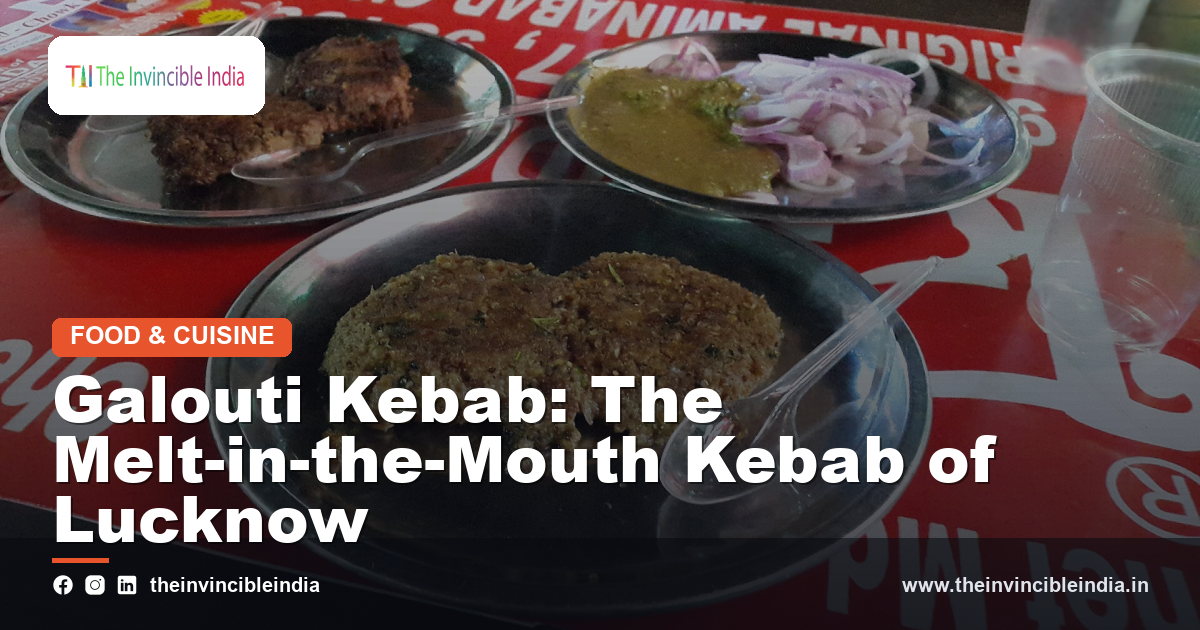
Galouti kebab is the celebrated minced-meat kebab of Lucknow, a dish so tender that it is said to dissolve on the tongue almost as soon as it is tasted. It belongs to the refined Awadhi tradition, a courtly style of cooking that grew in the old kingdom of Awadh and values subtlety, aroma and texture above brute heat. Unlike the coarser seekh kebab, the galouti is made from meat pounded to a smooth paste and scented with a carefully balanced blend of spices. It sits comfortably within the wider story of the regional cuisines of India, where a single dish often carries the identity of an entire city.
Quick Facts
| Detail | Information |
|---|---|
| Type | Minced-meat kebab, pan-cooked on a griddle |
| Region | Lucknow, Uttar Pradesh |
| Cuisine | Awadhi |
| Key ingredients | Finely minced meat, raw papaya, ghee and spices |
| Texture | Soft, smooth and melting |
| Served with | Ulte tawa ka paratha or sheermal |
What Galouti Kebab Is
Galouti kebab is a small, round and flat kebab made from very finely minced meat, traditionally mutton or lamb, that is ground and pounded until it becomes a smooth, almost silken paste. Once seasoned with a blend of aromatic spices and bound with a tenderising agent, the mixture is shaped into patties and cooked gently in ghee on a flat griddle. The result is a kebab with no resistance at all to the bite, a quality that has made it one of the most admired preparations in North Indian cooking. The word galouti itself is linked to the idea of something softened or melted, which neatly describes the experience of eating it. In short, the galouti is defined less by its flavour alone than by its extraordinary, yielding texture.
Origins in the Awadhi Courts
The galouti kebab is firmly associated with the Awadhi courts of Lucknow, where the nawabs and their kitchens became renowned for elaborate, refined cooking that treated the dining table as an art form. Awadh developed a culinary culture in which skilled cooks competed to create dishes of distinction, and the best of these came to be remembered long after the courts themselves had changed. The kebab is a product of that environment, shaped by an emphasis on delicacy, fragrance and technique rather than on simple spice and heat. Lucknow became a city whose reputation rested substantially on its food, and the galouti stands among its most recognisable ambassadors. Its origins therefore lie in the cultured, patient kitchens of Awadh, where refinement was a point of pride.
The Popular Legend of the Toothless Nawab
A widely repeated tradition holds that the galouti was created for an elderly ruler of Awadh who had lost his teeth but not his appetite for kebabs, and whose cooks were therefore challenged to produce a kebab that required no chewing at all. The story is told in many versions and attached to different rulers, which is typical of food legends, and it should be treated as a charming piece of folklore rather than a documented fact. Even so, it captures something true about the dish, which is that its entire purpose is to be exquisitely soft. Whatever the exact truth of its beginnings, the tale endures because it explains the kebab so memorably. The legend, in other words, is a story told to account for the texture that defines the dish.
The Role of Raw Papaya
One of the defining ingredients in a galouti is raw papaya, which is ground into a paste and mixed through the meat as a natural tenderiser. Raw papaya contains an enzyme that breaks down the fibres in meat, and cooks in Awadh learned long ago to use this to produce a texture that could not be achieved by mincing alone. The quantity has to be judged with care, since too little leaves the kebab firm and too much can make it mushy and flavourless. Skilled cooks therefore rely on practised judgement and the feel of the mixture rather than on rigid measurements. Raw papaya is thus the quiet but essential secret behind the galouti, working behind the scenes to give the kebab its celebrated softness.
Choosing and Preparing the Meat
The quality of a galouti depends heavily on the meat chosen and on how it is prepared. Traditionally the kebab is made from tender cuts of mutton or lamb, with a small proportion of fat included to keep the patties moist and give them their rich, rounded flavour. The meat is minced repeatedly, and in classic kitchens it is pounded as well, until no trace of grain or fibre remains and the mixture feels like a smooth, cohesive paste. This laborious preparation is a large part of what separates a true galouti from an ordinary minced kebab. Patience at this stage is repaid at the table, because it is the thoroughness of the grinding that allows the finished kebab to melt so completely. Careful preparation of the meat is therefore the foundation of the entire dish.
The Spice Blend and Its Fragrance
Galouti kebab is known for a spice blend that is aromatic rather than aggressively hot, in keeping with the Awadhi preference for fragrance and balance. Cooks traditionally draw on warm whole and ground spices such as cardamom, cloves, mace, nutmeg and black pepper, together with ingredients such as ginger, garlic and roasted gram flour, and sometimes a touch of rose or kewra essence. Every kitchen and every family guards its own proportions, and the exact composition of the masala is often described as a closely held secret. The aim is a gentle, layered perfume that supports the meat instead of overpowering it. In this way the spice blend of the galouti reflects the larger Awadhi principle that depth of aroma matters more than sheer intensity, an approach also explored in the guide to Indian spices.
Binding and Shaping the Patties
Because the meat is so fine and soft, galouti patties need a binder that holds them together without making them firm. Cooks commonly use roasted gram flour or a similar gentle thickener, mixed in modest quantities so that it supports the structure of the patty while preserving its tenderness. The mixture is often rested for a period, allowing the flavours to settle and the tenderising effect of the papaya to work through the meat. It is then shaped by hand into small, flat rounds, a task that requires a light touch to avoid compressing the mixture. These modest steps are easy to overlook, yet they determine whether the patties hold their form on the griddle and remain delicate within. Careful binding and shaping, in short, allow the softest of kebabs to keep its shape.
Cooking on the Tawa
Unlike the seekh kebab, which is grilled over open coals on skewers, the galouti is traditionally cooked on a flat iron griddle known as a tawa, using generous amounts of ghee. The patties are placed on the hot surface and cooked slowly, turned carefully so that each side develops a thin, golden crust while the interior remains soft and moist. The mixture is far too delicate to survive skewering, which is precisely why the griddle became the natural cooking surface. The ghee contributes both flavour and a gentle, glossy finish that is characteristic of a well-made galouti. The tawa, then, is not merely a convenience but an essential part of the method, suited to a kebab whose chief virtue is its fragile tenderness.
The Role of Ghee
Ghee is central to the galouti, serving as the cooking medium, a source of richness and a carrier of aroma. In Awadhi kitchens clarified butter is valued for its nutty, comforting fragrance, and its generous use in shallow frying contributes to the glossy surface and rounded taste of the finished kebab. The ghee also helps to form the delicate crust that contrasts so pleasingly with the soft centre. Used with restraint it enriches the dish, while used carelessly it can overwhelm the subtle spices, so balance remains important. The partnership of ghee and minced meat is typical of North Indian cooking, where clarified butter is regarded as both a luxury and a mark of hospitality. Ghee thus lends the galouti much of its warmth, depth and indulgent character.
The Classic Accompaniment
A galouti kebab is rarely served alone, and the classic companion is a layered flatbread. In Lucknow it is commonly paired with ulte tawa ka paratha, a bread cooked on the reverse side of the griddle, or with sheermal, a lightly sweet, saffron-tinged flatbread that is a signature of the city’s bakers. The kebab is often placed on the bread, topped with slivers of onion, a squeeze of lemon and a sprinkle of mint chutney, and eaten as a kind of small, rich sandwich. The soft kebab and the slightly crisp, flaky bread complement each other beautifully, each providing what the other lacks. This pairing has become so closely linked to the dish that the two are often spoken of together. The bread, in effect, completes the galouti as an experience.
Onions, Lemon and Chutney
The garnishes served with a galouti are simple but carefully chosen to cut through its richness. Thinly sliced raw onions, often lightly steeped in lemon juice or vinegar, provide a sharp, crunchy contrast, while a fresh green chutney made from mint and coriander adds brightness and a gentle heat. A final squeeze of lemon lifts the flavour of the kebab and refreshes the palate between bites. These accompaniments are not afterthoughts but part of the intended balance, ensuring that the soft, ghee-rich kebab never becomes heavy. Such pairings are a common feature of Indian cooking, where acidity and freshness are used to balance richness. The garnishes, therefore, play a quiet but important supporting role in the enjoyment of the kebab.
Lucknow's Kebab Culture
Lucknow is widely regarded as one of India’s great kebab cities, with a culture of kebab-making that extends from street-side stalls in the old quarters to the dining rooms of well-known restaurants. Generations of cooks have refined their craft within this environment, and several family-run establishments have become institutions known across the country for their particular style of kebab. The galouti stands at the centre of this tradition, together with other preparations such as the kakori kebab and the shami kebab. A visit to the older parts of the city remains, for many food lovers, a pilgrimage in search of the most tender galouti. The city’s enduring kebab culture shows how closely the identity of Lucknow is tied to its table, and to this kebab in particular.
Galouti and the Other Awadhi Kebabs
The galouti is one of several celebrated Awadhi kebabs, each distinguished by its method, texture and character. The kakori kebab, associated with a town near Lucknow, is also known for its fine, soft texture, while the shami kebab combines minced meat with ground lentils to form a firmer, more substantial patty. The seekh kebab, cooked on skewers over coals, offers a smokier and more robust experience. Set beside these, the galouti is the most delicate and the most luxurious in feel, the one whose appeal rests almost entirely on its softness. Understanding the differences between these kebabs helps to appreciate how varied the Awadhi repertoire is. The galouti thus occupies a distinct place within a rich family of kebabs, each with its own personality.
Vegetarian and Other Variations
While the classic galouti is made from mutton or lamb, cooks across India have created variations to suit different tastes and dietary traditions. Versions made with chicken are common, offering a lighter texture, and in recent years vegetarian adaptations have appeared that use ingredients such as raw banana, yam, mushrooms or paneer, bound and spiced to echo the original’s softness. These interpretations vary in how closely they capture the character of the traditional kebab, and purists generally maintain that nothing quite replaces the original. Nonetheless they show how widely the idea of the galouti has travelled and how adaptable it has proved. The existence of such variations is itself a sign of the dish’s popularity and its influence on modern Indian cooking.
Cultural Meaning and Hospitality
In Awadhi culture, food is closely bound up with ideas of hospitality, courtesy and refinement, often summed up in the traditional Lucknowi concern with etiquette and graciousness. Serving a guest an expertly made galouti is a way of demonstrating respect, since the dish requires time, skill and quality ingredients. The care that goes into producing such a delicate kebab mirrors the care expected in welcoming a visitor. This cultural meaning helps to explain why the galouti has remained a point of pride for the city rather than being simply another item on a menu. A kebab that melts so gently reflects a tradition that values grace over show. The galouti therefore carries, in its softness, a whole philosophy of generous and cultivated hospitality.
Festive and Special Occasions
Galouti kebabs are particularly associated with celebrations and special meals, especially during Eid and at the festive gatherings of Lucknow’s Muslim families, where lavish spreads reflect the generosity of the host. The dish also features at weddings and formal dinners, often served as a starter that sets the tone for the meal to follow. Because it is time-consuming to prepare properly, it has traditionally been reserved for moments when care and effort are worth investing. In many households the recipe is passed down within the family, treated as an inheritance of taste. Its association with celebration has added to the sense that the galouti is a special rather than an everyday dish. It remains, in this sense, a kebab for occasions that deserve something memorable.
Galouti Kebab Today
Today the galouti kebab is enjoyed well beyond Lucknow, featuring on the menus of restaurants across India and in Indian dining rooms around the world. It has become one of the best-known symbols of Awadhi cuisine and a favourite starter at celebrations, while chefs continue to experiment with new forms, including bite-sized versions and plated, contemporary presentations. Despite such changes, the essential qualities of the dish endure: a finely minced mixture, a fragrant and balanced spice blend, gentle cooking on a griddle and a texture that yields at the slightest touch. For visitors to the city, a plate of galouti with a warm bread remains a defining culinary experience. The galouti today stands as proof that a dish built on patience and refinement can remain beloved across generations.
Sources & Further Reading
- Ministry of Tourism, Government of India, on the cuisines of India (tourism.gov.in).
- Ministry of Culture, Government of India (indiaculture.gov.in).
Frequently Asked Questions
What is galouti kebab?
Galouti kebab is a soft, flat kebab from Lucknow made from very finely minced meat, usually mutton or lamb, blended with aromatic spices and a tenderiser such as raw papaya. It is cooked in ghee on a griddle and is known for a texture that melts in the mouth.
Why is galouti kebab so soft?
Its softness comes from meat that is minced and pounded to a smooth paste and from the addition of raw papaya, which tenderises the fibres. Gentle cooking on a griddle then preserves this delicate texture.
What is the legend behind galouti kebab?
A popular tradition says the kebab was devised for an elderly ruler of Awadh who could no longer chew well. The story is folklore told in several versions, and it should not be read as documented history.
What is galouti kebab served with?
It is traditionally served with a flatbread such as ulte tawa ka paratha or sheermal, along with sliced onions, lemon and green mint chutney. The bread adds a pleasing contrast of texture to the soft kebab.
How is galouti kebab different from seekh kebab?
Galouti is made from a smooth meat paste and cooked on a flat griddle, giving it a very soft texture. Seekh kebab uses coarser minced meat shaped onto skewers and cooked over coals, resulting in a firmer, smokier kebab.


