

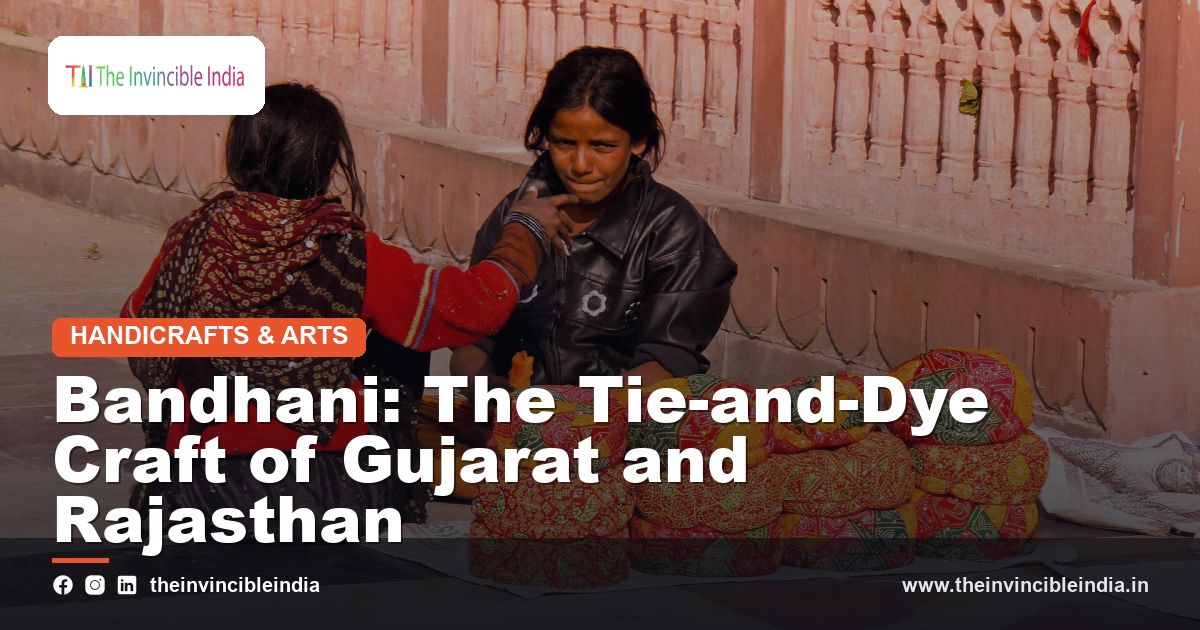
Bandhani is the tie-and-dye craft of western India, in which a cloth is pinched and bound into thousands of tiny knots before dyeing, so that the knotted points resist the colour and reveal a pattern of dots when untied. Practised mainly in Gujarat and Rajasthan, it produces the vividly patterned dupattas, sarees and turbans associated with weddings, festivals and everyday dress. Its sense of colour and its community-based craftsmanship can be compared with the work described in the guide to Phulkari embroidery, another textile art in which patient handwork marks the most important moments of life.
Quick Facts
| Detail | Information |
|---|---|
| Craft | Tie-and-dye (resist dyeing) textile art |
| Main regions | Gujarat and Rajasthan |
| Also known as | Bandhej |
| Technique | Binding tiny points of cloth with thread before dyeing |
| Common fabrics | Cotton, silk and georgette |
| Typical use | Sarees, dupattas, turbans, wedding wear |
What Is Bandhani
Bandhani is a method of decorating cloth by tying and dyeing. Small portions of fabric are plucked up and bound tightly with thread, and the cloth is then dipped in dye. The tied areas remain undyed, while the rest takes the colour, and when the threads are removed the pattern appears as small dots and rings of the original colour on a coloured ground.
The craft is practised across Gujarat and Rajasthan and is known in different places as Bandhani or Bandhej. It is one of the oldest forms of resist dyeing in India, and its patterns are among the most recognisable in the subcontinent. The technique is simple in principle, yet extremely demanding in execution, which is why a fine piece is valued as a mark of skill and patience.
The Meaning of the Name
The word Bandhani is commonly traced to the Sanskrit root bandh, meaning to bind or to tie. This origin fits the process exactly, since the whole craft depends on binding fabric before dyeing. The alternative name Bandhej comes from the same idea and is widely used in Rajasthan.
The name therefore describes a technique rather than a particular design, which is why many different patterns can be grouped under it. The same tying principle appears in various forms around the world, but the Indian tradition has a distinct vocabulary of dots, waves and grids and a close relationship with local costume. Understanding the name helps to clarify that Bandhani is defined by a method, not by a single look.
History and Early Traces
Tie-and-dye textiles in India have a long history, and the tradition is generally regarded as ancient. Painted representations in old art and descriptions in literature have been interpreted as evidence of early dyed and patterned cloth. The exact date of the first Bandhani cannot be given with certainty, so it is wiser to speak of a tradition that has been developed over many centuries.
Trade routes along the western coast helped Gujarat and Rajasthan to become important centres of dyed cloth, and merchants carried Bandhani to distant markets. Local communities refined the craft, creating distinctive regional patterns and colour traditions. In this long evolution, Bandhani moved from a specialised craft of certain communities to a widely loved textile found in many Indian households.
The Tying Technique
The heart of Bandhani is the tying. The designer first marks the pattern on the cloth, often using a stamp or a tracing with a washable colour. Skilled tiers then pluck up a tiny point of fabric at each marked spot, wind a fine thread around it several times and move on to the next, often without cutting the thread between knots.
The work is done with the fingertips and a trained sense of rhythm, and it is traditionally performed by women, who tie knots with remarkable speed and accuracy. A single dupatta can carry thousands of knots, and the tightness and size of each affect the final dot. The skill lies in uniformity, since even spacing and consistent knot size give a cloth its crisp, jewel-like appearance.
Dyeing in Stages
After tying, the cloth is dyed. When more than one colour is desired, the dyeing proceeds in stages, usually from the lightest colour to the darkest. Between dye baths, additional areas may be tied to protect colours that have already been fixed, so that the pattern becomes richer with each stage.
This sequence requires careful planning, because colours cannot be removed once they are applied, and the final look depends on the order of dyeing and tying. Dyers judge the temperature, time and strength of the baths from experience. After dyeing, the cloth is washed and dried, and the knots are carefully opened. The moment of untying is the reveal of the pattern, when the work of the tiers and dyers finally becomes visible.
Colours and Their Associations
Bandhani is known for its vibrant colours. Reds, yellows, greens, blacks, maroons, pinks and blues are frequently used, often placed against each other in bold contrast. Red and yellow have strong associations with auspicious occasions in Indian culture, and they feature prominently in wedding clothing and festive wear.
Historically, natural dyes from plants and minerals were used, and some workshops continue this tradition today, while many producers now use modern dyes for a wider and more stable range. The colour choices also vary by community and season, with certain combinations preferred by particular groups. In every case, the aim is to create a lively play of colour and pattern that expresses celebration and a sense of belonging.
Dots, Waves and Other Patterns
The basic unit of Bandhani is the dot, but the dots can be arranged into countless designs. A single tied point makes a small circle, while grouped ties make larger rings, squares, flowers or leaf shapes. Names such as bundi, kodi and laddu are used by craftspeople for different dot sizes and formations, and artisans often have a rich vocabulary for their patterns.
Beyond dots, there are designs of stripes and waves, grid patterns, bands of floral motifs and cloth divided into coloured sections. Some patterns draw on birds, elephants, dancing figures and temple shapes. This variety shows that a simple tying method can produce elaborate and expressive compositions, depending on the imagination and the experience of the craftsperson.
Leheriya and Related Tie-Dye Styles
Rajasthan is also known for leheriya, a related resist-dyeing method that produces diagonal waves rather than dots. In leheriya the cloth is rolled and tied before dyeing, and the pattern emerges as flowing stripes in contrasting colours. It is often associated with the monsoon season and with festive turbans and scarves.
Although leheriya is distinct from Bandhani in its technique, the two are closely related members of the same family of Indian tie-dye traditions. In some places they are found in the same fabric, with waves forming one section and dots another. Seeing them together shows how resist dyeing in western India offers many artistic possibilities from the same basic principle of protecting parts of cloth from colour.
Gujarat Traditions
In Gujarat, Bandhani is closely associated with towns of Saurashtra and Kutch, including Jamnagar and Bhuj, where communities such as the Khatris have practised dyeing and tying for generations. Gujarati Bandhani is known for fine, tightly tied work and for traditional garments such as the odhani and the wedding saree.
The Gharchola, a Gujarati wedding saree with a pattern of squares and grids, is one of the best known examples, and it is worn by brides as a symbol of marriage and good fortune. Gujarat Bandhani often combines tying with other techniques such as embroidery and mirror work. The local identity of the craft is strong, and it remains an important part of the cultural life of the state.
Rajasthan Traditions
In Rajasthan, Bandhej is practised in several towns and is closely linked to regional dress. Colourful odhnis, turbans and sarees are worn in everyday life and at festivals. The desert state has a long love of strong colour, and Bandhej fits this taste, adding movement and brightness to the landscape.
Different regions have their own preferred patterns and colour combinations, and the craft is closely bound up with the life of local communities. Markets in cities such as Jaipur and Jodhpur display a wide range of Bandhej fabric. The craft has also adapted to changing needs, appearing in contemporary clothing and household goods without losing its link to tradition.
Bandhani at Weddings and Festivals
Bandhani has a special place in celebration. Brides in many communities wear Bandhani sarees or odhnis, and gifts of Bandhani cloth are exchanged among relatives. Festivals such as Teej, Holi and Navratri see people dressed in brightly coloured tie-dyed fabric.
The craft is associated with good fortune, and the many small dots are sometimes interpreted as symbols of blessing and abundance. At the same time, Bandhani is not reserved for the formal occasions, and lighter versions are worn throughout the year. This range of use helps to explain the continuing popularity of the craft and its deep connection with the emotional life of western Indian families.
The Craftspeople and Community Structure
Bandhani depends on a division of labour among tiers, dyers, washers and traders. The tiers are frequently women who work from home, fitting the craft around household duties. The dyers and finishing workers may belong to separate families with their own specialised knowledge.
This structure allows a large amount of fine work to be produced, but it also means that the people who perform the most time-consuming task, the tying, are sometimes the least well paid. Cooperatives, craft organisations and government schemes have sought to improve conditions and income for tiers. Recognising the role of these women is important, since the excellence of Bandhani rests on their sustained skill and effort.
Cloth, Quality and Authenticity
True Bandhani is recognised by the fact that each dot is formed by a tied knot, which leaves a small raised point in the cloth. When the fabric is gently stretched, the points often show a small centre mark and a slightly rough texture. The design is usually slightly uneven in a way that reflects hand work.
Printed imitations imitate the look using screens or machines, but they lack the characteristic puckering and variations of tied work. Fabric quality also matters, since fine cotton, silk and georgette are all suitable but respond differently to dye. A buyer who wishes to support the craft can look for the raised dots, ask about the producer and prefer sellers who share information about the people who made the cloth.
Caring for Bandhani Cloth
Bandhani textiles benefit from gentle care. Many pieces, especially those with deep colours, are best washed separately by hand in cool water with a mild detergent for the first few washes, since some colour may bleed. They should be dried in shade, as strong sunlight can fade the dyes over time.
Silk Bandhani may require dry cleaning, and special pieces such as bridal sarees should be stored folded in soft cotton cloth away from damp and insects. It is also helpful to avoid wringing the fabric, which can weaken the knotted areas and distort the pattern. With attentive care, a Bandhani piece can be used and cherished for many years, and often becomes a family heirloom.
Recognition, Revival and Challenges
Bandhani has received recognition as an important craft heritage of India, and Kutch and Jamnagar products have been the subject of efforts to protect their identity. Exhibitions, craft fairs and cooperative marketing have increased visibility. Designers regularly use Bandhani in fashion, which has brought the craft to new audiences.
Yet challenges remain. Machine printed copies undercut hand tied work, tiers are often paid little for their labour, and the effects of water pollution from dyeing can harm local environments. Responsible production, fair wages, the use of safer dyes and better public awareness all contribute to a more secure future. The craft survives when its makers are respected and its authenticity is understood.
Bandhani Today
Bandhani today remains a living craft that connects tradition with contemporary life. Brides still wear the Gharchola, festival crowds still fill the streets in bright tie-dyed cloth, and designers still return to the humble dot for inspiration. New colours, fabrics and cuts keep the form fresh while the basic act of tying and dyeing remains unchanged.
The strength of Bandhani lies in the combination of simplicity and skill, as a tiny knot and a dip in colour can create a design of great beauty. By valuing hand tied work and supporting the families who practise it, admirers of Indian textiles can help ensure that this brilliant craft of Gujarat and Rajasthan continues to colour the future.
Sources & Further Reading
- Ministry of Textiles, Government of India (texmin.nic.in), resources on handloom and handicrafts.
- Ministry of Culture, Government of India (indiaculture.gov.in).
Frequently Asked Questions
What is Bandhani?
Bandhani is a tie-and-dye textile craft in which tiny points of cloth are tied with thread before dyeing. The tied points resist the colour and form dotted patterns when the threads are removed.
Where is Bandhani made?
Bandhani is mainly made in Gujarat and Rajasthan, with well known centres in towns such as Jamnagar, Bhuj, Jaipur and Jodhpur. In Rajasthan it is also called Bandhej.
What is the Gharchola saree?
The Gharchola is a traditional Gujarati wedding saree decorated with a grid of tied squares. It is worn by brides as a symbol of marriage and good fortune.
How is Bandhani different from leheriya?
Bandhani produces patterns of dots, while leheriya produces diagonal wave stripes by rolling and tying the cloth. Both are resist dyeing methods from western India.
How can I tell if Bandhani is handmade?
Handmade Bandhani shows small raised points where the knots were tied, along with slight natural irregularities in the dots. Printed imitations look flat and unusually uniform.


