

Pootharekulu is one of the most unusual sweets in India, a delicacy made from sheets of rice starch so thin that they resemble translucent paper. Closely associated with the village of Atreyapuram in the Godavari delta of Andhra Pradesh, the sweet is made by folding or rolling these fragile sheets around a filling of powdered sugar or jaggery with ghee and dry fruit, creating a confection that melts on the tongue almost without effort. The name itself means coating sheet in Telugu, a fair description of the craft. Among the famous sweets of India, it stands out for the extraordinary skill required to make its wrapper.
Quick Facts
| Detail | Information |
|---|---|
| Type | Rolled or folded sheet sweet |
| Region | Atreyapuram, Godavari delta, Andhra Pradesh |
| Wrapper | Wafer-thin rice starch sheets |
| Fillings | Powdered sugar or jaggery, ghee and dry fruit |
| Texture | Delicate, crisp and melting |
| Recognition | Carries a Geographical Indication tag |
What Pootharekulu Is
Pootharekulu is a traditional sweet from Andhra Pradesh in which a paper-thin sheet made from rice batter is wrapped around a sweet filling to form a neat roll or folded packet. The sheet itself is almost weightless and nearly transparent, with a delicate crispness that dissolves quickly in the mouth. Inside, the sweetness comes from powdered sugar or jaggery, enriched with ghee and often sprinkled with chopped nuts or cardamom. The overall effect is light, fragrant and very different from the heavier syrup-soaked or milk-based sweets common elsewhere in India. Its unique character lies in the contrast between the almost invisible wrapper and the rich, buttery interior. Pootharekulu is therefore a sweet in which craftsmanship, rather than complexity of flavour, is the principal attraction.
The Meaning of the Name
The name pootharekulu comes from Telugu and is commonly understood to combine words meaning to coat or cover and a thin sheet or petal, describing the sweet’s defining feature, a coating of delicate sheets. This descriptive quality is typical of regional food names, which often refer directly to the method or appearance of a dish. Because the sheets resemble paper, the sweet is also widely known in English as the paper sweet, a name that has helped it to travel in popular conversation far beyond Andhra Pradesh. Hearing either name conjures the image of a roll that looks almost too fragile to eat. The name, in this way, captures the essence of the sweet in a single word.
Atreyapuram and the Godavari Delta
The sweet is inseparably linked with Atreyapuram, a village in the fertile Godavari delta region of coastal Andhra Pradesh, where generations of families have been engaged in the craft. The delta is one of the great rice-growing areas of the country, and the abundance of rice there provided the raw material for the sheets that give the sweet its identity. Over time the village became so closely associated with the delicacy that its name is attached to it in common usage, and visitors to the region often seek out the local makers directly. Many households in and around the village have contributed to the trade, with skills passed from parent to child. Atreyapuram is thus the cultural home of pootharekulu, and the sweet is a source of local pride.
Rice and the Starch Sheet
The wrapper of pootharekulu begins with rice, soaked and then ground into a fine, smooth batter. In the traditional method the batter is allowed to settle so that the starch can be separated and used in a thin, flowing form, which is then spread across a hot surface to cook almost instantly. The result is a sheet of extraordinary delicacy, thin enough to see through and light enough to lift with a fingertip. The quality of the rice and the consistency of the batter strongly influence how the sheet turns out, and experienced makers have a refined sense of what is required. Rice is not simply an ingredient here but the foundation of the whole sweet, and its transformation into a flexible, paper-like sheet is the central marvel of the craft.
The Inverted Pot Technique
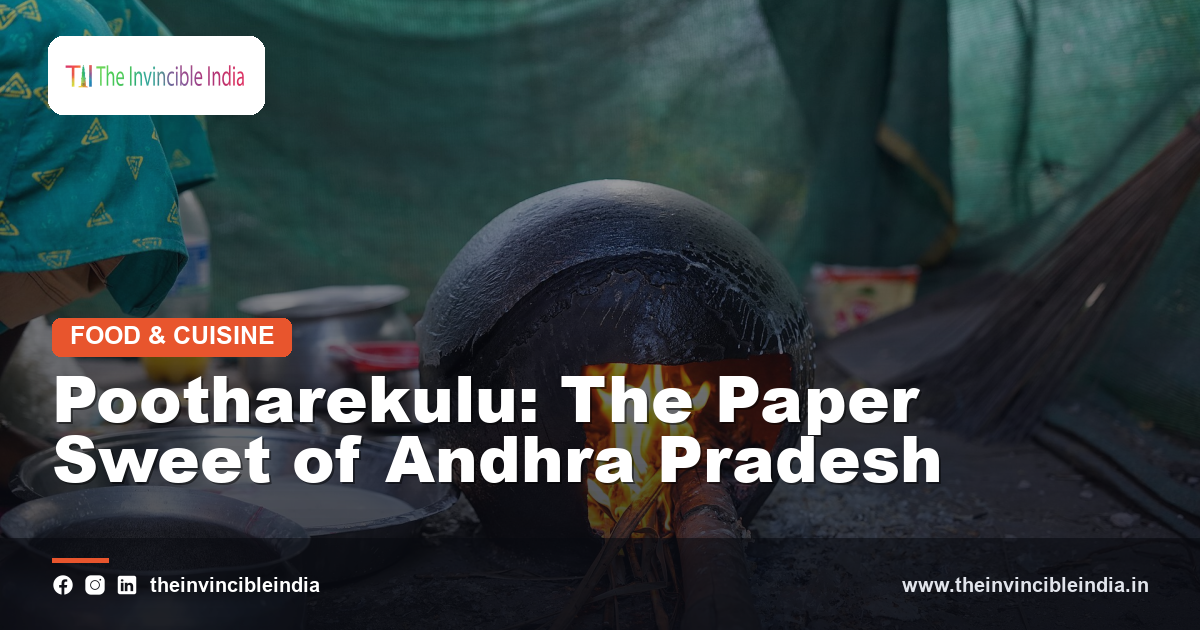
The most distinctive feature of making pootharekulu sheets is the cooking surface, traditionally a large earthen pot turned upside down over a fire so that its rounded base becomes a hot, curved griddle. The maker dips a cloth into the thin rice batter and draws it quickly across the heated surface in a smooth, sweeping motion, leaving a fine layer of batter behind. Within moments the layer cooks and can be gently peeled away as a complete sheet. The process demands speed, a steady hand and a close feel for the temperature, since the slightest hesitation can tear or thicken the sheet. This technique is one of the most striking examples of traditional Indian kitchen ingenuity. It transforms a humble clay pot into an instrument of remarkable precision.
Skill and Years of Practice
Making the sheets of pootharekulu is a skill that takes considerable time to master, and those who practise it are often regarded as artisans whose abilities cannot be quickly acquired. The motion of spreading the batter must be even and confident, the heat must be judged without instruments and the sheet must be lifted at precisely the right moment. Beginners commonly produce sheets that are torn, uneven or too thick. Families in Atreyapuram have traditionally trained younger members through long observation and repetition, so that the technique becomes almost instinctive. This transfer of skill is an example of living heritage in practice. The craft endures because each generation takes care to learn what the previous one has perfected.
Assembling the Sweet
Once the sheets are ready, the sweet is assembled by laying several layers of sheet one above another, with a coating of melted ghee brushed between them and a layer of powdered sugar or jaggery sprinkled across the surface. The stack is then rolled or folded into a neat shape, often cut into convenient portions and sometimes finished with chopped nuts. The layering is done carefully to avoid tearing the fragile sheets, and the amount of ghee must be judged so that the roll is moist without becoming soggy. The final product is a small, neat parcel that looks simple yet conceals considerable care in its construction. The assembly, then, is the second half of the craft, completing what the sheet began.
Sugar and Jaggery Fillings
Two principal fillings define the traditional range of pootharekulu: powdered sugar and jaggery. The sugar version is lighter, whiter and more delicate in flavour, allowing the buttery notes of ghee and the faint crispness of the sheet to come forward. The jaggery version, made with finely grated or powdered unrefined cane sugar, is darker, with a deeper, more earthy and caramel-like sweetness that many people regard as more traditional. Each has its devoted admirers, and both are commonly sold side by side. The choice between them is largely a matter of personal taste, and neither is considered superior. Together they show how a single structural idea can be adapted to produce quite different pleasures.
Ghee, Cardamom and Dry Fruit
Ghee is the essential binder and flavouring in a pootharekulu, brushed generously between the layers so that the sheets cling to the filling and the sweet acquires a rich, nutty fragrance. Cardamom is often mixed into the sugar to add aroma, while chopped cashews, almonds or pistachios provide texture and a gentle richness. In some versions other flavourings are included, such as a hint of saffron or a spoonful of dried fruit. These additions are always restrained, since the sweet depends on subtlety and the delicate sheet can easily be overwhelmed. The balance between ghee, sweetener, spice and nuts is part of what makes a well-made pootharekulu memorable. Restraint is therefore as important as richness in the flavour of this sweet.
Texture and the Melt on the Tongue
The appeal of pootharekulu lies as much in its texture as in its flavour. The sheets are crisp for a moment when bitten, then soften almost instantly as they meet the moisture of the mouth, dissolving together with the sugar and ghee into a sweet, buttery whisper. The experience is delicate and fleeting, quite unlike that of a dense, chewy or syrupy sweet. Because the sheets are so fine, the sweet must be handled and stored with care to prevent them from softening or breaking. Eating one is a brief but memorable sensory event. The texture of pootharekulu is thus its signature, and it is this melting lightness that most visitors remember long after the taste has faded.
Festive and Wedding Traditions
Pootharekulu has a long association with celebrations in Andhra Pradesh, where it is commonly offered at festivals, family gatherings and weddings. It is a customary gift to give to relatives and neighbours, and in many households no important occasion is complete without a box of sweets. Because the sheets are so fragile, the sweet is carefully packed to arrive intact, and visitors travelling from the region often carry boxes home as presents. Its role in gift-giving has helped establish it as a symbol of Andhra hospitality and generosity. By appearing at the happiest moments of family life, pootharekulu has come to represent the warmth and festivity of the coastal Andhra table.
Pootharekulu Among Andhra Sweets
Andhra Pradesh has a rich repertoire of traditional sweets, ranging from the ghee-rich bobbatlu, a stuffed flatbread, to the sugar-syrup delicacy kakinada kaja and the jaggery-based ariselu. Placed among these, pootharekulu is unusual for its lightness and its reliance on a wrapper rather than a dense dough or syrup. It also stands apart for its technique, since few other Indian sweets depend on a sheet made so thin and so quickly. Yet it fits naturally within the state’s sweet-making tradition, which values ghee, jaggery and rice in abundance. The paper sweet is therefore both an outlier and a representative, distinct in form but fully at home in the larger Andhra sweet family.
A Geographical Indication
In recognition of its strong link with a particular place and craft, Atreyapuram pootharekulu has been awarded a Geographical Indication tag, a form of legal protection that identifies a product as originating from a specific region and possessing qualities tied to that origin. Such recognition is intended to safeguard the reputation of authentic products and to support the artisans who make them. For pootharekulu, it affirms that the sweet is not merely a recipe that anyone may reproduce but a heritage product bound to the skills and landscape of the Godavari delta. This status has helped to raise awareness of the craft beyond the region. The tag, in short, formalises what local tradition has long held, that the paper sweet belongs to Atreyapuram.
Livelihood and Community
Beyond its cultural meaning, pootharekulu supports the livelihoods of many families in and around Atreyapuram, with households engaged in preparing sheets, assembling sweets and packing them for sale. The trade is largely a home-based craft, with women and men both playing important roles, and it connects local farmers who supply rice and ghee producers with the artisans who transform them. As demand has grown beyond the region, orders from distant cities have helped to sustain the work and to encourage younger members of the community to learn it. The sweet therefore functions as a small economic engine as well as a cultural emblem. Its continued success depends on the community that makes it, and in turn it helps to sustain that community.
Modern Flavours and Innovations
While the sugar and jaggery versions remain the classics, makers in recent years have introduced a range of newer fillings and flavours, including chocolate, dried fruit mixtures, coconut and various spiced or fruit-flavoured blends. These contemporary versions are designed to appeal to younger customers and to the gifting market, and they are often sold in attractive boxes. Opinions differ on the value of such innovations, with traditionalists preferring the original, while others welcome them as a way to keep the craft commercially vibrant. Whatever one’s view, the willingness of artisans to experiment shows that pootharekulu is a living tradition rather than a fixed relic. Innovation, handled with care, can help an old craft remain relevant to new tastes.
Pootharekulu Today
Today pootharekulu is known across India and beyond, sold in sweet shops, ordered online and given as a gift to those who want to share a distinctive taste of Andhra Pradesh. It has become a popular subject for food writers and travellers drawn by its unusual form and the fascinating technique behind it. The craft of the inverted pot and the drawn sheet continues in Atreyapuram, supported by recognition of its heritage value. For visitors to the Godavari delta, watching a skilled maker draw a perfect sheet remains an unforgettable sight. Pootharekulu today stands as a testament to how humble rice, a clay pot and an expert hand can combine to create one of the most delicate sweets in the world.
Sources & Further Reading
- Ministry of Tourism, Government of India, on the cuisines of India (tourism.gov.in).
- Ministry of Culture, Government of India (indiaculture.gov.in).
Frequently Asked Questions
What is pootharekulu?
Pootharekulu is a sweet from Andhra Pradesh made of wafer-thin rice starch sheets that are layered with ghee and powdered sugar or jaggery and then rolled or folded. It is often called the paper sweet because of the wrapper’s delicate, translucent appearance.
Where does pootharekulu come from?
It is most closely associated with Atreyapuram, a village in the Godavari delta of coastal Andhra Pradesh. Local families have practised the craft there for generations.
How are the sheets of pootharekulu made?
A thin rice batter is drawn across the outside of a heated, inverted earthen pot in a quick, sweeping motion. The batter cooks almost instantly into a delicate sheet that is then peeled away.
What fillings are used in pootharekulu?
The traditional fillings are powdered sugar or jaggery, along with ghee and often chopped dry fruit or cardamom. Modern versions also include chocolate, coconut and other flavours.
Does pootharekulu have a Geographical Indication tag?
Yes, Atreyapuram pootharekulu has been recognised with a Geographical Indication tag. This protects the sweet’s identity as a product linked to a particular region and craft.


