

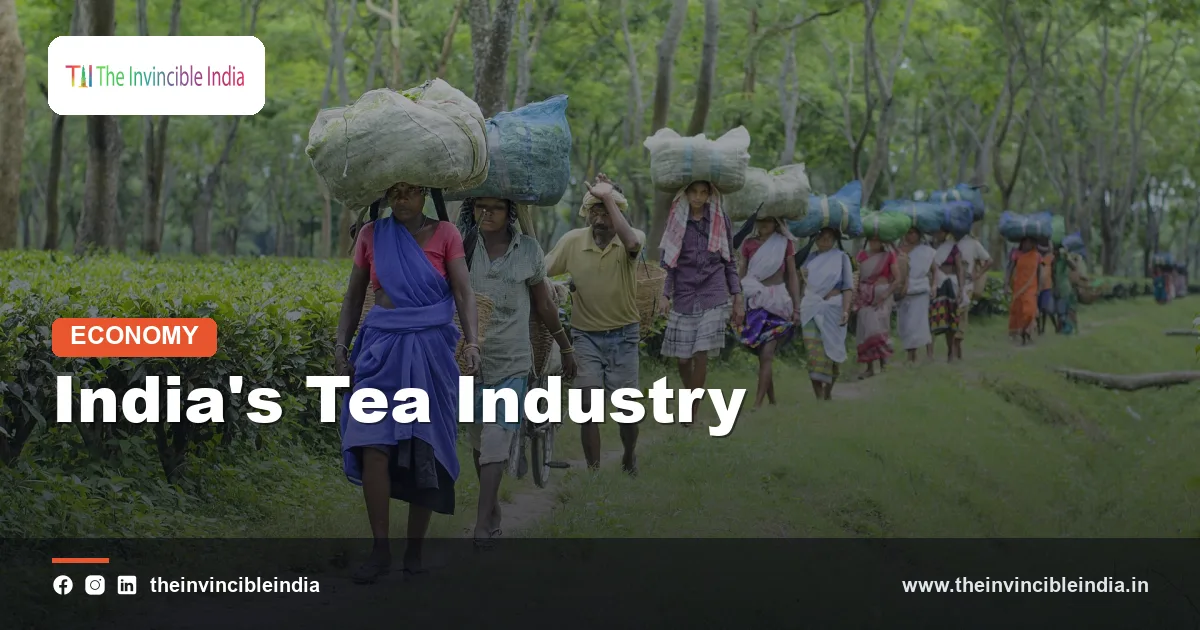
The tea industry in India is one of the country’s oldest organised agro-industries, a sector that links remote hill plantations to kitchens, tea stalls and export markets across the world. India is among the largest producers of tea in the world, second only to China in volume, and it is also one of the biggest consumers, with the bulk of its produce drunk at home. From the misty slopes of Darjeeling to the flat floodplains of Assam and the rolling Nilgiri hills, tea shapes landscapes, livelihoods and daily habits.
This explainer sets out how the Indian tea industry developed, where tea is grown, how CTC and orthodox teas differ, what the Tea Board of India does, how the auction system works, why the Darjeeling tea GI tag matters, and how the plantation workforce lives and works. The focus is on stable, well-established facts rather than year-to-year production figures, which change with weather, prices and demand.
Quick Facts
| Feature | Details |
|---|---|
| Botanical name | Camellia sinensis (China variety) and Camellia sinensis var. assamica (Assam variety) |
| Global rank | Second-largest producer after China; among the largest consumers |
| Major growing regions | Assam, West Bengal (Darjeeling, Terai, Dooars), Tamil Nadu and Kerala (Nilgiris, Anamalais, Munnar) |
| Regulator | Tea Board of India, set up under the Tea Act, 1953 |
| Tea Board headquarters | Kolkata |
| Parent ministry | Ministry of Commerce and Industry |
| First GI-tagged Indian product | Darjeeling tea (registered in the early 2000s) |
| Main types by manufacture | CTC (crush, tear, curl) and orthodox |
| Labour law | Plantations Labour Act, 1951 |
A Short History of Tea in India
Tea drinking was known in India in some local forms, but the plantation industry grew under British colonial rule in the nineteenth century. The East India Company, keen to break China’s near-monopoly on tea supply, explored growing the crop in India. In 1823, Robert Bruce reported tea plants growing wild in Assam, and local leaders such as Maniram Dewan helped reveal the indigenous Assam variety. The Assam Company, one of the earliest joint-stock tea companies, was formed in 1839.
In the Darjeeling hills, plants brought from China were tried out in the 1840s and found to suit the cool, high-altitude climate. In the south, planters turned to tea in the second half of the nineteenth century, often clearing land that had earlier been used for coffee. By the end of the century, tea was a major export commodity, shipped mainly to Britain through Calcutta and later Cochin.
After independence
After 1947, ownership of many estates gradually passed into Indian hands, and the government created institutions to regulate and promote the sector. The Tea Act of 1953 established the Tea Board of India, and research bodies were set up to improve yields and quality. Over time, small tea growers also became an important part of the industry, particularly in Assam, North Bengal and the Nilgiris.
How Tea Is Grown and Made
Tea is a perennial evergreen shrub that is kept pruned to a waist-high bush so that leaves can be plucked by hand. It prefers acidic, well-drained soils, abundant rainfall and a warm, humid climate. Only the tender top two leaves and a bud are typically plucked, as these produce the finest tea. Plucking occurs in cycles through the growing season, and bushes may remain productive for several decades.
From leaf to cup
- Plucking of the shoots, mostly by hand.
- Withering to reduce moisture and soften the leaf.
- Rolling or cutting to break cell walls, whichever process is used for the style of tea being made.
- Oxidation (fermentation) to develop colour, flavour and strength.
- Drying to halt oxidation and lock in the character.
- Sorting and grading by leaf size and appearance before packing.
The quality of a given tea depends on altitude, soil, rainfall, plucking standards and the processing skill of the factory. Estates generally have their own factories close to the gardens so that freshly plucked leaf can be processed within hours.
Major Tea-Growing Regions
India’s tea is concentrated in a few distinct regions, each producing teas with a recognisable character.
| Region | State | Character |
|---|---|---|
| Assam valley | Assam | Strong, malty, full-bodied, widely used in breakfast blends |
| Darjeeling | West Bengal | Delicate, floral and muscatel notes from high-altitude gardens |
| Terai and Dooars | West Bengal | Plains teas with good colour and strength |
| Nilgiris | Tamil Nadu | Bright, fragrant and brisk, often used for iced tea and blends |
| Munnar and Anamalais | Kerala and Tamil Nadu | High-grown teas of the southern Western Ghats |
| Other regions | Himachal Pradesh, Uttarakhand, Sikkim, Tripura and others | Smaller producers, including Kangra tea |
Assam: The Heartland of Indian Tea
Assam is the largest tea-producing state in India by a clear margin, with the Brahmaputra valley accounting for the great majority of the state’s output. Warm temperatures, heavy rainfall and fertile alluvial soil suit the large-leaved Assam variety, which yields a strong, brisk, malty liquor. The state also has gardens in the Barak valley and Karbi Anglong.
Assam tea is the backbone of many breakfast blends worldwide and is particularly known for its second flush, harvested around May and June, which has a richer flavour and bright tips. The state has an old research tradition, with the Tea Research Association’s centre at Tocklai near Jorhat said to be among the oldest tea research stations in the world.
Role in the state’s economy
Tea provides jobs for a large number of workers in Assam and has shaped its demographic and cultural history. Communities that came to the plantations as labourers, often from central and eastern India during the colonial period, are commonly called the tea tribes or tea garden communities. Their welfare, wages and education remain important public policy issues in the state.
Darjeeling: The Champagne of Teas
Darjeeling tea is grown in the hilly terrain of the Darjeeling district in northern West Bengal at altitudes that can reach well above a thousand metres. Cool temperatures, mist, slopes and a slower growth cycle create the delicate aroma and light colour for which it is prized. It is typically produced through the orthodox method and graded by leaf style.
The flushes
- First flush in spring, with a light, green, fresh and floral character.
- Second flush in early summer, with a fuller body and the muscatel flavour that connoisseurs seek.
- Monsoon (rain) flush in the wet season, generally stronger and used in blends.
- Autumn flush after the rains, with a mellow, coppery cup.
Darjeeling produces a relatively small quantity compared with Assam, yet it commands premium prices and global prestige. Its limited supply, combined with demand from collectors, makes it vulnerable to imitation, which led to legal protection through a geographical indication.
The Nilgiris and Southern India
The Nilgiri hills in Tamil Nadu, along with the Anamalai hills and the high ranges of Kerala such as Munnar, form the principal southern tea region. Much of southern tea is grown at moderate to high elevation and is harvested almost year-round because the climate is milder than in the north-east, although quality peaks in the dry winter months.
Nilgiri tea is known for being fragrant, bright and brisk. It is widely used in blends and for the iced tea trade. The region has a strong presence of small growers, many of them from the Badaga community and other local groups, who sell green leaf to bought-leaf factories. Southern tea also has its own research body, the UPASI Tea Research Foundation in Valparai, and a significant auction centre in Coonoor.
Challenges in the south
Southern growers contend with fluctuating prices, rising wage costs, climate variability and the pressure of land use change in sensitive hill ecosystems. Declining yields on ageing bushes and the need for replanting are recurring concerns.
CTC and Orthodox Tea: What Is the Difference?
The two main manufacturing methods in India produce quite different teas.
CTC tea
CTC stands for crush, tear, curl. In this method, withered leaf is passed through cylindrical rollers fitted with sharp teeth that crush and tear it into small, hard granules. The method was developed in the 1930s in Assam and became the dominant style in India because it extracts colour and strength quickly, works well with milk and sugar, and suits tea bags. CTC tea forms the bulk of India’s output and domestic consumption.
Orthodox tea
Orthodox tea is made by rolling the leaf, whole or in large pieces, either by hand or machine, so that it keeps its shape. It preserves more of the leaf’s subtle aromatics and yields a lighter, more nuanced liquor. Darjeeling and many premium Assam and Nilgiri teas are made by this method. Orthodox teas typically fetch higher prices and are in strong demand in export markets such as Europe, Japan, the Middle East and parts of Russia and the CIS countries.
| Aspect | CTC | Orthodox |
|---|---|---|
| Leaf form | Small, hard granules | Whole or broken leaf pieces |
| Liquor | Strong, dark, quick brewing | Lighter, aromatic, complex |
| Typical use | Milk tea, tea bags, mass market | Specialty and premium segments |
| Share of production | Larger share | Smaller share |
The Tea Board of India
The Tea Board of India is a statutory body under the Ministry of Commerce and Industry, constituted under the Tea Act, 1953, and headquartered in Kolkata. It replaced earlier bodies set up to promote the commodity and has a wide mandate covering the development of the whole industry. The Board has regional offices in the main tea regions and overseas offices to support exports.
Functions
- Regulating the production and marketing of tea, including registration of growers, manufacturers and exporters.
- Assisting research and development to raise productivity and quality.
- Offering financial and technical support for replanting, rejuvenation and the modernisation of factories.
- Supporting small tea growers through self-help groups and producer organisations.
- Promoting Indian tea abroad, including brand promotion and quality certification.
- Running welfare schemes for plantation workers, such as housing, education and health support.
The Board also administers the Tea Marketing Control Order, which governs how tea is sold, and monitors the quality of tea imports and exports in line with food safety rules.
The Auction System
A distinctive feature of the Indian tea trade is its auction system. A large share of tea, particularly in the CTC segment, has historically been sold through public auctions, where producers offer lots through brokers and buyers bid for them. The first auction was held in Calcutta in the nineteenth century, and the practice spread to other centres.
Auction centres
- North India: Kolkata, Siliguri and Guwahati.
- South India: Cochin (Kochi), Coonoor and Coimbatore.
Over the years, auctions have moved from paper catalogues and in-person bidding to electronic platforms, which allow buyers across the country to participate online. Auctions help in price discovery, bring transparency and give small producers access to national markets. At the same time, a portion of tea is also sold through private sales and direct contracts, and debates continue about the right balance between the two channels, the role of brokers and the handling of unsold lots.
Exports and Domestic Consumption
India exports tea to dozens of countries. Traditional buyers have included Russia and other CIS countries, Iran, the United Arab Emirates, the United Kingdom, the United States and Germany, with demand varying by tea type and by economic and political conditions. Premium Darjeeling is prized in Japan and Europe, while CTC and orthodox Assam teas find buyers in the Middle East and the CIS region.
However, tea is not merely an export crop. India has a deep tea-drinking culture, from the roadside chai stall to the household kettle, and the majority of production is consumed within the country. Domestic demand has been rising along with population and incomes, and packaged and branded teas have taken a large share of the market. This large home market protects the industry somewhat from export fluctuations, though growers still face price pressures.
Other segments
Green tea, organic tea, specialty teas and ready-to-drink formats are growing categories. Instant tea, tea bags and flavoured blends reflect changing consumer preferences and add value beyond bulk tea.
GI Tags and Brand Protection
A geographical indication, or GI, tag is a form of intellectual property protection that identifies a product as originating from a specific area where its quality or reputation is linked to that origin. Darjeeling tea was the first Indian product to be granted a GI tag, and its logo and certification mark are administered through the Tea Board. Because far more tea is sold worldwide as Darjeeling than the hills actually produce, protection against fraud has been a priority.
Other Indian teas have also gained GI recognition, including Assam orthodox tea, Nilgiri tea and Kangra tea. These tags help growers earn higher prices, safeguard authenticity and encourage investment in quality. Certification schemes, such as the Darjeeling logo, allow consumers and trade partners to verify genuine produce.
The Plantation Workforce
Tea is a labour-intensive crop, and plantations employ a very large workforce, a majority of whom are women, who do much of the skilled plucking. Many workers live on estates in housing provided by the management, and generations of the same families have often worked in the same garden. Resident workers and their dependants make up a substantial community in tea-growing districts.
Legal framework and welfare
The Plantations Labour Act, 1951 requires employers to provide facilities such as housing, drinking water, medical care, crèches and schools for children on larger estates. Wages are set under tripartite or state-level agreements and differ across regions. In recent years, new labour codes have been introduced to consolidate older laws.
Persisting concerns
- Wage levels and the quality of housing and healthcare on some estates.
- Closure or abandonment of sick gardens, especially in North Bengal, which have left workers without income.
- Ageing bushes and low investment in replanting.
- Climate change affecting rainfall patterns, pests and flush timing.
- Rising costs and price volatility for growers.
Small tea growers, who now account for a significant share of output in several regions, face separate challenges such as access to credit, quality inputs and fair prices for green leaf.
Sustainability and the Road Ahead
The tea industry in India is working on sustainability, from reducing pesticide residues to improving shade trees, soil health and water use. Certification schemes, organic cultivation and more careful use of agrochemicals respond to buyer standards at home and abroad. Mechanisation of pruning and plucking is being explored, though hand plucking remains central to quality.
Future growth depends on higher productivity, replanting of old bushes, better returns to small growers, stronger branding of Indian origin teas and diversification into value-added products. Protecting the livelihoods of plantation workers while keeping Indian tea competitive in a crowded global market is the central balancing act.
Conclusion
Few industries blend history, geography and culture as tea does. The Indian tea industry grew from colonial plantations into a mature sector with its own regulator, auction system, research institutions and protected origins. Assam, Darjeeling and the Nilgiris each contribute distinct teas, while CTC and orthodox processing serve different markets. Its future will depend on the welfare of workers and small growers as much as on exports and branding. Last reviewed: 3 October 2026.
Frequently Asked Questions
Which Indian state produces the most tea?
Assam is by far the largest tea-producing state in India, followed by West Bengal and then the southern states of Tamil Nadu and Kerala. The Brahmaputra valley in Assam accounts for most of the state’s output.
What is the difference between CTC and orthodox tea?
CTC tea is crushed, torn and curled into small granules that brew quickly into a strong, dark cup, suited to milk tea and tea bags. Orthodox tea is rolled to keep the leaf largely intact, giving a lighter and more aromatic liquor often used for premium teas such as Darjeeling.
What does the Tea Board of India do?
The Tea Board of India is a statutory body under the Ministry of Commerce and Industry, set up under the Tea Act of 1953 and based in Kolkata. It regulates and promotes the industry, supports research, helps small growers, assists exports and runs welfare schemes for workers.
Why is Darjeeling tea special?
Darjeeling tea is grown on high hill slopes in North Bengal, where cool, misty conditions produce a delicate, floral and muscatel flavour. It was the first Indian product to receive a GI tag, which protects the name from misuse and helps authenticate genuine produce.
How is tea sold in India?
A large part of tea is sold through public auctions held at centres such as Kolkata, Guwahati, Siliguri, Cochin, Coonoor and Coimbatore, now largely conducted electronically. Some tea is also sold privately through direct contracts and packers.
Who works on tea plantations?
Plantations employ a large workforce, with women forming the majority of pluckers. The Plantations Labour Act of 1951 requires employers to provide basic facilities such as housing, health care and schooling, although wages and living conditions remain a subject of public debate.


