

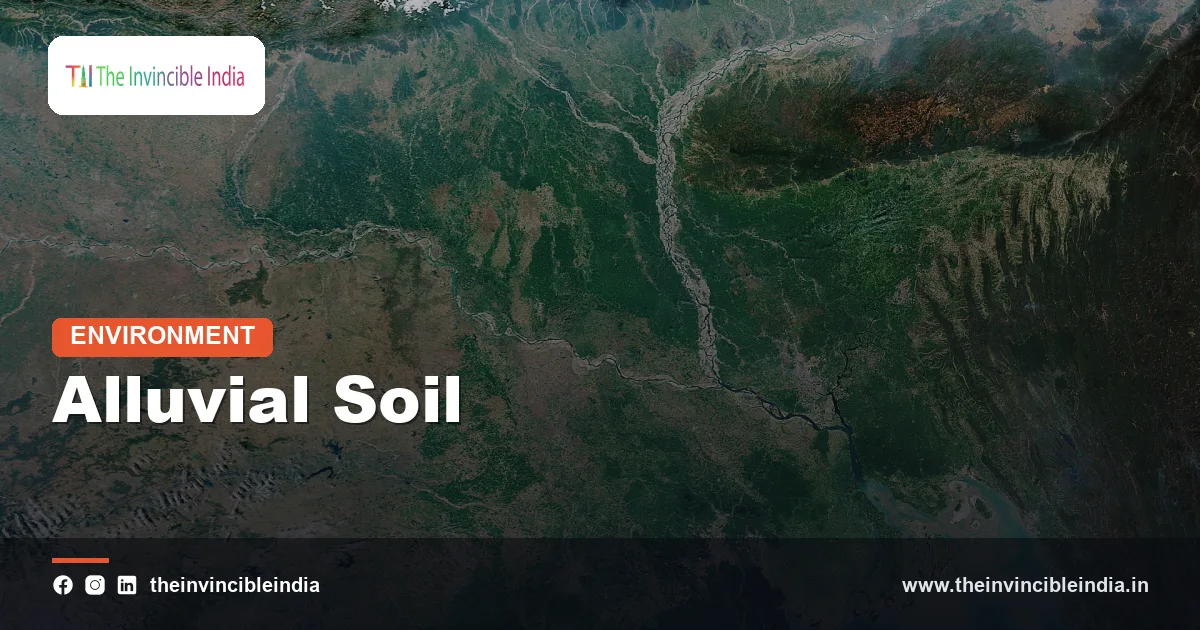
Alluvial soil is the fertile, river-deposited soil that blankets the northern plains and the coastal deltas of India, making it the country’s most widespread and most productive soil and the foundation of its foodgrain output. Laid down as silt, sand and clay by the Indus, Ganga and Brahmaputra systems and by peninsular rivers near the sea, it supports a large share of India’s population.
Alluvial soil covers roughly two-fifths of the country’s land area, and the farmland growing on it produces most of India’s wheat and rice. Understanding where it comes from, how its two main types differ and what threatens it explains why the plains of Punjab, Uttar Pradesh, Bihar and Bengal are called the nation’s food bowl.
| Attribute | Detail |
|---|---|
| Meaning of the name | From Latin alluvius, meaning washed against; soil deposited by flowing water |
| Origin | Sediment carried by rivers from the Himalayas and the peninsular uplands |
| Share of India’s land | Roughly two-fifths of the country |
| Main regions | Indo-Gangetic Plain, Brahmaputra valley, east and west coastal plains, river deltas |
| Two main types | Khadar (new alluvium) and bhangar (old alluvium) |
| Texture | Sandy loam to clay loam; light grey to ash-brown in colour |
| Rich in | Potash and lime |
| Typically low in | Nitrogen, phosphorus and humus |
Key Takeaways
- Alluvial soil is a river-deposited soil that covers roughly two-fifths of India and is the most extensive and most agriculturally productive soil group in the country.
- Alluvial soil is found mainly across the Indo-Gangetic Plain and Brahmaputra valley, and along the east and west coastal plains and deltas such as those of the Mahanadi, Godavari, Krishna and Kaveri.
- Khadar is the young, fine-grained alluvium of active floodplains, while bhangar is the older, higher and more clayey alluvium of river terraces.
- Alluvial soil is naturally rich in potash and lime but usually short of nitrogen, phosphorus and organic matter, so farmers add fertiliser and manure.
- Wheat, rice, sugarcane, maize, pulses, oilseeds, potatoes and jute are the principal crops grown on alluvial soil in India.
- Salinity, waterlogging, falling organic carbon and groundwater depletion are the main threats to the long-term fertility of alluvial soil.
What is alluvial soil?
Alluvial soil is a soil formed from sediment carried and deposited by rivers, consisting of varying proportions of sand, silt and clay. It occurs on floodplains, deltas and coastal plains, and it is the product of thousands of years of repeated flooding.
Unlike soils that form in place from the rock beneath them, alluvial soil is transported material. The particles come from distant mountains, are ground down on their journey, and are spread across flat country when rivers overflow. Because rivers carry a mixture of minerals from many rock types, the deposit is naturally varied and rich.
The Indian soil classification of the National Bureau of Soil Survey and Land Use Planning (NBSS&LUP) places most alluvial soils in the Entisols and Inceptisols, young soils with limited profile development. Their youth is exactly what keeps them fertile, since they have not yet been leached of their nutrients.
How does alluvial soil form?
Alluvial soil forms when rivers erode mountains and uplands, carry the debris downstream, and deposit it on gentle slopes and flat plains when the current slows. Floods renew the layer each monsoon, adding fresh silt to the land.
The northern plains lie in a deep trough created as the Indian plate pushed against Asia and raised the Himalayas. Rivers flowing from the rising mountains have filled this trough with sediment, which in places reaches depths of hundreds to thousands of metres. The Himalayas are young and steep, so they erode quickly and supply an enormous load of fine material.
Different rivers shape different deposits. Himalayan rivers such as the Ganga, Yamuna, Ghaghara, Kosi and Brahmaputra carry coarse and fine sediment alike. Peninsular rivers build delta plains where they meet the sea, and coastal currents add sand and silt along the shore.
Where is alluvial soil found in India?
Alluvial soil is found chiefly across the Indo-Gangetic Plain from Punjab and Haryana through Uttar Pradesh, Bihar and West Bengal, in the Brahmaputra valley of Assam, and along the coastal plains and deltas of the east and west coasts. It is the most extensive soil in these regions.
- Northern plains: Punjab, Haryana, Uttar Pradesh, Bihar and West Bengal, the heartland of alluvial agriculture.
- Brahmaputra valley: the lowlands of Assam, replenished each year by flood sediment.
- East coast deltas: the Mahanadi, Godavari, Krishna and Kaveri deltas, formed where peninsular rivers enter the Bay of Bengal.
- West coast and Gujarat plains: narrower belts of coastal alluvium and the plains around the Narmada, Tapi and Sabarmati rivers.
- Rajasthan and Gujarat pockets: alluvial plains linked to rivers such as the Luni and Mahi.
The Ganga delta in West Bengal and Bangladesh, including the Sundarbans, is one of the largest river deltas in the world. Its soils are young, silty and constantly reworked by tides and floods.
What are khadar and bhangar?
Khadar is the new, fertile alluvium of active floodplains, while bhangar is the old, higher alluvium of terraces that floods no longer reach. The two names, used across north India, describe a real difference in age, position and soil character.
| Feature | Khadar (new alluvium) | Bhangar (old alluvium) |
|---|---|---|
| Age | Recent; deposited in the last few thousand years | Older; deposited over tens of thousands of years or more |
| Position | Low-lying riverbank floodplains | Raised terraces above flood level |
| Flooding | Renewed with fresh silt almost every year | Rarely or never flooded now |
| Texture | Finer, sandy and silty, lighter in colour | More clayey, darker and more compact |
| Kankar nodules | Few or none | Common; calcium carbonate concretions |
| Fertility | Very high | Good, but lower than khadar |
Khadar land is easy to plough and gives high yields without much fertiliser, though it floods. Bhangar land is safer from floods but can need more irrigation and nutrient inputs. Geologists broadly equate khadar with Holocene and bhangar with Pleistocene deposits.
Bhabar and terai
At the foot of the Himalayas the alluvium changes character. The bhabar is a belt of coarse pebbles and gravel where streams emerge from the hills and sink underground. South of it, where the water re-emerges, lies the terai, a marshy, forested zone that has been largely cleared for farming in the last century.
What are the properties of alluvial soil?
Alluvial soil is a loamy, well-drained, mostly neutral-to-slightly-alkaline soil, naturally rich in potash and lime and deficient in nitrogen, phosphorus and humus. Its colour ranges from light grey to ash-brown.
The soil is generally porous and easy to plough, with good moisture-holding capacity and root penetration. It has no strong structure, so it can be worked with simple tools. The mineral variety in the deposits supplies many trace elements, although zinc and sulphur are commonly short in intensively farmed areas.
Because the profile is young, it lacks the distinct layers seen in older soils. Clay content rises towards the deltas and lower reaches of the rivers, while the upper plains and foothill areas have more sand.
Which crops grow best in alluvial soil?
Wheat and rice are the leading crops grown in alluvial soil, supported by sugarcane, maize, pulses, oilseeds, potatoes, vegetables and jute. The combination of flat land, deep soil and river or groundwater irrigation suits intensive cropping.
The rice-wheat rotation dominates the Indo-Gangetic Plain: rice in the monsoon season and wheat in winter. Sugarcane is concentrated in western Uttar Pradesh and Bihar, jute in West Bengal and the eastern delta, and mustard, gram and lentils in winter on the drier plains. Deltaic soils are especially suited to paddy because of their water supply.
- Cereals: wheat, rice, maize, barley.
- Cash crops: sugarcane, jute, cotton in parts of Punjab and Haryana.
- Pulses and oilseeds: gram, lentil, pigeon pea, mustard, sesame.
- Horticulture: potato, vegetables and mango orchards in Uttar Pradesh and Bihar.
Why is alluvial soil important to India’s food security?
Alluvial soil is important to food security because the plains it covers produce the bulk of India’s wheat and rice, the staples that feed the country’s population. The Green Revolution of the 1960s and 1970s concentrated on the alluvial wheat belt of Punjab, Haryana and western Uttar Pradesh, and its success rested on this soil.
The soil combines flat terrain, deep profiles and plentiful water. Rivers and shallow groundwater, replenished by monsoon rain and Himalayan snowmelt, made irrigation easy, and canals such as those of the Ganga and Sutlej systems extended it. As a result, a small fraction of India’s land area contributes a major share of the national foodgrain procurement.
Alluvial plains are also among the most densely settled regions on Earth. The same fertility that feeds the country draws high populations, so land pressure, urban growth and farming intensity run together.
What threatens alluvial soil?
Alluvial soil is threatened by salinity and waterlogging, loss of organic matter, nutrient mining, falling groundwater and conversion of farmland to buildings. Decades of intensive rice-wheat farming have reduced the margin for error.
- Salinity and sodicity: in canal-irrigated parts of Punjab, Haryana and Uttar Pradesh, rising water tables bring salts to the surface, creating patches of barren land locally called usar, reh or kallar.
- Nutrient depletion: crops remove more nutrients than are returned, with growing deficiencies of zinc, sulphur and organic carbon.
- Groundwater decline: heavy pumping for rice lowers water tables across the north-western plains.
- Soil removal and sealing: topsoil is dug for bricks, and fertile fields are paved over for towns and roads.
- Residue burning: burning of crop stubble destroys organic matter and contributes to air pollution.
Responses include gypsum treatment of sodic soils, laser land levelling, green manuring with crops such as dhaincha, crop diversification and direct-seeded rice. The Soil Health Card scheme, launched by the Government of India in 2015, gives farmers soil test reports and fertiliser recommendations to encourage balanced nutrient use.
How does alluvial soil compare with other Indian soils?
Alluvial soil differs from black, red and laterite soils in origin and fertility: it is transported by rivers, whereas the others form in place from rock. This is why it is both the most widespread and the most fertile.
Black cotton soil, formed from Deccan lava, is richer in clay and holds more water but needs careful handling. Red soils on old crystalline rock are lighter and less fertile, and laterite soils are leached and acidic. Alluvial soil sits at the productive end of this range, though its fertility depends on regular replenishment and good management.
Bottom Line
Alluvial soil is the quiet foundation of Indian food production, built by rivers from the debris of mountains. Its fertility is renewable only if it is cared for, which makes soil health, water management and balanced fertiliser use the central challenge for the plains in the years ahead.
Frequently Asked Questions
What is alluvial soil in India?
Alluvial soil in India is a fertile soil deposited by rivers, covering the northern plains, river valleys and coastal deltas. It is the most widespread soil in the country, covering roughly two-fifths of the land. It forms from silt, sand and clay carried down from the Himalayas and peninsular uplands.
What is the difference between khadar and bhangar?
Khadar is new alluvium found on active floodplains, while bhangar is older alluvium found on higher terraces. Khadar is finer, lighter in colour and more fertile because floods renew it, whereas bhangar is more clayey and often contains kankar nodules. Both are used for farming across north India.
Which crops grow on alluvial soil?
Wheat and rice are the main crops on alluvial soil, along with sugarcane, maize, pulses, oilseeds, potatoes and jute. The rice-wheat rotation dominates the Indo-Gangetic Plain. Deltas are particularly suited to paddy and jute.
Why is alluvial soil so fertile?
Alluvial soil is fertile because rivers keep adding fresh mineral-rich sediment from the mountains, and the soil is young and unleached. It is naturally rich in potash and lime, and it is porous, deep and easy to plough. It lacks nitrogen and phosphorus, so fertiliser still helps.
Where is alluvial soil found in India?
Alluvial soil is found mainly in the Indo-Gangetic Plain, the Brahmaputra valley and the east and west coastal plains. Major deltas such as those of the Ganga, Mahanadi, Godavari, Krishna and Kaveri are made of it. States like Punjab, Haryana, Uttar Pradesh, Bihar and West Bengal rely heavily on it.
Is alluvial soil good for building?
Alluvial soil is generally not an ideal base for heavy building because it can be soft, waterlogged and prone to settling, particularly near rivers. Foundations in alluvial areas often need piles or raft designs to carry loads safely. It is better suited to farming than to heavy construction, though it is used to make bricks.
{“@context”:”https://schema.org”,”@graph”:[{“@type”:”FAQPage”,”mainEntity”:[{“@type”:”Question”,”name”:”What is alluvial soil in India?”,”acceptedAnswer”:{“@type”:”Answer”,”text”:”Alluvial soil in India is a fertile soil deposited by rivers, covering the northern plains, river valleys and coastal deltas. It is the most widespread soil in the country, covering roughly two-fifths of the land. It forms from silt, sand and clay carried down from the Himalayas and peninsular uplands.”}},{“@type”:”Question”,”name”:”What is the difference between khadar and bhangar?”,”acceptedAnswer”:{“@type”:”Answer”,”text”:”Khadar is new alluvium found on active floodplains, while bhangar is older alluvium found on higher terraces. Khadar is finer, lighter in colour and more fertile because floods renew it, whereas bhangar is more clayey and often contains kankar nodules. Both are used for farming across north India.”}},{“@type”:”Question”,”name”:”Which crops grow on alluvial soil?”,”acceptedAnswer”:{“@type”:”Answer”,”text”:”Wheat and rice are the main crops on alluvial soil, along with sugarcane, maize, pulses, oilseeds, potatoes and jute. The rice-wheat rotation dominates the Indo-Gangetic Plain. Deltas are particularly suited to paddy and jute.”}},{“@type”:”Question”,”name”:”Why is alluvial soil so fertile?”,”acceptedAnswer”:{“@type”:”Answer”,”text”:”Alluvial soil is fertile because rivers keep adding fresh mineral-rich sediment from the mountains, and the soil is young and unleached. It is naturally rich in potash and lime, and it is porous, deep and easy to plough. It lacks nitrogen and phosphorus, so fertiliser still helps.”}},{“@type”:”Question”,”name”:”Where is alluvial soil found in India?”,”acceptedAnswer”:{“@type”:”Answer”,”text”:”Alluvial soil is found mainly in the Indo-Gangetic Plain, the Brahmaputra valley and the east and west coastal plains. Major deltas such as those of the Ganga, Mahanadi, Godavari, Krishna and Kaveri are made of it. States like Punjab, Haryana, Uttar Pradesh, Bihar and West Bengal rely heavily on it.”}},{“@type”:”Question”,”name”:”Is alluvial soil good for building?”,”acceptedAnswer”:{“@type”:”Answer”,”text”:”Alluvial soil is generally not an ideal base for heavy building because it can be soft, waterlogged and prone to settling, particularly near rivers. Foundations in alluvial areas often need piles or raft designs to carry loads safely. It is better suited to farming than to heavy construction, though it is used to make bricks.”}}]}]}


