

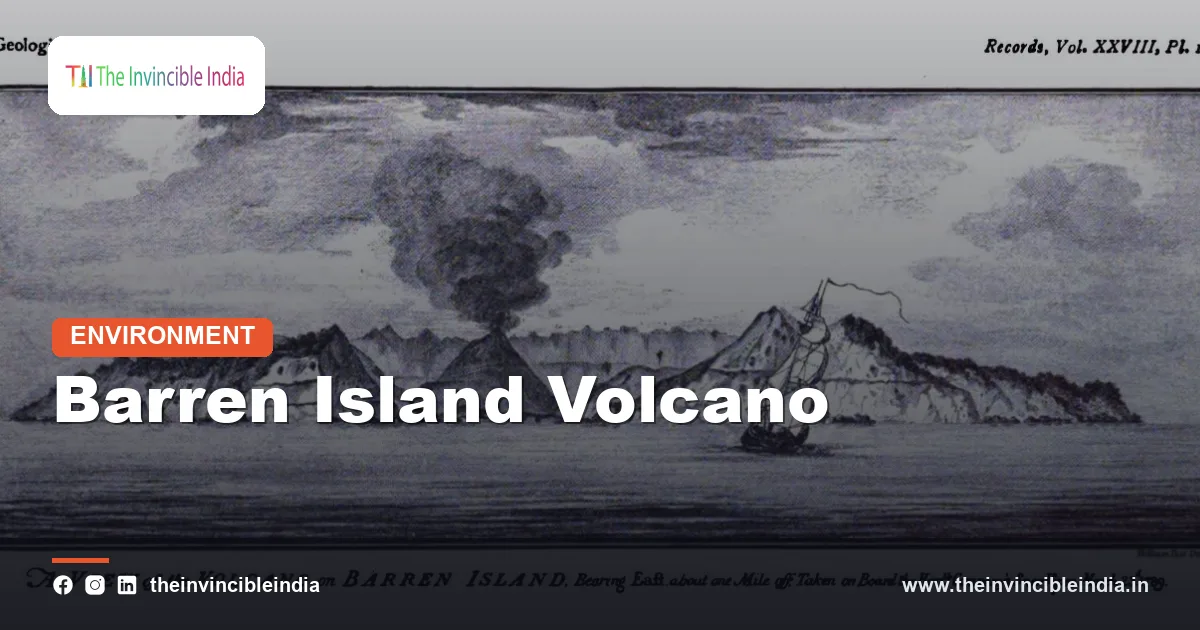
Barren Island is a small, uninhabited volcanic island in the Andaman Sea, part of India’s Andaman and Nicobar Islands, and it is the only confirmed active volcano in India and in South Asia. Its black cone has erupted repeatedly since the first written record in 1787, most recently in a series of episodes since the 1990s.
The island sits on a chain of volcanoes created by the collision and subduction of tectonic plates along the Sumatra-Andaman arc. Barren Island is remote, closely restricted and rarely visited, yet it is one of the most closely watched natural features in the Indian Ocean region and a valuable natural laboratory for volcanologists.
| Attribute | Detail |
|---|---|
| Location | Andaman Sea, northeast of Port Blair, in the Andaman and Nicobar Islands (Union Territory) |
| Distance from Port Blair | Roughly 135 km to the northeast |
| Type of volcano | Stratovolcano with a central cone inside a caldera |
| Height above sea level | About 350 metres, the summit of a much taller undersea volcano |
| Island size | Roughly 3 km across, a few square kilometres in area |
| Rock type | Basalt to basaltic andesite |
| First recorded eruption | 1787 |
| Status | Uninhabited; access restricted; India’s only confirmed active volcano |
Key Takeaways
- Barren Island is the only confirmed active volcano in India and in South Asia, and it lies in the Andaman Sea about 135 km northeast of Port Blair.
- Barren Island is the exposed summit of a volcano that rises roughly two kilometres from the seafloor and stands about 350 metres above sea level.
- Barren Island formed because the Indian plate dives beneath the Burma microplate along the Andaman-Nicobar subduction zone, generating magma that feeds a volcanic arc.
- Barren Island has erupted on and off since 1787, went quiet for much of the nineteenth and twentieth centuries, and became active again in 1991.
- Barren Island is uninhabited and access is restricted, so it is viewed mainly from boats and monitored by satellites and scientific surveys.
- Narcondam Island, to the northeast of Barren Island, is a volcanic island that Indian authorities treat as dormant, not active.
What is Barren Island?
Barren Island is a roughly circular volcanic island in the Andaman Sea whose steep, ash-covered cone contains India’s only confirmed active volcano. It belongs to the Andaman and Nicobar Islands, a Union Territory of India, and lies in the open sea east of the main island chain.
The island is the rim of a caldera, a large volcanic depression, about two kilometres wide. Steep walls rise from the sea on most sides, and a gap in the western wall lets the sea flow in. Inside, a small cone built by recent eruptions stands in the middle, topped by a crater from which gas, ash and lava have been emitted.
Despite its name, the island is not completely bare. Vegetation has colonised the lower slopes, and the island has been recorded as home to birds, fruit bats, rodents and feral goats, although eruptions repeatedly strip away what grows.
Geologists believe the caldera formed in a past collapse, when a large volume of magma left the chamber beneath the volcano and the summit sank into the void. The younger central cone has since grown inside this depression, which is why the island looks like a small volcano nested within a larger one. The pattern is common among island volcanoes and explains the ring of steep cliffs seen from the sea.
Where is Barren Island located?
Barren Island is located in the Andaman Sea at roughly 12 degrees north latitude, about 135 km northeast of Port Blair, the capital of the Andaman and Nicobar Islands. It is part of the arc of islands that stretches from Sumatra through the Andamans and Nicobars towards Myanmar.
The island is separated from the nearest inhabited land by deep water. The surrounding seafloor falls to more than two kilometres below the sea surface, so the volcano as a whole is far larger than the visible island. Sailors approaching from the west see only the black cone and the steep caldera walls.
Why does India have a volcano at Barren Island?
India has a volcano at Barren Island because the Indian plate is sliding beneath the overriding Burma microplate along the Andaman-Nicobar subduction zone, and the melting of the sinking plate generates magma that rises to form volcanoes. Barren Island is one of the few places where that magma reaches the surface above sea level.
This tectonic setting is part of the same system that produces the large earthquakes and tsunamis of the region, including the Sumatra-Andaman earthquake of December 2004. Along the subduction boundary, the sinking slab releases water into the mantle above, which lowers the melting point of the rock and forms magma. The magma rises through the crust, producing a volcanic arc roughly parallel to the trench.
- Trench: the Andaman-Nicobar trench marks where the Indian plate descends.
- Forearc: the main Andaman and Nicobar islands rest on the forearc, which is not volcanic.
- Volcanic arc: Barren Island and Narcondam lie along the volcanic line east of the main islands.
- Back-arc basin: further east lies the Andaman Sea spreading centre.
The Himalayas and the Deccan Traps are also products of plate motion, but they are not currently erupting. Barren Island is the only place on the Indian territory where the geological processes of subduction volcanism are visible at the surface today.
What is the eruption history of Barren Island?
Barren Island has a documented eruption history that begins in 1787, includes a number of episodes into the early nineteenth century, and resumes in 1991 after a long quiet period, with further eruptions in the 1990s, 2000s and 2010s. The record before 1787 is incomplete because the island was seldom visited.
British mariners recorded the first eruption in 1787 and described a fiery glow visible at night. Further activity was reported in the following decades, producing lava flows that reached the sea and building the central cone. After the early 1800s the volcano appeared dormant for roughly a century and a half, and geologists considered it possibly extinct.
That view changed in 1991, when an eruption was observed from passing ships and reported to the Geological Survey of India (GSI). Scientists then monitored a series of eruptions through the mid-1990s. Activity resumed in the mid-2000s, after the 2004 earthquake, and several researchers have discussed whether the stress changes from that earthquake and renewed eruptions are connected. Episodes of ash, lava and gas emission have been reported intermittently in later years.
| Period | What is known |
|---|---|
| 1787 | First recorded eruption, reported by British ships |
| Early nineteenth century | Intermittent eruptions and lava flows into the sea |
| Late nineteenth to late twentieth century | Long quiet period with only fumarolic activity |
| 1991 | Eruption observed; volcano re-awakens |
| Mid-1990s | Further eruptions and surveys by the Geological Survey of India |
| 2000s onwards | Renewed episodes of ash and lava, observed by satellites and visiting teams |
How does Barren Island erupt?
Barren Island erupts in a style called Strombolian, with intermittent explosions that throw glowing fragments of lava into the air, together with ash emissions and slow lava flows. The eruptions are generally moderate, but they can be dramatic at night.
The magma is basaltic to basaltic andesite, which is relatively fluid and low in silica. Gas bubbles burst at the crater, flinging molten blobs that build up a cone of cinder and ash. Lava can spill down the slopes and enter the sea, where it quenches and creates steam.
Occasionally the volcano emits ash plumes high enough to be tracked by satellites. Because shipping lanes and air routes cross the Andaman Sea, volcanic ash advisories matter, even though the island itself has no population. Scientists use satellite thermal images, ash tracking and field surveys to follow the activity.
Is anyone allowed to visit Barren Island?
Access to Barren Island is restricted, and landing is generally not permitted without official clearance, so most visitors see the volcano only from boats at a distance. The island is uninhabited and can be dangerous because of falling rock, ash and unstable slopes.
The Andaman and Nicobar administration, the forest department and the security forces regulate movement in these waters, and a permit system applies to the whole island group. Boat trips from Port Blair and Havelock Island have taken tourists to view the volcano from the sea when conditions are suitable, and the sight of a smoking cone rising from the water is among the most memorable in the region. Scientific expeditions and survey vessels visit under official permission.
Visitors should follow only authorised operators and current rules, which can change, particularly when the volcano is active. Rough seas and the possibility of eruptions also mean trips are not always possible.
How does Barren Island differ from Narcondam and mud volcanoes?
Barren Island is a confirmed active magmatic volcano, whereas Narcondam, farther northeast, is a volcanic island considered dormant, and the mud volcanoes of the Andamans are cold features driven by gas rather than magma. These distinctions explain why Barren Island alone is called India’s active volcano.
- Barren Island: active, with recorded eruptions of lava and ash since 1787.
- Narcondam Island: a volcanic cone with no confirmed historical eruptions, treated as dormant, and known for the endemic Narcondam hornbill.
- Baratang mud volcanoes: vents on Baratang Island that push out mud and gas, with occasional eruptions that are not magmatic.
- Deccan Traps and other Indian volcanic rocks: ancient lava fields erupted millions of years ago, long inactive.
Scientists use the terms active, dormant and extinct to describe volcanoes, but the boundaries are not always sharp. A volcano is usually called active if it has erupted in recent history, dormant if it has not but may erupt again, and extinct if it is not expected to erupt.
Why is Barren Island important to science and to India?
Barren Island is important because it is the only accessible example of an active subduction-zone volcano in India, offering a rare chance to study magma chemistry, eruption behaviour and the link between tectonics and volcanism. It also adds to understanding of hazards in the Bay of Bengal and Andaman Sea region.
The volcano is studied by institutions such as the Geological Survey of India, the National Institute of Oceanography and the National Centre for Seismology, along with international researchers. Analysis of its rocks shows how magma evolves as it rises through the crust, and seafloor mapping reveals its large submarine flanks.
Hazards are modest for people, since there are no residents, but ash and sea-borne effects can affect ships and aircraft, and volcanic landslides into the sea could in principle generate local waves. Monitoring in the Andaman region therefore combines volcano watching with the earthquake and tsunami warning systems established after 2004.
Bottom Line
Barren Island is India’s lone active volcano, a smoking cone rising from the deep Andaman Sea along a tectonic boundary. It is closed to casual landing and little known to the public, but its eruptions are a reminder that the same plate collision that raised the Himalayas also drives fire beneath the ocean.
Frequently Asked Questions
Is Barren Island the only active volcano in India?
Yes, Barren Island is the only confirmed active volcano in India and in South Asia. It lies in the Andaman Sea about 135 km northeast of Port Blair. Other volcanic features in India, such as the Deccan Traps and Narcondam, are ancient or dormant.
Where is Barren Island located?
Barren Island is located in the Andaman Sea, about 135 km northeast of Port Blair in the Andaman and Nicobar Islands. It lies along a volcanic arc east of the main island chain. The island is uninhabited and surrounded by deep water.
When did Barren Island last erupt?
Barren Island has erupted in several episodes since 1991, after a long quiet period, with activity reported in the 1990s, 2000s and 2010s. Eruptions consist of ash, gas and lava emitted from a small central cone. Check current reports from monitoring agencies, since the volcano can become active again at any time.
Why is it called Barren Island?
The island is called Barren Island because its steep, ash-covered volcanic slopes support little vegetation, and eruptions repeatedly clear what grows. The name was given by early mariners, not scientists. The island is not entirely bare, as some plants and animals live there.
Can tourists visit Barren Island?
Tourists generally cannot land on Barren Island, because access is restricted for safety and security reasons. Authorised boat trips from Port Blair or Havelock Island may allow people to view the volcano from the sea. Rules and sailing conditions change, so travellers should check with local authorities.
Why does Barren Island have a volcano?
Barren Island has a volcano because the Indian plate is subducting beneath the Burma microplate along the Andaman-Nicobar trench, creating magma. The magma rises to the surface and forms a chain of volcanoes. Barren Island is the active part of that chain within Indian territory.
{“@context”:”https://schema.org”,”@graph”:[{“@type”:”FAQPage”,”mainEntity”:[{“@type”:”Question”,”name”:”Is Barren Island the only active volcano in India?”,”acceptedAnswer”:{“@type”:”Answer”,”text”:”Yes, Barren Island is the only confirmed active volcano in India and in South Asia. It lies in the Andaman Sea about 135 km northeast of Port Blair. Other volcanic features in India, such as the Deccan Traps and Narcondam, are ancient or dormant.”}},{“@type”:”Question”,”name”:”Where is Barren Island located?”,”acceptedAnswer”:{“@type”:”Answer”,”text”:”Barren Island is located in the Andaman Sea, about 135 km northeast of Port Blair in the Andaman and Nicobar Islands. It lies along a volcanic arc east of the main island chain. The island is uninhabited and surrounded by deep water.”}},{“@type”:”Question”,”name”:”When did Barren Island last erupt?”,”acceptedAnswer”:{“@type”:”Answer”,”text”:”Barren Island has erupted in several episodes since 1991, after a long quiet period, with activity reported in the 1990s, 2000s and 2010s. Eruptions consist of ash, gas and lava emitted from a small central cone. Check current reports from monitoring agencies, since the volcano can become active again at any time.”}},{“@type”:”Question”,”name”:”Why is it called Barren Island?”,”acceptedAnswer”:{“@type”:”Answer”,”text”:”The island is called Barren Island because its steep, ash-covered volcanic slopes support little vegetation, and eruptions repeatedly clear what grows. The name was given by early mariners, not scientists. The island is not entirely bare, as some plants and animals live there.”}},{“@type”:”Question”,”name”:”Can tourists visit Barren Island?”,”acceptedAnswer”:{“@type”:”Answer”,”text”:”Tourists generally cannot land on Barren Island, because access is restricted for safety and security reasons. Authorised boat trips from Port Blair or Havelock Island may allow people to view the volcano from the sea. Rules and sailing conditions change, so travellers should check with local authorities.”}},{“@type”:”Question”,”name”:”Why does Barren Island have a volcano?”,”acceptedAnswer”:{“@type”:”Answer”,”text”:”Barren Island has a volcano because the Indian plate is subducting beneath the Burma microplate along the Andaman-Nicobar trench, creating magma. The magma rises to the surface and forms a chain of volcanoes. Barren Island is the active part of that chain within Indian territory.”}}]}]}


