

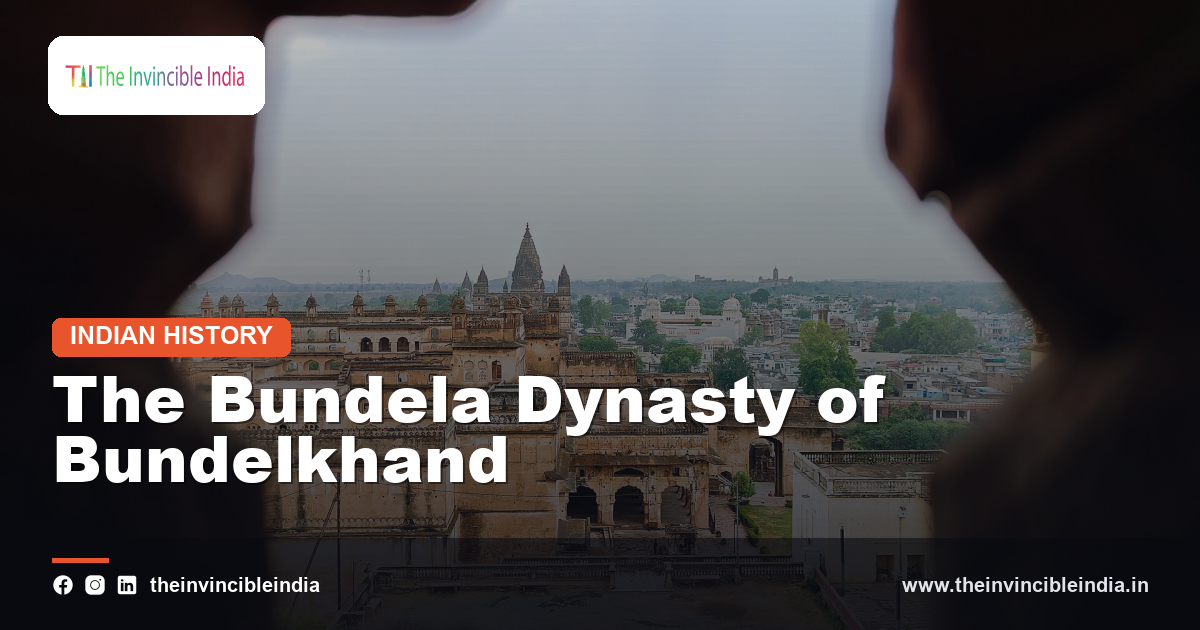
The Bundela dynasty gave its name to Bundelkhand, the rocky and forested heartland of central India that lies between the Ganga and Yamuna plains to the north and the Vindhya ranges to the south. A Rajput line that rose to prominence in the late medieval period, the Bundelas founded the town of Orchha on the Betwa river, built palaces and temples of great beauty, and became known for their willingness to resist more powerful neighbours. Their story is closely linked to the wider history of Rajput clans described in our guide to the Rajputs, yet it has a distinct regional flavour shaped by hills, rivers, forts and a living tradition of poetry and devotion.
Quick Facts
| Detail | Information |
|---|---|
| Dynasty | Bundela Rajput clan |
| Homeland | Bundelkhand in central India |
| Early Capital | Orchha on the Betwa river |
| Notable Rulers | Rudra Pratap, Bir Singh Deo and Chhatrasal |
| Later Seat | Panna, associated with Chhatrasal |
| Heritage | Orchha palaces, chhatris, temples and the Jhansi fort |
Overview of the Bundela Dynasty
The Bundelas were a Rajput clan whose rulers governed much of the region now called Bundelkhand, which today spans parts of Madhya Pradesh and Uttar Pradesh. They are remembered for their independent spirit, for the architecture of their capitals and for the cultural life of their courts, where poets, musicians and painters found generous patronage.
The dynasty did not form a single continuous empire. Instead, it developed as a family of related states, each centred on a fort or town, with Orchha as the most celebrated seat. This structure gave Bundelkhand a rich variety of local traditions while the Bundela name provided a shared identity across the region.
The Land of Bundelkhand
Bundelkhand is a landscape of low granite hills, scrub forest, rivers and natural fortresses, and its geography shaped the character of its rulers. The rugged terrain favoured defence, and strongholds were built on rocky heights that overlooked river crossings and trade routes between north and south India.
The Betwa, Ken and Dhasan rivers watered the valleys, supporting farming and pastoral life. Earlier dynasties such as the Chandelas, who built the temples of Khajuraho, had also left their mark here, giving the region a long memory of royal splendour. The Bundelas inherited this setting and gave it a new political and cultural identity.
Origins and the Meaning of the Name
The origins of the Bundelas are described in clan traditions that connect them with older Rajput lineages and with the goddess associated with the Vindhya hills. A popular explanation of the name links it to a ritual drop of blood offered to the goddess, though historians treat such stories as part of the clan memory rather than documented history.
What is clear is that the Bundelas emerged in the late medieval period as local chieftains who gradually gained control of fortified places and gathered followers. Their rise coincided with a time when regional powers were reshaping the politics of northern and central India, and the Bundelas used the opportunity to establish a lasting presence.
The Founding of Orchha
Orchha, whose name is often interpreted as meaning hidden or concealed, was established as the Bundela capital in the sixteenth century by Rudra Pratap. The site was chosen with care, on an island formed by the Betwa river and surrounded by forest and rock, which gave it both beauty and security.
From this position the early Bundela rulers extended their authority over the surrounding country and developed the town as a centre of governance and worship. Over time, Orchha acquired a skyline of palaces, temples and memorial pavilions that today make it one of the most atmospheric historic towns in central India. Its founding marked the real beginning of Bundela statehood.
Relations with the Mughal Empire
The Bundelas lived in the shadow of the expanding Mughal empire, and their relations with it moved between cooperation and conflict. Some rulers accepted Mughal service and held rank in the imperial system, while others resisted what they saw as an infringement of their independence. The balance depended on the personality of the ruler and the circumstances of the time.
The history of the Mughal empire explains the larger political order within which these choices were made. For the Bundelas, the challenge was to retain autonomy in a region that lay close to the heart of imperial ambitions, and their varied responses shaped the later history of Bundelkhand.
Raja Bir Singh Deo and His Building Programme
Raja Bir Singh Deo is remembered as one of the most prominent Bundela rulers and a great builder. His reign saw the construction of fortresses, palaces and temples across the region, and he is credited with founding the fort of Jhansi, which later gained fame in the nineteenth century. His court maintained close contact with the Mughal rulers of his day.
The architecture associated with him combines Rajput and Mughal features, creating a style that is distinctive to Bundelkhand. Domes, jharokha balconies, carved brackets and lofty gateways give his buildings a graceful and commanding presence. The monuments of his age remain central to how the Bundelas are visually remembered.
The Palaces of Orchha
The palace complex at Orchha includes the Raj Mahal and the Jahangir Mahal, the latter associated with the Mughal emperor Jahangir and constructed to receive an imperial visit. These structures are built of local stone and brick with lime plaster, and they rise in tiers around open courtyards, with balconies, arched corridors and pavilions crowned by domes.
The interiors of some palaces preserve mural paintings that depict religious themes, courtly scenes and decorative patterns. The architecture makes use of light and shade to create a sense of lightness despite the massive masonry. Together, the palaces form an outstanding example of Rajput court architecture in central India.
Temples and the Worship of Rama as King
Orchha is unusual among Indian towns for the way it honours Rama as a king. The Ram Raja temple, which began as a palace, enshrines an image of Rama who is treated as the sovereign of the town, and this tradition of royal devotion continues to draw large numbers of pilgrims. Nearby stand other notable shrines, such as the Chaturbhuj temple, built on a high platform with a towering profile.
The Lakshmi Narayan temple is known for its murals, which blend devotional and secular subjects. These shrines show how deeply Vaishnava faith shaped Bundela identity, and they remain living places of worship and a major attraction for visitors to Orchha.
Chhatris on the Betwa
One of the most recognisable sights of Orchha is the row of chhatris, or memorial cenotaphs, built along the banks of the Betwa river to honour members of the ruling family. Each chhatri rises on a platform with domes and pillared pavilions, and together they create a striking silhouette against the sky, especially at sunset.
Building such memorials was a common Rajput custom, and the Bundelas gave it a distinctive scale and elegance. The chhatris reflect a sense of dynastic memory and respect for ancestors, and their placement beside the river adds a quiet, contemplative quality. They remain among the best-loved symbols of Bundela heritage.
Maharaja Chhatrasal and Bundela Resistance
Maharaja Chhatrasal stands among the most celebrated Bundela figures. Rising in a period when Mughal power pressed on the region, he gathered followers, won strongholds and carved out a kingdom in eastern Bundelkhand, with Panna as a principal centre. His career is remembered in popular memory as a heroic defence of local freedom.
Chhatrasal also sought allies beyond the region when he faced strong opposition, and he is associated with cooperation with the Marathas during a later conflict. After his death his realm was divided among his heirs. His legacy lies in the example of determined resistance and in the fact that he united much of Bundelkhand under a single banner for a time.
Panna and the Diamond Country
Panna, linked with the later phase of Bundela rule, is known for its diamond-bearing earth, and the region has long been associated with gem mining. Tradition holds that the discovery of diamonds in the area enhanced the prosperity of the court and strengthened its standing among neighbouring states.
The town and its temples, including those with distinctive domed features, reflect the blending of influences that characterised late Bundela architecture. Panna remains known today for its connection with diamonds and for the surrounding forests and wildlife. Its history shows how natural resources and political ambition were closely entwined in Bundelkhand.
Forts and Defensive Architecture
The Bundelas built or controlled a series of forts that guarded the passes and river crossings of Bundelkhand. Their strongholds used the natural rock of the region, with walls following the contours of the hills and gateways placed to give maximum protection. Water tanks, granaries and living quarters inside the forts allowed garrisons to withstand long sieges.
Some forts, such as Jhansi, grew in importance in later years, while others remained local centres of administration. The scale and strategic planning of these structures show the practical intelligence of the builders. The fortified landscape of Bundelkhand is a lasting reminder of the region’s turbulent but resilient history.
Poetry, Music and Painting at the Bundela Courts
Bundela courts were lively centres of the arts. The poet Keshavdas, who served at Orchha, is among the leading figures of medieval Hindi literature, and his works on poetics and devotion were widely admired. The courts also patronised musicians, dancers and scholars who gathered under royal protection.
Painting flourished as well, and the Orchha school of miniature and mural painting produced work that reflects the tastes of the court. Themes of devotion, nature and courtly life appear in bright colours on palace walls and manuscripts. This cultural activity gives the Bundela story a depth that goes beyond politics and warfare.
Society, Folk Culture and Ballads
Bundelkhand has a rich tradition of folk culture, and the Bundelas helped nurture it through festivals, fairs and patronage of local performers. Heroic ballads, which celebrate legendary warriors of the region, are sung at gatherings and are an important part of the area’s oral heritage. Regional dance, drama and song continue to flourish.
The Bundeli dialect, with its own literary and spoken traditions, became closely associated with the territory, and it lent a distinctive voice to local poetry and storytelling. This folk heritage links the royal courts with village life, and it shows how the dynasty belonged to a wider society that shared its stories and values.
Decline and the Colonial Period
In the eighteenth century the Bundela states were weakened by divisions among heirs and by the pressures of larger powers, including the Marathas and later the British. Many of the smaller states entered into treaty relations with the colonial government and continued to exist as princely states under British paramountcy.
The famous events of the revolt of 1857, which involved the queen of Jhansi, took place in a landscape shaped by Bundela forts and traditions. With Indian independence, the princely states of Bundelkhand were integrated into the new republic. The end of Bundela rule was gradual, but the cultural memory of the dynasty remained strong throughout the region.
The Bundelas Today
Today the Bundela heritage is most visible in Orchha, where palaces, temples and chhatris draw visitors from India and abroad, and where the Ram Raja temple remains a vibrant centre of worship. Conservation work seeks to protect the delicate murals and stonework, and the town has been proposed for recognition as a heritage site of wider significance.
Across Bundelkhand, the memory of rulers such as Bir Singh Deo and Chhatrasal is preserved in monuments, songs and local pride. The Bundela story endures as an example of how a regional dynasty can leave a lasting imprint on art, architecture and identity, long after the end of its political rule.
Sources & Further Reading
- Archaeological Survey of India (asi.nic.in).
- Ministry of Culture, Government of India (indiaculture.gov.in).
Frequently Asked Questions
Who were the Bundelas?
The Bundelas were a Rajput clan that ruled Bundelkhand in central India from the late medieval period. Their capital at Orchha and their later seat at Panna became centres of art and politics.
Why is Orchha famous?
Orchha is known for its palaces, temples and riverside chhatris built under the Bundela rulers. It is also notable for the Ram Raja temple, where Rama is worshipped as a king.
Who was Maharaja Chhatrasal?
Chhatrasal was a Bundela ruler who resisted Mughal pressure and established a kingdom in eastern Bundelkhand, with Panna as a main centre. He is remembered as a symbol of regional independence.
Is Khajuraho connected to the Bundelas?
No, the temples of Khajuraho were built by the earlier Chandela dynasty. The Bundelas rose later in the same general region and are associated with Orchha.
What is the architectural style of the Bundelas?
Bundela architecture blends Rajput and Mughal features, with domes, balconies, chhatris and fortified palaces. Orchha offers the best examples of this style.


