

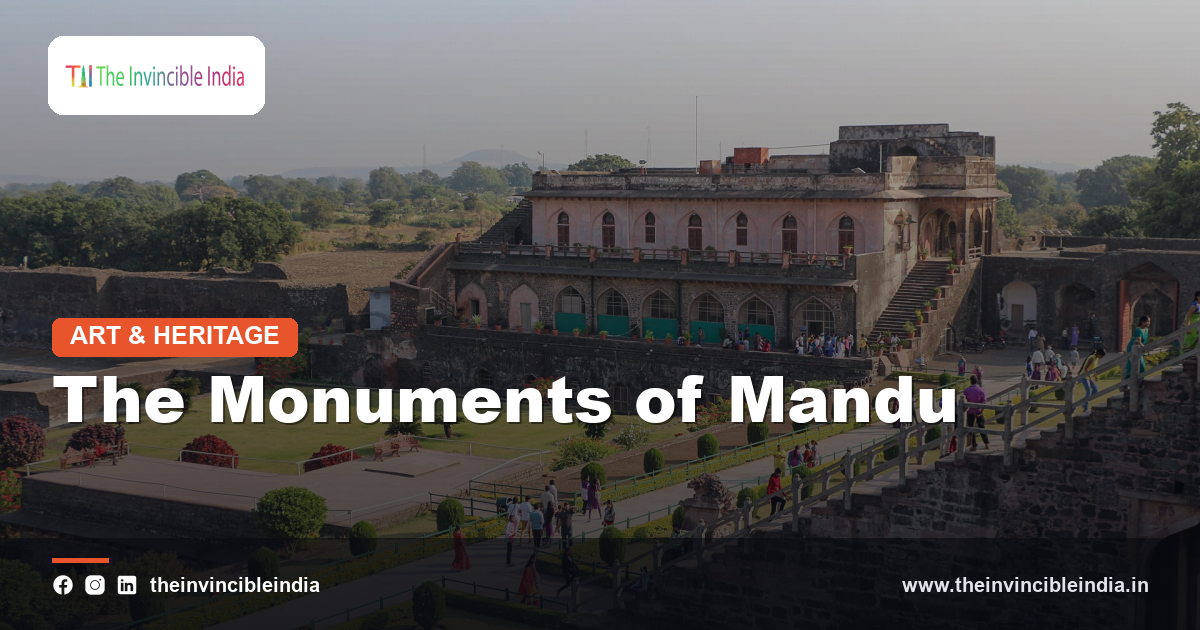
High on a rocky plateau of the Vindhya range in western Madhya Pradesh lies Mandu, a fortified city whose ruined palaces, mosques, and tombs rank among the finest achievements of Indo-Islamic architecture. Once the capital of the Malwa sultans, Mandu was a place of power, pleasure, and refined taste, and its monuments still reflect that golden age. Graceful arches, domes, pavilions, and reservoirs spread across a wide plateau enclosed by massive walls. The city has also long been associated with romantic legend, most famously the tale of the musician-ruler Baz Bahadur and his beloved Roopmati. Visitors who explore the site, much as they would study the Mughal architecture that followed, discover a distinct and elegant architectural voice that shaped later traditions.
Quick Facts
| Detail | Information |
|---|---|
| Location | Dhar district, Madhya Pradesh |
| Setting | Vindhya plateau fortified city |
| Ruling power | Sultans of Malwa |
| Style | Indo-Islamic (Malwa) architecture |
| Best-known monuments | Jahaz Mahal, Hindola Mahal, Hoshang Shah’s Tomb |
| Also known for | Baz Bahadur and Roopmati legend |
A City on the Plateau
Mandu stands on a broad, flat-topped hill that rises sharply above the plains of Malwa, and this natural fortress shaped everything about the city. The plateau is enclosed by a long circuit of walls that follow the edge of the cliffs, while deep ravines on several sides offer further protection. Within these defences lies a spacious area that once held palaces, mosques, markets, tanks, and gardens. The high location also brought a cooler climate and fresh breezes, which made Mandu a pleasant retreat as well as a stronghold. Rain gathers in natural depressions and in constructed reservoirs, giving the plateau a lush, green appearance after the monsoon. The combination of defensive strength, healthy air, and open space made the site an ideal capital for a ruling dynasty. Today the remains scattered across the plateau still convey the sense of a complete city, laid out with both security and comfort in mind.
The Rise of the Malwa Sultanate
The monuments of Mandu are the legacy of the Sultanate of Malwa, a regional kingdom that emerged in central India during the medieval period when authority over the Delhi Sultanate weakened and independent sultanates arose. The rulers of Malwa chose Mandu as their capital and devoted considerable resources to making it a city worthy of their power. Over time several dynasties held the throne, and each left its mark on the plateau through new buildings and repairs. The period was marked by a flourishing of architecture, music, and learning, with patrons drawing artists and craftsmen from many regions. The result was a distinctive local style that blended Islamic forms with the building traditions of central India. Mandu thus stands as a record of regional history, showing how provincial kingdoms developed their own cultural identities and contributed richly to the wider heritage of the subcontinent.
Defensive Walls and Gateways
The fortifications of Mandu are among the most extensive of any hill city in India, with walls running for many kilometres along the rim of the plateau. A series of gateways pierce the circuit, each designed to control access to the city and to impress those who approached it. The best known is the Delhi Darwaza, the main entrance to the fort, reached by a winding road that climbs steeply through a series of arched gates. These gateways are built of stone, with strong arches, battlements, and protective towers, and some carry traces of decorative detail. The long ramparts overlook sheer drops, offering both military advantage and magnificent views over the plains. The scale of the defences demonstrates the importance of Mandu to its rulers, who invested heavily in its protection. Walking along the walls today, the visitor gains a strong sense of the city’s former strength and of the care taken to secure it.
The Jahaz Mahal, the Ship Palace
The Jahaz Mahal, or Ship Palace, is the most famous monument of Mandu and one of the most graceful buildings of medieval India. Its long, narrow form stretches between two bodies of water, so that from certain angles it appears to float like a ship on the lake. The building is generally associated with the Khalji sultans of Malwa and is thought to have served as a pleasure palace and residence for royal women. Its architecture features open terraces, arched halls, domed pavilions, and bathing areas, all arranged to catch cool air and reflect the water. The upper terraces provide fine views over the lakes and surrounding plateau. The Jahaz Mahal captures the refined, leisurely atmosphere of court life in Mandu, and its elegant proportions have made it the emblem of the city. It remains a masterpiece of architectural harmony between building and water.
The Hindola Mahal, or Swinging Palace
The Hindola Mahal, known as the Swinging Palace, is another celebrated monument and one of the most distinctive structures of Mandu. It takes its name from the sloping, battered side walls of its main hall, which give the building the appearance of a swing seen from the side. The great hall is T-shaped in plan and was probably used as an audience chamber, with tall arches supporting a roof that has long since fallen. The walls are thick and plain, relying on strong proportions and solid masonry for their effect rather than elaborate ornament. Nearby lie the remains of additional palace buildings, forming part of a larger royal complex. The Hindola Mahal illustrates how the architects of Malwa developed forms of their own, combining strength with grace. Its imposing, unusual silhouette makes it one of the most memorable and photographed buildings of the entire plateau.
Hoshang Shah's Tomb
The tomb of Hoshang Shah, one of the early sultans of Malwa, is a landmark of Indian architecture and among the earliest marble buildings of its type in the subcontinent. Set within a walled courtyard, the tomb is topped by a large central dome and surrounded by smaller domed pavilions at the corners. Its walls are pierced by finely carved stone screens, or jalis, that admit soft light to the interior while preserving a sense of calm and dignity. The simple geometry of the building, with its clean lines and balanced proportions, lends it a timeless quality. Many scholars have observed that its design anticipates elements later seen in the great tombs of the Mughal period, making it an important link in the history of Indian funerary architecture. The tomb remains a place of quiet beauty and a fitting memorial to a ruler of the Malwa sultanate.
The Jami Masjid and the Ashrafi Mahal
Close to the tomb of Hoshang Shah stand the Jami Masjid, the great congregational mosque of Mandu, and the ruins of the Ashrafi Mahal, once a madrasa and later associated with a royal tomb. The Jami Masjid is a large and impressive building with a vast courtyard surrounded by arcaded cloisters, a prayer hall with many domes, and a monumental entrance reached by a flight of steps. Its design draws on the traditions of earlier mosques, particularly those of Delhi, yet it is adapted to the local character and materials of Malwa. The Ashrafi Mahal, though badly damaged, preserves traces of its former grandeur, including remnants of a great staircase and tower. Together these buildings show the place of religion and learning in the life of the city. They demonstrate that Mandu was not only a centre of courtly pleasure but also a community of worship, scholarship, and civic life.
Baz Bahadur's Palace
Baz Bahadur’s Palace is a sixteenth-century structure that overlooks a large courtyard and a reservoir, and it is closely linked with the last independent sultan of Malwa, a ruler remembered as a lover of music. The palace is built around a spacious open court, with halls and rooms arranged on the sides and a high terrace offering views of the surrounding countryside. Its architecture shows the influence of both regional Hindu and Islamic building traditions, with stone brackets, domes, and arched openings. The building has been described as a fine example of the gracious residential architecture of its time. Though it has lost much of its original furnishing and decoration, its basic form is well preserved and its atmosphere is serene. Standing among its courtyards, visitors can imagine the music that once filled the halls. The palace keeps alive the memory of Baz Bahadur as both a ruler and a patron of the arts.
Roopmati's Pavilion
Perched on the southern edge of the plateau, high above the plain of the Narmada valley, stands Roopmati’s Pavilion, a structure that has become inseparable from the romantic legend of Mandu. Tradition says that Roopmati, a singer who loved the river, wished to look upon the Narmada each day, and that the pavilion was built so that she might do so from the heights. Whether or not the story is historically exact, the building certainly occupies a spectacular vantage point, with two domed pavilions crowning a sturdy base. It may originally have functioned as a military observation post before taking on its romantic associations. The setting provides sweeping views across the valley below, especially at sunrise and sunset. The pavilion shows how architecture and legend can become intertwined, giving a place layers of meaning that extend well beyond its stones and its documented history.
The Love Story of Baz Bahadur and Roopmati
The story of Baz Bahadur and Roopmati is one of the best-loved tales of Indian folklore, retold in poems, songs, paintings, and stories for generations. According to tradition, the ruler of Malwa, devoted to music, fell in love with a gifted singer and brought her to Mandu, where their lives became bound together in melody and affection. The tale ends in tragedy when a powerful neighbouring force advanced upon Malwa and the kingdom fell. Versions of the story differ in their details, and historians treat the narrative as a blend of tradition and history rather than a precise record. Even so, its cultural importance is great, for it has shaped the way Mandu is imagined and remembered. The legend gives the monuments a human voice, turning ruins into settings for a story of love, art, and loss that continues to move those who hear it.
Reservoirs, Tanks, and Water Management
Water management was essential to life on the dry plateau of Mandu, and the city contains a remarkable network of lakes, tanks, and stepped wells. The two large lakes beside the Jahaz Mahal, known as Munja Talao and Kapur Sagar, collected monsoon runoff and supported the palaces built beside them. Other reservoirs, such as the Sagar Talao and various baolis, or stepwells, stored water for the population and provided cool resting places. Some structures were connected by channels and conduits that moved water through the settlement. The engineers who designed these systems understood the local rainfall and terrain and made full use of them. The result was a self-sufficient city capable of withstanding long periods of isolation. These water works are also beautiful, with stone embankments and arches mirrored in still water, proving that practical engineering and artistic sensibility were closely united in the building of Mandu.
Rewa Kund and the Nilkanth Palace
On the southern part of the plateau lies Rewa Kund, a reservoir associated with the water supply of Baz Bahadur’s Palace and with a legend that its water was sacred to the Narmada. The reservoir is built of stone, with steps leading down to the water, and it sits in a quiet setting among trees and ruins. Not far away stands the Nilkanth Palace, an early structure with a Shiva shrine, built in a style that reflects the tradition of Hindu and Islamic elements living side by side. Cool and shaded, it was designed to provide a refreshing retreat with water channels running through its halls. The building is notable for its calligraphic inscriptions and its open design. Together these two sites illustrate how the different cultural traditions of the region shaped Mandu, as well as how the planners used water to create comfort and beauty within the dry upland setting.
Architectural Character of Malwa Style
The architecture of Mandu is distinguished by a certain austere grace, achieved through strong proportions, simple forms, and a careful use of local stone, including red sandstone and marble. Builders of the Malwa sultanate made use of arches, domes, and pillared halls, and they often adorned their buildings with tiles, carved screens, and inscriptions. The use of battered walls, as at the Hindola Mahal, and of long arcaded terraces, as at the Jahaz Mahal, gave the monuments a distinct individuality. Elements drawn from earlier temple architecture appear in the pillars and brackets of some buildings, a sign of cooperation between traditions. The tomb of Hoshang Shah and other structures suggest ideas that would later flourish in the Mughal period. Scholars therefore regard Mandu as a significant step in the evolution of Indo-Islamic architecture, a place where local and imported traditions combined to create a refined and original expression of the building arts.
Mandu Under the Mughals and After
After the fall of the Malwa sultanate, Mandu came under the authority of larger powers, among them the Mughals, who valued the city as a pleasant retreat and a strategic position. Emperors and their courts visited the plateau, particularly during the rainy season when its cool breezes and green landscape were most appealing. Some visitors left inscriptions and records of their stay, and a few buildings received additions or repairs. In time, however, the city lost its role as a capital and gradually declined, its population dwindling as political centres shifted elsewhere. The palaces and mosques fell silent, and nature slowly took over parts of the plateau. Yet the monuments survived, protected by their strong construction and by the memory attached to them. The later history of Mandu is therefore one of quiet decline rather than sudden destruction, leaving a vast and haunting collection of ruins that continue to enchant those who explore them.
Preservation and Visiting Mandu Today
The monuments of Mandu are protected and maintained by the Archaeological Survey of India, which has carried out conservation work on many of the principal buildings. Preserving such a large and scattered site is a complex task, involving repairs to masonry, control of vegetation, and the management of visitors. The plateau can be explored by road or on foot, and the monuments are usually grouped into several clusters, the Royal Enclave, the Sagar Talao group, and the Rewa Kund group among them. Visitors are best advised to allow ample time, since the distances between sites are considerable and the atmosphere rewards a slow pace. The monsoon season transforms the plateau into a green landscape, though the dry months offer clear conditions for walking. Respect for the monuments, including avoiding climbing on fragile walls, helps protect them. With care, Mandu will continue to inspire future generations as one of central India’s most precious heritage sites.
Mandu Today
Today the monuments of Mandu stand as a vivid reminder of the artistic and political achievements of the Malwa sultanate and of the long history of cultural exchange in central India. The Jahaz Mahal, the Hindola Mahal, the tomb of Hoshang Shah, and the many mosques, palaces, and reservoirs form an architectural ensemble of exceptional quality. Over them hangs the gentle presence of legend, especially the story of Baz Bahadur and Roopmati, which gives the ruins an emotional depth that visitors find unforgettable. For historians and architects, the site offers essential evidence of regional style and its influence on later building. For travellers, it offers a landscape of calm beauty, where ancient stone meets open sky and quiet water. Mandu remains a treasure of Madhya Pradesh and of India, a place where history, art, and imagination come together in a single enduring and deeply memorable setting.
Sources & Further Reading
- Archaeological Survey of India (asi.nic.in).
- Ministry of Culture, Government of India (indiaculture.gov.in).
Frequently Asked Questions
Where is Mandu located?
Mandu is located in the Dhar district of western Madhya Pradesh, on a plateau of the Vindhya range. It overlooks the plains of Malwa and the valley of the Narmada river.
What is the Jahaz Mahal?
The Jahaz Mahal, or Ship Palace, is a long, narrow palace built between two lakes, so that it appears to float like a ship. It is the most famous monument of Mandu and is generally linked with the Khalji sultans of Malwa.
Why is Hoshang Shah's Tomb important?
It is among the earliest marble buildings of its kind in India, with a graceful dome and finely carved stone screens. Many scholars see its design as anticipating features of later Mughal tombs.
Who were Baz Bahadur and Roopmati?
Baz Bahadur was the last independent sultan of Malwa, remembered as a lover of music, and Roopmati is traditionally described as a singer whom he loved. Their story is a celebrated legend of Indian folklore, although its details vary between accounts.
What is the best time to visit Mandu?
The monsoon and the months just after it bring lush greenery to the plateau, while the cooler winter months are comfortable for walking between the monuments. Allow a full day or more to see the main groups of buildings.


