

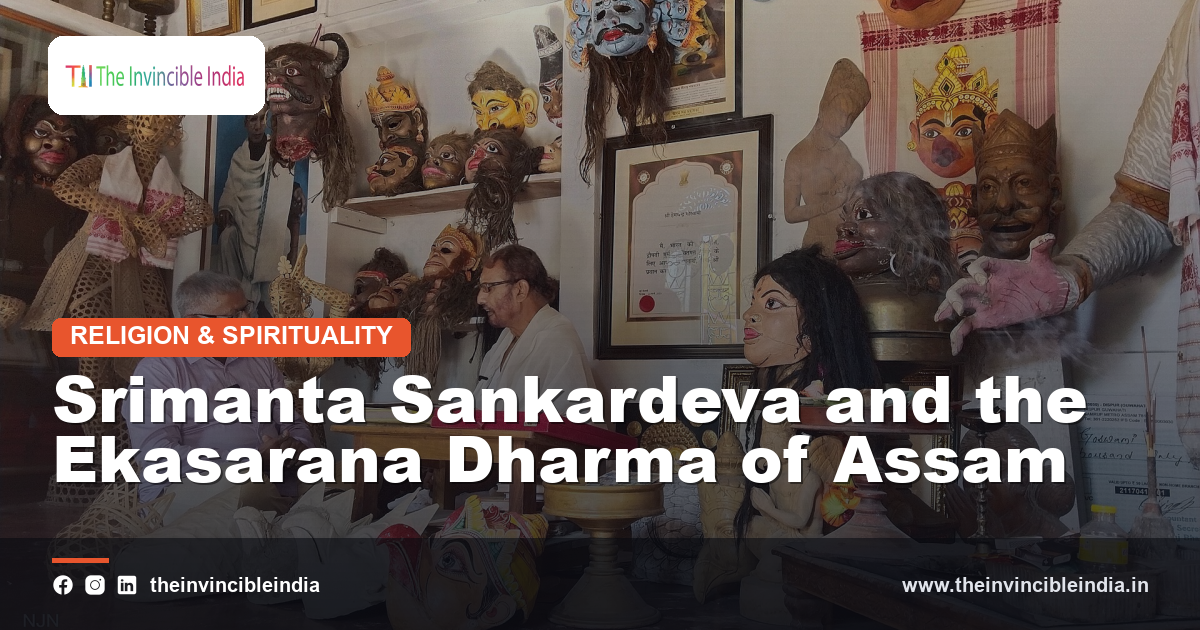
Srimanta Sankardeva is among the most celebrated figures in the cultural history of Assam, remembered as a saint, poet, dramatist, musician and social reformer who lived at the close of the medieval period. He taught a devotional path called Ekasarana Dharma, which centres on surrender to a single God, understood as Krishna or Vishnu, and on the congregational chanting of the divine name. His influence extended far beyond religion, giving the region its devotional songs, one-act plays, dance, painting and monastic institutions. As a major voice within the broader Bhakti movement, he turned devotion into a shared cultural life open to people of many communities, and this guide explores his life, teachings, institutions and artistic legacy.
Quick Facts
| Detail | Information |
|---|---|
| Tradition | Ekasarana Dharma (Neo-Vaishnavism of Assam) |
| Founder | Srimanta Sankardeva |
| Region | Assam, India |
| Central Practice | Naam-kirtan, congregational chanting |
| Key Institutions | Namghar and satra |
| Artistic Legacy | Borgeet, Ankia Naat, Bhaona, Sattriya dance |
A Saint of Assam
Srimanta Sankardeva is honoured in Assam with the title Srimanta, which expresses deep reverence for a teacher whose work shaped the identity of an entire region. He was born in the Nagaon area of the Brahmaputra valley and is generally placed in the late fifteenth and sixteenth centuries, a period when Assam was home to several kingdoms and a rich mix of communities and beliefs. Accounts of his life, preserved in later biographies and in oral memory, describe a gifted scholar who turned from worldly responsibilities to a life of devotion and public teaching. His mission combined religious reform with cultural creativity, so that his followers received not only a philosophy but also songs, plays and rituals through which to express it. The remembrance of Sankardeva remains central to Assamese self-understanding, and he is often described as the father of modern Assamese culture in a spiritual and artistic sense.
The Social and Religious Setting
The Assam of Sankardeva’s time was a meeting ground of many traditions, including local tribal beliefs, Shakta and Shaiva worship, and Tantric practices, along with Vedic and Puranic customs carried by different groups. Religious life often involved elaborate rituals and sacrifices that were accessible mainly to specialists, leaving many ordinary people at a distance from formal worship. Into this setting Sankardeva introduced a simpler and more inclusive devotional path that stressed faith and the singing of the divine name over complex ceremony. His movement should be seen as part of a wider wave of devotional reform across the subcontinent, yet it developed distinctive features rooted in Assamese language and landscape. By offering a common spiritual vocabulary to diverse communities, the teaching helped to knit together a society of many peoples, and this contribution is remembered as one of its great social achievements.
Pilgrimage and the Search for a Path
Traditional biographies describe Sankardeva undertaking long pilgrimages to sacred sites across the subcontinent, during which he is said to have encountered holy places, scholars and devotional communities. These journeys are treated in the tradition as formative, deepening his understanding of devotion and convincing him of the importance of the Bhagavata Purana. Specific itineraries and details vary among the accounts and are best regarded as traditional narrative rather than precise record. What is clear is that he returned to Assam with a strengthened sense of mission and a clear programme for spreading devotion among the people. The theme of pilgrimage is common in the lives of Indian saints, serving as a symbol of inner search as well as outer travel. In the case of Sankardeva, it forms the bridge between his early life as a scholar and his later work as a teacher and organizer.
The Ekasarana Dharma
The name Ekasarana means taking refuge in one, and it points to the central principle of Sankardeva’s teaching, which is exclusive devotion to a single supreme God. In this tradition the Supreme is worshipped as Krishna, regarded as the highest form of Vishnu, and other deities are not made the objects of ritual worship. The faith is also known as the Mahapurushiya Dharma, after the title Mahapurusha given to its founder and his chief disciple. Its emphasis falls on faith, humility and constant remembrance of the divine, rather than on elaborate rites or pilgrimages. Followers hold that the divine name itself carries saving power and that devotion is open to all who take refuge in it. The simplicity of the principle gave the movement great reach, allowing it to flourish among people of every background in the region.
The Four Components of Devotion
Ekasarana Dharma is often summarized as resting on four elements, which are Deva, Naam, Guru and Bhakat. Deva refers to the one supreme God who is the sole object of worship, while Naam means the divine name, whose chanting and hearing form the principal spiritual practice. Guru denotes the teacher who guides the disciple, and Bhakat refers to the community of devotees who support one another on the path. Together these four make up a complete framework, in which the individual is connected to God through the name, to the teacher through instruction and to the community through fellowship. The scheme is memorable and practical, which helped it spread among people without formal learning. By placing the community of devotees alongside the deity and the teacher, the tradition expresses the idea that spiritual life is shared rather than solitary.
Naam-Kirtan and Congregational Worship
The heart of worship in this tradition is naam-kirtan, the communal singing and recitation of the names and glories of God, often accompanied by cymbals and drums. Instead of relying on priests to perform elaborate ceremonies on behalf of the community, the devotees gather together and take part directly in the act of praise. Sessions of kirtan are held regularly and on festival occasions, and they follow established patterns of verses, responses and rhythms that have been handed down through generations. The practice reflects the conviction that devotion belongs to everyone and that the voice of the community, raised in unison, is itself an offering. It also creates strong bonds among participants, who share the same songs and rituals. In this way the simple act of singing together became the foundation of a living religious culture in Assam.
The Namghar as Community Space
The namghar, literally the house of the name, is the characteristic place of worship in the Ekasarana tradition and is found in villages across Assam. It is typically a long, open hall with a simple sanctuary at one end, where a sacred scripture, rather than an image, is placed on a seat of honour. The namghar serves not only as a house of prayer but also as a centre for community life, hosting meetings, discussions, festivals and cultural performances. Because it does not belong to any single caste or clan, it has helped to nurture a sense of shared village identity. Its modest design stands in contrast to the grand temples of other traditions, reflecting the movement’s emphasis on devotion over display. The namghar thus remains a lasting symbol of the inclusive and community-centred character of Assamese Vaishnavism.
Satras and the Monastic Tradition
The satra is the monastic institution of the Ekasarana tradition, developed by Sankardeva and his followers as a centre of religious life, learning and the arts. Headed by a satradhikar, a satra typically includes a prayer hall, residential quarters for resident devotees and spaces for teaching and performance. Some satras follow a celibate monastic discipline, while others are associated with householder communities, reflecting the variety within the tradition. Over time the satras became custodians of manuscripts, music, dance and drama, preserving cultural forms that might otherwise have been lost. They also played a role in local society by offering education and acting as places of social gathering. The satra system remains one of the most distinctive features of Assamese religious heritage, and many continue to function as active centres of devotional and artistic life.
Majuli and Its Satras
Majuli, a large river island in the Brahmaputra, is widely known as a stronghold of the satra tradition and has been home to many such institutions. Visitors to the island encounter monastic establishments where devotees continue to practise daily prayer, music and dance in line with long-standing custom. The island’s isolated setting, surrounded by the great river, has helped preserve distinctive customs, including crafts such as the making of masks used in traditional performances. The satras of Majuli attract scholars, pilgrims and travellers interested in living cultural heritage, and they have become a symbol of Assamese spiritual identity. The island has also faced challenges from the changing course of the river, which has long threatened its land and has led to concern for its conservation. Majuli therefore stands as both a treasured cultural landscape and a reminder of the need to protect living traditions.
Borgeet and the Devotional Music
Sankardeva composed a body of devotional songs known as Borgeet, meaning great songs, which remain among the most cherished forms of Assamese music. These songs are set to specific ragas and express devotion, humility and longing for the divine, often in a language that blends Assamese with the literary Brajavali. They are sung in temples, namghars and concerts, and they continue to be taught to new generations of singers. Their melodies and lyrics have been preserved through a long tradition of oral and written transmission, and they are regarded as an important contribution to the classical heritage of the region. Beyond religious use, the Borgeet have influenced the broader musical culture of Assam and are admired for their poetic quality. As a living repertoire, they connect modern listeners with the devotional world of the sixteenth century.
Ankia Naat and Bhaona
Another great contribution of Sankardeva was the Ankia Naat, a form of one-act devotional drama that retells episodes from the stories of Krishna and Rama. The plays are performed in a theatrical style called Bhaona, which combines song, dance, dialogue, mime and striking costume, with a narrator known as the Sutradhar guiding the audience through the story. Performances are held in namghars and satras, especially during festivals, and they serve both as entertainment and as religious instruction. The language mixes Assamese with Brajavali, giving the plays a distinctive literary flavour. Masks and elaborate costumes bring divine and mythological characters to life, adding visual richness to the occasion. Through such theatre, complex religious narratives were made accessible to ordinary audiences, and the tradition continues to be staged with great enthusiasm today.
Sattriya Dance
Sattriya is a classical dance form that developed within the satras as part of the devotional and dramatic life of the Ekasarana tradition. It was nurtured over generations by the monastic community, whose members performed it as an offering and as part of religious ceremonies and plays. The dance combines graceful movement, stylized gesture, rhythmic footwork and expressive storytelling, and it draws on the narratives of Krishna and other themes from the Vaishnava tradition. In the modern period it moved beyond the monasteries to the wider stage, and it received recognition as one of the classical dance forms of India. Its journey from the prayer hall to national and international audiences shows how a regional devotional art can acquire broad cultural significance. Sattriya today is performed by both monastic and secular dancers, keeping alive an heritage that began as an act of worship.
Literary and Linguistic Contribution
Sankardeva is also honoured as a pioneer of Assamese literature, whose writings helped to establish the language as a vehicle for serious religious and poetic expression. He rendered portions of the Bhagavata Purana into Assamese verse and composed devotional works such as the Kirtana Ghosha, a collection of poems in praise of God that is revered by followers. His writings were meant to be understood by ordinary people, which encouraged the growth of vernacular literature at a time when learned texts were often confined to Sanskrit. His chief disciple, Madhavadeva, extended this literary work with devotional poetry and the compilation known as the Naam Ghosha. Together these writings formed the scriptural core of the tradition and gave Assamese a lasting literary foundation. The result was a body of work that is valued both for its devotion and for its place in the history of the language.
Inclusiveness and Social Harmony
A prominent feature of Sankardeva’s teaching is its welcome to people from many social backgrounds, which stood out in a society divided by hierarchy and custom. Traditional accounts describe disciples drawn from different communities, including tribal groups and others on the margins of orthodox society, who found a place in the devotional fellowship. The emphasis on the name of God, which anyone may chant, removed the need for priestly mediation and made worship available to all. This approach contributed to social cohesion in a region of great diversity and helped build shared cultural bonds across communities. At the same time, scholars note that later developments within the tradition were shaped by the usual complexities of history. The ideal of inclusiveness nevertheless remains a central part of the movement’s legacy and a major reason for the affection in which Sankardeva is held.
Disciples and Later Developments
After Sankardeva, his work was carried forward by disciples and successors, the most prominent of whom was Madhavadeva, who is honoured as a saint and poet in his own right. Other leading followers, such as Damodaradeva and Haridevadeva, also guided branches of the movement, and over time the tradition developed several subgroups with their own emphases and centres. These groups differ in details of organization and practice, yet they share the foundational teaching of devotion to one God through the divine name. The satras and namghars multiplied across the Brahmaputra valley, anchoring the movement in local communities. Patronage from rulers and local leaders at various times helped the institutions to grow, though the tradition remained rooted in popular devotion. The diversity of the later community reflects the vitality of the original teaching and its ability to adapt to changing circumstances.
Sankardeva and Ekasarana Dharma Today
Today the legacy of Srimanta Sankardeva is visible throughout Assam, in namghars that stand in nearly every village, in the satras that preserve music and dance, and in the festivals that mark his life and teaching. The Borgeet, Ankia Naat and Sattriya dance continue to be performed and taught, and cultural institutions in the region work to document and promote them. Scholars and devotees alike study his writings, while his message of devotion, humility and community remains a source of inspiration. The tradition faces modern challenges, from preserving fragile heritage sites to passing on skills to younger generations, yet interest in its heritage remains strong. For many people in Assam, Sankardeva is not only a historical saint but a living presence in cultural memory. His Ekasarana Dharma endures as one of the great devotional achievements of the Indian subcontinent.
Sources & Further Reading
- Ministry of Culture, Government of India (indiaculture.gov.in).
- Sangeet Natak Akademi, national academy for music, dance and drama (sangeetnatak.gov.in).
Frequently Asked Questions
Who was Srimanta Sankardeva?
Srimanta Sankardeva was an Assamese saint, poet, dramatist and reformer who lived in the late medieval period. He founded the Ekasarana Dharma and left a rich legacy in the religion, literature and arts of Assam.
What is Ekasarana Dharma?
Ekasarana Dharma is a devotional tradition centred on exclusive devotion to one God, worshipped as Krishna or Vishnu. Its main practice is the chanting and hearing of the divine name in community.
What is a namghar?
A namghar is a community prayer hall found in Assamese villages, where devotees gather for congregational worship and cultural events. It usually has a scripture, rather than an image, as its focus.
What is a satra?
A satra is a monastic and cultural institution of the Ekasarana tradition, serving as a centre for worship, learning and the arts. Many satras are located on the island of Majuli.
What art forms came from Sankardeva?
Sankardeva is associated with the Borgeet devotional songs, the Ankia Naat one-act plays and the Bhaona performance style. The Sattriya dance developed in the satras within the same tradition.


