

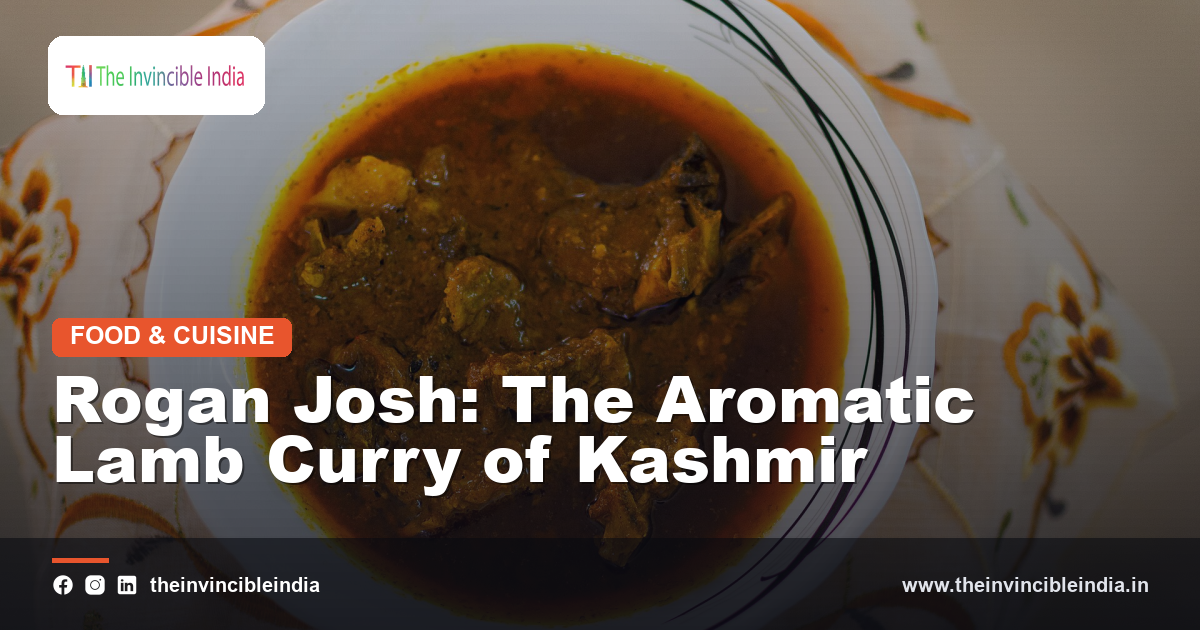
Rogan Josh is the dish most closely identified with the cuisine of Kashmir, a lamb curry of deep red colour, fragrant spice and remarkable depth that has travelled far beyond the valley. Its name, its colour and its cooking method all point to the layered history of a region where Persian, Central Asian and Indian influences have met for centuries. Part of the great family of dishes described in the guide to the regional cuisines of India, it is cooked in both Kashmiri Pandit and Kashmiri Muslim households, each with its own distinctive approach, and it occupies an honoured place at the valley’s ceremonial feast, the Wazwan.
Quick Facts
| Detail | Information |
|---|---|
| Origin | Kashmir Valley |
| Main ingredient | Lamb or mutton |
| Signature colour | Deep red from Kashmiri chilli |
| Key spices | Fennel, dry ginger, cardamom, cloves |
| Festive context | Part of the Kashmiri Wazwan |
| Served with | Steamed rice |
Kashmir and Its Culinary Crossroads
The Kashmir Valley, ringed by high mountains, has long been a meeting point of cultures. Trade routes, pilgrims, rulers and artisans connected it with Persia, Central Asia and the plains of India, and each left an imprint on its language, crafts and food. The result is a cuisine unlike any other in the subcontinent, built on slow cooking, aromatic spices, dried fruits, dairy and meat in generous measure. Rogan Josh sits at the centre of this tradition because it brings together so many of its defining traits: meat cooked patiently in its own juices, a vivid colour drawn from local chillies and a spice profile that favours warmth and fragrance over fire. The dish cannot be separated from the valley that gave it character, nor from the history of exchange that made that character possible.
The Meaning of the Name
The name Rogan Josh is generally traced to Persian, which fits the long Persian influence on Kashmiri culture. Rogan is commonly understood to mean oil or clarified fat, and josh to mean heat, passion or an intense, bubbling cook. Together the words are usually interpreted as meat cooked in fat over strong heat, although alternative explanations also circulate. The exact origin of the name remains a matter of tradition rather than settled record, and it is wise to treat any single explanation with caution. What is certain is that the name belongs to the valley’s Persianate linguistic heritage, just as many Kashmiri words for crafts, foods and customs do. In this sense even the title of the dish tells a story of cultural meeting, preserving in a few syllables the memory of centuries of connection.
The Colour of Kashmiri Chilli
The most striking feature of Rogan Josh is its rich red colour, which comes largely from the Kashmiri red chilli, a variety prized for imparting intense colour with moderate heat. This quality allows the curry to look fiery without overwhelming the palate, which suits the valley’s preference for balance. In some traditional kitchens, additional natural colouring agents are used, including a root known as ratan jot, which gives the oil a deep red hue. The colour is not merely decorative: it signals the care with which the chillies have been prepared and the oil infused. A well-made Rogan Josh shows a glossy, deep red sheen on the surface. Colour, in this tradition, is a promise of flavour, and the Kashmiri chilli has become almost synonymous with the visual identity of the dish.
Choosing and Cutting the Meat
Rogan Josh is traditionally made with lamb or mutton, and the choice and cut of meat matter greatly. Cooks favour pieces with bone and a measure of fat, because the bone enriches the gravy and the fat carries flavour and gives the dish its characteristic gloss. Shoulder, leg and ribs are commonly used in different households, often combined to provide a range of textures. The meat is cut into generous pieces that can withstand long, slow cooking without falling apart. Because the dish depends on the quality of its principal ingredient, experienced cooks treat the selection of meat as the first and most important step. A tender, well-flavoured cut transforms the curry, while poor meat cannot be rescued by spices alone, a principle that applies throughout Indian meat cookery.
The Role of Fat and Oil
Fat is central to the identity of Rogan Josh, as the name itself suggests. Traditionally, mustard oil is the cooking medium in Kashmiri kitchens, heated until it loses its raw pungency before the meat is added. Its sharp, distinctive character gives the curry a recognisable base that sets it apart from dishes cooked in ghee or neutral oils. The oil also carries the colour of the chillies and the fragrance of the spices through the gravy, forming a glossy layer that is considered a sign of a well-made dish. Cooks pay careful attention to the temperature and timing of this stage. The handling of fat in Rogan Josh illustrates how Indian regional cuisines often rely on a signature cooking medium to define their flavour, giving each region an unmistakable culinary voice.
The Spice Profile
The spices of Rogan Josh are chosen for warmth and fragrance rather than raw heat. Ground fennel and dry ginger powder are especially characteristic, lending a sweet, gently pungent note that is rarely found in curries from other parts of India. Black and green cardamom, cloves, cinnamon and bay leaf add aroma, while the Kashmiri chilli supplies colour and mild heat. The spices are often added in a careful sequence, with whole spices first blooming in the hot oil and ground spices following. The effect is a layered, perfumed gravy in which no single spice dominates. This restraint is part of what makes the Kashmiri palate distinctive, and it is a major reason why the dish appeals to people who might find other Indian curries too intense, offering depth without aggression.
Kashmiri Pandit Style
The Kashmiri Pandit community has its own distinctive way of preparing Rogan Josh, shaped by long-standing dietary custom. In this style, onion and garlic are traditionally omitted, and flavour is built instead with asafoetida, dry ginger, fennel and yogurt, along with the signature chilli and mustard oil. The result is a gravy that is intensely aromatic but cleaner and sharper in character. Yogurt, whisked to prevent curdling, is added with great care and cooked until the oil separates. This version highlights how restrictions can inspire creativity, producing a curry that achieves richness without the usual aromatic base of the Indian kitchen. It is often regarded as one of the clearest examples of how community tradition shapes a dish, and it remains central to the festive and everyday food of Kashmiri Pandit families.
Kashmiri Muslim Style
In Kashmiri Muslim households and in the professional kitchens of the valley, Rogan Josh is prepared with a slightly different emphasis. Onion is commonly used in some preparations, though practices vary by family, and cooks may add other spices according to custom. The cooking is typically unhurried, with the meat simmered until tender in a gravy that thickens naturally. This tradition is closely tied to the valley’s professional cooks, known as wazas, who preserve ceremonial recipes across generations. While the two styles differ in details, they share the core features of the dish: deep red colour, aromatic warmth and slow cooking. Their coexistence is a reminder that Kashmiri cuisine is a shared inheritance of multiple communities, each contributing its own refinements to a dish that belongs to the whole valley.
Rogan Josh in the Wazwan
The Wazwan is the grand ceremonial feast of Kashmir, served at weddings and important gatherings, and consists of a long succession of meat dishes prepared by master cooks known as wazas. Rogan Josh holds an honoured place among its courses, standing alongside other celebrated preparations such as the meatball dish gushtaba and the yogurt-based curry known as yakhni. The meal is traditionally shared from a large platter called a traem, around which diners sit in groups of four. In this setting Rogan Josh is more than a dish; it is part of a ritual of hospitality and community. The Wazwan shows how food in Kashmir expresses social bonds, and Rogan Josh, as one of its central courses, carries that meaning into every pot.
Slow Cooking and Technique
The technique of Rogan Josh depends on patience. The meat is browned lightly, then cooked slowly with spices and a little water, so that it gradually tenderises in a concentrated, aromatic gravy. Cooks monitor the heat to prevent scorching, stirring at intervals and adding liquid in small amounts. Traditional preparation often takes place in heavy copper or brass vessels, which distribute heat evenly. The dish is ready when the meat is soft, the oil has separated and the gravy has reduced to a smooth, glossy coating. This process cannot be hurried without sacrificing flavour. In the Kashmiri kitchen, time is considered an ingredient, and the willingness to wait for the meat and spices to unite is one of the principal reasons the dish has earned its reputation.
Serving Rogan Josh
Rogan Josh is customarily served with steamed rice, which is the staple of the Kashmiri table and provides a gentle background for the intensity of the curry. In Kashmir, rice is often cooked simply, allowing the gravy to take centre stage. The dish may also be accompanied by local breads, a fresh salad of onion and radish or a spoonful of tangy chutney made from walnuts or other regional produce. The curry is best eaten hot, when the aroma is at its fullest and the oil still glistens on the surface. In winter, in particular, it offers warmth and comfort in a cold climate. The simplicity of the accompaniments is deliberate, designed to highlight the main dish and let the long-cooked flavours speak for themselves.
Comparisons with Other Indian Curries
Set beside the curries of other regions, Rogan Josh reveals its distinctiveness. Where many North Indian meat curries rely on a heavy base of onions, tomatoes and garlic, the Kashmiri version leans on dry ginger, fennel and chilli for character. Where southern and coastal curries often use coconut or tamarind, Kashmir uses yogurt, mustard oil and dried spices. The result is a gravy that is rich yet clear, aromatic yet not hot, and unmistakably tied to a mountain culture. Such comparisons help illustrate the central theme of Indian cuisine, that geography, climate and history shape taste. For instance, the fiery coastal tradition behind Goan vindaloo is as different from Rogan Josh as a seaside town is from a Himalayan valley.
The Himalayan Climate and Its Influence
The cold, mountainous climate of Kashmir has strongly influenced its food. Long winters encouraged the preservation of vegetables and meats and the development of hearty, warming dishes, while the valley’s fertile soil produced walnuts, almonds, saffron and a variety of fruits. Cooking methods that rely on slow simmering suit a climate in which a warm kitchen is a source of comfort. Rogan Josh embodies this relationship between environment and cuisine: it is rich, warming and substantial, designed to sustain people through the cold months. The dish also demonstrates the importance of local ingredients such as Kashmiri chilli, which is closely associated with the region. Understanding Rogan Josh thus involves understanding the valley itself, its seasons, its produce and the ways in which its people have adapted to their surroundings.
Hospitality and the Kashmiri Table
Hospitality is one of the most prized values of Kashmiri culture, and food is its primary language. A guest is expected to be fed generously, and meals are often elaborate affairs involving several courses and a great deal of shared conversation. Rogan Josh, as a flagship dish, frequently appears at such occasions, whether in a family home or at a large celebration. The act of sharing a meal from a common platter reinforces the sense of community. This attitude to food is reflected across India, where the thali and the feast are central social institutions, as in the Indian thali tradition. In Kashmir, however, the ceremonial structure of the Wazwan gives hospitality a particularly formal and memorable expression.
Cooking Rogan Josh at Home
Cooks who wish to prepare Rogan Josh at home should focus on a few essentials. Begin with good bone-in lamb, use genuine Kashmiri chilli for colour, and cook in mustard oil heated properly before use. Add fennel and dry ginger for authentic character, and handle yogurt carefully so that it does not curdle. Most importantly, allow the dish to cook slowly until the oil separates and the meat is tender. Many cooks find that the flavour improves when the curry rests for some time before serving. While exact quantities vary by household, these principles remain constant. Preparing the dish at home offers an appreciation of the discipline behind Kashmiri cooking, and it demonstrates that the finest results come from respect for ingredients, patience and a steady hand rather than from complicated technique.
Rogan Josh Today
Today Rogan Josh is known throughout India and across the world as an emblem of Kashmiri cuisine, served in homes, restaurants and festive gatherings far from the valley. Its popularity has produced many adaptations, some of which differ considerably from the traditional preparation, but the original continues to be cherished by those who value its distinctive spice profile and unhurried method. The dish endures because it carries so much meaning: the Persian heritage of its name, the colour of Kashmiri chilli, the care of the wazas, the hospitality of the Wazwan and the identity of two communities. Preserving authentic Rogan Josh means preserving a piece of Kashmir’s cultural memory, ensuring that future generations can taste the valley’s history in a single, fragrant bowl.
Sources & Further Reading
- Ministry of Culture, Government of India (indiaculture.gov.in).
- Ministry of Tourism, Government of India (incredibleindia.gov.in).
Frequently Asked Questions
What is Rogan Josh?
Rogan Josh is a traditional lamb curry from Kashmir, known for its deep red colour, aromatic spices and slow cooking. It is a signature dish of Kashmiri cuisine and part of the Wazwan feast.
What does the name Rogan Josh mean?
The name is generally traced to Persian, with rogan understood as oil or fat and josh as heat or intensity. The exact origin is a matter of tradition, and several explanations are offered.
What gives Rogan Josh its red colour?
The colour comes mainly from Kashmiri red chilli, which imparts vivid colour with mild heat. Some traditional kitchens also use ratan jot to deepen the hue of the oil.
How do Pandit and Muslim versions differ?
The Kashmiri Pandit version traditionally omits onion and garlic and relies on asafoetida, ginger and fennel. The Muslim version may use onion and varies by family, though both share the same red, aromatic character.
What is Rogan Josh served with?
It is customarily served with steamed rice, which is the staple of the Kashmiri table. Fresh salad, local breads or chutney may accompany it.


