

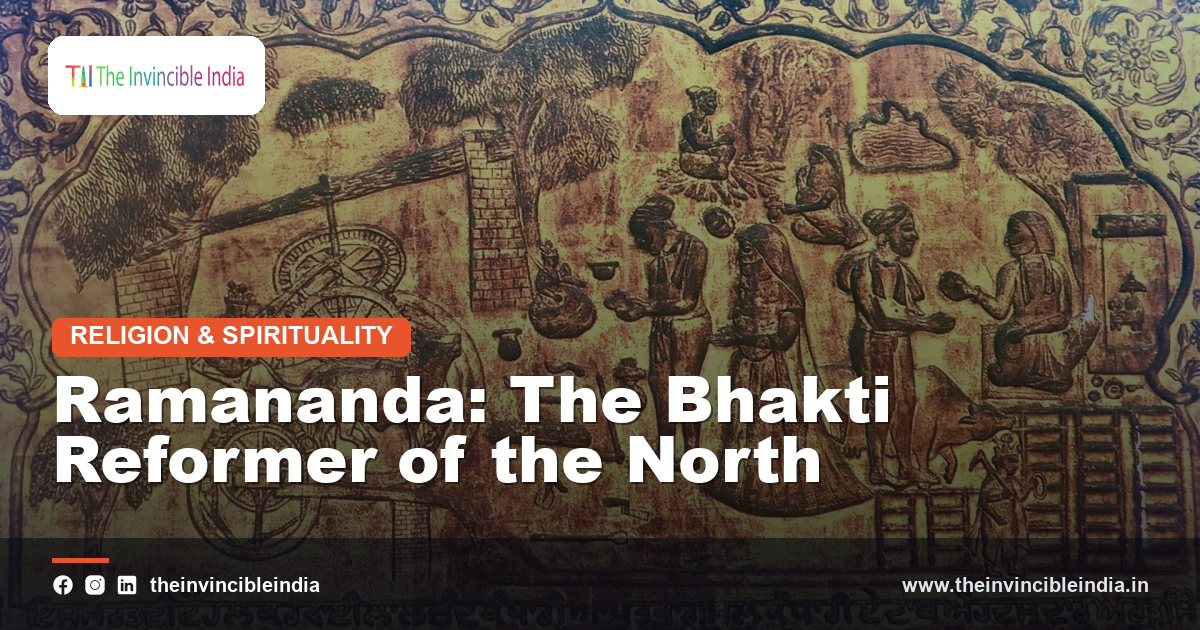
Ramananda is remembered as one of the pivotal figures in the spread of devotional religion across northern India, a teacher whose message of loving surrender to Rama reached people far beyond the circles of Sanskrit learning. Tradition places him in the holy city of Varanasi, where he is said to have guided disciples of many backgrounds and encouraged the use of everyday language in religious teaching. The monastic order that carries his name, the Ramanandi, is counted among the largest ascetic communities of Vaishnava India. As a bridge between the learned southern devotional schools and the vernacular saint-poets of the north, he holds a significant place in the Bhakti movement, and this guide explores his life, ideas, disciples and enduring influence.
Quick Facts
| Detail | Information |
|---|---|
| Tradition | Ramanandi Sampradaya (Vaishnava) |
| Teacher | Ramananda, medieval Bhakti reformer |
| Associated City | Varanasi (Kashi) |
| Chief Deity | Rama, with Sita |
| Notable Feature | Teaching in vernacular language, open to many castes |
| Traditional Disciples | Kabir, Ravidas, Pipa, Sena, Dhanna and others |
Who Was Ramananda?
Ramananda is honoured as a medieval Vaishnava teacher who helped carry the devotion to Rama into the heart of northern India. Historical certainty about his life is limited, and the dates usually proposed for him are matters of scholarly discussion, so most details come from devotional tradition rather than from contemporary records. He is generally placed in the medieval period, in a time when devotional currents were gathering strength across the subcontinent. Followers revere him as an acharya who combined religious learning with a compassionate concern for ordinary people. His importance lies less in a single surviving body of writing than in the movement that grew around his teaching and in the remarkable group of disciples traditionally associated with him. Understanding Ramananda therefore means appreciating both a historical personality and a living memory kept alive by generations of devotees.
Varanasi as His Spiritual Home
Tradition associates Ramananda with Varanasi, also called Kashi, the ancient city on the Ganga that has long been a centre of learning and pilgrimage for Hindus. The riverbank steps of the city, known as ghats, form the setting for many stories of saints and scholars, and Ramananda is remembered as having taught in this environment. The city’s character as a meeting place of pilgrims from across the country made it an ideal place for ideas to spread. A monastic seat linked to his memory is traditionally pointed out near the river, and devotees honour it as part of their heritage. Varanasi’s role as a crossroads of Sanskrit scholarship and popular devotion helps explain why a movement that spoke to both could take root there. The city thus remains an essential part of the story of the teacher and his order.
The Context of Medieval Devotion
Ramananda’s teaching arose in a period when devotional movements were transforming religious life in many parts of India. In the south, the poet-saints and the teachers of the Sri Vaishnava tradition had developed a rich theology of loving devotion to Vishnu, and these ideas gradually travelled northward. In the north, society was shaped by hierarchies of birth and by the dominance of learned Sanskrit in formal religion, while popular devotion expressed itself in regional languages and folk forms. Rulers and communities of varied faiths lived side by side, producing a lively exchange of ideas. Within this setting, a teacher who spoke simply, welcomed seekers and centred worship on a beloved deity could have a profound effect. The broad Bhakti current gave Ramananda a framework, and his own contribution was to make it widely accessible in the north.
Devotion to Rama and Sita
The distinguishing feature of Ramananda’s tradition is its focus on Rama, the hero of the Ramayana, as the supreme form of the divine, worshipped together with his consort Sita. While earlier Vaishnava devotion often centred on Vishnu in general or on Krishna, the Ramanandi path made Rama the central object of love and meditation. Devotees repeat the name of Rama as a mantra and regard it as a source of protection and grace. The ideal of Rama as a figure of righteousness, compassion and fidelity gave the movement an ethical depth alongside its emotional warmth. In the home and the temple, devotees salute one another with names of Rama and Sita, expressing a culture of mutual respect. This devotion helped to make Rama a beloved presence in the daily life of millions across northern India.
Teaching in the Language of the People
One of the most significant aspects traditionally attributed to Ramananda is his willingness to teach in the spoken languages of the people rather than relying solely on Sanskrit. This approach opened religious ideas to those who had no formal education and encouraged a flowering of devotional poetry in regional tongues such as the forms of Hindi. The shift had far-reaching cultural consequences, since it dignified the speech of ordinary communities as a vehicle for spiritual expression. Poets who followed in the wake of the movement composed verses that are still sung today, and these songs carry the heritage of Bhakti into everyday life. The use of the vernacular did not reject Sanskrit scholarship but supplemented it with a wider voice. In this way the teacher is remembered as one who brought the treasures of devotion within reach of everyone.
An Open Door for Seekers
Tradition holds that Ramananda welcomed disciples without regard to birth, a principle often summed up in a saying that those who seek God belong to God. This attitude stood out in a society where access to religious learning and ritual was frequently restricted, and it forms a central part of his reputation as a reformer. Accounts speak of disciples from many social backgrounds, including craftsmen, farmers and rulers, who gathered around him as spiritual equals. Scholars caution that the full historical picture is complex and that later retellings may idealize the story, yet the egalitarian tone of the movement is well established. The message that devotion, not lineage, is the true qualification for spiritual life resonated deeply and shaped later reform movements. It is this inclusive spirit that makes the figure of Ramananda a lasting symbol of social and religious openness.
The Traditional Circle of Disciples
Devotional tradition lists a circle of disciples around Ramananda, often described as twelve in number, who are said to have spread his teaching in many directions. Among those named are Kabir, the weaver-poet; Ravidas, the saint-poet traditionally linked with Varanasi; Pipa, remembered as a ruler who became a devotee; Sena, a barber; and Dhanna, a farmer. The list also includes other figures whose names are preserved in devotional literature. It should be stressed that these associations come from tradition and from later hagiographical works, and historians debate how closely each figure was connected with the teacher. Even so, the symbolic force of the list is clear, as it presents a community in which rulers and craftsmen stand side by side. The circle of disciples thus embodies the movement’s ideal of devotion as a shared and levelling experience.
Kabir and Ravidas in the Tradition
Among the traditional disciples, Kabir and Ravidas have become towering figures of Indian devotional poetry in their own right. Kabir is remembered for terse and striking verses that question ritual formalism and speak of the divine in a language of everyday imagery, and his songs are cherished by many communities. Ravidas is honoured for devotional poetry of deep humility and longing, and his compositions are valued by large numbers of followers. Tradition connects both with Ramananda as their teacher, although the nature of the relationship is explained differently in different accounts and discussed by historians. Whatever the historical details, their poetry reveals the creative energy that the Bhakti current released among people from outside the circles of formal learning. Their presence in the tradition underlines how far the influence attributed to Ramananda reached, shaping poetic voices that continue to be heard across India.
The Ramanandi Sampradaya
The Ramanandi Sampradaya is the monastic and devotional order that traces itself to Ramananda, and it is widely regarded as the largest community of Vaishnava renunciants in India. Members, known as Ramanandis or Vairagis, commit themselves to a life of devotion, simplicity and service, and they live in monasteries and temples across the country. The order has a network of seats, teachers and lineages that preserve its customs and teaching. Its monks are recognizable by marks on the forehead and by their devotion to the names of Rama and Sita. Over the centuries the community has become an important presence in pilgrimage towns and has contributed to the religious and social life of many regions. As a living institution, the Ramanandi order demonstrates how the work of a single teacher can grow into a vast and enduring tradition.
Relation to Sri Vaishnavism
The connection between the Ramanandi tradition and the older Sri Vaishnava lineage of Ramanuja is a subject that tradition and scholarship discuss with some care. Many Ramanandis hold that their teacher belonged to the Sri Vaishnava line before founding a distinct path, and they honour the earlier acharyas as spiritual ancestors. Historians, however, point to the differences in emphasis, particularly in the focus on Rama and the open attitude toward disciples, and some see the Ramanandi movement as an independent development. Both views agree that the devotional theology of the south influenced the north and that Ramananda was a key transmitter of this influence. The question illustrates how religious identities in medieval India were formed through a mixture of inheritance and innovation. Whatever the precise relationship, the tradition acknowledges a deep debt to the earlier Vaishnava heritage while maintaining its own character.
Works Attributed to Ramananda
A small number of works are traditionally attributed to Ramananda, including a Sanskrit commentary on the Brahma Sutras and a manual of worship, along with devotional hymns in the vernacular. Scholars remain divided about the authorship and dating of some of these texts, and for this reason it is wise to treat them as attributed rather than securely established. A few short devotional verses in regional languages are also associated with his name and appear in later collections of sacred poetry. What is certain is that the movement he inspired produced a large body of literature, from hymns to hagiographies, that preserves the memory of his teaching. The relative scarcity of firmly authenticated writings makes the oral and communal transmission of his ideas all the more important. The legacy of Ramananda lives therefore not only in texts but in the practices and songs of his followers.
Galta and the Ramanandi Centres
Beyond Varanasi, the Ramanandi tradition has important centres in various regions, and one of the best known is the Galta complex near Jaipur in Rajasthan. Galta is a hill-side pilgrimage site with temples, water tanks and monastic buildings, and it has long been associated with the order. Ayodhya, the traditional birthplace of Rama in the Ramayana, is another major focus of Ramanandi devotion, where many monasteries and temples are maintained. The order has also been present in other holy cities and pilgrimage routes, forming a network that connects the whole of the north. These centres serve as places of worship, learning and hospitality for pilgrims and travelling ascetics. The geographical spread of the tradition illustrates the reach of the movement and reflects the deep roots that Rama devotion has put down in the religious landscape.
Monastic Life and Ascetic Orders
Ramanandi monastic life centres on renunciation, worship and service, and many members belong to organized ascetic groups with their own customs and leadership. Within the wider world of Vaishnava renunciants, the Ramanandis form a prominent group, and they take part in major gatherings of ascetics, including the great pilgrimage fairs that bring together monks from across the country. Daily routine usually involves prayer, recitation of the name of Rama, study of sacred texts and care of the temple or monastery. Many members also take part in charitable work and in the feeding of pilgrims and the poor. The structure of the order combines respect for seniority and lineage with the shared ideal of humble service. This disciplined communal life has allowed the order to maintain its traditions and its place in Indian religious society over many centuries.
Rama Devotion and Later Poets
The tradition of Rama devotion that Ramananda helped to popularize provided fertile ground for later poets, most famously Tulsidas, whose retelling of the Ramayana in Awadhi became beloved across northern India. Devotional communities, including the Ramanandi order, have long cherished this work, and many accounts connect the poet with the broader world of Rama worship that Ramananda’s followers nurtured. The exact connections between particular figures and lineages are explained differently by different sources and should be understood with care. Nevertheless, the cultural impact is unmistakable, since the stories and songs of Rama became part of the shared heritage of the region. Recitations, dramatic performances and festivals centred on Rama draw on this inheritance. In this way the movement associated with Ramananda helped to shape a literary and devotional culture that continues to flourish.
Ramananda and His Legacy Today
Today Ramananda is remembered as one of the great bridges of Indian devotional history, linking the philosophical heritage of the south with the vernacular saint-poets of the north. The Ramanandi order continues to flourish, with monasteries, temples and followers throughout India, and its salutations and songs form part of everyday religious life for many people. His reputation as a teacher who opened the path of devotion to all has made him an inspiring figure in discussions of social and religious reform. While historians continue to study the sources and debate the details of his life, the enduring influence of the movement he began is beyond doubt. The poets, saints and communities associated with his name show the creative power of an idea shared widely and generously. Ramananda thus endures as a symbol of devotion, openness and the living continuity of the Bhakti tradition.
Sources & Further Reading
- Ministry of Culture, Government of India (indiaculture.gov.in).
- Sahitya Akademi, national academy of letters (sahitya-akademi.gov.in).
Frequently Asked Questions
Who was Ramananda?
Ramananda was a medieval Vaishnava teacher traditionally associated with Varanasi, who helped spread devotion to Rama in northern India. Most details of his life come from tradition, and his dates are debated by scholars.
What is the Ramanandi Sampradaya?
The Ramanandi Sampradaya is the monastic and devotional order that traces itself to Ramananda. It is widely regarded as the largest community of Vaishnava renunciants in India.
Who were the traditional disciples of Ramananda?
Tradition names a circle of disciples that includes Kabir, Ravidas, Pipa, Sena and Dhanna, among others. These associations come from devotional tradition, and historians discuss how closely each figure was connected to him.
Why is Ramananda considered a reformer?
He is remembered for teaching in the language of the people and for welcoming seekers regardless of birth. This inclusive approach made devotion accessible to a wider society.
What is Galta?
Galta is a pilgrimage complex near Jaipur in Rajasthan that is closely associated with the Ramanandi order. It has temples, water tanks and monastic buildings.


