

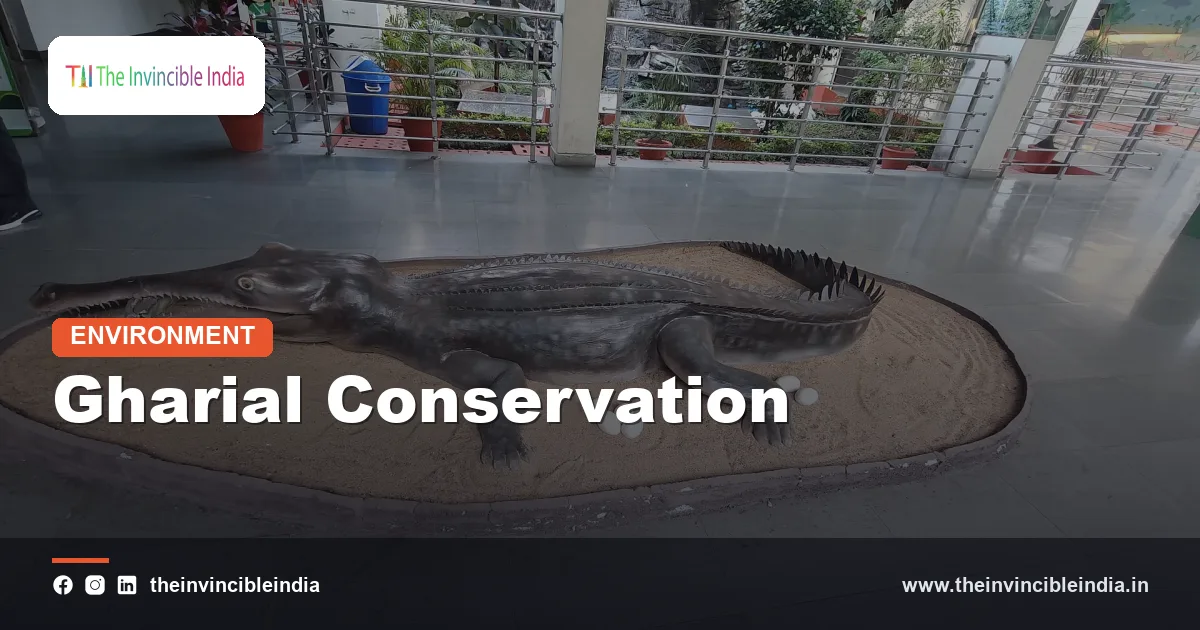
With a long, slender, tooth-studded snout and a body built for deep, fast-flowing water, the gharial looks like a creature from the age of dinosaurs. It is a fish-eating crocodilian that once lived in nearly every large river system of the northern Indian subcontinent. Today it survives in only a few river stretches, and gharial conservation has become one of the most closely watched wildlife efforts in the country, with the species listed as Critically Endangered by the International Union for Conservation of Nature (IUCN).
The gharial’s story is both a warning and a hope. Its numbers collapsed during the twentieth century because of hunting, loss of river habitat and fishing pressure, falling to a few hundred individuals by the 1970s. A national programme begun in 1975, known as Project Crocodile, built a network of breeding centres and sanctuaries, with the National Chambal Sanctuary emerging as the species’ stronghold. This explainer covers its biology, history of decline, conservation measures, threats and importance as an indicator of river health.
Quick Facts
| Parameter | Details |
|---|---|
| Scientific name | Gavialis gangeticus |
| IUCN status | Critically Endangered |
| Legal protection in India | Schedule I of the Wildlife (Protection) Act, 1972 |
| International trade control | CITES Appendix I |
| Diet | Almost entirely fish |
| Stronghold | National Chambal Sanctuary (Madhya Pradesh, Rajasthan, Uttar Pradesh) |
| Key conservation programme | Project Crocodile, launched in 1975 with United Nations support |
| Other habitats | Girwa (Katarniaghat), Gandak, Ken, Son, Mahanadi (Odisha) and other rivers |
| Distinctive feature | Bulbous “ghara” on the male’s snout tip; narrow jaws |
Meet the Gharial: Biology and Appearance
The gharial belongs to the order Crocodilia but is the only surviving member of its own family, Gavialidae. Its most remarkable feature is its very long, narrow snout, which is lined with a large number of sharp, interlocking teeth. This shape offers little resistance when swept sideways through water, allowing the animal to snap at fish with lightning speed. Gharials cannot take large prey like their broad-snouted cousins, and they are not regarded as a danger to people.
Adult males carry a hollow, pot-like growth at the tip of the snout. The word “gharial” comes from the Hindi word “ghara”, meaning a pot. The ghara helps males produce a buzzing sound when they exhale, a signal used in courtship and in establishing dominance. It also appears to help with visual display. Females do not have this growth, and adult males are considerably larger, often growing several metres long.
Body Adaptations
- Long, slender jaws: built for catching fast-moving fish.
- Webbed hind feet and powerful tail: the animal is an excellent swimmer.
- Weak legs for walking: adults rarely move far from the water and push themselves over sand on the belly.
- Eyes and nostrils on top of the head: allowing the body to stay submerged while the animal watches the surroundings.
Habitat and Distribution
Gharials prefer deep, clear, flowing rivers with sandy banks, a combination that supports both abundant fish and suitable nesting sites. They bask on exposed sandbanks, retreat to deep pools called “kunds” in the dry season and need a continuous stretch of clean river to feed, breed and move.
Historically, the species ranged across the Indus, Ganga, Brahmaputra and Mahanadi river systems and into neighbouring countries including Pakistan, Nepal, Bhutan, Bangladesh and Myanmar. It has disappeared from most of this range. Today, India and Nepal hold the most important populations, with Chambal supporting the single largest breeding population.
Where They Survive in India
- National Chambal Sanctuary: the largest and most important population, along a stretch of the Chambal shared by Madhya Pradesh, Rajasthan and Uttar Pradesh.
- Girwa River (Katarniaghat Wildlife Sanctuary), Uttar Pradesh: a stronghold near the Nepal border.
- Gandak River: including the Valmiki landscape in Bihar.
- Ken Gharial Sanctuary: in Madhya Pradesh, on the Ken River.
- Son Gharial Sanctuary: in Madhya Pradesh, along the Son River.
- Mahanadi in Odisha: where early captive breeding and release took place.
The National Chambal Sanctuary
The Chambal River rises in the Vindhya hills of Madhya Pradesh and flows northeast, passing through Rajasthan before joining the Yamuna in Uttar Pradesh. Unlike many other rivers of the northern plains, the Chambal has remained relatively clean and lightly populated along much of its course, because its ravines and badlands historically discouraged settlement. That relative isolation turned out to be a blessing for wildlife.
The National Chambal Sanctuary was established in the late 1970s as a tri-state protected area and covers a long, narrow stretch of the river and its adjoining ravines. Its principal purpose is to protect the gharial, but it also supports other significant species.
Other Wildlife of the Sanctuary
- the Ganges river dolphin, a freshwater mammal that is also an indicator of river health;
- the mugger or marsh crocodile;
- several species of freshwater turtles, including the red-crowned roofed turtle, which is itself threatened;
- smooth-coated otters;
- a rich variety of resident and migratory birds, such as the Indian skimmer and various waterfowl.
The sanctuary is managed by forest departments of the three states, coordinated by the sanctuary administration. It is a favoured destination for boat-based wildlife tourism, which provides a modest source of local income.
A Dramatic Decline in the Twentieth Century
For most of history, gharials were common in the great rivers of northern India. Over the twentieth century, their numbers fell dramatically, and by the mid-1970s the surviving population was estimated at only a few hundred animals, a collapse of well over ninety per cent from earlier levels. Several forces were responsible.
- Hunting and trade: gharials were killed for skins, for trophies and for the ghara, which was wrongly believed to have medicinal or aphrodisiac properties. Eggs were also collected.
- Dams, barrages and irrigation: river engineering altered flow, trapped sand and fragmented populations.
- Sand mining and riverbed cultivation: destroyed nesting banks and basking sites.
- Fishing: competition for fish and accidental drowning in nets.
- Pollution: contaminated water and reduced prey.
The species was also affected by the sheer fact that it requires a very specific habitat: a deep river with sandy banks. Any disturbance to those conditions, even without direct killing, can cause local extinction. By the time conservation authorities woke up to the crisis, the gharial was missing from most of its historical range.
Project Crocodile (1975)
In 1975, India launched the Crocodilian Conservation Project, popularly known as Project Crocodile, with technical and financial support from the United Nations Development Programme and the Food and Agriculture Organization. Its goals were to protect the three crocodilian species in India, the gharial, the mugger and the saltwater crocodile, and to increase their numbers by captive breeding and release. The early work began in Odisha, with centres such as the one at Tikarpada on the Mahanadi, and it was later expanded to other states.
Rear-and-Release Strategy
The strategy was simple but effective. Eggs were collected from natural nests, particularly from places where they were at risk of flooding, theft or predation, and incubated at protected centres. Hatchlings were then raised in enclosures, protected from predators and fed fish until they reached a size at which they could survive in the wild. Juveniles were released into carefully chosen river stretches, typically in sanctuaries where they would be protected.
| Stage | What happens |
|---|---|
| Egg collection | Nests are located on sandbanks in the nesting season and eggs are collected or protected in place |
| Incubation | Eggs are hatched in controlled hatcheries |
| Rearing | Young animals are raised in pens until they are large enough to avoid most predators |
| Release | Juveniles are released in protected river stretches, often with marking or tagging |
| Monitoring | Surveys and telemetry track survival and breeding |
Project Crocodile led to the release of thousands of gharials over the following decades and to the creation of sanctuaries along the Chambal, Girwa, Son, Ken and elsewhere. It is widely regarded as one of India’s foundational species recovery programmes, though its limitations have also become clear over time.
Successes and Limits of Captive Breeding
Rear-and-release saved the gharial from probable extinction in India. In particular, the Chambal population rebounded and became the species’ global stronghold. Many of the released gharials survived and went on to breed, establishing new groups in areas where they had disappeared.
However, conservationists later recognised that releasing animals alone could not guarantee a viable wild population. Some released gharials did not survive because the habitat they were placed in remained unsafe, and sometimes they were released in rivers that lacked adequate fish or nesting banks. In the following decades, the emphasis shifted towards protecting and restoring the river habitat itself.
Population Trends and Setbacks
Wild populations at some locations increased through the 1990s and 2000s, but the species has suffered setbacks. A large die-off in the Chambal during the winter of 2007 to 2008 killed over a hundred gharials, and subsequent research pointed to the role of pollution and a disease affecting the kidneys and liver. It was a stark reminder that a population concentrated in one river is vulnerable to a single catastrophe. The IUCN had already re-assessed the species as Critically Endangered in 2007, and the die-off underlined why that listing was justified.
Threats Facing Gharials Today
Despite protection, gharials still face serious threats, most of which relate to the river itself.
Sand Mining
Illegal and unregulated sand extraction from riverbeds and banks is one of the most serious problems. Gharials need undisturbed sandbanks to lay eggs, and mining destroys nests, disturbs basking and alters river channels. Heavy machinery and trucks on banks add to the damage.
Fishing and Entanglement
Gill nets and other fishing gear can drown gharials, especially juveniles. Overfishing reduces the prey base, and in some stretches fishing competes directly with gharials for food.
Dams, Barrages and Water Extraction
Barrages and dams alter the flow of rivers, cut off connectivity and trap sediment that is needed to build sandbanks. Excessive water withdrawal for irrigation leaves too little water in the dry season. Nest sites may flood if water is released at the wrong time.
Pollution and Disease
- industrial and agricultural runoff;
- heavy metals and other contaminants that accumulate up the food chain;
- plastics and discarded fishing gear in the river;
- possible links between water quality and mass mortality events.
Small Populations
Because the surviving populations are small and scattered, they are exposed to chance events and loss of genetic diversity. A single flood or disease outbreak in the wrong place can wipe out a significant fraction of the global population.
Legal Protection and Institutions
The gharial is listed under Schedule I of the Wildlife (Protection) Act, 1972, which gives it the highest level of protection in India. Hunting, trade and disturbance are prohibited and carry severe penalties. Internationally, it is on Appendix I of CITES, which bans international commercial trade.
The key actors in conservation include:
- State forest departments that manage sanctuaries and breeding centres;
- The Ministry of Environment, Forest and Climate Change, which coordinates national policy and recovery plans;
- The Wildlife Institute of India and research bodies that carry out surveys and studies;
- The Crocodile Specialist Group of the IUCN and non-governmental organisations that provide technical advice and field support;
- Local communities, particularly fishers and riverside villagers, who are partners in protecting nests and avoiding entanglement.
Protected areas such as the Chambal Sanctuary, Katarniaghat and Son and Ken sanctuaries restrict many activities. Even so, enforcement against sand mining and illegal fishing has been a persistent challenge, and the courts and the National Green Tribunal have intervened on matters relating to riverbed mining.
The Gharial as an Indicator of River Health
The gharial is often called a flagship or indicator species. As a top predator in the river’s food chain, it depends on a healthy supply of fish, which in turn relies on clean water, adequate flow and intact habitat. If gharials are doing well in a stretch of river, it is a strong sign that the ecosystem as a whole is functioning.
The conservation of gharials therefore benefits many other species and also human communities. Healthy rivers support fisheries, provide water for farming, recharge groundwater and sustain tourism and cultural traditions. The same principle applies to the Ganges river dolphin, which shares many habitats with gharials. Efforts such as river rejuvenation programmes, regulation of sand mining, maintaining environmental flows and restoring floodplains all help both species.
Ecological Role
- Gharials help regulate fish populations and remove weak or sick fish.
- Nesting sites on sandbanks are part of the dynamic structure of the river.
- Their presence draws attention and funding to river protection.
Community Involvement and Research
Local communities are now regarded as essential partners. In some places, fishers are trained to release accidentally caught gharials safely, villagers help to guard nests during the nesting season and local youth work as guides or monitors. Awareness programmes in schools and villages have also improved attitudes to a species that can be misunderstood.
Scientific methods are advancing as well. Biologists use annual population surveys, radio and satellite telemetry to study movement, genetic analysis to assess diversity and drones for monitoring nesting banks. Such studies help identify the best places for release and the stretches of river that most urgently need protection. Understanding how gharials respond to changing river flows and water quality is central to the next phase of conservation.
The Way Forward
The experience of the last five decades suggests several priorities for gharial conservation.
- Protect and restore river habitat, with strict control of sand mining and riverbank cultivation near nesting sites.
- Maintain adequate environmental flows in rivers, especially in the dry season and during nesting.
- Establish additional wild populations in suitable rivers, reducing the risk of dependence on a single stronghold.
- Reduce fishing-related mortality through safer gear, seasonal restrictions and community engagement.
- Monitor water quality and disease and respond quickly to unusual mortality.
- Coordinate across states and with neighbouring countries, because rivers do not respect boundaries.
Conclusion
The gharial is a living link to an ancient lineage and an important sentinel for India’s rivers. The recovery programme begun in 1975 prevented its disappearance, and the National Chambal Sanctuary continues to hold the world’s most important breeding population. But the species remains Critically Endangered, and its fate is bound up with the condition of the rivers it lives in. Gharial conservation is therefore not merely about one reptile; it is about keeping rivers alive, clean and free-flowing for wildlife and people alike.
Frequently Asked Questions
Why is the gharial critically endangered?
The gharial’s numbers fell sharply in the twentieth century because of hunting, loss of river habitat, sand mining, fishing nets and river engineering such as dams and barrages. The population is small and scattered, so it remains vulnerable to pollution, disease and floods. The IUCN classifies it as Critically Endangered.
Where is the gharial found in India?
The largest population lives in the National Chambal Sanctuary, which spans Madhya Pradesh, Rajasthan and Uttar Pradesh. Smaller populations survive in the Girwa river in Katarniaghat, the Gandak, the Ken and Son rivers and parts of the Mahanadi. Historically it was found across most large rivers of northern India.
What is Project Crocodile?
Project Crocodile was launched in 1975 with support from the United Nations to protect India’s three crocodilian species, including the gharial. It collected eggs, hatched and raised young in centres, and released juveniles into protected rivers. It also helped establish sanctuaries and is regarded as a pioneering recovery effort.
What does a gharial eat and is it dangerous to humans?
The gharial feeds almost entirely on fish, which it catches with a quick sideways snap of its narrow jaws. It has a slender snout that is poorly suited to large prey, so it is not considered a threat to people. This sets it apart from the broad-snouted mugger and saltwater crocodile.
What is the “ghara” on a male gharial’s snout?
The ghara is a hollow, pot-shaped bulge at the tip of an adult male’s snout, and the species is named after it. It amplifies a buzzing sound made during courtship and is also a visual signal of maturity. Females and young animals do not have it.
Why is the gharial called an indicator of river health?
As a fish-eating top predator, the gharial needs clean water, plentiful fish, free-flowing rivers and undisturbed sandbanks. If a river supports a healthy gharial population, the ecosystem is likely to be in good condition. Declines in gharial numbers therefore signal problems such as pollution, over-extraction of water or excessive sand mining.
{“@context”:”https://schema.org”,”@graph”:[{“@type”:”FAQPage”,”mainEntity”:[{“@type”:”Question”,”name”:”Why is the gharial critically endangered?”,”acceptedAnswer”:{“@type”:”Answer”,”text”:”The gharial’s numbers fell sharply in the twentieth century because of hunting, loss of river habitat, sand mining, fishing nets and river engineering such as dams and barrages. The population is small and scattered, so it remains vulnerable to pollution, disease and floods. The IUCN classifies it as Critically Endangered.”}},{“@type”:”Question”,”name”:”Where is the gharial found in India?”,”acceptedAnswer”:{“@type”:”Answer”,”text”:”The largest population lives in the National Chambal Sanctuary, which spans Madhya Pradesh, Rajasthan and Uttar Pradesh. Smaller populations survive in the Girwa river in Katarniaghat, the Gandak, the Ken and Son rivers and parts of the Mahanadi. Historically it was found across most large rivers of northern India.”}},{“@type”:”Question”,”name”:”What is Project Crocodile?”,”acceptedAnswer”:{“@type”:”Answer”,”text”:”Project Crocodile was launched in 1975 with support from the United Nations to protect India’s three crocodilian species, including the gharial. It collected eggs, hatched and raised young in centres, and released juveniles into protected rivers. It also helped establish sanctuaries and is regarded as a pioneering recovery effort.”}},{“@type”:”Question”,”name”:”What does a gharial eat and is it dangerous to humans?”,”acceptedAnswer”:{“@type”:”Answer”,”text”:”The gharial feeds almost entirely on fish, which it catches with a quick sideways snap of its narrow jaws. It has a slender snout that is poorly suited to large prey, so it is not considered a threat to people. This sets it apart from the broad-snouted mugger and saltwater crocodile.”}},{“@type”:”Question”,”name”:”What is the “ghara” on a male gharial’s snout?”,”acceptedAnswer”:{“@type”:”Answer”,”text”:”The ghara is a hollow, pot-shaped bulge at the tip of an adult male’s snout, and the species is named after it. It amplifies a buzzing sound made during courtship and is also a visual signal of maturity. Females and young animals do not have it.”}},{“@type”:”Question”,”name”:”Why is the gharial called an indicator of river health?”,”acceptedAnswer”:{“@type”:”Answer”,”text”:”As a fish-eating top predator, the gharial needs clean water, plentiful fish, free-flowing rivers and undisturbed sandbanks. If a river supports a healthy gharial population, the ecosystem is likely to be in good condition. Declines in gharial numbers therefore signal problems such as pollution, over-extraction of water or excessive sand mining.”}}]}]}


