

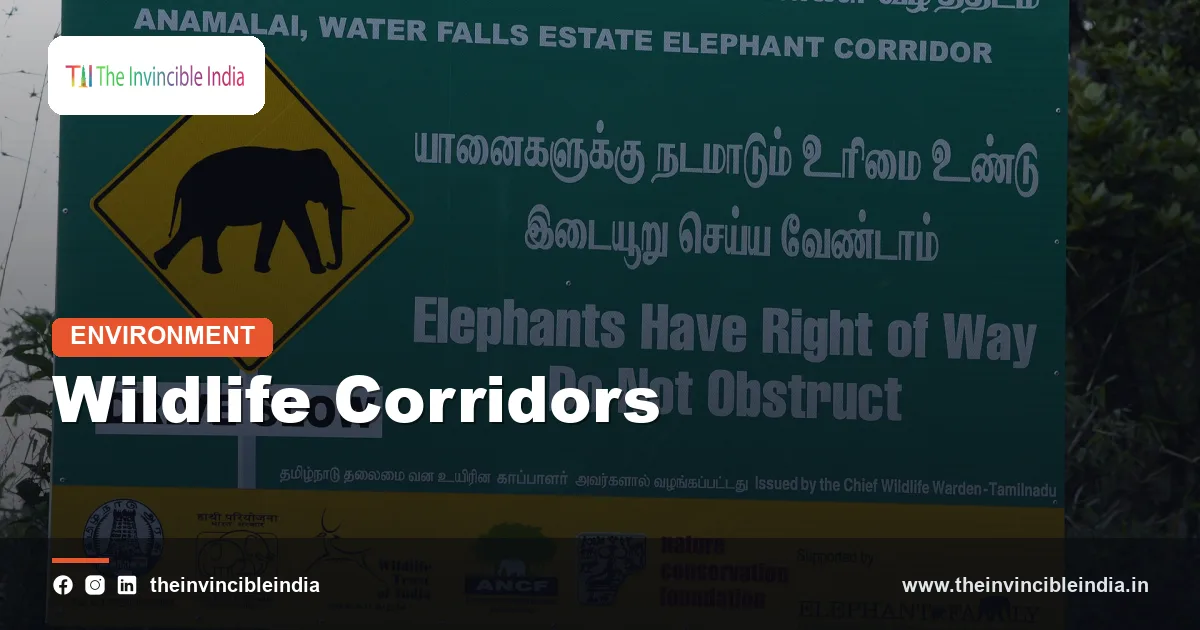
Imagine a tiger born in a protected reserve that has to leave its birthplace to find a mate and a territory of its own, only to meet a highway, a railway line or a mining pit in its path. Wildlife corridors are the strips of forest, grassland, riverbank or other natural habitat that stop such journeys from ending in failure. They connect larger patches of habitat so that animals can move, feed, breed and disperse safely even in a landscape increasingly cut up by human development.
India holds a very large share of the world’s wild Asian elephants and tigers in a densely populated country where forests are fragmented by farms, towns and infrastructure. That makes wildlife corridors in India a central conservation issue. Around one hundred elephant corridors have been identified, and many tiger corridors link protected reserves across the central Indian highlands, the Western Ghats and the Terai. This article explains what corridors are, why they matter, what threatens them and how law and engineering are trying to protect them.
Quick Facts
| Parameter | Details |
|---|---|
| What a wildlife corridor is | A habitat link that connects larger wild areas and allows animal movement between them |
| Elephant corridors identified | Around 100, documented in the “Right of Passage” study (2017) by the Wildlife Trust of India and the Project Elephant authorities |
| Earlier elephant corridor surveys | 2005 report identified 88 corridors; later revised and expanded |
| Project Elephant | Launched in 1992 to protect elephants and their habitats and corridors |
| Project Tiger | Launched in 1973; tiger reserves linked by landscape-level corridors |
| Key legal framework | Wildlife (Protection) Act, 1972, as amended; Forest (Conservation) Act, 1980 |
| Notable mitigation example | Underpasses and crossing structures on NH-44 through the Kanha-Pench corridor, Madhya Pradesh |
| Main threats | Roads, railways, mining, canals, encroachment and urban expansion |
What Are Wildlife Corridors?
A wildlife corridor is a stretch of habitat that links two or more larger areas of wild habitat, such as national parks and sanctuaries. It need not be pristine forest; it can be a strip of scrub, a river valley, an agricultural belt where animals tolerate human presence or even a narrow passage between two villages. What matters is that animals actually use it to move between larger habitats.
Conservationists distinguish between different forms of connectivity.
- Linear corridors: continuous strips of habitat, such as forested ridges or river valleys, between two reserves.
- Stepping stones: small habitat patches, such as sacred groves or village woodlots, spaced so that animals can hop from one to another.
- Landscape linkages: broad areas of mixed land use in which wildlife can still pass, for example plantations or low-intensity farmland.
- Riparian corridors: rivers and their banks, which many species follow naturally.
Some corridors are used daily, as when elephants move between a forest and a water source. Others are used seasonally, such as animals shifting between high and low ground, and some are used only once in a lifetime by young animals dispersing to establish new territories. All three kinds matter.
Why Habitat Connectivity Matters
Protected areas in India cover only a modest part of the country’s land, and many are islands surrounded by cultivated or built-up land. A small isolated population is at risk of local extinction from disease, fire, drought or simple bad luck. Connectivity reduces this risk because it allows animals to move, recolonise empty habitats and supplement small populations.
Genetic Health
When a population is cut off, its members eventually breed with close relatives. Inbreeding reduces genetic diversity, making animals more vulnerable to disease and lowering survival and fertility. Corridors permit gene flow between groups, keeping populations healthy over many generations. For wide-ranging species such as tigers, young males often disperse over long distances, and without corridors they are either trapped in the natal reserve or die trying to cross unsuitable terrain.
Access to Resources
Large herbivores need to move across large areas to find food, water and salt as conditions change through the year. Elephants, for example, follow traditional routes that may be centuries old, and when such routes are blocked they can wander into fields and settlements. Corridors therefore serve both animals and people.
Climate Resilience
As climate patterns shift, some species may need to move to cooler or wetter habitats. Linked landscapes give wildlife the flexibility to adapt, while isolated reserves may become traps.
Elephant Corridors of India
The Asian elephant is a landscape-scale species that ranges across forests, grasslands and farms. It is India’s National Heritage Animal and is protected under Schedule I of the Wildlife (Protection) Act. Elephant populations are spread across four main regions: the southern states, the north-eastern states, the east-central belt and the north-western belt in the foothills of the Himalaya.
Project Elephant, launched in 1992 by the Central Government, aims to protect elephants, their habitats and their corridors and to address human-elephant conflict. A series of studies by government agencies and conservation groups mapped corridors. A widely cited 2005 report identified 88 elephant corridors. A subsequent exercise, published as “Right of Passage: Elephant Corridors of India” in 2017, identified around 100 corridors, and described each one’s ecological, legal and land-use features.
Where the Corridors Lie
- South India: corridors link the Nilgiri Biosphere Reserve, the Anamalai hills, the Periyar landscape and the forests of Karnataka, Kerala and Tamil Nadu.
- North-east India: corridors connect the Kaziranga landscape with the Karbi Anglong hills and link Manas, Garo Hills and other forested regions.
- East-central India: corridors across Odisha, Jharkhand and West Bengal pass through mining and densely populated regions.
- North-west India: corridors in Uttarakhand and Uttar Pradesh link Rajaji and Corbett and cross the Ganga near Haridwar.
Many of these corridors are narrow and are used by elephants on a daily or seasonal basis, which is why a few hundred metres of lost forest can matter greatly.
Tiger Corridors and Landscapes
Tigers need large territories, and tiger reserves in India are not isolated from one another by chance alone. Conservation planners think in terms of “tiger landscapes”, such as the Terai Arc, the central Indian highlands, the Western Ghats and the Sundarbans. Within these landscapes, forest corridors connect source populations in protected reserves with surrounding forests and with other reserves.
Major Tiger Landscapes
- Terai Arc Landscape: a belt along the Himalayan foothills from Rajaji and Corbett through Dudhwa to Valmiki, extending into Nepal.
- Central Indian Highlands: the Kanha, Pench, Satpura, Bandhavgarh, Tadoba and other reserves, linked by forest patches across Madhya Pradesh, Maharashtra, Chhattisgarh and neighbouring states.
- Western Ghats: the Nagarhole, Bandipur, Mudumalai and Wayanad complex, which supports one of the largest tiger populations in the world.
- North-east hills and Brahmaputra plains: reserves such as Kaziranga, Manas and Nameri, with links to hill forests.
The Wildlife Institute of India and the National Tiger Conservation Authority have studied connectivity in these landscapes, using genetic data, camera traps and satellite imagery. A key lesson is that tigers are often found outside reserves, passing through corridors, and so management cannot stop at the reserve boundary. Dispersing tigers, especially young males, can travel very long distances and are often the first victims of roads, railways and conflict.
Why Corridors Reduce Human-Wildlife Conflict
When corridors are lost, wildlife does not simply disappear. Animals still try to move, and they come into conflict with people. Elephants raid crops, damage houses and sometimes kill people; leopards enter villages; tigers kill livestock. In many cases the conflict can be traced to blocked or degraded traditional routes.
A secure corridor channels animal movement along a predictable path, away from settlements and farmland. This helps in several ways.
- Farmers can plan and avoid cultivating the most sensitive stretches.
- Early-warning systems and watch towers can be concentrated at the right places.
- Animals spend less time stuck in fragmented patches near human settlements.
- Voluntary relocation of families from within the corridor can reduce risk to both sides.
In several states, conservation organisations have worked with villagers to purchase or lease private land in the narrowest corridor sections and hand it over to the forest department, an approach designed to avoid forcible displacement. Such voluntary models have become an important part of corridor protection.
Threats to Wildlife Corridors
Corridors are often vulnerable precisely because they are narrow and lie outside formally protected areas. Their land may be owned by private individuals, revenue departments or industries, and enforcement is complex.
Linear Infrastructure
Roads, highways, railways and canals slice through habitats. Fast traffic causes roadkill, trains hit elephants that cross tracks at night and canals without crossing points can trap animals. Even where animals survive, noise and light discourage them from crossing, effectively blocking the corridor.
Mining and Industry
Mining pits, haul roads and associated industry cause large-scale habitat loss in some of India’s richest forest areas, particularly in the central and eastern belts where elephants and tigers coexist with mineral deposits. Dust, noise and blasting further reduce habitat quality.
Encroachment and Land-Use Change
Expanding agriculture, plantations, resorts, townships and illegal settlements gradually close gaps between forest patches. Fencing and electrified boundaries can also act as barriers. In some places, wrongly designed fencing has trapped or killed wildlife.
Other Pressures
- Invasive plants that degrade habitat and reduce food for herbivores;
- Unregulated tourism in sensitive corridor zones;
- Poaching and illegal hunting, which increase when forest access is easier.
Engineering Solutions: Underpasses, Overpasses and Eco-Bridges
Infrastructure and wildlife can coexist if projects are planned with animals in mind. The Wildlife Institute of India has published guidelines for avoiding and mitigating the impact of linear infrastructure, including recommendations on where structures should be placed and what dimensions they need.
| Structure | How it helps |
|---|---|
| Underpass (box or arch culvert, viaduct) | Lets animals walk beneath a road or railway; elevated sections are better for large species |
| Overpass or “green bridge” | A vegetated bridge over a road connecting habitat on both sides |
| Elevated road or rail section | Leaves the ground free for animals to move beneath |
| Speed limits, signs and rumble strips | Reduce collisions on roads passing through forests |
| Fencing that funnels animals to crossing points | Guides animals to safe crossings and keeps them off the carriageway |
| Early-warning systems for trains | Alert loco pilots when elephants are near tracks |
The NH-44 Example
One of the best-known examples is the national highway, NH-44, passing through the Kanha-Pench corridor in Madhya Pradesh. This corridor links two famous tiger reserves, and a widening of the highway was originally feared to cut it. After consideration by expert bodies and the courts, the project was redesigned with a series of wildlife underpasses and other mitigation measures, designed with the Wildlife Institute of India. It is regarded as a landmark in India of integrating wildlife needs into highway design, and similar approaches have since been tried elsewhere.
Legal and Policy Framework
There is no single law that explicitly creates a “wildlife corridor” as a protected category, but a combination of statutes, policies and court orders gives corridors some protection.
Wildlife (Protection) Act, 1972
This Act allows the declaration of national parks, wildlife sanctuaries, conservation reserves and community reserves. The last two categories, introduced by an amendment in 2002, are particularly useful for areas adjacent to protected areas and for corridors that include community or government land. The 2006 amendment gave statutory status to the National Tiger Conservation Authority and strengthened tiger reserve management, including buffer zones. Later amendments have refined the scheme.
Forest (Conservation) Act, 1980
Diversion of forest land for non-forest use, such as a road or mine, needs prior approval from the Central Government, which provides a regulatory checkpoint. Conditions such as compensatory afforestation and mitigation structures can be imposed.
Other Instruments
- Eco-sensitive zones around protected areas, notified under the Environment (Protection) Act, 1986, regulate activity near boundaries.
- Environmental impact assessment for roads, mines and railways can require corridor-specific studies.
- Court rulings have protected specific corridors. In a well-known case concerning the Sigur elephant corridor in the Nilgiris, the Supreme Court upheld the notification of the corridor and the regulation of resorts and other structures within it.
Even so, many identified corridors lack formal notification, and the legal status of land in them varies widely. Advocates therefore argue for a clearer, national-level policy on corridor recognition and securing.
Community Role and the Way Forward
Corridors usually pass through land used by people, so their survival depends on local cooperation. Programmes that provide compensation for crop damage, promote crop choices unpalatable to elephants, install solar-powered fencing carefully and offer alternative livelihoods help to build tolerance.
Key priorities for the future include:
- mapping corridors with up-to-date data and recording them in land and forest records;
- integrating corridors into regional and district development plans;
- making wildlife crossings a standard part of road and rail design;
- securing narrow, high-risk corridors through voluntary purchase or notification as conservation reserves;
- restoring degraded corridors by planting native species and removing invasive plants;
- coordinating action between states, as many corridors cross administrative boundaries.
Conclusion
Wildlife corridors are the quiet infrastructure of conservation. They allow elephants to follow ancestral routes, tigers to find mates and new territories and countless smaller species to move through a changing landscape. India has made progress in mapping them and in designing highways and railways that respect animal movement, as the work on NH-44 shows. The challenge now is to turn identification into secure protection, balancing development and wildlife through careful planning, legal clarity and local partnership.
Frequently Asked Questions
What is a wildlife corridor?
A wildlife corridor is a strip or patch of natural habitat that connects larger protected areas and lets animals move between them. It may be a forested ridge, a river bank or a mixed-use landscape through which animals can pass. Corridors help animals find food, water and mates and avoid isolation.
How many elephant corridors are there in India?
Studies by the Wildlife Trust of India and the Project Elephant authorities have identified around 100 elephant corridors across the country. An early report in 2005 listed 88, and a later study published in 2017 documented about 100. The exact figure can change as new surveys are done.
Why are wildlife corridors important for tigers?
Tigers need large territories, and young animals must disperse to find mates and unoccupied ground. Corridors let them move between reserves, which maintains genetic diversity and prevents inbreeding. Without them, small reserves become isolated and more prone to local extinction.
What are the main threats to wildlife corridors?
The main threats are roads, railways, canals, mining, encroachment, expanding agriculture and urban development. These fragment habitat, cause roadkill and train accidents and push animals into conflict with people. Poorly designed fencing and invasive plants also reduce connectivity.
What is the NH-44 Kanha-Pench corridor project?
NH-44 passes through the forest corridor linking the Kanha and Pench tiger reserves in Madhya Pradesh. When the highway was widened, the design was modified to include underpasses and other mitigation structures so that tigers and other wildlife could continue to cross. It is often cited as a model for wildlife-friendly road design in India.
Are wildlife corridors legally protected in India?
Corridors do not have a single dedicated law, but they receive protection through the Wildlife (Protection) Act, the Forest (Conservation) Act, eco-sensitive zone notifications and court orders. Some are declared as conservation reserves or protected by judicial rulings, such as the one on the Sigur elephant corridor. Many corridors still lack formal notification, so policy experts call for stronger and clearer protection.
{“@context”:”https://schema.org”,”@graph”:[{“@type”:”FAQPage”,”mainEntity”:[{“@type”:”Question”,”name”:”What is a wildlife corridor?”,”acceptedAnswer”:{“@type”:”Answer”,”text”:”A wildlife corridor is a strip or patch of natural habitat that connects larger protected areas and lets animals move between them. It may be a forested ridge, a river bank or a mixed-use landscape through which animals can pass. Corridors help animals find food, water and mates and avoid isolation.”}},{“@type”:”Question”,”name”:”How many elephant corridors are there in India?”,”acceptedAnswer”:{“@type”:”Answer”,”text”:”Studies by the Wildlife Trust of India and the Project Elephant authorities have identified around 100 elephant corridors across the country. An early report in 2005 listed 88, and a later study published in 2017 documented about 100. The exact figure can change as new surveys are done.”}},{“@type”:”Question”,”name”:”Why are wildlife corridors important for tigers?”,”acceptedAnswer”:{“@type”:”Answer”,”text”:”Tigers need large territories, and young animals must disperse to find mates and unoccupied ground. Corridors let them move between reserves, which maintains genetic diversity and prevents inbreeding. Without them, small reserves become isolated and more prone to local extinction.”}},{“@type”:”Question”,”name”:”What are the main threats to wildlife corridors?”,”acceptedAnswer”:{“@type”:”Answer”,”text”:”The main threats are roads, railways, canals, mining, encroachment, expanding agriculture and urban development. These fragment habitat, cause roadkill and train accidents and push animals into conflict with people. Poorly designed fencing and invasive plants also reduce connectivity.”}},{“@type”:”Question”,”name”:”What is the NH-44 Kanha-Pench corridor project?”,”acceptedAnswer”:{“@type”:”Answer”,”text”:”NH-44 passes through the forest corridor linking the Kanha and Pench tiger reserves in Madhya Pradesh. When the highway was widened, the design was modified to include underpasses and other mitigation structures so that tigers and other wildlife could continue to cross. It is often cited as a model for wildlife-friendly road design in India.”}},{“@type”:”Question”,”name”:”Are wildlife corridors legally protected in India?”,”acceptedAnswer”:{“@type”:”Answer”,”text”:”Corridors do not have a single dedicated law, but they receive protection through the Wildlife (Protection) Act, the Forest (Conservation) Act, eco-sensitive zone notifications and court orders. Some are declared as conservation reserves or protected by judicial rulings, such as the one on the Sigur elephant corridor. Many corridors still lack formal notification, so policy experts call for stronger and clearer protection.”}}]}]}


