

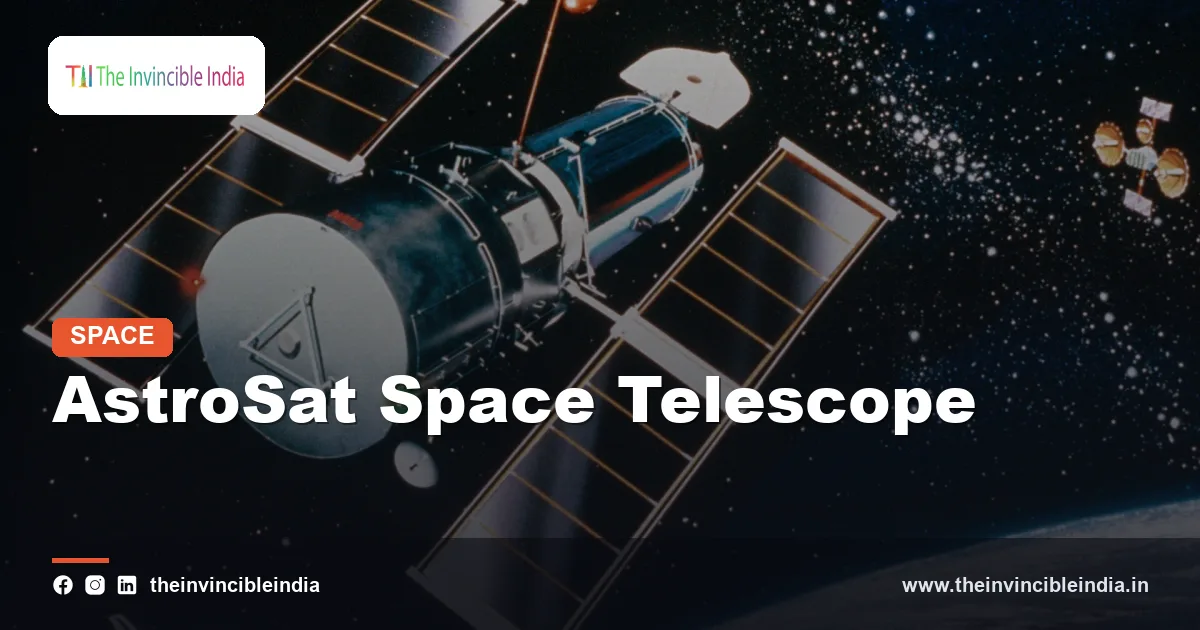
AstroSat is India’s first dedicated multi-wavelength space observatory, built and operated by the Indian Space Research Organisation (ISRO) to study the universe in ultraviolet, optical and X-ray light at the same time. Launched on 28 September 2015 aboard a Polar Satellite Launch Vehicle (PSLV) from Sriharikota, it placed India in a small group of countries operating their own space-based astronomical observatories.
Unlike most telescopes that specialise in one band of light, AstroSat carries five complementary instruments that can look at the same celestial object simultaneously across a wide range of energies. This ability has allowed Indian and international astronomers to study black holes, neutron stars, active galaxies, star clusters and gamma-ray bursts in a new way. This explainer describes the mission, its instruments, its scientific results and its significance in Indian astronomy.
| Feature | Details |
|---|---|
| Mission type | Multi-wavelength astronomy satellite (space observatory) |
| Agency | Indian Space Research Organisation (ISRO), with partner institutes |
| Launch date | 28 September 2015 |
| Launch vehicle and site | PSLV-C30 from the Satish Dhawan Space Centre, Sriharikota |
| Orbit | Near-equatorial low Earth orbit at roughly 650 km altitude |
| Satellite mass | About 1,500 kg |
| Instruments | UVIT, SXT, LAXPC, CZTI and SSM, plus a charged particle monitor |
| Designed life | Five years; it has operated well beyond that |
Why India Built a Space Telescope
Earth’s atmosphere blocks most ultraviolet and X-ray radiation, which is fortunate for life but unfortunate for astronomers. To observe the hottest and most energetic phenomena in the cosmos, such as gas falling into black holes or the surfaces of newborn hot stars, instruments must be placed above the atmosphere. Optical and radio observations can be carried out from the ground, and India has such facilities, including the Giant Metrewave Radio Telescope near Pune and optical observatories in places such as Kavalur, Nainital and Hanle in Ladakh. But for high-energy astronomy, space is the only option.
India had earlier flown small X-ray experiments. Its first satellite, Aryabhata, launched in 1975, carried an X-ray astronomy payload, and the Indian X-ray Astronomy Experiment flew on a remote sensing satellite in 1996. These modest efforts built expertise in detectors and data analysis. By the early 2000s, the Indian astronomical community was ready for a larger, dedicated observatory, and AstroSat was conceived as a national facility to put that expertise to work.
Development and Collaborating Institutions
AstroSat was approved by the Government of India in 2004 and took more than a decade to build. It is not simply an ISRO project: it is the outcome of a collaboration among several research institutions, with each contributing a different instrument.
- Tata Institute of Fundamental Research (TIFR), Mumbai: the Large Area X-ray Proportional Counters, the Soft X-ray Telescope and the Cadmium Zinc Telluride Imager, the last with support from IUCAA.
- Indian Institute of Astrophysics (IIA), Bengaluru: the Ultra-Violet Imaging Telescope, together with the Inter-University Centre for Astronomy and Astrophysics (IUCAA), Pune.
- ISRO Satellite Centre (ISAC), Bengaluru: the satellite’s structure and the Scanning Sky Monitor, along with the integration of the spacecraft.
- Raman Research Institute (RRI), Bengaluru: scientific and technical contributions to the payload effort.
- International partners: the Canadian Space Agency contributed detectors for the ultraviolet telescope, and the University of Leicester in the United Kingdom supported the soft X-ray telescope’s camera.
The satellite is controlled from the ISRO Telemetry, Tracking and Command Network (ISTRAC) in Bengaluru, which acts as the mission operations centre. Data are downloaded to ground stations and processed before being archived.
Launch and Orbit
AstroSat lifted off on 28 September 2015 on PSLV-C30 from Sriharikota. The PSLV is ISRO’s workhorse launcher, and on this mission it placed AstroSat into an orbit around 650 km above Earth. Along with AstroSat, the rocket carried several small satellites from foreign customers, including Canadian, Indonesian and American payloads, an example of ISRO’s habit of sharing launches.
Why a near-equatorial orbit?
The satellite orbits at a low inclination to the equator, only a few degrees. This keeps it away from the high-radiation regions over the poles and reduces the time spent in the zone known as the South Atlantic Anomaly, where the Earth’s inner radiation belt dips closest to the surface and swamps sensitive detectors with charged particles. Detectors are switched off or protected when the satellite passes through that area, and a charged particle monitor on board helps to manage this.
Operating life
The mission was designed for a minimum of five years of operation, but the spacecraft has continued to function well beyond its planned life, which has permitted a long series of observations and monitoring programmes.
The Five Instruments at a Glance
The distinctive feature of AstroSat is that its payloads cover a wide energy range, from the near-ultraviolet up to hard X-rays, so that a single source can be studied in many bands at once.
| Instrument | Full name | Band | Main purpose |
|---|---|---|---|
| UVIT | Ultra-Violet Imaging Telescope | Far-ultraviolet, near-ultraviolet and visible | High-resolution imaging of galaxies, star-forming regions and hot stars |
| SXT | Soft X-ray Telescope | Soft X-rays (roughly 0.3 to 8 keV) | Imaging and spectroscopy of X-ray sources and hot gas |
| LAXPC | Large Area X-ray Proportional Counters | Medium to hard X-rays (about 3 to 80 keV) | Timing studies of rapidly varying sources with large collecting area |
| CZTI | Cadmium Zinc Telluride Imager | Hard X-rays (about 10 to 100 keV and above) | Hard X-ray imaging, spectroscopy, polarisation and gamma-ray burst detection |
| SSM | Scanning Sky Monitor | Soft X-rays (about 2.5 to 10 keV) | Monitoring the sky for new and flaring X-ray sources |
UVIT: The Ultraviolet Eye
The Ultra-Violet Imaging Telescope consists of twin telescopes. One observes in the far-ultraviolet, and the other observes in the near-ultraviolet and visible light. Each has a mirror about 38 cm in diameter, and the instrument offers images that are sharper than those from earlier ultraviolet missions, with resolution comparable to or better than the Galaxy Evolution Explorer satellite over a wide field of view.
What UVIT studies
- Young, hot stars and star-forming regions in nearby galaxies.
- Star clusters, including globular clusters, where ultraviolet light reveals exotic hot stars.
- Galaxy structure, since ultraviolet light traces recent star formation.
- Hot white dwarfs and planetary nebulae.
UVIT’s imaging is a major strength, because it complements the X-ray instruments by showing where energetic activity is accompanied by young stellar populations.
SXT and LAXPC: The X-ray Workhorses
X-rays are emitted by gas heated to millions of degrees, usually in extreme environments such as the neighbourhood of black holes, neutron stars and the hot gas inside galaxy clusters. AstroSat studies this with two main instruments.
Soft X-ray Telescope (SXT)
The SXT uses focusing optics to concentrate soft X-rays onto a sensitive camera, giving images and spectra of sources such as supernova remnants, X-ray binaries and active galactic nuclei. It reveals how the hot gas is distributed and what elements are present.
Large Area X-ray Proportional Counters (LAXPC)
The LAXPC consists of three large detectors that together provide a very large collecting area at medium X-ray energies. This makes it exceptionally good at recording how the brightness of a source changes on very short timescales, down to a fraction of a millisecond. Timing studies are important for black hole binaries and neutron stars, where rapid flickering and quasi-periodic oscillations encode information about the strong gravity and fast-moving matter around the compact object.
CZTI and SSM: Hard X-rays and Sky Monitoring
The Cadmium Zinc Telluride Imager works at higher energies than the other X-ray instruments. It uses an array of semiconductor detectors and a coded mask to create images of the hard X-ray sky. At the highest energies, where the mask becomes transparent, it can act as an all-sky monitor and as a polarimeter, measuring how X-ray light is oriented. Polarisation is a powerful diagnostic of magnetic fields and geometry near compact objects, and was previously difficult to measure at these energies.
The Scanning Sky Monitor consists of position-sensitive proportional counters mounted on a rotating platform, which scan large parts of the sky regularly. It acts as a sentinel, detecting sudden outbursts from X-ray binaries or other transients. When it detects a flare, observers can quickly point the other instruments at the source, getting multi-band data at the critical moment.
The Strength of Simultaneous Multi-Wavelength Observation
Many astrophysical sources change their behaviour over hours, days or even seconds. When separate telescopes observe the same source at different times, it is difficult to know whether differences in the data reflect real physical changes or just different observing epochs. AstroSat avoids this problem because all its instruments observe the same target at the same time.
- Black hole binaries: the ultraviolet reveals the outer accretion disc, the soft X-rays show the inner disc and the hard X-rays trace the corona of very hot electrons.
- Active galaxies: variations in the ultraviolet and X-rays can be compared to test models of how the central black hole feeds.
- Pulsars and neutron stars: pulsations can be tracked from ultraviolet to hard X-rays to understand where the emission originates.
- Transient events: the SSM can trigger rapid observations that capture the full spectrum of an outburst.
Several other observatories, such as NASA’s Hubble Space Telescope, Chandra X-ray Observatory, Swift and the European XMM-Newton, are more powerful in individual bands. AstroSat’s niche lies in its combination of bands in a single platform and its large hard X-ray timing capability.
Key Scientific Results
Since 2015, AstroSat has contributed to hundreds of research papers by Indian and international teams. Some of its best-known results illustrate the range of its science.
Extreme ultraviolet light from a distant galaxy
Using UVIT, an international team detected extreme-ultraviolet emission from a galaxy catalogued as AUDFs01, located billions of light years away, in a deep field that the Hubble Space Telescope had also studied. The result, published in 2021, was significant because it offered evidence of how early galaxies may have leaked ionising radiation, which helped to end the cosmic “dark ages” and reionise the universe.
Hard X-ray polarisation and gamma-ray bursts
The CZTI measured the hard X-ray polarisation of the Crab Nebula and pulsar, a well-known supernova remnant, giving constraints on its magnetic field. It also detected and studied many gamma-ray bursts, including measurements of polarisation in some of the brightest, and took part in follow-up observations of electromagnetic counterparts to gravitational wave events.
Black holes and neutron stars
The LAXPC and SXT have studied the black hole binary Cygnus X-1 and the micro-quasar GRS 1915+105, revealing rapid oscillations and changes in the accretion flow. AstroSat also observed the neutron star binaries and a variety of X-ray pulsars, providing measurements of magnetic fields and spin behaviour.
Star clusters and blue stragglers
Ultraviolet imaging of star clusters, such as the old open cluster NGC 188, has shown the hot companions of so-called blue straggler stars, supporting the idea that these stars gain mass from companions in binary systems. Such work helps in understanding how stars evolve in dense environments.
Open Data and the Indian Astronomy Community
AstroSat is operated as a national facility. Observing time is awarded on the basis of proposals submitted by scientists, with initial priority for the instrument-building teams and later opening to Indian researchers and then to international users. After a proprietary period, typically around a year, the data are made public through the Indian Space Science Data Centre (ISSDC), part of ISRO’s archive, which allows any astronomer to use them.
This open approach has trained a generation of students and young researchers. Universities and institutes across India now run workshops on AstroSat data analysis, and software pipelines for each instrument have been developed and released. Scientists from several countries, including the United Kingdom, Canada, Japan, Italy and the United States, have used the observatory.
AstroSat in the Larger Story of Indian Astronomy
India has a long tradition in astronomy, from the work of Aryabhata and Varahamihira to the twentieth-century achievements of Meghnad Saha, C. V. Raman and, among those with Indian roots, Subrahmanyan Chandrasekhar, who received the Nobel Prize in Physics in 1983 for his theoretical work on stellar evolution, including the mass limit for white dwarfs that bears his name. Modern Indian astronomy has been strengthened by the development of ground-based facilities and, with AstroSat, a world-class space platform.
Related missions
- Aditya-L1 (2023): India’s first dedicated solar observatory, launched on 2 September 2023 and positioned near the Sun-Earth Lagrange point L1.
- XPoSat (2024): an X-ray polarimetry mission launched on 1 January 2024, which builds on India’s polarisation work, including CZTI.
- Chandrayaan and Mangalyaan: planetary missions that illustrate ISRO’s ability to carry out frontier science alongside applications satellites.
AstroSat gave ISRO and the Indian science community confidence in building complex astronomy payloads and in running an international user facility, paving the way for further projects.
Limitations and Challenges
Like all instruments, AstroSat has limitations. Its mirrors are smaller than those on flagship observatories such as Chandra or XMM-Newton, so it cannot match their sensitivity in faint-source imaging. Some detectors have experienced ageing effects, and gas leaks in parts of the LAXPC units have reduced the performance of individual detectors over time, which scientists have accounted for in calibration. Operating a satellite for longer than designed also means managing thermal and power constraints.
Further, data analysis for a multi-instrument mission is complex, and calibration across bands requires care. The Indian astronomical community has addressed this through dedicated calibration teams and public software. A future follow-on mission, often discussed in planning circles, would aim for greater sensitivity and wider sky coverage.
Conclusion
AstroSat represents a landmark in India’s space science journey. Launched on a homegrown PSLV on 28 September 2015, this multi-wavelength observatory has provided simultaneous ultraviolet and X-ray views of the cosmos, produced important discoveries and become a platform for training Indian astronomers. Its operation beyond the planned life has delivered added value for taxpayers and scientists alike, and it stands as a foundation for future missions in high-energy astrophysics. Last reviewed: 5 October 2026.
Frequently Asked Questions
What is AstroSat?
AstroSat is India’s first dedicated multi-wavelength space observatory, built by ISRO and partner institutions. It observes the universe in ultraviolet, optical and X-ray light at the same time, using five instruments mounted on one satellite.
When and how was AstroSat launched?
AstroSat was launched on 28 September 2015 on a PSLV-C30 rocket from the Satish Dhawan Space Centre in Sriharikota. It was placed into a low Earth orbit at around 650 km altitude with a low inclination to the equator.
What are the five instruments on AstroSat?
The five instruments are the Ultra-Violet Imaging Telescope (UVIT), Soft X-ray Telescope (SXT), Large Area X-ray Proportional Counters (LAXPC), Cadmium Zinc Telluride Imager (CZTI) and Scanning Sky Monitor (SSM). Together they cover the ultraviolet, optical and X-ray bands.
Why is simultaneous multi-band observation important?
Many cosmic sources, such as black holes and pulsars, vary quickly. By observing the same object in several bands at the same time, AstroSat allows scientists to compare the changes directly and build more reliable physical models.
What are some of AstroSat’s major discoveries?
Notable results include the detection of extreme-ultraviolet light from a very distant galaxy, hard X-ray polarisation measurements of the Crab pulsar and gamma-ray bursts, studies of black hole binaries such as Cygnus X-1, and ultraviolet views of hot companions in star clusters.
Can researchers outside ISRO use AstroSat data?
Yes. AstroSat is a national facility, and observing time is awarded through proposals. After a proprietary period, the data are released through the Indian Space Science Data Centre, so astronomers in India and abroad can analyse them.
{“@context”:”https://schema.org”,”@graph”:[{“@type”:”FAQPage”,”mainEntity”:[{“@type”:”Question”,”name”:”What is AstroSat?”,”acceptedAnswer”:{“@type”:”Answer”,”text”:”AstroSat is India’s first dedicated multi-wavelength space observatory, built by ISRO and partner institutions. It observes the universe in ultraviolet, optical and X-ray light at the same time, using five instruments mounted on one satellite.”}},{“@type”:”Question”,”name”:”When and how was AstroSat launched?”,”acceptedAnswer”:{“@type”:”Answer”,”text”:”AstroSat was launched on 28 September 2015 on a PSLV-C30 rocket from the Satish Dhawan Space Centre in Sriharikota. It was placed into a low Earth orbit at around 650 km altitude with a low inclination to the equator.”}},{“@type”:”Question”,”name”:”What are the five instruments on AstroSat?”,”acceptedAnswer”:{“@type”:”Answer”,”text”:”The five instruments are the Ultra-Violet Imaging Telescope (UVIT), Soft X-ray Telescope (SXT), Large Area X-ray Proportional Counters (LAXPC), Cadmium Zinc Telluride Imager (CZTI) and Scanning Sky Monitor (SSM). Together they cover the ultraviolet, optical and X-ray bands.”}},{“@type”:”Question”,”name”:”Why is simultaneous multi-band observation important?”,”acceptedAnswer”:{“@type”:”Answer”,”text”:”Many cosmic sources, such as black holes and pulsars, vary quickly. By observing the same object in several bands at the same time, AstroSat allows scientists to compare the changes directly and build more reliable physical models.”}},{“@type”:”Question”,”name”:”What are some of AstroSat’s major discoveries?”,”acceptedAnswer”:{“@type”:”Answer”,”text”:”Notable results include the detection of extreme-ultraviolet light from a very distant galaxy, hard X-ray polarisation measurements of the Crab pulsar and gamma-ray bursts, studies of black hole binaries such as Cygnus X-1, and ultraviolet views of hot companions in star clusters.”}},{“@type”:”Question”,”name”:”Can researchers outside ISRO use AstroSat data?”,”acceptedAnswer”:{“@type”:”Answer”,”text”:”Yes. AstroSat is a national facility, and observing time is awarded through proposals. After a proprietary period, the data are released through the Indian Space Science Data Centre, so astronomers in India and abroad can analyse them.”}}]}]}


