

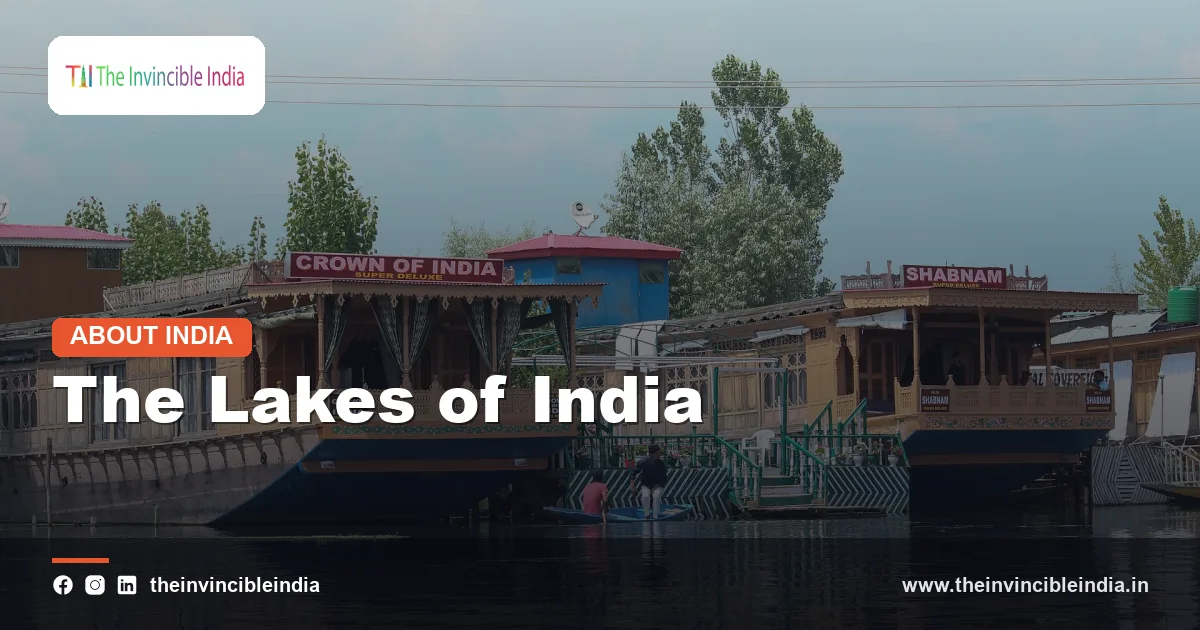
The lakes of India range from glittering high-altitude Himalayan waters to vast coastal lagoons and salt flats, and from ancient natural basins to reservoirs created by modern dams. They support fisheries, irrigation, drinking water, tourism and some of the richest birdlife on the subcontinent, and many are sacred sites woven into local culture and religion.
No single lake can summarise such diversity. Wular in Jammu and Kashmir is India’s largest freshwater lake, Chilika in Odisha is the largest brackish lagoon, Sambhar in Rajasthan is the largest inland salt lake, and Vembanad in Kerala is the longest lake in the country. This explainer surveys the main kinds of lakes, the best-known examples, their ecology, and the pressures they face today.
| Feature | Details |
|---|---|
| Largest freshwater lake | Wular Lake, Jammu and Kashmir |
| Largest brackish water lagoon | Chilika Lake, Odisha |
| Largest inland salt lake | Sambhar Salt Lake, Rajasthan |
| Longest lake | Vembanad Lake, Kerala |
| Famous high-altitude lake | Pangong Tso, Ladakh, shared with China |
| Best-known urban lake | Dal Lake, Srinagar |
| Ramsar wetlands | Several lakes, such as Chilika, Loktak, Wular, Sambhar and Vembanad-Kol, are Ramsar sites |
| Main threats | Pollution, siltation, encroachment, invasive weeds, climate change |
How Lakes Are Formed: Types of Lakes in India
Geographers classify lakes by their origin, and India has examples of nearly every type. The country’s geological variety, from the young folded Himalaya to the ancient peninsular plateau and the long coastline, explains this diversity.
| Type | How it forms | Examples |
|---|---|---|
| Tectonic | Earth movements create a depression or block a valley | Wular, Tso Moriri |
| Glacial | Glaciers carve basins or leave moraine dams | Gurudongmar, Tsomgo (Changu), Chandratal |
| Lagoon or coastal | Sand bars separate a shallow sea inlet from the ocean | Chilika, Pulicat, Vembanad |
| Salt or saline | Closed basins in dry regions concentrate salts | Sambhar, Didwana, Lunkaransar |
| Crater | A meteorite impact forms a bowl | Lonar Lake |
| Oxbow | A river meander is cut off from the main channel | Kanwar Lake (Kabartal) in Bihar |
| Man-made reservoir | Dams and embankments hold back water | Gobind Sagar, Hirakud, Hussain Sagar |
| Floodplain or wetland | Seasonal flooding fills shallow basins | Loktak, Kolleru |
Freshwater Himalayan Lakes
The Himalayan lakes are fed by snowmelt, glaciers and mountain streams, and many sit at remarkable altitudes. They are important for local water supply, tourism and religious tradition, and also serve as indicators of climate change.
Wular Lake
Wular Lake in the Bandipora district of Jammu and Kashmir is the largest freshwater lake in India. It is believed to have been formed by tectonic activity and is fed mainly by the Jhelum River, which flows in and out of it. It is an important fishery and a major wintering and breeding ground for waterbirds. The lake’s surface area has varied over time because of siltation and encroachment, and it was designated a Ramsar site in 1990.
Dal Lake
Dal Lake in Srinagar is perhaps India’s most recognisable lake. Surrounded by the Zabarwan mountains and the famed Mughal gardens of Nishat Bagh and Shalimar Bagh, it is divided by causeways into several basins, including Nigeen Lake. The lake is famous for shikara boats, houseboats, floating vegetable gardens known as raads, and lotus blooms in summer. Its shoreline has been heavily settled, and restoration of the lake has been a long-running government priority.
Pangong Tso
Pangong Tso in Ladakh lies at an altitude of over 4,000 metres and stretches roughly 130 km in length, with the larger part in the Tibet Autonomous Region of China and roughly 40 per cent in India. Although it is fed by snowmelt, the water is brackish because the basin has no outlet to the sea. The lake is narrow, with a striking blue colour, and freezes completely in winter. It is also a sensitive strategic area on the Line of Actual Control and has become a popular tourist destination.
- Tso Moriri (Ladakh): a high-altitude lake and Ramsar site, home to the bar-headed goose and the black-necked crane.
- Tso Kar (Ladakh): a saline lake in the Changthang plateau, important for migratory birds.
- Gurudongmar and Tsomgo (Sikkim): sacred glacial lakes at great height, drawing pilgrims and visitors.
- Chandratal (Himachal Pradesh): a crescent-shaped lake in the Spiti region, popular with trekkers.
- Nainital, Bhimtal and Naukuchiatal (Uttarakhand): the lakes of the Kumaon lake district, giving hill stations their character.
Lakes of the North-East: Loktak and Beyond
The north-eastern states hold several unique wetlands. Loktak Lake in Manipur is the largest freshwater lake in north-east India and is best known for its phumdis, floating masses of vegetation, soil and organic matter. The phumdis support the Keibul Lamjao National Park, the world’s only floating national park, which is the last natural habitat of the sangai, or brow-antlered deer, one of India’s most endangered mammals.
Loktak also provides water for the Loktak hydroelectric project, supports a large fishing community, and is a Ramsar site, designated in 1990. Local people living on floating huts called phumsangs have a distinctive way of life tied to the lake. However, the lake has also seen changes from the construction of the Ithai barrage, which altered water levels and affected the natural cycle of phumdi growth and nourishment.
Other north-eastern lakes include Deepor Beel near Guwahati in Assam, a Ramsar site known for migratory birds and an important wetland close to a city, and Sela Lake in the high mountains of Arunachal Pradesh. Many glacial and landslide-dammed lakes are found in Arunachal Pradesh and Sikkim.
Coastal Lagoons and Brackish Water Lakes
India’s long coastline has produced several shallow lagoons, separated from the sea by sand bars but connected through narrow openings. Their water is a mix of fresh and saline, and varies with the seasons, producing highly productive ecosystems.
Chilika Lake
Chilika in Odisha is the largest brackish water lagoon in India and one of the largest coastal lagoons in the world. It lies along the Bay of Bengal, separated by a long sand ridge and connected to the sea through a channel. Its area changes seasonally, expanding during the monsoon as rivers, notably the Daya, feed it, and contracting in summer. Chilika has hundreds of islands, and its fisheries sustain a large number of families. In 1981 it became one of the first two Indian wetlands, along with Keoladeo, to be designated a Wetland of International Importance under the Ramsar Convention. The lake was listed on the Montreux Record in the 1990s because of siltation and, after a restoration effort led by the Chilika Development Authority, including opening a new mouth to the sea, it was removed from the list in 2002, a success often cited internationally.
Pulicat Lake
Pulicat Lake, on the Andhra Pradesh and Tamil Nadu border, is the second largest brackish water lagoon in India. It is separated from the Bay of Bengal by the barrier island of Sriharikota, which also hosts India’s spaceport. Pulicat is a major site for migratory birds, especially flamingos, pelicans and waders, and a Pulicat Lake bird sanctuary protects parts of it. The lake supports fisheries and prawn catching for local communities.
Saline and Salt Lakes of the Arid Zones
In the dry interior, closed basins without outlets accumulate salts, creating saline lakes. These are often of economic and ecological importance.
Sambhar Salt Lake
Sambhar Lake in Rajasthan, lying west of Jaipur, is the largest inland salt lake in India. It is a shallow lake that fills during the monsoon from seasonal rivers and recedes in summer, leaving salt pans. Salt has been produced here for centuries and the lake is a significant source of salt for the country. The wetland is a Ramsar site, designated in 1990, and attracts flamingos and many other migratory waders in winter. Mass bird deaths reported in 2019 were attributed by investigators to factors such as disease and changes in water quality, which led to greater attention on its management.
- Didwana and Pachpadra (Rajasthan): other salt lakes in the Thar region used for salt extraction.
- Lonar Lake (Maharashtra): a crater lake formed by a meteorite impact in the basaltic Deccan plateau, with saline and alkaline water; its age is estimated in the tens of thousands of years or more, and it is a geological curiosity of global interest.
- Rann of Kachchh: a vast seasonal salt marsh in Gujarat that fills with water during the monsoon.
Vembanad and the Backwaters of Kerala
Vembanad Lake is the longest lake in India and the largest in Kerala. It stretches along the coast for roughly 90 km or more, with its northern end near Kochi and its southern part near Alappuzha, and is separated from the Arabian Sea by a narrow strip of land. Several rivers, including the Periyar, Pamba, Meenachil, Achankovil and Manimala, drain into it. The Vembanad-Kol wetland was designated a Ramsar site in 2002.
Life on the backwaters
The lake is the heart of the backwater network, which has made Kerala famous for houseboat tourism. The Nehru Trophy Boat Race, a snake boat race held on Punnamada Lake, a part of the Vembanad system, draws thousands of spectators each year. The low-lying Kuttanad region along its shores is known for rice cultivation below sea level, protected by bunds and spillways, which has earned it a place among globally important agricultural heritage systems.
Salinity and the Thanneermukkom bund
A saltwater barrier built at Thanneermukkom was intended to keep sea water from entering the Kuttanad paddy fields. While it protected agriculture, it also altered the lake’s natural flow and affected fisheries and water quality. Ashtamudi Lake, a Ramsar site in Kollam, and Sasthamkotta, the largest freshwater lake in Kerala, are other notable water bodies in the state.
Man-Made Lakes and Reservoirs
India has a long tradition of creating lakes. Medieval rulers dug tanks and built embankments, and post-independence dam projects created some of the biggest artificial lakes in Asia.
- Gobind Sagar (Himachal Pradesh): the reservoir created by the Bhakra Dam on the Sutlej, named after Guru Gobind Singh.
- Hirakud reservoir (Odisha): formed by the Hirakud Dam on the Mahanadi, completed in the 1950s and among the longest earthen dams in the world.
- Nagarjuna Sagar (Telangana and Andhra Pradesh): a major reservoir on the Krishna.
- Indira Sagar and Sardar Sarovar (Madhya Pradesh and Gujarat): large reservoirs on the Narmada.
- Hussain Sagar (Hyderabad): a historic lake built in the sixteenth century and now at the heart of the city.
- Pichola and Fateh Sagar (Udaipur): lakes created by the Mewar rulers, giving Udaipur its title as the “City of Lakes”.
- Upper Lake (Bhopal): an ancient reservoir that is part of the Bhoj Wetland, a Ramsar site.
Reservoirs provide irrigation, hydropower, drinking water and flood control, and many have become havens for fish and waterbirds. However, they also involve displacement of people and changes to river ecology, issues that have long been debated in India.
Ecology and Birdlife of Indian Lakes
Lakes and wetlands are among the most productive ecosystems. They recharge groundwater, buffer floods, trap sediments and nutrients, and support food chains from plankton to fish, reptiles and birds.
A flyway for migratory birds
India lies on the Central Asian Flyway, a route used each winter by millions of migratory birds travelling from Siberia, Central Asia and the Himalayas to the subcontinent. Lakes such as Chilika, Pulicat, Sambhar, Wular, Loktak, Nal Sarovar in Gujarat and Kolleru in Andhra Pradesh host ducks, geese, waders, flamingos, pelicans and cranes. Kolleru, between the Krishna and Godavari deltas, is known for spot-billed pelicans.
Other wildlife
- Irrawaddy dolphins in Chilika, one of the few places in the world where this species lives in a lagoon.
- Sangai deer on the floating phumdis of Loktak.
- Fish such as mahseer, snow trout and hilsa in different lake systems.
- Aquatic plants such as lotus, water chestnut and makhana, which provide food and livelihoods.
Lakes, Ramsar Sites and Legal Protection
The Ramsar Convention, signed in 1971 in Ramsar, Iran, is an international treaty for the conservation and wise use of wetlands. India joined in 1982, and has since designated a steadily growing network of Wetlands of International Importance, many of which are lakes, such as Chilika, Loktak, Wular, Sambhar, Kolleru, Bhoj, Ashtamudi, Vembanad-Kol, Nal Sarovar, Tso Moriri and Deepor Beel. For the current number of sites, readers should consult official sources, as additions are made regularly.
Within India, protection comes from several instruments. The Wetlands (Conservation and Management) Rules, notified in 2017, regulate activities in notified wetlands. The National Lake Conservation Plan, launched in 2001, funded restoration of urban and semi-urban lakes, and later merged into the National Plan for Conservation of Aquatic Ecosystems. Many lakes are also protected as sanctuaries or national parks under the Wildlife Protection Act, 1972. State authorities, such as the Chilika Development Authority and the Loktak Development Authority, manage individual lakes.
Threats Facing India’s Lakes
Lakes are under pressure across the country, and the problems are often interconnected.
- Pollution and eutrophication: untreated sewage, agricultural runoff and industrial effluents add nutrients that trigger algal blooms and oxygen loss.
- Encroachment and urbanisation: lakes in cities have been built over or shrunk, as seen in many urban water bodies.
- Siltation: soil erosion in catchments fills lake basins, reducing depth and capacity.
- Invasive species: water hyacinth and other weeds choke surfaces, affecting light, oxygen and navigation.
- Over-extraction and changed flows: dams, barrages and diversions upset natural water cycles.
- Climate change: altered rainfall, melting glaciers and rising temperatures change lake levels, while glacial lake outburst floods endanger Himalayan valleys, as in the South Lhonak Lake event in Sikkim in 2023.
What works
Successful restoration, such as at Chilika, has combined scientific monitoring, community participation, hydrological repairs and regulation of fishing and aquaculture. Treating sewage before it enters lakes, protecting catchments and buffer zones, removing encroachments and involving fishing communities are widely recognised priorities.
Conclusion
The lakes of India are living landscapes that provide water, food, livelihoods, beauty and refuge for wildlife. From the freshwater expanse of Wular and the sacred waters of Dal to the salt flats of Sambhar, the lagoon of Chilika and the backwaters of Vembanad, each lake tells a story of geology, ecology and human society. Protecting them demands both sound science and local involvement, and their health will be a measure of how well the country manages its water in the coming decades. Last reviewed: 5 October 2026.
Frequently Asked Questions
Which is the largest freshwater lake in India?
Wular Lake in the Bandipora district of Jammu and Kashmir is generally regarded as the largest freshwater lake in India. It was formed through tectonic activity, is fed by the Jhelum River and is a Ramsar site.
What is the largest brackish water lagoon in India?
Chilika Lake in Odisha is the largest brackish water lagoon in India and among the largest coastal lagoons in the world. It was among the first Indian wetlands to be designated a Ramsar site, in 1981, and is known for its Irrawaddy dolphins and migratory birds.
Which is the largest inland salt lake in India?
Sambhar Lake in Rajasthan is India’s largest inland salt lake. It supports salt production and hosts flamingos and other migratory birds in winter, and it has been designated a Ramsar site.
Which lake is the longest in India?
Vembanad Lake in Kerala is the longest lake in India, stretching along the coast from near Kochi towards Alappuzha. It is part of the backwater system and is known as a Ramsar site called Vembanad-Kol Wetland.
Is Pangong Lake freshwater or saltwater?
Pangong Tso in Ladakh is a brackish, mildly saline lake even though it lies in the high Himalaya and is fed by snowmelt. It has no outlet to the sea, so salts accumulate, and it is shared between India and China.
What are the main threats to lakes in India?
The major threats include pollution from sewage and farm runoff, siltation, encroachment, invasive weeds like water hyacinth and the effects of climate change. Restoration plans and legal protections, including Ramsar designation, aim to address these pressures.
{“@context”:”https://schema.org”,”@graph”:[{“@type”:”FAQPage”,”mainEntity”:[{“@type”:”Question”,”name”:”Which is the largest freshwater lake in India?”,”acceptedAnswer”:{“@type”:”Answer”,”text”:”Wular Lake in the Bandipora district of Jammu and Kashmir is generally regarded as the largest freshwater lake in India. It was formed through tectonic activity, is fed by the Jhelum River and is a Ramsar site.”}},{“@type”:”Question”,”name”:”What is the largest brackish water lagoon in India?”,”acceptedAnswer”:{“@type”:”Answer”,”text”:”Chilika Lake in Odisha is the largest brackish water lagoon in India and among the largest coastal lagoons in the world. It was among the first Indian wetlands to be designated a Ramsar site, in 1981, and is known for its Irrawaddy dolphins and migratory birds.”}},{“@type”:”Question”,”name”:”Which is the largest inland salt lake in India?”,”acceptedAnswer”:{“@type”:”Answer”,”text”:”Sambhar Lake in Rajasthan is India’s largest inland salt lake. It supports salt production and hosts flamingos and other migratory birds in winter, and it has been designated a Ramsar site.”}},{“@type”:”Question”,”name”:”Which lake is the longest in India?”,”acceptedAnswer”:{“@type”:”Answer”,”text”:”Vembanad Lake in Kerala is the longest lake in India, stretching along the coast from near Kochi towards Alappuzha. It is part of the backwater system and is known as a Ramsar site called Vembanad-Kol Wetland.”}},{“@type”:”Question”,”name”:”Is Pangong Lake freshwater or saltwater?”,”acceptedAnswer”:{“@type”:”Answer”,”text”:”Pangong Tso in Ladakh is a brackish, mildly saline lake even though it lies in the high Himalaya and is fed by snowmelt. It has no outlet to the sea, so salts accumulate, and it is shared between India and China.”}},{“@type”:”Question”,”name”:”What are the main threats to lakes in India?”,”acceptedAnswer”:{“@type”:”Answer”,”text”:”The major threats include pollution from sewage and farm runoff, siltation, encroachment, invasive weeds like water hyacinth and the effects of climate change. Restoration plans and legal protections, including Ramsar designation, aim to address these pressures.”}}]}]}


