

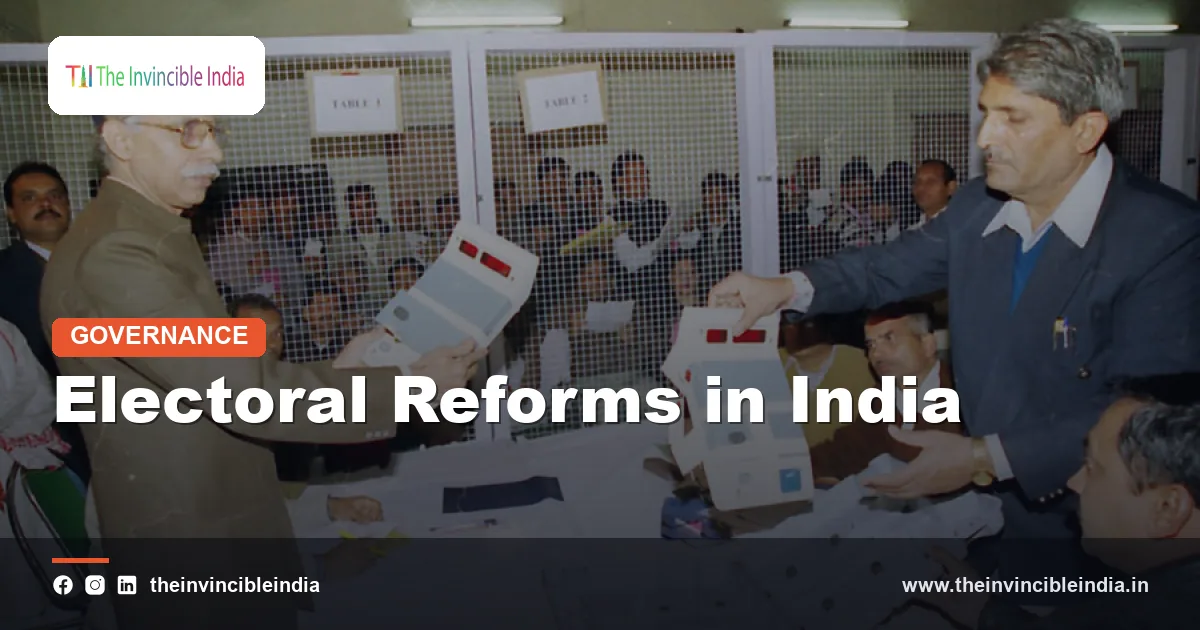
Electoral reforms in India are the legal, administrative and judicial changes made since 1950 to make elections freer, fairer, more transparent and more inclusive, covering areas such as electronic voting machines, candidate disclosure, party funding, voter identification, the Model Code of Conduct and the control of defections. The reforms have come through three routes: Acts of Parliament and constitutional amendments, directions of the Election Commission of India under Article 324, and judgments of the Supreme Court and High Courts.
Since the first general election of 1951-52, India has repeatedly revised how it registers voters, nominates candidates, polls votes and polices the money involved. Committees such as the Tarkunde Committee, the Dinesh Goswami Committee and the Indrajit Gupta Committee, along with the Law Commission of India, have proposed many of these changes. Some proposals have become law, while others remain under discussion.
| Quick Facts | Details |
|---|---|
| Constitutional basis | Part XV (Articles 324 to 329), with Article 324 vesting superintendence of elections in the Election Commission of India |
| Main statutes | Representation of the People Act, 1950 (rolls) and Representation of the People Act, 1951 (conduct and disqualification) |
| Voting age lowered to 18 | 61st Constitutional Amendment, 1988 (from 21) |
| Anti-defection law | 52nd Amendment, 1985 (Tenth Schedule); tightened by the 91st Amendment, 2003 |
| Photo voter ID (EPIC) | Introduced in the early 1990s under Chief Election Commissioner T. N. Seshan |
| NOTA option | Introduced after the Supreme Court’s 2013 judgment in PUCL v. Union of India |
| Candidate disclosure | Supreme Court direction in ADR v. Union of India (2002), followed by Section 33A of the 1951 Act |
| Voting technology | EVMs tried in 1982, legally enabled in 1989, used nationwide since the 2004 Lok Sabha election; VVPAT slips added from 2013 |
Key Takeaways
- Electoral reforms in India have been delivered by Parliament, the Election Commission of India and the Supreme Court, and the three have often moved in sequence on the same issue.
- Electronic Voting Machines were first used in a limited trial in Kerala in 1982, received statutory backing in 1989 and were used across the country in the 2004 Lok Sabha election.
- The Supreme Court’s 2013 judgment in PUCL v. Union of India introduced NOTA (“None of the Above”) on ballots, though NOTA votes do not change who wins.
- The Supreme Court’s 2002 judgment in ADR v. Union of India made it compulsory for candidates to disclose criminal cases, assets, liabilities and educational qualifications.
- The Tenth Schedule, added by the 52nd Amendment in 1985, disqualifies legislators who defect from their party, and the 91st Amendment in 2003 removed the exemption for splits of one-third of a legislature party.
- The Supreme Court struck down the electoral bonds scheme for political funding in February 2024, leaving funding transparency a continuing area of reform.
What Are Electoral Reforms in India?
Electoral reforms in India are measures that change the rules, institutions or technology of elections in order to improve their integrity, accessibility and fairness. They range from technical steps, such as updating electoral rolls, to structural questions, such as who may contest and how parties are funded.
The Constitution of India set up an independent Election Commission under Article 324 and promised universal adult franchise under Article 326. The detailed rules were then written into the Representation of the People Acts of 1950 and 1951. Reform has since been an ongoing process because new problems, such as the cost of campaigns and the entry of persons with criminal cases into politics, kept arising.
Reform proposals are usually assessed against a few objectives: honest registration of voters, a level playing field for candidates, secrecy and accuracy in voting, clean campaign finance, and accountability of elected members after the election.
Why Has India Needed Electoral Reforms?
India has needed electoral reforms because the scale and competitiveness of its elections have repeatedly exposed weaknesses in the original rules. With hundreds of millions of registered voters, many parties and a large number of candidates, any gap in the law is quickly exploited.
Several recurring concerns drove the changes:
- Bogus voting, booth capturing and violence at polling stations in the era of paper ballots.
- Faulty electoral rolls, with duplicate or missing names.
- The rising cost of campaigns, and the opacity of how parties raised money.
- Candidates with serious criminal cases contesting and winning elections.
- Frequent defections of legislators that toppled governments.
- The misuse of official machinery, and of religion, caste or money, during campaigns.
How Did Electoral Reforms Evolve? A Timeline
Electoral reforms in India have evolved in waves, with the biggest changes in the 1980s, the 1990s and the 2000s. The table below lists some well-known milestones.
| Year | Milestone |
|---|---|
| 1950 | Election Commission of India established on 25 January, a date now observed as National Voters’ Day |
| 1951 | Representation of the People Act enacted for conduct of elections and disqualifications |
| 1975 | Tarkunde Committee, set up by Jayaprakash Narayan, recommended a series of electoral changes |
| 1982 | First trial of EVMs in a by-election at Paravur in Kerala |
| 1985 | 52nd Amendment adds the Tenth Schedule on anti-defection |
| 1988 | 61st Amendment lowers the voting age to 18 |
| 1989 | Law amended to allow EVMs; party registration provisions introduced |
| 1990 | Dinesh Goswami Committee report on electoral reforms |
| 1993 | Election Commission made a multi-member body; photo identity cards introduced |
| 1996 | Amendments limit a candidate to two constituencies and raise security deposits |
| 1998 | Indrajit Gupta Committee on state funding of elections |
| 2002 | ADR judgment on disclosure of candidate details |
| 2003 | 91st Amendment strengthens the anti-defection law |
| 2013 | NOTA introduced; Supreme Court orders VVPAT; Lily Thomas ruling on disqualification |
| 2018 | Electoral bonds scheme introduced |
| 2024 | Supreme Court strikes down the electoral bonds scheme |
How Do EVMs and VVPAT Work?
An Electronic Voting Machine (EVM) records votes electronically through a ballot unit that the voter presses and a control unit that stores the count, and the Voter Verifiable Paper Audit Trail (VVPAT) prints a paper slip that lets the voter see the choice recorded. The machines are manufactured by two public sector undertakings, Bharat Electronics Limited and Electronics Corporation of India Limited.
EVMs were first used in a limited trial in 1982 in a by-election in Kerala. In 1984 the Supreme Court held that using EVMs required statutory authority, so Parliament amended the Representation of the People Act in 1989 to permit EVMs. They were rolled out in phases and were used across the whole country in the 2004 Lok Sabha election.
VVPAT came into use after the Supreme Court’s 2013 judgment in Subramanian Swamy v. Election Commission of India, which held that a paper trail was an indispensable requirement of free and fair elections. It was first used in a by-election in Nagaland in 2013 and was later expanded to every constituency. In 2019 the Supreme Court directed that slips of more than one polling station per assembly segment be matched against the EVM count. Petitions seeking a full count of all VVPAT slips were considered by the Court and were not accepted in 2024.
Supporters say that the machines have reduced booth capturing, invalid votes and counting time. Critics have periodically raised questions about security and verifiability, which the Election Commission has answered by pointing to standalone design, randomisation of machines and the paper trail.
What Is NOTA and What Does It Do?
NOTA, short for “None of the Above”, is an option on the ballot that lets a voter formally reject all candidates without abstaining. The Supreme Court introduced it in September 2013 in PUCL v. Union of India, reasoning that the right to vote includes the right not to vote for anyone, while keeping the secrecy of that choice.
NOTA was first used in the 2013 assembly elections in several states and has appeared on every EVM since. It has a symbol and its votes are counted, but they have no effect on the outcome, which means that the candidate with the most valid votes still wins even if NOTA gets more votes than any candidate. A proposal to make an election void if NOTA leads has been discussed, but it is not law. The Election Commission extended NOTA to Rajya Sabha elections in 2014, but the Supreme Court held in 2018 that it cannot be used in those indirect elections.
What Is the Model Code of Conduct?
The Model Code of Conduct (MCC) is a set of guidelines issued by the Election Commission of India for parties and candidates that comes into force when the poll schedule is announced and remains until results are declared. It is not a statute, and it draws its force from the Commission’s powers under Article 324 and from the consensus of political parties.
The code traces its origins to a voluntary arrangement in the Kerala assembly elections of 1960. The Commission circulated a broader version for the 1968-69 elections and expanded it over time. Rules about the party in power were added later, to stop the use of official position for campaigning.
Typical provisions include:
- No announcement of new schemes or projects that might influence voters once the schedule is out.
- No use of government vehicles, buildings or staff for campaigning.
- No appeals to caste or communal feelings, and no bribing or intimidating voters.
- Rules for meetings, processions and the conduct of polling day.
- Restrictions on advertising at public expense by the party in power.
Section 126 of the Representation of the People Act separately prohibits campaigning in the 48 hours before the close of polling, a period often called the silence period.
How Have Voter ID and Electoral Rolls Changed?
Electoral rolls in India are prepared under the Representation of the People Act, 1950, and have shifted from handwritten lists to computerised, photo-linked records. The Electors Photo Identity Card (EPIC) was introduced in the early 1990s under Chief Election Commissioner T. N. Seshan to reduce impersonation.
The rolls are revised regularly, and the Election Commission runs a National Voters’ Service Portal where citizens can check, correct and register. The law has been amended to provide more than one qualifying date a year for new voters turning 18, so that young people need not wait for a year. Service voters, and certain overseas Indians, can also register under the Act.
The Election Laws (Amendment) Act, 2021 permitted voluntary linking of Aadhaar numbers to the electoral roll to help weed out duplicate entries. The linking has been described as voluntary, and discussions continue on privacy and accuracy. The Commission has also worked on remote voting for migrant workers and on postal ballot facilities for older and disabled voters.
How Did Courts Address Criminalisation of Politics?
Courts addressed the criminalisation of politics mainly by requiring transparency and by tightening disqualification rules, since the Constitution leaves the power to bar candidates to Parliament. The concern gained attention after the 1993 Vohra Committee report on the links between criminals and politicians.
Candidate affidavits
In Association for Democratic Reforms v. Union of India (2002), the Supreme Court held that voters have a right to know about the candidates, and directed disclosure of criminal cases, assets, liabilities and educational qualifications. Parliament then added Section 33A to the 1951 Act, and in 2003 the Court upheld the principle in PUCL v. Union of India. Candidates now file an affidavit with the nomination paper, and false information can lead to penalties.
Disqualification of convicted lawmakers
Section 8 of the Representation of the People Act disqualifies a person convicted of certain offences, and a prison sentence of two years or more leads to disqualification during the sentence and for six years after release. In Lily Thomas v. Union of India (2013), the Supreme Court struck down Section 8(4), which had allowed sitting members to continue while an appeal was pending, so that disqualification now follows conviction.
Disclosure by parties
In Public Interest Foundation v. Union of India (2018), a Constitution Bench asked candidates to declare criminal cases prominently and parties to publish those details. In 2020 the Court in the Rambabu Singh Thakur matter directed parties to publish why they chose candidates with criminal cases. The Court has also asked for speedy trials of cases against legislators.
What Is the Anti-Defection Law?
The anti-defection law is the Tenth Schedule of the Constitution, which disqualifies a member of Parliament or a state legislature who voluntarily gives up party membership or defies the party whip on a vote. It was added by the 52nd Amendment in 1985 after a period of frequent floor-crossing, often described as “Aaya Ram, Gaya Ram” politics.
The 91st Amendment of 2003 removed the earlier exemption for a split of one-third of a legislature party and retained only a merger of two-thirds. It also capped the size of the council of ministers at 15 per cent of the strength of the house. The presiding officer decides the question of disqualification, and in Kihoto Hollohan v. Zachillhu (1992) the Supreme Court upheld the Schedule while holding that such decisions are open to judicial review. Debate continues on whether the presiding officer, who belongs to a party, is the right authority.
How Are Political Parties Funded, and What Reforms Have Been Proposed?
Political parties in India are funded mainly through donations from individuals and organisations, and the main reform questions concern disclosure, limits and the possibility of state funding. The law requires parties to report contributions above Rs 20,000 to the Election Commission, and tax law caps cash donations at a small amount per donor.
Several committees have studied the issue. The Dinesh Goswami Committee of 1990 recommended, among many other proposals, partial state support in kind for recognised candidates, changes in the way the Election Commission is appointed and measures to curb money power. The Indrajit Gupta Committee of 1998 examined state funding and favoured partial support in kind, such as facilities and materials, for recognised parties. The Law Commission’s reports of 1999 and 2015 also proposed wider changes.
Other steps include the Electoral Trusts Scheme of 2013, and the electoral bonds scheme introduced in 2018, which the Supreme Court held unconstitutional in February 2024 in a case brought by the Association for Democratic Reforms and others, on the ground that it undermined the voter’s right to information. Ideas such as limits on party spending, stronger auditing and fuller disclosure continue to be debated.
What Other Reforms Are Under Discussion?
Several reforms were passed recently or remain under debate, and a neutral reading shows that they have supporters and critics in equal measure. These include the following.
- Women’s reservation: the 106th Amendment of 2023 provides for one-third reservation of seats for women in the Lok Sabha and state assemblies, to take effect after delimitation following a census.
- Appointments to the Election Commission: after the Supreme Court’s 2023 judgment in Anoop Baranwal v. Union of India, which set out an interim selection committee, Parliament passed a law in 2023 that sets a different selection committee, and the arrangement continues to be debated.
- Simultaneous elections: a high-level committee examined holding Lok Sabha and state elections together, and the proposal is under discussion.
- Remote voting for migrant workers, which the Commission has piloted but which needs legal changes.
- Proportional or mixed systems in place of first-past-the-post, which the Law Commission has examined but not recommended wholesale.
- Stronger rules on paid news and on social media advertising during campaigns.
Bottom Line
Electoral reforms in India are a steady, layered process shaped by Parliament, the Election Commission and the courts. Voting technology, disclosure rules and defection law have changed a great deal since 1950, while party funding, criminal cases against candidates and the structure of the Election Commission remain active subjects of debate.
Frequently Asked Questions
What are the main electoral reforms in India?
The main electoral reforms in India include EVMs and VVPAT, the NOTA option, the Model Code of Conduct, photo voter ID cards, candidate affidavits and the anti-defection law. Many were introduced through Supreme Court judgments, while others came through constitutional amendments and Election Commission orders. Party funding reform remains an area of continuing debate.
When was NOTA introduced in India?
NOTA was introduced in India after the Supreme Court’s judgment in PUCL v. Union of India in September 2013. It first appeared in the 2013 assembly elections in several states. NOTA votes are counted, but they do not decide the outcome of the election.
Is the Model Code of Conduct a law?
No, the Model Code of Conduct is not a statute. It is a set of guidelines issued by the Election Commission under its constitutional powers and the consent of political parties. It applies from the announcement of the election schedule until the results are declared.
What did the Supreme Court say about criminal cases against candidates?
The Supreme Court held that voters have a right to know about candidates, and made disclosure of criminal cases, assets and education compulsory in ADR v. Union of India in 2002. In Lily Thomas v. Union of India in 2013, it held that a lawmaker convicted of a disqualifying offence is disqualified immediately. The Court has not itself barred candidates facing charges, leaving that to Parliament.
What is the anti-defection law in India?
The anti-defection law is the Tenth Schedule of the Constitution, added in 1985, which disqualifies legislators who voluntarily leave their party or defy its whip. The 91st Amendment of 2003 removed the exemption for splits and kept only mergers of two-thirds of the legislature party. The presiding officer decides on disqualification, subject to judicial review.
Which committees recommended electoral reforms in India?
Major committees include the Tarkunde Committee (1975), the Dinesh Goswami Committee (1990), the Vohra Committee (1993) and the Indrajit Gupta Committee (1998), along with several reports of the Law Commission of India. They looked at issues such as the Election Commission’s appointment, criminalisation and state funding of elections. Some of their suggestions became law, and others remain recommendations.
{“@context”:”https://schema.org”,”@graph”:[{“@type”:”FAQPage”,”mainEntity”:[{“@type”:”Question”,”name”:”What are the main electoral reforms in India?”,”acceptedAnswer”:{“@type”:”Answer”,”text”:”The main electoral reforms in India include EVMs and VVPAT, the NOTA option, the Model Code of Conduct, photo voter ID cards, candidate affidavits and the anti-defection law. Many were introduced through Supreme Court judgments, while others came through constitutional amendments and Election Commission orders. Party funding reform remains an area of continuing debate.”}},{“@type”:”Question”,”name”:”When was NOTA introduced in India?”,”acceptedAnswer”:{“@type”:”Answer”,”text”:”NOTA was introduced in India after the Supreme Court’s judgment in PUCL v. Union of India in September 2013. It first appeared in the 2013 assembly elections in several states. NOTA votes are counted, but they do not decide the outcome of the election.”}},{“@type”:”Question”,”name”:”Is the Model Code of Conduct a law?”,”acceptedAnswer”:{“@type”:”Answer”,”text”:”No, the Model Code of Conduct is not a statute. It is a set of guidelines issued by the Election Commission under its constitutional powers and the consent of political parties. It applies from the announcement of the election schedule until the results are declared.”}},{“@type”:”Question”,”name”:”What did the Supreme Court say about criminal cases against candidates?”,”acceptedAnswer”:{“@type”:”Answer”,”text”:”The Supreme Court held that voters have a right to know about candidates, and made disclosure of criminal cases, assets and education compulsory in ADR v. Union of India in 2002. In Lily Thomas v. Union of India in 2013, it held that a lawmaker convicted of a disqualifying offence is disqualified immediately. The Court has not itself barred candidates facing charges, leaving that to Parliament.”}},{“@type”:”Question”,”name”:”What is the anti-defection law in India?”,”acceptedAnswer”:{“@type”:”Answer”,”text”:”The anti-defection law is the Tenth Schedule of the Constitution, added in 1985, which disqualifies legislators who voluntarily leave their party or defy its whip. The 91st Amendment of 2003 removed the exemption for splits and kept only mergers of two-thirds of the legislature party. The presiding officer decides on disqualification, subject to judicial review.”}},{“@type”:”Question”,”name”:”Which committees recommended electoral reforms in India?”,”acceptedAnswer”:{“@type”:”Answer”,”text”:”Major committees include the Tarkunde Committee (1975), the Dinesh Goswami Committee (1990), the Vohra Committee (1993) and the Indrajit Gupta Committee (1998), along with several reports of the Law Commission of India. They looked at issues such as the Election Commission’s appointment, criminalisation and state funding of elections. Some of their suggestions became law, and others remain recommendations.”}}]}]}


