

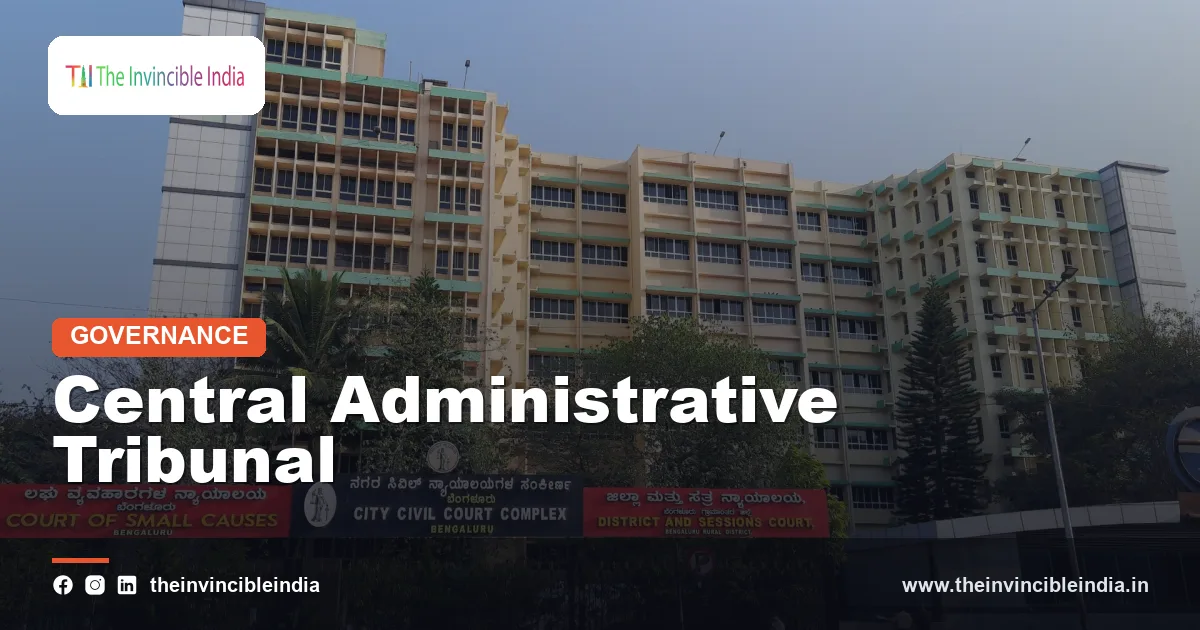
The Central Administrative Tribunal (CAT) is a specialised quasi-judicial body in India, set up under Article 323A of the Constitution and the Administrative Tribunals Act, 1985, to hear disputes about the recruitment and service conditions of central government employees. The tribunal began functioning on 1 November 1985 and is meant to give civil servants a faster and cheaper forum than the regular civil courts.
The Central Administrative Tribunal has its principal bench in New Delhi and benches in several other cities, and its orders can be examined by the High Court under Articles 226 and 227 following the Supreme Court’s ruling in L. Chandra Kumar v. Union of India (1997). Understanding the Central Administrative Tribunal helps explain how service disputes are decided in India without crowding the High Courts.
| Quick Facts | Details |
|---|---|
| Full name | Central Administrative Tribunal (CAT) |
| Constitutional basis | Article 323A (Part XIVA), inserted by the 42nd Amendment, 1976 |
| Parent statute | Administrative Tribunals Act, 1985 |
| Started functioning | 1 November 1985 |
| Principal bench | New Delhi, with benches in many other cities |
| Members | Chairman and Members, who are either Judicial Members or Administrative Members |
| Subject matter | Recruitment and service matters of central government employees and certain public-sector staff covered by the Act |
| Procedure | Not bound by the Code of Civil Procedure, 1908; guided by natural justice |
| Challenge to orders | Writ petition before the High Court under Articles 226 and 227, after L. Chandra Kumar (1997) |
Key Takeaways
- The Central Administrative Tribunal (CAT) is a statutory tribunal created by the Administrative Tribunals Act, 1985, under the constitutional authority of Article 323A.
- The Central Administrative Tribunal hears disputes about recruitment, promotion, seniority, pay, discipline, pension and other service matters of central government employees.
- The Central Administrative Tribunal is not bound by the procedure of the Code of Civil Procedure, 1908, and instead follows the principles of natural justice and its own procedural rules.
- Each bench of the Central Administrative Tribunal normally sits with a Judicial Member and an Administrative Member, which blends legal training with administrative experience.
- In L. Chandra Kumar v. Union of India (1997), a seven-judge Bench of the Supreme Court held that the High Courts retain power of judicial review over tribunals, so appeals from the Central Administrative Tribunal go to the High Court and not directly to the Supreme Court.
- The Central Administrative Tribunal does not handle the service matters of members of the armed forces, or of the staff of the Supreme Court, High Courts and Parliament secretariats.
What Is the Central Administrative Tribunal?
The Central Administrative Tribunal is a specialised adjudicatory body that decides complaints of public servants about their recruitment and conditions of service under the Union of India. It was created so that service matters could be decided by a forum that understands administrative law and public employment rules.
Before 1985, a government employee with a grievance, such as an unfair transfer, wrongful dismissal or denial of promotion, had to approach the High Court by a writ petition or the civil courts by a suit. Such cases made up a large share of pending litigation, and they could take years. The Central Administrative Tribunal was meant to reduce this load and offer a quicker process.
The tribunal is a creature of statute. This means that its jurisdiction, powers and procedure all come from the Administrative Tribunals Act, 1985 and the rules made under it, and not from any inherent judicial power.
What Is the Constitutional Basis of the CAT?
The constitutional basis of the Central Administrative Tribunal is Article 323A, which Parliament inserted through the 42nd Constitutional Amendment of 1976 on the recommendation of the Swaran Singh Committee. Article 323A allows Parliament to make a law that sets up administrative tribunals for the recruitment and conditions of service of persons appointed to public services of the Union, the states and certain other bodies.
The article lies in Part XIVA of the Constitution, titled “Tribunals”. The same Part contains Article 323B, which allows tribunals for other subjects, such as taxation, land reforms, industrial disputes and elections to the legislatures. A significant difference is that only Parliament can create tribunals under Article 323A, whereas under Article 323B both Parliament and state legislatures can do so within their respective fields.
Using Article 323A, Parliament passed the Administrative Tribunals Act, 1985. The Act created the Central Administrative Tribunal for central employees and permitted the Union to establish State Administrative Tribunals for state employees on the request of the concerned state government.
What Disputes Does the Central Administrative Tribunal Decide?
The Central Administrative Tribunal decides disputes about the recruitment and the conditions of service of persons in civil services and civil posts under the Union, including All India Services. The list of matters that fall within its jurisdiction is broad and practical.
Matters commonly heard
- Recruitment disputes, such as the legality of selection procedures, eligibility conditions and results.
- Promotion, seniority, confirmation and reservation in service.
- Transfers, postings and deputation.
- Disciplinary proceedings, suspension, removal, dismissal and compulsory retirement.
- Pay, allowances and fixation of pay scales.
- Pension and retirement benefits.
- Appointment on compassionate grounds, where the case is brought as a service matter.
Persons and bodies covered
The Act covers members of All India Services, persons holding civil posts under the Union, civilian employees of the defence services, and employees of certain government-controlled corporations or societies when the Government notifies them under the Act. The Union has applied the tribunal’s jurisdiction to some public sector bodies through notification.
Persons and matters excluded
The Act does not apply to members of the naval, military and air forces, to officers and servants of the Supreme Court or High Courts, or to secretarial staff of Parliament or state legislatures. Service matters of the armed forces are heard by the Armed Forces Tribunal, a separate body. Certain other categories of staff are also excluded by the Act and its notifications.
How Is the CAT Organised? Principal Bench and Benches
The Central Administrative Tribunal is organised with a Principal Bench in New Delhi and regional benches spread across the country. The Chairman is the head of the tribunal and has his seat in the Principal Bench, and benches are constituted by the Chairman with Judicial and Administrative Members.
The tribunal is widely listed as having benches in about seventeen cities, and some benches also hold circuit sittings in other towns to reduce travel for litigants. The benches are located in places such as Delhi, Mumbai, Kolkata, Chennai, Bengaluru, Hyderabad, Ahmedabad, Allahabad, Lucknow, Patna, Chandigarh, Jaipur, Jabalpur, Guwahati, Cuttack and Ernakulam. The precise number and location of benches may change through notification.
| Element | Details |
|---|---|
| Principal Bench | New Delhi, which also houses the office of the Chairman |
| Regional benches | Located in major cities, usually at or near the seat of a High Court |
| Circuit sittings | Held at other places to take hearings closer to litigants |
| Typical bench | Division Bench of one Judicial Member and one Administrative Member |
| Single-member sittings | Possible for certain matters as the rules and the Chairman allow |
| Administrative department | Department of Personnel and Training under the Union government handles administration of the Act |
Who Are the Chairman and Members of the CAT?
The Central Administrative Tribunal consists of a Chairman and Members, who are appointed by the President and who are either Judicial Members or Administrative Members. The dual structure is a deliberate feature of the design, because service disputes involve both legal questions and administrative practice.
Judicial Members
A Judicial Member is generally a person with judicial or legal experience, such as a sitting or former High Court judge or a person who has held a judicial office or practised in the field of law for the required period. Judicial Members bring training in evidence, procedure and the law of service.
Administrative Members
An Administrative Member is generally a senior officer who has held a high post in the government, such as a Secretary or Additional Secretary to the Government of India or an equivalent position. Administrative Members bring knowledge of how rules, files and departments work in reality.
Appointment, tenure and independence
Appointments are made by the President, in consultation with the Chief Justice of India for important appointments such as that of the Chairman, in line with the Act and judicial rulings. The terms of office, retirement age and service conditions of tribunal members have been shaped by the Administrative Tribunals Act, by the Tribunals Reforms Act, 2021 and by several Supreme Court judgments, in particular those arising from petitions of the Madras Bar Association, which stress the independence of tribunals. Readers should consult the current rules for exact tenure and age limits.
How Does the CAT Work? Procedure Before the Tribunal
The Central Administrative Tribunal works through a simple and flexible procedure that begins with an Original Application filed by the aggrieved employee, and it is not bound by the Code of Civil Procedure, 1908. Section 22 of the Administrative Tribunals Act says that the tribunal is guided by the principles of natural justice and may regulate its own procedure.
The tribunal still has important powers of a civil court for specific purposes. It can summon and examine witnesses, require the discovery and production of documents, receive evidence on affidavits, issue commissions for the examination of witnesses and review its own decisions. It also has the power to punish for contempt of itself as per the Contempt of Courts Act.
Steps in a typical case
- The employee first uses available departmental remedies, such as an appeal or a representation, because Section 20 of the Act generally requires this before approaching the tribunal.
- The employee files an Original Application under Section 19 within the limitation period set by Section 21, which is generally one year from the final order, or six months after a representation goes unanswered, with power to condone delay for sufficient cause.
- The tribunal admits the application, issues notice to the Government, and may give interim relief.
- The government files a reply, the applicant may respond, and the bench hears the arguments.
- The bench decides the case and may quash an order, direct reinstatement, direct the promotion or payment of dues, or dismiss the application.
Representation and costs
The applicant may appear in person or through a lawyer, and the government may be represented by a departmental representative or a legal practitioner. The filing fee is small, and the procedure is intended to be cheaper than a regular suit. The tribunal is expected to try to decide cases within a few months, although in reality delays may occur because of vacancies and volume.
Can a CAT Decision Be Challenged? The L. Chandra Kumar Ruling
Yes, a decision of the Central Administrative Tribunal can be challenged by a writ petition before the High Court under Articles 226 and 227 of the Constitution, following the Supreme Court’s 1997 judgment in L. Chandra Kumar v. Union of India. The case was decided by a seven-judge Bench and is one of the most important rulings on tribunals in India.
When the Administrative Tribunals Act was first passed, it barred the High Courts from hearing service matters that fell under the tribunal, and an appeal lay only to the Supreme Court under Article 136. In S. P. Sampath Kumar v. Union of India (1987), the Supreme Court upheld the scheme on the basis that the tribunal was an effective alternative to the High Court.
In L. Chandra Kumar, the Court revisited the issue. It held that the power of judicial review of the High Courts and the Supreme Court under Articles 226, 227 and 32 is part of the basic structure of the Constitution, so Parliament cannot take it away. The provisions of Article 323A and the Act that excluded the jurisdiction of the High Courts were declared unconstitutional to that extent. The tribunals were held to be competent to decide questions of law, including the constitutional validity of statutory provisions, except the validity of their parent statute, but their decisions are subject to scrutiny by a Division Bench of the High Court within whose jurisdiction the tribunal falls.
In practice, therefore, a person unhappy with a decision of the Central Administrative Tribunal first goes to the High Court, and then, if needed, to the Supreme Court by a special leave petition under Article 136 against the High Court’s decision.
How Does the CAT Differ From a High Court?
The Central Administrative Tribunal differs from a High Court because it has a narrow, service-law jurisdiction, a mixed bench and a simplified procedure, while a High Court is a constitutional court with broad original and appellate powers. The table below summarises the main distinctions.
| Feature | Central Administrative Tribunal | High Court |
|---|---|---|
| Source of authority | Administrative Tribunals Act, 1985 under Article 323A | Constitution of India, Articles 214 onwards |
| Subject matter | Service matters of central employees | All civil, criminal and constitutional matters |
| Members | Judicial and Administrative Members | Judges only |
| Procedure | Not bound by the Code of Civil Procedure; natural justice | Bound by procedural codes and High Court rules |
| Challenge | Writ petition before the High Court | Appeal to the Supreme Court |
| Power to review its own orders | Yes, in the manner of a civil court | Yes, as a court of record |
What About State Administrative Tribunals?
State Administrative Tribunals are tribunals under the same Act that handle the service matters of state government employees, and they are set up only when a state government asks the Union to establish one. The Central Administrative Tribunal deals only with Union employees, so state employees are heard either by a State Administrative Tribunal or by the High Court.
Some states established such tribunals after 1985, and some later wound them up, so the position differs from state to state. A joint tribunal for two or more states can also be formed by agreement. The existence of a State Administrative Tribunal, like the Central one, remains subject to review by the High Court.
Why Does the Central Administrative Tribunal Matter?
The Central Administrative Tribunal matters because it is the first and often the main judicial forum for lakhs of central government employees and pensioners, and its decisions set the standards of fairness in public employment. It also keeps the High Courts and the Supreme Court free from a large number of service disputes.
Several criticisms are discussed alongside its benefits. Critics point to vacancies in the benches, delays and the question of whether administrative members should be fully equal to judges. Supporters respond that the combination of experts has improved the quality of decisions in technical service matters. The ongoing debate on tribunal independence and the Tribunals Reforms Act, 2021 means that the structure of the tribunal continues to evolve.
Bottom Line
The Central Administrative Tribunal is India’s dedicated forum for the service disputes of central government employees, created under Article 323A and the Administrative Tribunals Act, 1985. Its mixed benches and flexible procedure aim at speed, while the L. Chandra Kumar judgment keeps High Court review in place over its decisions.
Frequently Asked Questions
What is the Central Administrative Tribunal in simple terms?
The Central Administrative Tribunal is a special court-like body that hears service disputes of central government employees, such as promotion, transfer, pay and disciplinary matters. It was created under the Administrative Tribunals Act, 1985 and started working on 1 November 1985. It saves employees from filing a regular civil suit or going straight to the High Court.
Which article of the Constitution deals with administrative tribunals?
Article 323A of the Constitution deals with administrative tribunals. It was inserted by the 42nd Amendment in 1976 and lets Parliament create tribunals for the recruitment and service conditions of public servants. Article 323B separately covers tribunals for other subjects such as tax and industrial disputes.
Is the Central Administrative Tribunal bound by the Code of Civil Procedure?
No, the Central Administrative Tribunal is not bound by the Code of Civil Procedure, 1908. Section 22 of the Administrative Tribunals Act makes it follow the principles of natural justice and its own procedural rules. It still has certain civil-court powers, such as summoning witnesses and requiring documents.
Where do you appeal against a Central Administrative Tribunal order?
An order of the Central Administrative Tribunal can be challenged before the High Court through a writ petition under Articles 226 and 227. This rule follows the Supreme Court’s 1997 judgment in L. Chandra Kumar v. Union of India. After the High Court decides, a special leave petition may be filed in the Supreme Court.
Who are the members of the Central Administrative Tribunal?
The Central Administrative Tribunal has a Chairman and Members appointed by the President, who are either Judicial Members or Administrative Members. Judicial Members have a legal or judicial background, while Administrative Members are senior officers with experience in government. A bench generally includes one of each.
Who cannot approach the Central Administrative Tribunal?
Members of the armed forces, and officers and staff of the Supreme Court, the High Courts and the secretariats of Parliament and state legislatures cannot approach the Central Administrative Tribunal for their service matters. Armed forces personnel go to the Armed Forces Tribunal instead. State government employees go to a State Administrative Tribunal where one exists, or to the High Court.
{“@context”:”https://schema.org”,”@graph”:[{“@type”:”FAQPage”,”mainEntity”:[{“@type”:”Question”,”name”:”What is the Central Administrative Tribunal in simple terms?”,”acceptedAnswer”:{“@type”:”Answer”,”text”:”The Central Administrative Tribunal is a special court-like body that hears service disputes of central government employees, such as promotion, transfer, pay and disciplinary matters. It was created under the Administrative Tribunals Act, 1985 and started working on 1 November 1985. It saves employees from filing a regular civil suit or going straight to the High Court.”}},{“@type”:”Question”,”name”:”Which article of the Constitution deals with administrative tribunals?”,”acceptedAnswer”:{“@type”:”Answer”,”text”:”Article 323A of the Constitution deals with administrative tribunals. It was inserted by the 42nd Amendment in 1976 and lets Parliament create tribunals for the recruitment and service conditions of public servants. Article 323B separately covers tribunals for other subjects such as tax and industrial disputes.”}},{“@type”:”Question”,”name”:”Is the Central Administrative Tribunal bound by the Code of Civil Procedure?”,”acceptedAnswer”:{“@type”:”Answer”,”text”:”No, the Central Administrative Tribunal is not bound by the Code of Civil Procedure, 1908. Section 22 of the Administrative Tribunals Act makes it follow the principles of natural justice and its own procedural rules. It still has certain civil-court powers, such as summoning witnesses and requiring documents.”}},{“@type”:”Question”,”name”:”Where do you appeal against a Central Administrative Tribunal order?”,”acceptedAnswer”:{“@type”:”Answer”,”text”:”An order of the Central Administrative Tribunal can be challenged before the High Court through a writ petition under Articles 226 and 227. This rule follows the Supreme Court’s 1997 judgment in L. Chandra Kumar v. Union of India. After the High Court decides, a special leave petition may be filed in the Supreme Court.”}},{“@type”:”Question”,”name”:”Who are the members of the Central Administrative Tribunal?”,”acceptedAnswer”:{“@type”:”Answer”,”text”:”The Central Administrative Tribunal has a Chairman and Members appointed by the President, who are either Judicial Members or Administrative Members. Judicial Members have a legal or judicial background, while Administrative Members are senior officers with experience in government. A bench generally includes one of each.”}},{“@type”:”Question”,”name”:”Who cannot approach the Central Administrative Tribunal?”,”acceptedAnswer”:{“@type”:”Answer”,”text”:”Members of the armed forces, and officers and staff of the Supreme Court, the High Courts and the secretariats of Parliament and state legislatures cannot approach the Central Administrative Tribunal for their service matters. Armed forces personnel go to the Armed Forces Tribunal instead. State government employees go to a State Administrative Tribunal where one exists, or to the High Court.”}}]}]}


