

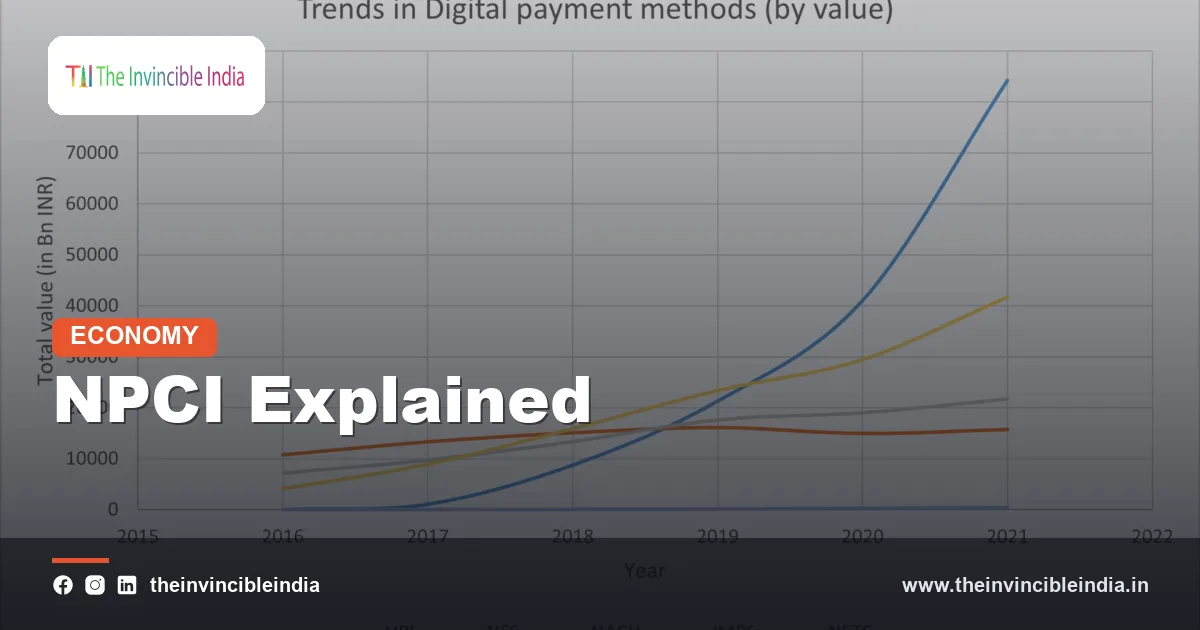
The National Payments Corporation of India (NPCI) is a not-for-profit umbrella organisation, set up in 2008 by the Reserve Bank of India (RBI) and the Indian Banks’ Association (IBA), that operates India’s main retail payment and settlement systems, including UPI, RuPay, IMPS, NACH, AePS, FASTag and Bharat BillPay. It is incorporated as a Section 8 company under the Companies Act, 2013 (originally a Section 25 company under the 1956 Act) and has its headquarters in Mumbai.
The National Payments Corporation of India was created under the Payment and Settlement Systems Act, 2007, to give the country a common, interoperable and low-cost infrastructure for retail payments. Over the years it has moved from running a shared ATM switch to operating real-time mobile payments used by hundreds of millions of people, and its subsidiary NPCI International Payments Limited (NIPL) now takes Indian payment systems abroad.
| Attribute | Details |
|---|---|
| Full name | National Payments Corporation of India (NPCI) |
| Established | Incorporated in 2008; began operations in 2009 |
| Founders | Reserve Bank of India (RBI) and Indian Banks’ Association (IBA) |
| Legal form | Not-for-profit company under Section 8 of the Companies Act, 2013 |
| Legal framework | Payment and Settlement Systems Act, 2007; regulated by the RBI |
| Headquarters | Mumbai, Maharashtra |
| Flagship products | UPI (launched in 2016), RuPay (launched in 2012), IMPS, NACH, AePS, NETC FASTag, BBPS |
| International arm | NPCI International Payments Limited (NIPL), set up in 2020 |
| Ownership | Owned by member banks, with an initial group of ten promoter banks that later expanded |
Key Takeaways
- The National Payments Corporation of India was set up in 2008 by the Reserve Bank of India and the Indian Banks’ Association as a not-for-profit company to run retail payment systems.
- The National Payments Corporation of India operates Unified Payments Interface (UPI), which launched in 2016 and has become one of the largest real-time payment systems in the world by transaction volume.
- The National Payments Corporation of India launched the RuPay card scheme in 2012 as a domestic alternative to international card networks.
- The National Payments Corporation of India also runs IMPS, NACH, the Aadhaar Enabled Payment System (AePS), NETC FASTag, Bharat BillPay and clearing under the Cheque Truncation System.
- NPCI International Payments Limited (NIPL), a wholly owned subsidiary created in 2020, promotes UPI and RuPay in other countries through links with foreign payment networks.
- The National Payments Corporation of India is a Section 8 company, which means its surpluses are reinvested in its objectives instead of being distributed as dividends.
What is the National Payments Corporation of India?
The National Payments Corporation of India (NPCI) is the umbrella organisation for retail payments in India, set up by the central bank and the banking industry to build shared systems that all banks can use. It does not hold customer accounts or lend money; instead it runs the networks and rules through which banks and payment apps move money.
The idea behind the NPCI was that retail payment systems tend to work best when they are interoperable and operated as a shared utility. Before it was created, India had a variety of separate ATM networks, card schemes and clearing arrangements that did not always work with each other, and customers of one bank often faced fees and restrictions when using another bank’s infrastructure. A neutral, bank-owned body could provide common standards and reduce costs.
The NPCI works within the regulatory framework of the Reserve Bank of India, which authorises payment system operators and supervises them under the Payment and Settlement Systems Act, 2007. The NPCI is treated as the principal operator of retail payments, and the RBI’s framework also allows other umbrella entities to be set up, although the NPCI remains the incumbent.
How and why was the National Payments Corporation of India set up?
The National Payments Corporation of India was set up in 2008 on the recommendation of the Reserve Bank of India, which wanted a single organisation to consolidate and operate retail payment systems across the banking industry. It was incorporated in December 2008 and started working in 2009.
The RBI’s vision and the new Payment and Settlement Systems Act, 2007 gave the legal footing for such an organisation. The Indian Banks’ Association, which represents banks, joined as a co-promoter. Ten major banks were the initial promoters, including public sector banks such as the State Bank of India, Punjab National Bank, Canara Bank, Bank of Baroda, Union Bank of India and Bank of India, private banks such as ICICI Bank and HDFC Bank, and foreign banks such as Citibank and HSBC.
The ownership was later broadened to include more banks, including regional rural banks, small finance banks and payment banks, so that the institution would not be dominated by a handful of large lenders. This helped align it with its function as shared infrastructure.
What are the main systems run by the National Payments Corporation of India?
The main systems run by the National Payments Corporation of India are UPI, RuPay, IMPS, NACH, AePS, NETC FASTag, Bharat BillPay and the National Financial Switch for ATMs, along with clearing under the Cheque Truncation System. Together they cover most types of retail payment in the country.
| System | Full name | What it does |
|---|---|---|
| UPI | Unified Payments Interface | Instant real-time payments between bank accounts through mobile apps, using a virtual payment address or QR code |
| RuPay | RuPay card network | Domestic card scheme for debit, credit and prepaid cards |
| IMPS | Immediate Payment Service | Round-the-clock interbank fund transfers through mobile, internet and branches |
| NACH | National Automated Clearing House | Bulk and recurring payments such as salaries, subsidies, loan instalments and mandates |
| AePS | Aadhaar Enabled Payment System | Basic banking services, such as cash withdrawal and balance enquiry, using Aadhaar authentication and a micro-ATM |
| NETC FASTag | National Electronic Toll Collection | Automatic toll payment at highway toll plazas through a tag on the vehicle |
| BBPS | Bharat Bill Payment System | Interoperable platform for paying utility and other recurring bills, also branded Bharat Connect |
| NFS | National Financial Switch | Interbank ATM network that links bank ATMs across the country |
| CTS | Cheque Truncation System | Clears cheques using electronic images instead of physical movement of paper |
What is UPI and how did the National Payments Corporation of India build it?
Unified Payments Interface (UPI) is an instant real-time payment system developed by the National Payments Corporation of India that lets users send money from one bank account to another using a mobile phone. It was launched in April 2016 and is built on the infrastructure of the Immediate Payment Service.
A UPI payment is made through a smartphone application from a bank or a third party, using a virtual payment address, a mobile number or a QR code, and is authorised with a PIN. The money moves between bank accounts within seconds at any time of day, including holidays, without the sender needing to share account details. The system is interoperable, so a user of one app can pay a user of another app and a merchant using a different bank.
The growth of UPI was helped by the spread of low-cost smartphones, mobile data, the Jan Dhan accounts for financial inclusion and the Aadhaar identity system. The BHIM app, launched in late 2016, was the NPCI’s own application, while many private and bank apps joined as third-party providers. Later features have included recurring payments through mandates, a lightweight wallet-like mode for small transactions, access for feature phones, and credit-linked use. UPI is now used for everything from street vendors to government payments, and the number of monthly transactions is counted in the billions.
What is RuPay and why was it created?
RuPay is a domestic card payment network launched by the National Payments Corporation of India in 2012 to give India its own card scheme alongside international networks. The name combines the words rupee and payment.
RuPay was designed to lower the cost of card acceptance and to keep domestic card transactions within India’s own infrastructure. It became widely known through the Jan Dhan Yojana, under which many new bank account holders received RuPay debit cards. RuPay now covers debit, credit and prepaid cards and is accepted at ATMs, point-of-sale terminals and online merchants. Through partnerships, RuPay cards can also be used in some other countries.
What other services does the National Payments Corporation of India provide?
The National Payments Corporation of India also provides bulk payments, bill payments, toll collection, assisted banking services and electronic vouchers in addition to its main products. These services extend digital payments to areas beyond person-to-person transfers.
- NACH: Replaced earlier electronic clearing systems and supports large-scale credits such as salaries and welfare payments, as well as debit mandates for loan instalments and insurance premiums.
- AePS: Allows account holders to carry out basic transactions through business correspondents using fingerprint or iris authentication linked to Aadhaar, which helps in areas with few bank branches.
- NETC FASTag: Uses radio-frequency identification to collect tolls electronically, reducing waiting time at toll plazas, and became compulsory for most vehicles in 2021.
- Bharat BillPay (BBPS): Provides a common platform for paying electricity, water, gas, telecom, insurance and other bills, with standard complaint handling.
- IMPS: Launched in 2010 as an instant interbank transfer service and served as the base for UPI.
- e-RUPI: A prepaid electronic voucher introduced in 2021 so that government or private sponsors can deliver benefits for a specific purpose without leakage.
- Cheque Truncation System: Speeds up cheque clearing by using images and data in place of physical cheques.
How is the National Payments Corporation of India taking UPI and RuPay abroad?
The National Payments Corporation of India takes UPI and RuPay abroad through NPCI International Payments Limited (NIPL), a wholly owned subsidiary established in 2020 to handle international operations. NIPL signs agreements with payment networks, banks and governments in other countries so that Indian systems can be used outside India.
The international strategy works in two ways. In one, NIPL links UPI with another country’s fast payment system, so users in one country can pay in the other. This approach was used in links with Singapore’s PayNow and with neighbours such as Nepal and Bhutan. In the other, UPI technology is offered to other central banks and payment providers to build their own systems, or UPI is accepted by merchants and in tourist destinations. UPI acceptance has been announced in a growing list of countries, including the United Arab Emirates, Sri Lanka, Mauritius and France, and RuPay has been launched in several countries including Singapore, the UAE, Bhutan and Nepal.
These moves are meant to make payments for Indian travellers and students easier, to reduce the cost of remittances, and to extend the reach of Indian financial technology. They also support India’s broader effort to present its digital public infrastructure as a model for other countries.
Who runs and regulates the National Payments Corporation of India?
The National Payments Corporation of India is run by a board of directors that includes representatives of its promoter banks, independent directors and officials with experience in banking and technology, and it is regulated by the Reserve Bank of India. It is managed day to day by a chief executive and a management team based in Mumbai.
As a Section 8 company, the NPCI is not allowed to distribute profits to its members; any surplus must be used for its objectives, such as improving systems and security. The RBI sets the regulatory framework for payment systems, authorises the NPCI to operate and oversees its systems for safety, resilience and fair access. Decisions on charges and rules for some products, such as fees for payments, are also influenced by the RBI and the Government.
The regulator has encouraged competition and reduced concentration risk. It has invited proposals for new umbrella entities for retail payments, and the NPCI has proposed limits on the share of transactions that any single app can hold in UPI to avoid dependence on a few large providers.
Why does the National Payments Corporation of India matter?
The National Payments Corporation of India matters because it operates the infrastructure that makes everyday digital payments in India fast, cheap and interoperable, and that supports the wider financial inclusion effort. Its systems have changed how people pay for goods, services and government benefits.
- Financial inclusion: Low-cost, simple payment tools bring small merchants, street vendors and rural users into the formal financial system.
- Efficiency and transparency: Direct transfers and electronic payments reduce cash handling and leakages in welfare delivery.
- Interoperability: A common standard lets customers and merchants use any bank or app.
- Domestic control: Domestic card and payment networks reduce dependence on foreign infrastructure for core payments.
- Global influence: UPI has become a reference model for fast payments in other countries, and India’s share of global real-time payments is large.
The model also raises issues that the NPCI and the RBI manage, including fraud and cybersecurity, outages and the resilience of a system that so many people depend on, the business model of free-to-use payments, and the concentration of volumes among a few apps.
Bottom Line
The National Payments Corporation of India has turned a banking-industry initiative into the backbone of India’s retail payments, through UPI, RuPay and a family of related systems. Its not-for-profit structure, its link to the central bank and its growing international role make it one of the most significant institutions in India’s digital public infrastructure.
Frequently Asked Questions
What is the National Payments Corporation of India (NPCI)?
The National Payments Corporation of India is a not-for-profit umbrella organisation that operates India’s retail payment and settlement systems. It was set up in 2008 by the Reserve Bank of India and the Indian Banks’ Association. It runs UPI, RuPay, IMPS, NACH, AePS, FASTag and Bharat BillPay.
Who owns the National Payments Corporation of India?
The National Payments Corporation of India is owned by member banks, starting with ten promoter banks and later widened to include more banks and payment institutions. It is incorporated as a Section 8 company, so it does not pay dividends. The Reserve Bank of India is its regulator and was one of its founders.
Is NPCI a government organisation?
No, the National Payments Corporation of India is not a government department; it is a not-for-profit company owned by banks and established on the initiative of the Reserve Bank of India and the Indian Banks’ Association. It is regulated by the RBI and works closely with the Government on public payment policy. Its surpluses are reinvested, not distributed.
What is the difference between NPCI and UPI?
NPCI is the organisation, while UPI is one of the payment systems that the organisation operates. UPI, launched in 2016, lets users make instant payments between bank accounts through mobile apps. NPCI also runs RuPay, IMPS, NACH and other systems.
What is NPCI International Payments Limited?
NPCI International Payments Limited (NIPL) is a wholly owned subsidiary of the National Payments Corporation of India, set up in 2020 to take Indian payment systems abroad. It signs agreements with foreign payment networks, banks and governments to enable UPI and RuPay acceptance. Examples include links with Singapore, Nepal, Bhutan, the UAE, Sri Lanka and Mauritius.
When was RuPay launched and what is it?
RuPay was launched by the National Payments Corporation of India in 2012 as India’s own domestic card payment network. It covers debit, credit and prepaid cards and is widely issued to account holders under financial inclusion schemes. The name is a combination of the words rupee and payment.
{“@context”:”https://schema.org”,”@graph”:[{“@type”:”FAQPage”,”mainEntity”:[{“@type”:”Question”,”name”:”What is the National Payments Corporation of India (NPCI)?”,”acceptedAnswer”:{“@type”:”Answer”,”text”:”The National Payments Corporation of India is a not-for-profit umbrella organisation that operates India’s retail payment and settlement systems. It was set up in 2008 by the Reserve Bank of India and the Indian Banks’ Association. It runs UPI, RuPay, IMPS, NACH, AePS, FASTag and Bharat BillPay.”}},{“@type”:”Question”,”name”:”Who owns the National Payments Corporation of India?”,”acceptedAnswer”:{“@type”:”Answer”,”text”:”The National Payments Corporation of India is owned by member banks, starting with ten promoter banks and later widened to include more banks and payment institutions. It is incorporated as a Section 8 company, so it does not pay dividends. The Reserve Bank of India is its regulator and was one of its founders.”}},{“@type”:”Question”,”name”:”Is NPCI a government organisation?”,”acceptedAnswer”:{“@type”:”Answer”,”text”:”No, the National Payments Corporation of India is not a government department; it is a not-for-profit company owned by banks and established on the initiative of the Reserve Bank of India and the Indian Banks’ Association. It is regulated by the RBI and works closely with the Government on public payment policy. Its surpluses are reinvested, not distributed.”}},{“@type”:”Question”,”name”:”What is the difference between NPCI and UPI?”,”acceptedAnswer”:{“@type”:”Answer”,”text”:”NPCI is the organisation, while UPI is one of the payment systems that the organisation operates. UPI, launched in 2016, lets users make instant payments between bank accounts through mobile apps. NPCI also runs RuPay, IMPS, NACH and other systems.”}},{“@type”:”Question”,”name”:”What is NPCI International Payments Limited?”,”acceptedAnswer”:{“@type”:”Answer”,”text”:”NPCI International Payments Limited (NIPL) is a wholly owned subsidiary of the National Payments Corporation of India, set up in 2020 to take Indian payment systems abroad. It signs agreements with foreign payment networks, banks and governments to enable UPI and RuPay acceptance. Examples include links with Singapore, Nepal, Bhutan, the UAE, Sri Lanka and Mauritius.”}},{“@type”:”Question”,”name”:”When was RuPay launched and what is it?”,”acceptedAnswer”:{“@type”:”Answer”,”text”:”RuPay was launched by the National Payments Corporation of India in 2012 as India’s own domestic card payment network. It covers debit, credit and prepaid cards and is widely issued to account holders under financial inclusion schemes. The name is a combination of the words rupee and payment.”}}]}]}


