

The jute industry in India is the agro-based industrial sector that grows jute, a natural bast fibre often called the “golden fibre”, and converts it into sacking, hessian, yarn, carpet backing and a widening range of diversified products. India is among the world’s largest producers of raw jute and the largest producer of jute goods, and the sector is concentrated in the eastern states, above all West Bengal.
The jute industry in India supports millions of farming families and a large mill workforce, and it is protected by a unique piece of legislation that reserves jute packaging for certain commodities. This guide explains where jute is grown, how it is processed, which laws and institutions govern it, and what opportunities and challenges lie ahead. Last reviewed: 7 October 2026.
| Attribute | Details |
|---|---|
| Common name | Jute, the “golden fibre” |
| Botanical species | Corchorus capsularis (white jute) and Corchorus olitorius (tossa jute) |
| Main growing states | West Bengal, Bihar and Assam, with smaller areas in Odisha, Tripura, Meghalaya and Uttar Pradesh |
| Main milling belt | Banks of the Hooghly river in West Bengal, from Kolkata northwards |
| First jute mill in India | Rishra, near Kolkata, in 1855 |
| Key law | Jute Packaging Materials (Compulsory Use in Packing Commodities) Act, 1987 |
| Raw jute procurement agency | Jute Corporation of India (JCI), set up in 1971 |
| Promotional body | National Jute Board, constituted under the National Jute Board Act, 2008 |
| Administrative ministry | Ministry of Textiles, Government of India |
Key Takeaways
- The jute industry in India is anchored in the Ganga-Brahmaputra delta, where West Bengal, Bihar and Assam together account for nearly all of the country’s raw jute output.
- Jute is a rain-fed, labour-intensive cash crop that is sown in spring, harvested in the monsoon and processed through a water-based step called retting.
- The Jute Packaging Materials (Compulsory Use in Packing Commodities) Act, 1987 requires specified commodities, such as foodgrains and sugar, to be packed in jute materials to a notified extent.
- The Jute Corporation of India buys raw jute at the Minimum Support Price (MSP) when market rates fall below it, protecting farmers from distress sales.
- The National Jute Board promotes research, product diversification, quality standards and export markets for jute goods under the Ministry of Textiles.
- Jute is biodegradable, renewable and recyclable, which gives the jute industry in India a growth opportunity as buyers look for alternatives to plastic packaging.
What is jute and why is it called the golden fibre?
Jute is a long, soft, shiny vegetable fibre taken from the stem of plants of the genus Corchorus, and it is called the “golden fibre” because of its natural golden-brown lustre and its historic economic importance to eastern India. The fibre is spun into coarse, strong threads that are woven into cloth, sacks and ropes.
Two species dominate cultivation. White jute (Corchorus capsularis) is traditionally grown in lower, flood-prone lands, while tossa jute (Corchorus olitorius) prefers somewhat higher, better-drained fields and generally yields a softer, stronger fibre. Jute is a bast fibre, meaning that it comes from the inner bark of the stem, in the same family of fibres as flax, hemp and kenaf.
A related crop, mesta (Hibiscus cannabinus and Hibiscus sabdariffa), produces a similar fibre and is often grouped with jute in official statistics and policy. Together the two are described as “jute and allied fibres” and are used in similar mills for similar products.
How did the jute industry in India develop?
The jute industry in India developed in the nineteenth century, when raw jute from Bengal was first shipped to Scotland and later processed locally in mills built on the banks of the Hooghly river near Kolkata. The first jute mill in India was established at Rishra in 1855, and the sector then expanded quickly along both banks of the river.
The industry grew in the colonial era because jute sacks were in heavy demand worldwide for packing grain, sugar, cement and cotton. Kolkata, then the capital of British India, was the natural port and financing centre. The Indian Jute Mills Association (IJMA), formed in 1884, became the main industry body of mill owners.
The Partition of 1947 split the jute economy. Most of the jute-growing land lay in the eastern part of Bengal that became East Pakistan, later Bangladesh, while most of the mills remained in India. India therefore had to expand its own jute cultivation rapidly, and cultivation spread to Bihar, Assam and other eastern areas. The strategic need to secure raw material shaped much of the later policy on the crop.
Where is jute grown in India?
Jute is grown mainly in the eastern states of West Bengal, Bihar and Assam, with West Bengal contributing the largest share of the country’s raw jute. Smaller quantities come from Odisha, Tripura, Meghalaya and parts of Uttar Pradesh.
Why does the crop suit the eastern plains?
Jute needs a warm, humid climate, plenty of rainfall during the growing season and fertile, well-drained alluvial soil that is renewed by river silt. The Ganga-Brahmaputra delta provides exactly this combination, which is why the crop is concentrated in the Bengal basin and neighbouring districts. Sowing is generally done between March and May, and harvesting takes place from July to September, depending on the variety and the region.
How is jute processed after harvest?
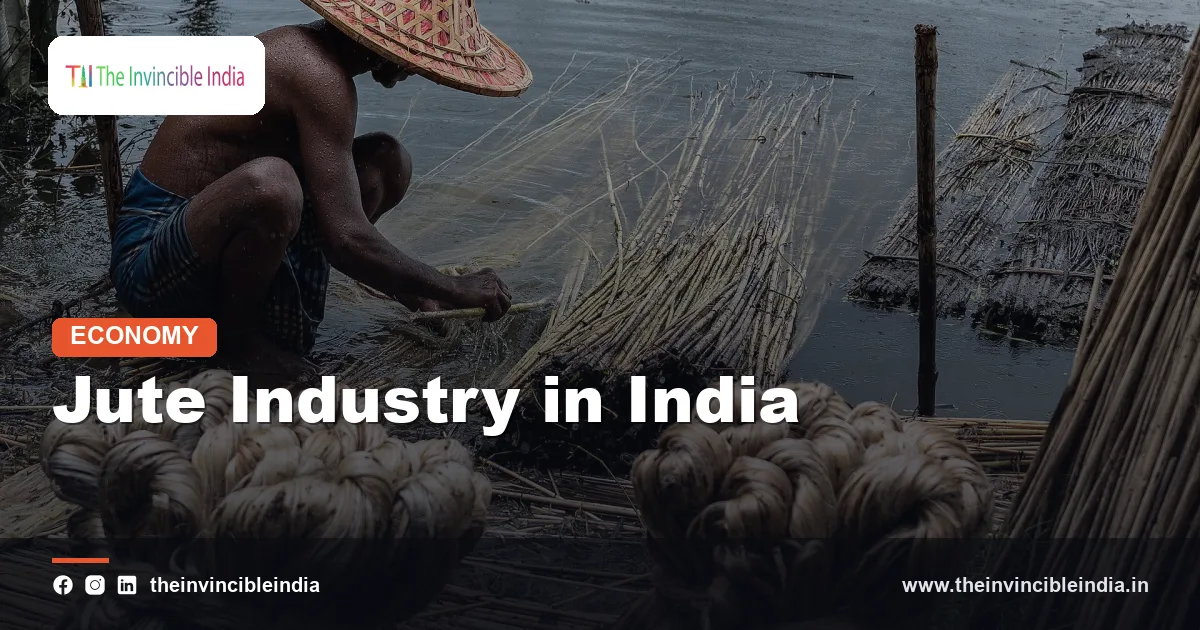
After cutting, jute stems are bundled and submerged in slow-moving or still water for a process called retting, in which microbes loosen the fibre from the woody core. Farmers then strip the fibre by hand, wash it, and dry it in the sun before selling it as raw jute. The quality of the water, the timing of retting and the care taken in stripping strongly affect the grade and price of the fibre.
Because retting needs water and manual labour, the crop is closely tied to smallholder farming households, who sell the dried fibre to traders and, in many cases, to procurement agencies.
Where are the jute mills of India located?
The jute mills of India are concentrated along the Hooghly river in West Bengal, in an industrial belt that runs from Kolkata northwards through towns such as Howrah, Serampore, Rishra, Barrackpore and Naihati. This belt has been the heart of the jute industry in India since the nineteenth century.
The river location had practical advantages. Raw jute could be brought in by boat, water was available for processing, and finished goods could move through the port of Kolkata. Over time, mills were also set up in other states, including Andhra Pradesh, Bihar, Odisha, Assam and Uttar Pradesh, although the Hooghly belt still holds most of the capacity.
The sector includes both composite mills, which spin and weave, and smaller units that make specific products. A great deal of the workforce lives in the mill towns around the river, which makes the industry important to the regional economy of West Bengal.
What products does the jute industry in India make?
The jute industry in India makes a range of products, the oldest being sacking and hessian and the newest being diversified items such as geo-textiles, home furnishings and jute composites. The product mix has been widening as mills respond to demand for sustainable materials.
| Product category | Description | Typical use |
|---|---|---|
| Sacking | Heavy, coarse woven cloth made into bags | Packing foodgrains, sugar and pulses |
| Hessian (burlap) | Lighter, finer woven cloth | Bags for agricultural produce, wrapping, gardening |
| Jute yarn and twine | Spun threads and ropes | Carpet backing, rope, handloom textiles |
| Carpet backing cloth | Woven base fabric | Floor coverings and mats |
| Jute geo-textiles | Open-weave, biodegradable mats and nets | Soil erosion control, slope protection, road and river-bank works |
| Diversified jute products | Shopping bags, decor items, footwear, stationery, composites | Consumer goods, handicrafts and eco-friendly packaging |
Sacking remains the largest category by volume, mainly because of government demand for foodgrain packing. Diversified products are smaller in volume but are valued for higher margins and for their appeal in export markets, particularly in environmentally conscious economies.
What is the Jute Packaging Materials (Compulsory Use) Act, 1987?
The Jute Packaging Materials (Compulsory Use in Packing Commodities) Act, 1987 is an Indian law that requires specified commodities to be packed in jute packaging materials, in order to protect the jute industry and the farmers who depend on it. The Act is commonly called the Jute Packaging Materials Act or JPM Act.
Under the Act, the central government notifies the commodities that must be packed in jute, and the proportion of production or supply to which the rule applies. Foodgrains and sugar have historically been the key commodities covered, and the notified reservation percentages have been revised from time to time in consultation with the Ministry of Textiles and the Jute Packaging Materials Advisory Committee.
The rationale is simple. Jute faces constant competition from cheaper synthetic sacks made from polypropylene, so a guaranteed demand base keeps mills running and sustains the farmers who supply raw fibre. The reservation has been criticised by some as a form of protection and defended by others as vital to rural livelihoods and to the environment. The Act remains the main legal pillar of the sector.
What is the role of the Jute Corporation of India and the MSP?
The Jute Corporation of India (JCI) is the central public-sector agency that acts as the nodal agency for price-support operations in raw jute, buying the fibre from farmers at the Minimum Support Price (MSP) whenever market rates fall below it. JCI was set up in 1971 under the Ministry of Textiles and has its headquarters in Kolkata.
How is the MSP for raw jute decided?
The MSP for raw jute is announced by the Government of India on the recommendation of the Commission for Agricultural Costs and Prices (CACP), which considers the cost of cultivation, market trends, demand and supply, and the interests of both growers and consumers. The MSP is declared for each jute season, and JCI sets up procurement centres in the main growing districts when prices come under pressure.
What else does JCI do?
JCI also supplies raw jute to mills when required, helps stabilise prices, and, under the packaging reservation system, supplies jute bags to government agencies that procure foodgrains. Its price-support function is especially valuable to small farmers, because it gives them a floor price they can count on before sowing.
What does the National Jute Board do?
The National Jute Board (NJB) is the statutory body under the Ministry of Textiles that works for the development, promotion and export of jute and jute products. It was constituted under the National Jute Board Act, 2008, and has its headquarters in Kolkata.
The Board advises the government on policy, supports research and development, and runs schemes that help farmers and mills adopt better practices. It also promotes jute goods in India and abroad, supports fairs and design programmes and encourages the use of jute in new applications. In earlier years, the sector had a Jute Manufactures Development Council, and the National Jute Board carries forward much of that developmental role.
Key support schemes have included the Jute Technology Mission, launched in the mid-2000s to modernise the sector across the chain from farm to factory, and programmes such as Jute ICARE, which promotes improved cultivation practices and better retting methods through the use of microbial agents. These schemes focus on raising yield, improving fibre quality and increasing incomes for farmers.
Why does the jute industry in India matter?
The jute industry in India matters because it supports livelihoods for a very large number of people in eastern India, supplies the packaging that carries the country’s foodgrains, and provides an eco-friendly material in a world moving away from plastics. The sector links agriculture, industry and the rural economy.
- Livelihoods: Millions of farming families grow jute, while lakhs of workers are employed in mills and in related trade, transport and handicrafts.
- Food security: Jute sacks are the traditional packaging for procured foodgrains, so the sector is tied to the public distribution system.
- Regional economy: The industry is a pillar of the economy of West Bengal and gives employment in Bihar, Assam and neighbouring states.
- Foreign exchange: Jute goods are exported, giving the country a modest but steady source of overseas earnings.
- Environment: Jute is renewable, biodegradable and captures carbon as the crop grows, and its stalks and leaves leave soil in better condition.
What are the opportunities in the jute industry?
The biggest opportunity in the jute industry in India is the rising global and domestic demand for sustainable, plastic-free materials, which suits a natural, biodegradable fibre such as jute. Concern over plastic waste has encouraged governments, retailers and consumers to look at alternatives.
Which areas offer growth?
- Eco-friendly packaging: Jute shopping bags, gift bags and food-grade packaging can replace single-use plastic items.
- Geo-textiles: Jute mats are used to control soil erosion on slopes, river banks and roadsides, and they decompose naturally after helping vegetation take hold.
- Lifestyle and design products: Home furnishings, rugs, bags, footwear and fashion accessories offer higher value than basic sacking.
- Composites and new materials: Research is exploring jute-based composites for automotive interiors, construction boards and paper pulp.
- Export markets: Demand for natural fibre products in Europe, North America and other regions offers growth for diversified goods.
Moving from low-value sacking to high-value diversified products is widely considered the most promising route for mills that want to reduce their reliance on government orders.
What challenges does the jute industry in India face?
The jute industry in India faces competition from synthetic packaging, dependence on government demand, price volatility in raw jute, and the need to modernise old mills and improve farm productivity. These challenges have been discussed in industry and policy forums for decades.
| Challenge | Why it matters |
|---|---|
| Synthetic competition | Polypropylene sacks are cheaper and lighter, putting pressure on jute packaging demand |
| Dependence on reserved demand | A large share of sacking sales is linked to government foodgrain procurement and the compulsory-use law |
| Raw jute price swings | Weather, acreage and trader stocking can cause sharp changes in fibre prices |
| Ageing machinery | Many mills use older equipment, which raises costs and limits product range |
| Retting and water issues | Traditional retting needs clean water and labour, and poor retting lowers fibre quality |
| Small, fragmented holdings | Low farm incomes and small plots make it harder to adopt new practices |
| Labour and workforce concerns | Wages, working conditions and mill closures have periodically affected the sector |
Responding to these issues, policy has focused on better seeds, improved retting methods, mill modernisation, wider product ranges and stronger marketing. The success of these efforts will decide how well the industry can use the shift towards sustainable materials.
Bottom Line
The jute industry in India is a historic, rural-based industry that connects small farmers in the eastern plains with mills on the Hooghly and with markets at home and abroad. Its future depends on moving beyond sacking towards diversified, eco-friendly products while protecting farmer incomes through institutions such as the Jute Corporation of India and the National Jute Board.
Frequently Asked Questions
Which state is the largest producer of jute in India?
West Bengal is the largest producer of jute in India, contributing the biggest share of the country’s raw jute. Bihar and Assam are the next major producers, with smaller quantities from Odisha, Tripura, Meghalaya and Uttar Pradesh. The Ganga-Brahmaputra delta provides the warm, humid climate and alluvial soil that the crop needs.
Why is jute called the golden fibre?
Jute is called the golden fibre because of its shiny golden-brown colour and because it has historically been a major earner for eastern India. The name reflects both the appearance of the raw fibre and its economic value. Jute remains a key cash crop for small farmers in the region.
What is the Jute Packaging Materials Act of 1987?
The Jute Packaging Materials (Compulsory Use in Packing Commodities) Act, 1987 is a law that makes it mandatory to pack notified commodities in jute materials. The central government notifies the commodities, such as foodgrains and sugar, and the share that must be packed in jute. The purpose is to guarantee demand for jute and protect farmers and mill workers from cheaper synthetic substitutes.
What does the Jute Corporation of India do?
The Jute Corporation of India (JCI) is the central agency that carries out price-support operations for raw jute. It buys raw jute from farmers at the Minimum Support Price when market rates fall below that level. JCI was established in 1971 under the Ministry of Textiles and is headquartered in Kolkata.
What is the role of the National Jute Board?
The National Jute Board is the statutory body that promotes the development and export of jute and jute products. It was constituted under the National Jute Board Act, 2008, and works under the Ministry of Textiles. It supports research, product diversification, farmer training and marketing of jute goods in India and abroad.
Is jute really eco-friendly?
Yes, jute is considered eco-friendly because it is a renewable, biodegradable and recyclable natural fibre. The plant grows quickly with limited need for fertilisers, absorbs carbon dioxide while growing and its leaves enrich the soil. Jute products can decompose naturally at the end of their life, unlike most plastic packaging.
{“@context”:”https://schema.org”,”@graph”:[{“@type”:”FAQPage”,”mainEntity”:[{“@type”:”Question”,”name”:”Which state is the largest producer of jute in India?”,”acceptedAnswer”:{“@type”:”Answer”,”text”:”West Bengal is the largest producer of jute in India, contributing the biggest share of the country’s raw jute. Bihar and Assam are the next major producers, with smaller quantities from Odisha, Tripura, Meghalaya and Uttar Pradesh. The Ganga-Brahmaputra delta provides the warm, humid climate and alluvial soil that the crop needs.”}},{“@type”:”Question”,”name”:”Why is jute called the golden fibre?”,”acceptedAnswer”:{“@type”:”Answer”,”text”:”Jute is called the golden fibre because of its shiny golden-brown colour and because it has historically been a major earner for eastern India. The name reflects both the appearance of the raw fibre and its economic value. Jute remains a key cash crop for small farmers in the region.”}},{“@type”:”Question”,”name”:”What is the Jute Packaging Materials Act of 1987?”,”acceptedAnswer”:{“@type”:”Answer”,”text”:”The Jute Packaging Materials (Compulsory Use in Packing Commodities) Act, 1987 is a law that makes it mandatory to pack notified commodities in jute materials. The central government notifies the commodities, such as foodgrains and sugar, and the share that must be packed in jute. The purpose is to guarantee demand for jute and protect farmers and mill workers from cheaper synthetic substitutes.”}},{“@type”:”Question”,”name”:”What does the Jute Corporation of India do?”,”acceptedAnswer”:{“@type”:”Answer”,”text”:”The Jute Corporation of India (JCI) is the central agency that carries out price-support operations for raw jute. It buys raw jute from farmers at the Minimum Support Price when market rates fall below that level. JCI was established in 1971 under the Ministry of Textiles and is headquartered in Kolkata.”}},{“@type”:”Question”,”name”:”What is the role of the National Jute Board?”,”acceptedAnswer”:{“@type”:”Answer”,”text”:”The National Jute Board is the statutory body that promotes the development and export of jute and jute products. It was constituted under the National Jute Board Act, 2008, and works under the Ministry of Textiles. It supports research, product diversification, farmer training and marketing of jute goods in India and abroad.”}},{“@type”:”Question”,”name”:”Is jute really eco-friendly?”,”acceptedAnswer”:{“@type”:”Answer”,”text”:”Yes, jute is considered eco-friendly because it is a renewable, biodegradable and recyclable natural fibre. The plant grows quickly with limited need for fertilisers, absorbs carbon dioxide while growing and its leaves enrich the soil. Jute products can decompose naturally at the end of their life, unlike most plastic packaging.”}}]}]}


