

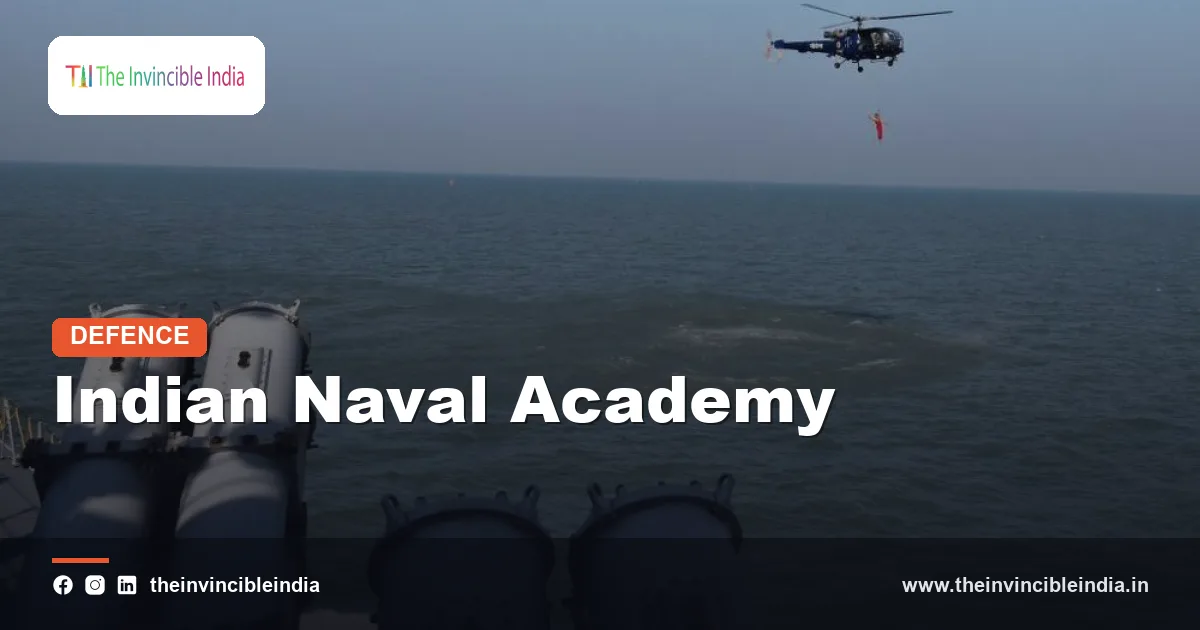
The Indian Naval Academy (INA) at Ezhimala, in Kannur district of Kerala, is the premier training institution that turns young men and women into commissioned officers of the Indian Navy, and it also trains officer cadets of the Indian Coast Guard. Commissioned in 2009 and spread over roughly 2,500 acres, the Indian Naval Academy is widely described as the largest naval academy in Asia by area.
The Indian Naval Academy sits on a coastal promontory on the Malabar coast, where the sea, hills and parade grounds are all part of the cadet’s classroom. This guide explains what the academy is, how cadets join, what they study, how the campus works and why the institution matters for India’s maritime security. Last reviewed: 7 October 2026.
| Attribute | Details |
|---|---|
| Full name | Indian Naval Academy (INA), Ezhimala |
| Location | Ezhimala, Kannur district, Kerala, on the Malabar coast |
| Commissioned | 8 January 2009 |
| Type | Naval officer training academy of the Indian Navy |
| Area | Around 2,500 acres, described as Asia’s largest naval academy by area |
| Trains | Officer cadets of the Indian Navy and the Indian Coast Guard, plus cadets from friendly foreign navies |
| Principal entry courses | 10+2 (B.Tech) Cadet Entry Scheme, graduate entries, and post-NDA naval training |
| Motto | Sheelam Param Bhushanam (Character is the supreme ornament) |
| Ministry | Ministry of Defence, Government of India |
Key Takeaways
- The Indian Naval Academy at Ezhimala was commissioned on 8 January 2009 and is located in Kannur district on the Malabar coast of Kerala.
- The Indian Naval Academy covers roughly 2,500 acres and is commonly described as the largest naval academy in Asia by area.
- Cadets who enter the Indian Naval Academy after 10+2 follow a four-year B.Tech programme combined with naval professional training before being commissioned as Sub Lieutenants.
- The Indian Naval Academy also hosts graduate-entry officers on shorter courses, including the Naval Orientation Course, and trains Indian Coast Guard officer cadets.
- Naval cadets who study at the National Defence Academy in Khadakwasla complete their pre-commissioning naval training at the Indian Naval Academy.
- The motto of the Indian Naval Academy, Sheelam Param Bhushanam, places character above every other attribute in the making of an officer.
What is the Indian Naval Academy?
The Indian Naval Academy is the Indian Navy’s principal institution for the initial training of officers, located at Ezhimala in Kerala. It brings together cadets from several entry routes and gives them the academic education, seamanship, leadership and physical conditioning that a naval officer needs before joining the fleet.
Before the academy was commissioned in 2009, naval officer training in India was spread across smaller and older establishments. The creation of one large, purpose-built academy on the Malabar coast consolidated the training of the officer corps in a single campus, with the facilities and land needed for modern naval instruction.
The academy is a defence institution under the Ministry of Defence and is run by the Indian Navy. Its head is a senior naval flag officer who holds the post of Commandant. Cadets of other services are not trained here, but the academy does train Coast Guard officers and, under bilateral arrangements, officer cadets from friendly countries.
Where is Ezhimala and why was it chosen?
Ezhimala is a hill and promontory in Kannur district on the northern Malabar coast of Kerala, and it was chosen for the Indian Naval Academy because of its extensive coastline, large tracts of available land and sheltered waters for sailing and boat training. The name Ezhimala is often explained as “seven hills” in Malayalam, referring to the hill formation of the headland.
The region has deep maritime associations. Ezhimala is mentioned in ancient and medieval Kerala history as a seat of the Mushika dynasty and a port region on the spice coast. In that sense, the academy sits in a landscape that has been connected with seafaring for many centuries.
The location also suits training. A long beachfront, calm bays for dinghy sailing, hills for adventure training and open ground for parades and drills can all be found on the same campus. The setting lets cadets spend time on the water from an early stage in their training.
When was the Indian Naval Academy established?
The Indian Naval Academy at Ezhimala was commissioned on 8 January 2009 by the then Defence Minister of India, and it began functioning as the Navy’s main officer training academy. The project followed a long planning process that began with the identification of the Ezhimala site in the late twentieth century.
| Milestone | Detail |
|---|---|
| Site identification | Ezhimala selected as the location for a major naval academy on the Malabar coast |
| Construction phase | Campus built in stages with academic blocks, parade grounds, jetties and residential areas |
| 8 January 2009 | Academy commissioned |
| After commissioning | Courses, facilities and intake expanded, including training for Coast Guard cadets |
Since commissioning, the academy has produced successive batches of officers who now serve across the Navy’s executive, engineering, electrical and education branches.
How does one join the Indian Naval Academy?
A candidate joins the Indian Naval Academy by being selected for a naval officer entry scheme, which typically involves a written examination or an academic merit list, followed by a Services Selection Board (SSB) interview and a medical examination. The route depends on the entry, and the Indian Navy publishes eligibility details for each scheme from time to time.
What are the main entry routes?
- 10+2 (B.Tech) Cadet Entry Scheme: For candidates who have passed Class 12 with physics, chemistry and mathematics. Selection is based on a national engineering entrance score, followed by an SSB interview and a medical test.
- National Defence Academy (NDA) entry: Candidates selected through the UPSC NDA examination who opt for the Navy spend three years at the National Defence Academy and then move to the Indian Naval Academy for a year of naval training.
- Graduate entries: Graduates and engineers join the Naval Orientation Course (NOC) after selection through schemes such as the Short Service Commission, the Combined Defence Services Examination and the University Entry Scheme, depending on the branch.
- Coast Guard entry: Officer cadets of the Indian Coast Guard receive their initial training at the academy after selection by the Coast Guard.
Women officers are also trained at the academy, as the Navy has opened a number of branches and entry schemes to women in recent years. The exact openings, age limits and educational criteria are revised from time to time, so candidates must check the latest official notification.
What courses are taught at the Indian Naval Academy?
The Indian Naval Academy runs a four-year B.Tech programme for 10+2 cadets, a shorter Naval Orientation Course for graduate entries and a pre-commissioning naval training year for officers who come from the National Defence Academy. Each course combines academics with service training.
| Course | Entry level | Approximate duration | Outcome |
|---|---|---|---|
| B.Tech cadet course | Class 12 (PCM) | Four years | B.Tech degree plus commission as Sub Lieutenant |
| Post-NDA naval training | NDA graduate, naval stream | About one year | Commission in the Navy |
| Naval Orientation Course (NOC) | Graduate or engineer | A few months (on the order of 22 weeks) | Commission in the Navy in the chosen branch |
| Coast Guard officer course | Selected Coast Guard cadets | Varies by scheme | Commission as Assistant Commandant |
The B.Tech degrees are awarded in affiliation with Jawaharlal Nehru University. Cadets typically study mechanical engineering or applied electronics and communication engineering, depending on their branch allocation.
What is the training like for a naval cadet?
Training for a naval cadet at the Indian Naval Academy combines classroom study, seamanship, navigation, physical fitness, drill and character-building activities, and it is designed to produce all-round officers who can lead sailors at sea. The routine is demanding, with early mornings, drills, sports and study in the same day.
What does the professional training cover?
- Seamanship and sailing: Cadets learn boat handling, rowing, dinghy and yacht sailing, knots, splices and the basics of working on a ship.
- Navigation and ship handling: Training uses charts, instruments and simulators to teach position fixing, collision regulations and bridge procedures.
- Engineering and technology: Cadets study marine engineering, electronics and weapon systems relevant to modern warships.
- Leadership and military studies: Subjects include naval history, strategy, maritime law, military leadership and service etiquette.
- Physical and outdoor training: Swimming, drill, obstacle courses, trekking and adventure activities build stamina and teamwork.
Sea training is a vital stage. Cadets embark on training ships of the Navy’s First Training Squadron, based in Kochi, so that classroom knowledge can be tested on actual voyages. They also visit ports and take part in exercises, which prepares them for fleet life after commissioning.
What are the campus, facilities and traditions of the academy?
The campus of the Indian Naval Academy includes academic blocks, laboratories, simulators, sports facilities, a waterfront with boat pools and jetties, parade grounds and residential areas, spread across roughly 2,500 acres of coastal land. The size and variety of the campus are among its defining features.
Traditions play an important role in shaping the cadets. The academy follows naval customs such as formal parades, ceremonial dress, mess etiquette and the observance of historic naval days. The culmination of the course is the Passing Out Parade, when cadets are formally commissioned as officers in front of their families and a reviewing officer. Awards are given for academic excellence, seamanship, sports and overall merit, and the best overall cadet is honoured with a ceremonial sword or medal.
The academy motto, Sheelam Param Bhushanam, which means that character is the supreme ornament, reflects the stress placed on integrity and conduct. Instructors teach that technical skill must go along with moral courage and a sense of duty.
Why does the Indian Naval Academy matter?
The Indian Naval Academy matters because it supplies the officer corps that commands and operates the Indian Navy, which is responsible for protecting India’s long coastline, island territories and maritime trade routes. A professional, well-trained officer cadre is essential for operating complex warships, submarines and aircraft.
- Single national hub: The academy gives the Navy a consistent standard of initial training across all entry routes.
- Technical depth: The combination of an engineering degree and professional training matches the technology of modern fleets.
- Coast Guard link: Training Coast Guard officers at the same campus builds familiarity between two maritime forces.
- Naval diplomacy: Training of foreign cadets strengthens relations with friendly navies in the Indian Ocean region and beyond.
- Regional development: The academy has brought employment, infrastructure and visibility to the Kannur region of Kerala.
As India expands its maritime role in the Indian Ocean, the demand for skilled naval officers continues to grow, and the academy is central to meeting that demand.
How does the Indian Naval Academy compare with other military academies?
The Indian Naval Academy is one of several pre-commissioning institutions of the Indian armed forces, each specialising in a service or entry route. The National Defence Academy at Khadakwasla trains cadets for all three services, while the Indian Military Academy at Dehradun, the Air Force Academy at Dundigal and the Officers Training Academy at Chennai serve specific branches.
| Institution | Location | Primary role |
|---|---|---|
| Indian Naval Academy | Ezhimala, Kerala | Initial training of Navy and Coast Guard officers |
| National Defence Academy | Khadakwasla, Pune | Joint foundation training for Army, Navy and Air Force cadets |
| Indian Military Academy | Dehradun, Uttarakhand | Army officer pre-commissioning training |
| Air Force Academy | Dundigal, Telangana | Air Force officer training |
| Officers Training Academy | Chennai, Tamil Nadu | Short Service Commission officers for the Army |
The Indian Naval Academy is therefore the naval counterpart of these academies and the only one dedicated exclusively to naval cadets.
Bottom Line
The Indian Naval Academy at Ezhimala is the central pillar of naval officer training in India, combining engineering education with seamanship and leadership on a vast coastal campus. Since its commissioning in 2009, the academy has built the officer corps that serves the Indian Navy and the Indian Coast Guard.
Frequently Asked Questions
Where is the Indian Naval Academy located?
The Indian Naval Academy is located at Ezhimala in Kannur district on the Malabar coast of Kerala. The campus occupies a coastal promontory with hills, beaches and sheltered waters. The setting allows cadets to train at sea level from the start of their course.
When was the Indian Naval Academy commissioned?
The Indian Naval Academy at Ezhimala was commissioned on 8 January 2009. It was built to consolidate officer training for the Indian Navy on a single, large campus. Since then it has trained successive batches of naval and Coast Guard officers.
Is the Indian Naval Academy the largest naval academy in Asia?
Yes, the Indian Naval Academy is widely described as the largest naval academy in Asia by area. The campus covers roughly 2,500 acres. Its size allows it to house academic buildings, waterfront facilities, parade grounds and large training areas together.
How can a student join the Indian Naval Academy after Class 12?
A student can join through the Navy’s 10+2 (B.Tech) Cadet Entry Scheme, which requires Class 12 with physics, chemistry and mathematics. Selection is based on an entrance score, followed by an SSB interview and a medical examination. Selected cadets complete a four-year B.Tech programme with naval training and are then commissioned as Sub Lieutenants.
Does the Indian Naval Academy train the Coast Guard?
Yes, the Indian Naval Academy trains officer cadets of the Indian Coast Guard along with those of the Indian Navy. Coast Guard cadets receive their initial officer training at the Ezhimala campus before being commissioned as Assistant Commandants. The arrangement builds common professional standards between the two maritime forces.
What is the motto of the Indian Naval Academy?
The motto of the Indian Naval Academy is Sheelam Param Bhushanam, which means that character is the supreme ornament. The motto stresses integrity and conduct as the foundation of leadership. It is used to remind cadets that technical skill must be matched by strength of character.
{“@context”:”https://schema.org”,”@graph”:[{“@type”:”FAQPage”,”mainEntity”:[{“@type”:”Question”,”name”:”Where is the Indian Naval Academy located?”,”acceptedAnswer”:{“@type”:”Answer”,”text”:”The Indian Naval Academy is located at Ezhimala in Kannur district on the Malabar coast of Kerala. The campus occupies a coastal promontory with hills, beaches and sheltered waters. The setting allows cadets to train at sea level from the start of their course.”}},{“@type”:”Question”,”name”:”When was the Indian Naval Academy commissioned?”,”acceptedAnswer”:{“@type”:”Answer”,”text”:”The Indian Naval Academy at Ezhimala was commissioned on 8 January 2009. It was built to consolidate officer training for the Indian Navy on a single, large campus. Since then it has trained successive batches of naval and Coast Guard officers.”}},{“@type”:”Question”,”name”:”Is the Indian Naval Academy the largest naval academy in Asia?”,”acceptedAnswer”:{“@type”:”Answer”,”text”:”Yes, the Indian Naval Academy is widely described as the largest naval academy in Asia by area. The campus covers roughly 2,500 acres. Its size allows it to house academic buildings, waterfront facilities, parade grounds and large training areas together.”}},{“@type”:”Question”,”name”:”How can a student join the Indian Naval Academy after Class 12?”,”acceptedAnswer”:{“@type”:”Answer”,”text”:”A student can join through the Navy’s 10+2 (B.Tech) Cadet Entry Scheme, which requires Class 12 with physics, chemistry and mathematics. Selection is based on an entrance score, followed by an SSB interview and a medical examination. Selected cadets complete a four-year B.Tech programme with naval training and are then commissioned as Sub Lieutenants.”}},{“@type”:”Question”,”name”:”Does the Indian Naval Academy train the Coast Guard?”,”acceptedAnswer”:{“@type”:”Answer”,”text”:”Yes, the Indian Naval Academy trains officer cadets of the Indian Coast Guard along with those of the Indian Navy. Coast Guard cadets receive their initial officer training at the Ezhimala campus before being commissioned as Assistant Commandants. The arrangement builds common professional standards between the two maritime forces.”}},{“@type”:”Question”,”name”:”What is the motto of the Indian Naval Academy?”,”acceptedAnswer”:{“@type”:”Answer”,”text”:”The motto of the Indian Naval Academy is Sheelam Param Bhushanam, which means that character is the supreme ornament. The motto stresses integrity and conduct as the foundation of leadership. It is used to remind cadets that technical skill must be matched by strength of character.”}}]}]}


