

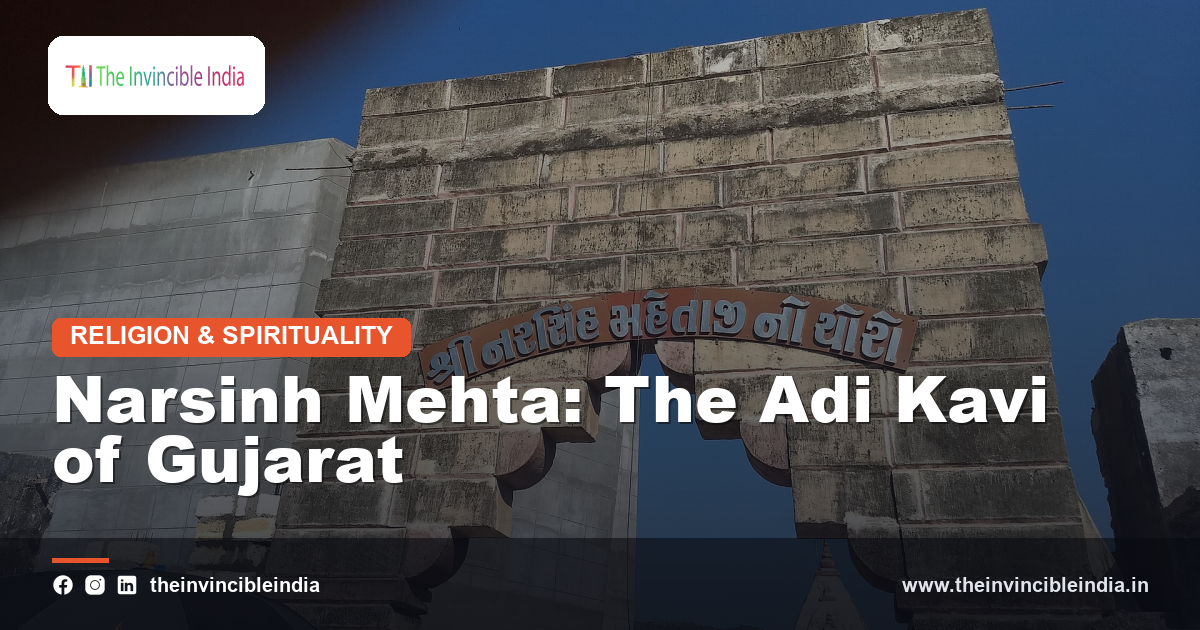
Narsinh Mehta, also written Narsi Mehta, Narsinh Maheta or Narsi Bhagat, is honoured as the Adi Kavi, the first poet, of Gujarati literature. Traditionally placed in the fifteenth century and linked with Junagadh in Saurashtra, he was a devotee of Krishna whose songs of love and surrender are still sung across Gujarat. His best-known bhajan, Vaishnav Jan To, became widely known as a favourite of Mahatma Gandhi. This guide describes his life and works in general terms and notes where details rest on tradition. It also places him within the wider Vaishnava tradition of India.
Quick answer: Narsinh Mehta is a fifteenth-century Gujarati poet-saint and devotee of Krishna, traditionally associated with Junagadh in Saurashtra and honoured as the Adi Kavi, or first poet, of Gujarati literature. He is remembered for devotional songs such as the prabhatiyas, or morning songs, and for the bhajan Vaishnav Jan To, which describes the qualities of a true devotee. His poetry shaped Gujarati devotional culture for centuries.
Key Takeaways
- Narsinh Mehta, also called Narsi Bhagat, is honoured as the Adi Kavi, the first poet, of Gujarati literature.
- Tradition places him in the fifteenth century and associates him with Talaja and Junagadh in the Saurashtra region of Gujarat.
- He was a devotee of Krishna, and his songs describe the divine play of Krishna and Radha as well as the devotee’s surrender.
- His bhajan Vaishnav Jan To describes the virtues of a true Vaishnava and was a favourite of Mahatma Gandhi.
- Prabhatiyas, devotional morning songs, are among the best-known forms of his poetry.
- Many stories about his life, including those of the hundi and the mameru, are told as tradition and are not verified history.
The sections below set out his life, works, teaching and present-day legacy in more detail.
Quick Facts
| Detail | Information |
|---|---|
| Also known as | Narsi Mehta, Narsi Bhagat, Narsinh Maheta, Adi Kavi of Gujarat |
| Tradition | Krishna bhakti and Vaishnavism of Gujarat |
| Era | Traditionally the fifteenth century |
| Associated places | Talaja, Junagadh, Girnar, Dwarka |
| Language | Old Gujarati |
| Best-known works | Vaishnav Jan To, prabhatiyas, Sudama Charitra |
Who Was Narsinh Mehta?
Narsinh Mehta was a Gujarati poet-saint and devotee of Krishna, remembered as the Adi Kavi of Gujarat. Tradition places him in the fifteenth century, and he is associated with Junagadh in the Saurashtra region. He belonged, according to the devotional biographies, to a Nagar Brahmin family, and he spent his life in the practice of devotion and the composition of songs.
His importance lies in the way he gave the Gujarati language a voice of deep feeling and devotion. Before him, there was religious and courtly writing in other languages, but his songs in the speech of the people became a foundation for the literature of Gujarat. For this reason, the title Adi Kavi, the first poet, is given to him with great affection across the state.
Where and When Did Narsinh Mehta Live?
Narsinh Mehta lived in the Saurashtra region of Gujarat, and tradition places him in the fifteenth century. His birthplace is traditionally linked with Talaja, a town near the Bhavnagar region, and his life is closely associated with Junagadh, the historic town at the foot of the Girnar hills. The exact dates of his birth and death vary between sources and are best treated as traditional.
Junagadh was a centre of religious life, home to Girnar with its ancient shrines and to a long tradition of both Shaiva and Vaishnava worship. The setting shaped the poet’s world. His songs echo the atmosphere of Saurashtra, with its pilgrims, hills and temple towns, and they remain closely tied in memory to this region.
What Does Tradition Say About His Early Life?
Tradition says that Narsinh Mehta lost his parents at a young age and was raised by his grandmother and his elder brother’s household. The accounts describe him as a child with little interest in worldly affairs and a strong inclination toward devotion and songs. Tension with his sister-in-law is a part of the story as told in the community.
According to the devotional narrative, he left home and went to meditate in a forest shrine of Shiva, where he received a vision that turned his heart toward Krishna. These stories are part of the oral and written tradition around him and should be read as tradition and not as verified history. They explain how devotees understand the sudden turn of his life toward song and surrender.
What Is the Story of His Vision of Krishna?
The best-known story says that Narsinh Mehta received a vision of Lord Krishna’s divine play, the rasa lila, through the grace of Shiva at a shrine near Junagadh. According to the tradition, Shiva blessed him and showed him the dance of Krishna and the gopis, and from that moment the poet devoted his life to Krishna.
This account is told as sacred tradition. It reflects a common feature of Gujarat’s religious life, in which Shaiva and Vaishnava elements are closely linked and are honoured together. The story should be understood as a devotional narrative that explains the origin of his poetry. His songs on the rasa lila and the love of Radha and Krishna draw on this central image of divine joy.
What Is Vaishnav Jan To?
Vaishnav Jan To is the best-known bhajan attributed to Narsinh Mehta, describing the qualities of a true Vaishnava, a true devotee. The song says that such a person feels the pain of others, remains humble, avoids envy and pride, speaks truthfully and respects all people. It is sung in Gujarati and is recognised across India.
The bhajan became especially famous because Mahatma Gandhi loved it and had it sung at his prayer meetings. Through him, its message of compassion and humility spread widely beyond Gujarat. For many people today, it is the first and most familiar song linked with Narsinh Mehta. It captures in a few lines the ethical ideal that runs through his devotional poetry and the Vaishnava tradition.
What Are Prabhatiyas?
Prabhatiyas are devotional morning songs sung at dawn to awaken the Lord and to begin the day with prayer, and they are among the most characteristic forms of Narsinh Mehta’s poetry. The word comes from prabhat, meaning morning. These songs praise Krishna and speak of the beauty of the new day and the joy of the divine name.
Many prabhatiyas attributed to him remain in the repertoire of Gujarati singers and are sung in temples and homes. Their melodies are gentle and their words are simple. They show how his poetry was meant to be part of daily life and worship. Because they are sung at the start of the day, they also carry a feeling of freshness and hope that has kept them popular for centuries.
What Other Works Are Attributed to Narsinh Mehta?
Besides the prabhatiyas and Vaishnav Jan To, a wide range of poems and narrative songs are attributed to Narsinh Mehta. They include songs on the childhood and playful acts of Krishna, songs of love between Radha and Krishna in the tradition of Shringara, and narrative poems such as those linked with the story of Sudama, the friend of Krishna.
Authorship of individual compositions is not always certain, since the songs were passed on orally for generations and later gathered into manuscripts, which sometimes added verses in his name. Scholars therefore speak of works attributed to him. Even so, the style and spirit of the collection are distinct, and the body of poetry gives a clear picture of his devotion and imagination.
Why Is He Called the Adi Kavi?
He is called the Adi Kavi because he is regarded as the first great poet of the Gujarati language, the one who opened the path for later writers. Poets such as Akho, Premanand and Dayaram are remembered in the same stream of Gujarati literature, but the honour of the first place goes to Narsinh in popular tradition and in many histories of the language.
The title does not mean that no verse was written in the region before him. It means that his songs gave Gujarati literary dignity and a devotional character that shaped later poetry. For this reason, institutions and literary honours in Gujarat have been named after him, including a university in Junagadh. The title reflects respect for his role as a founding voice of the language.
What Themes Appear in His Poetry?
The themes in Narsinh Mehta’s poetry include devotion to Krishna, the play of Krishna and Radha, the humility of the devotee, trust in divine care and the ethical life of a Vaishnava. Several songs speak of the unity of the soul with the divine, using the language of love and longing.
His poems also carry a message of equality and compassion. Tradition holds that he sang with people of all communities, including those treated as outcastes by society at the time, and that he was criticised for this. Whether or not every story is literal, the theme matches the message of his bhajans, which value kindness and inner purity over social status. This ethical breadth gives his work enduring appeal.
What Is the Hundi Legend?
The hundi legend says that Narsinh Mehta, who was poor, was asked by pilgrims to write a bill of exchange, a hundi, for their journey to Dwarka, and that Lord Krishna himself appeared in the form of a merchant named Shamaldas Seth to honour it. The story is meant to show that the Lord takes care of those who trust in him fully.
The tale is told in Gujarat with great affection and appears in songs and plays. It belongs to the world of devotional tradition and is not presented as documented history. Its meaning is spiritual: that faith is met by grace. The legend also explains why Dwarka, one of the sacred places of Krishna worship, holds a special place in the story of Narsinh Mehta.
What Is the Mameru Legend?
The mameru legend says that when Narsinh Mehta’s daughter Kunvarbai was to receive the traditional gifts from her maternal home for a ceremony, the poor poet had nothing to give, and that the Lord himself arrived to supply the gifts. The mameru is the customary gift presented by the maternal family in Gujarati tradition.
As with the other stories, it is told as devotional tradition. It is a popular theme in Gujarati songs, theatre and, in later times, film. Its message is that divine help comes to the humble and sincere devotee. The legend also shows how closely the poet’s story is woven into the family customs and social imagination of Gujarat, which is part of the reason he remains so beloved.
How Is Narsinh Mehta Linked to Mahatma Gandhi?
Narsinh Mehta is linked to Mahatma Gandhi through the bhajan Vaishnav Jan To, which Gandhi, himself a Gujarati, loved and made part of his daily prayer. The song’s ideals of compassion, humility and non-violence matched the values Gandhi sought to live by, and he drew attention to it among a wide audience.
Through this connection, a fifteenth-century devotional song became part of India’s modern public life. It is sung at national events and by singers across the country. The link also shows how a medieval saint’s words can continue to shape ethical thought in later times. For many Indians, the first meeting with Narsinh Mehta comes through this one bhajan and the memory of Gandhi.
Which Places Are Associated with Narsinh Mehta?
The places associated with Narsinh Mehta include Talaja, linked in tradition with his birth, and Junagadh, where his memory is strongest. In Junagadh, a locality known as Narsinh Mehta no Choro and a site known as his mandvi are pointed out by local tradition, and the nearby Damodar Kund, a sacred pool at the foot of Girnar, is also connected with his name.
Dwarka, one of the Char Dham, is linked with him through the hundi story. Pilgrims and visitors to Saurashtra often combine visits to these places with the ancient sites of Girnar. As with other traditional associations, local identifications may differ, but they show how thoroughly the poet is woven into the sacred geography of Gujarat.
How Should Traditional Accounts Be Read?
Traditional accounts of Narsinh Mehta should be read as devotional biography, valuable for what they reveal about how the people of Gujarat see him. The stories of his vision, the hundi and the mameru are told with reverence, and the dates and details differ between sources. They do not claim to meet the standards of modern historical records.
A respectful approach keeps two things in view. His poems can be studied directly, though attribution of single songs requires care, and they give real evidence of his spiritual voice. The stories express devotion and carry meaning of their own. Holding both together allows a reader to honour the tradition while remaining careful about specific historical claims.
Narsinh Mehta Today
Narsinh Mehta remains a beloved figure in Gujarat and among Gujaratis around the world. His prabhatiyas are sung at dawn, his bhajans are performed by classical and folk singers, and his stories are retold in theatre and kirtan. Bhakta Kavi Narsinh Mehta University in Junagadh and literary honours in his name keep his memory in public life.
For students of Indian culture, he offers a clear picture of how devotion can shape a language and a society. His example shows the strength of the Bhakti movement in western India and its ability to join feeling with ethical teaching. Readers who wish to learn more can listen to his songs, read translations and visit Junagadh and the Girnar region.
Sources & Further Reading
- Ministry of Culture, Government of India (indiaculture.gov.in).
- Sahitya Akademi (sahitya-akademi.gov.in).
Frequently Asked Questions
Who was Narsinh Mehta?
Narsinh Mehta was a fifteenth-century Gujarati poet-saint and devotee of Krishna, honoured as the Adi Kavi of Gujarati literature. He is traditionally associated with Junagadh in Saurashtra.
Why is Narsinh Mehta called the Adi Kavi of Gujarat?
Narsinh Mehta is called the Adi Kavi, or first poet, because he is regarded as the founding voice of Gujarati devotional literature. His songs gave the language a literary and spiritual character that shaped later poets.
What is Vaishnav Jan To?
Vaishnav Jan To is a Gujarati bhajan attributed to Narsinh Mehta that describes the qualities of a true devotee, such as compassion, humility and truthfulness. It became widely known as a favourite of Mahatma Gandhi.
When did Narsinh Mehta live?
Tradition places Narsinh Mehta in the fifteenth century. Exact dates differ between sources and are treated as traditional.
What are prabhatiyas?
Prabhatiyas are devotional morning songs sung at dawn, and they are among the best-known forms of Narsinh Mehta’s poetry. They praise Krishna and welcome the new day with prayer.
Which place is most associated with Narsinh Mehta?
Junagadh in Saurashtra, Gujarat, is the place most associated with Narsinh Mehta. Talaja is linked with his birth and Dwarka with the hundi legend.


