

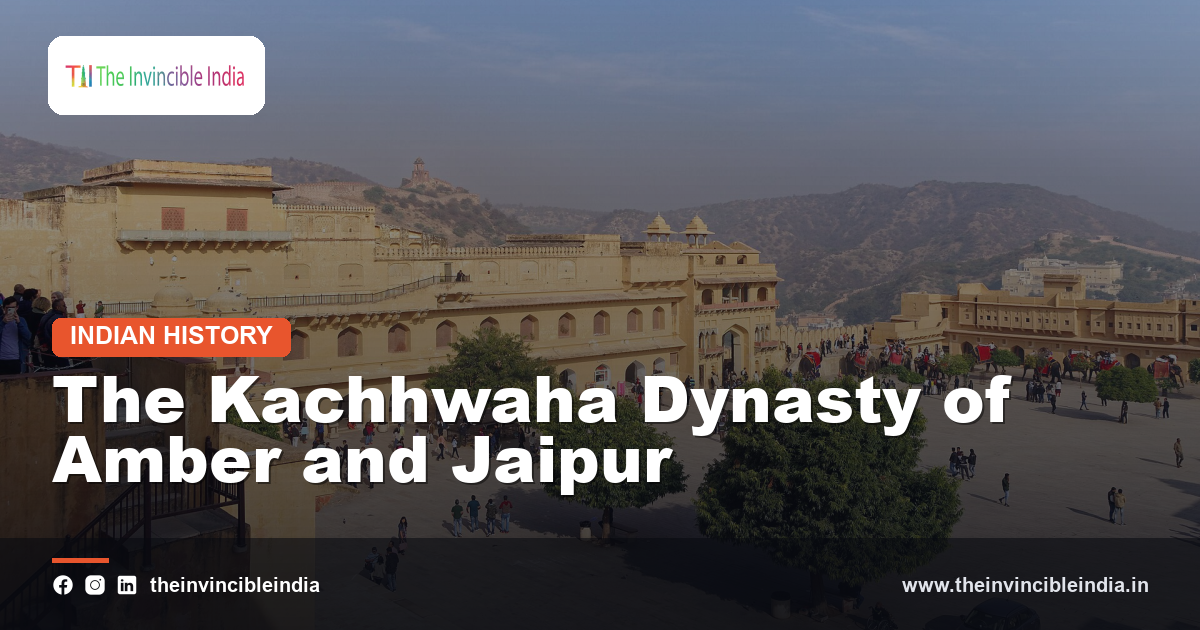
The Kachhwaha dynasty, also spelled Kachwaha or Kushwaha and known as the Kachhwaha Rajputs of Amber and Jaipur, ruled the region of Dhundhar in eastern Rajasthan from the medieval period to the mid-twentieth century. Their first major seat was at Amber, where a grand fort-palace still rises above a lake, and in the early eighteenth century Sawai Jai Singh II founded Jaipur as a new planned capital. Like the Rathores described in our guide to the Rajputs, the Kachhwahas built a major kingdom, but they were notable for their early and lasting partnership with the Mughals. Early origins are traditional, so this guide uses general terms.
Quick answer: The Kachhwaha dynasty was the Rajput ruling house of Amber and Jaipur in eastern Rajasthan, whose rulers formed an early alliance with the Mughal emperor Akbar and later founded the planned city of Jaipur under Sawai Jai Singh II. Their great monuments include Amber Fort, the City Palace, the Jantar Mantar observatory and Hawa Mahal. The state became a princely state under the British and merged into Rajasthan after independence.
Key Takeaways
- The Kachhwaha dynasty was the Rajput ruling house of Amber and later Jaipur in the Dhundhar region of Rajasthan.
- The Kachhwahas claim descent from Kusha, son of Rama, in the tradition of the solar dynasty, though this belongs to legend.
- They formed an early and lasting alliance with the Mughals, and Raja Man Singh I became one of Akbar’s leading commanders.
- Sawai Jai Singh II founded Jaipur in the early eighteenth century and built astronomical observatories in several cities.
- Amber Fort, Jantar Mantar and the walled city of Jaipur are recognised among India’s World Heritage sites.
- The Jaipur state merged into the new state of Rajasthan after independence.
Read on for the history, culture, and legacy in detail.
Quick Facts
| Detail | Information |
|---|---|
| Dynasty | Kachhwaha (Kachwaha) Rajputs of Amber and Jaipur |
| Region | Dhundhar, eastern Rajasthan |
| Capitals | Early seats in Dausa and Amber, then Jaipur |
| Founder of Jaipur | Sawai Jai Singh II, early eighteenth century |
| Famous Monuments | Amber Fort, City Palace, Jantar Mantar, Hawa Mahal |
| End of Princely Rule | Merger into Rajasthan in the late 1940s |
Who Were the Kachhwahas?
The Kachhwahas were a Rajput clan who rose from a regional chieftaincy to become one of the leading royal houses of north India. They governed Dhundhar, a region of hills and plains around Jaipur, and they were known for diplomacy, patronage and architectural ambition. Their rulers held the titles of Raja and later Maharaja, and the house was distinguished by the honorific Sawai, given to Jai Singh II. The Kachhwahas often chose cooperation with larger powers, a strategy that protected their land and wealth. They stand out among Rajput houses for combining political pragmatism with a strong cultural identity.
What Are the Origins of the Kachhwaha Clan?
The Kachhwaha clan traces its descent in tradition from Kusha, a son of Rama, and so claims a place in the solar dynasty. Another tradition links the name with the Kachchhapaghata rulers of the Gwalior region, a medieval line of kings. Historians regard the genealogy as a blend of legend and later clan memory, and the true origins remain debated. What is clear is that the clan established itself in Dhundhar, took control from earlier local groups such as the Meenas, and gradually expanded. The legend of Rama nonetheless remains a strong part of the dynasty’s self-image.
Where Is Dhundhar and Why Did It Matter?
Dhundhar is the historical region around Jaipur in eastern Rajasthan, bounded by the Aravalli hills and the plains leading to Delhi and Agra. The name is linked with the Dhundh river and later came to mean the territory of the Kachhwahas. The location gave the dynasty a close connection to the imperial heartland, since Delhi and Agra lay within reach. This proximity made alliances with the Mughals natural, and it also gave the kingdom access to trade routes and revenue. The geography therefore helps explain the Kachhwaha strategy and the wealth that sustained their building programmes.
Amber: The Early Capital
Amber, a short distance north of Jaipur, was the capital of the Kachhwahas for several centuries before the founding of the new city. The settlement sits among hills with a lake at its foot and was easily defended, with ridges guarding its approaches. Earlier seats of the clan, such as Dausa, preceded Amber, but the latter grew into the main royal centre. Temples, palaces and a town gathered around the fort, and the site drew pilgrims to the goddess Shila Devi. Amber thus served as the cradle of the dynasty’s political and religious life until the move to Jaipur.
Why Is Amber Fort Famous?
Amber Fort is famous as a palace-fortress that blends Rajput and Mughal architectural ideas, set above Maota Lake. Its courtyards, gateways and audience halls feature carved sandstone and white marble, and the Sheesh Mahal, or mirror palace, glitters with inlaid glass. The structure grew in stages under rulers from Raja Man Singh I to Sawai Jai Singh I, each adding halls and gardens. Visitors climb the ramp to the main gate, traditionally on elephants, and enter a series of courtyards. Amber Fort is part of a group of hill forts of Rajasthan recognised on the World Heritage list.
Raja Bharmal and the Mughal Alliance
Raja Bharmal, also called Bihari Mal, is remembered as the first Rajput ruler to enter a close alliance with the Mughal emperor Akbar in the sixteenth century. Tradition holds that he presented his daughter in marriage to the emperor as part of the arrangement, and she became the mother of the future emperor Jahangir. The alliance gave Amber protection and imperial favour, and it set the pattern for later Kachhwaha service. Some Rajput houses saw the move as pragmatic, others as controversial. Historians generally agree that it shaped the political fortunes of the Kachhwahas for the next two centuries.
Raja Man Singh I: Mughal General and Builder
Raja Man Singh I was a leading Mughal general and the most prominent Kachhwaha ruler of the sixteenth and early seventeenth centuries. He served Akbar in campaigns across the empire, from the north-west to Bengal and Odisha, and was among the highest-ranked nobles of the court. He is credited with expanding Amber Fort and commissioning the Shila Devi temple, as well as building temples in Vrindavan and Varanasi. His service brought great wealth to Amber and also raised the status of the house within the imperial structure. Man Singh remains the best-known figure of the early dynasty.
Mirza Raja Jai Singh I
Mirza Raja Jai Singh I was a senior Mughal commander and diplomat who served under Shah Jahan and Aurangzeb in the seventeenth century. He is remembered for campaigns in the Deccan and in Kandahar, and for negotiating the Treaty of Purandar with the Maratha leader Shivaji. His title Mirza Raja was an imperial honour that recognised his rank and service. He added to the palaces at Amber and strengthened the fort of Jaigarh above it. The relationship between Jai Singh and Shivaji, described in our guide to the Maratha Empire, is a notable chapter in Mughal and Rajput history.
Who Was Sawai Jai Singh II?
Sawai Jai Singh II was the astronomer-king who founded Jaipur and ruled in the early eighteenth century, during the decline of the Mughal empire. The title Sawai, meaning one and a quarter, is said to have been given by the Mughal emperor as a playful mark of his superiority. He was a statesman, a patron of scholars and a student of mathematics and astronomy. He held the Mughal rank and also performed Vedic sacrifices, symbolising his dual identity. His reign is regarded as the intellectual high point of the dynasty.
How Was Jaipur Planned and Built?
Jaipur was planned and built in the early eighteenth century as a gridded city, designed with the help of the scholar Vidyadhar Bhattacharya. The layout follows principles from Indian architectural texts, with broad streets, regular blocks and squares called chaupars. Walls and gates enclosed the city, and bazaars were planned along the main avenues. The City Palace stands at its centre, and the observatory and palace complex form the royal quarter. The Pink City colour, applied in the nineteenth century for a royal visit, gives the old town its popular name. Jaipur became a model of planned urban design in India.
Jantar Mantar: The Astronomical Observatory
The Jantar Mantar at Jaipur is a collection of large masonry astronomical instruments built by Sawai Jai Singh II to measure time and the position of stars. Its giant sundial, called the Samrat Yantra, can tell time to within a few seconds, and other instruments track the zodiac and planets. Jai Singh built similar observatories at Delhi, Ujjain, Varanasi and Mathura, and each reflects his interest in refining existing astronomical tables. The Jaipur observatory is recognised as a World Heritage site. It testifies to a tradition of scientific curiosity within a royal court and remains one of the most striking monuments of the city.
City Palace, Hawa Mahal and Royal Architecture
The City Palace and Hawa Mahal are the best-known royal buildings of Jaipur, both reflecting the dynasty’s taste for blended architecture. The City Palace complex includes courtyards, halls, museums and the continuing home of the royal family. The Hawa Mahal, built in the late eighteenth century by Maharaja Sawai Pratap Singh, is a five-storey facade of small windows that let royal women watch the street unseen. The Nahargarh and Jaigarh forts on the hills guard the city. Together these buildings give Jaipur its unmistakable skyline.
Art, Crafts and Learning at the Jaipur Court
The Jaipur court patronised painting, music, crafts and scholarship, making the city a centre of Rajasthani culture. Local artisans became known for block printing, blue pottery, gem cutting, enamel work and marble sculpture. Miniature painters of the Jaipur school depicted court scenes, portraits and devotional themes. The court housed libraries, manuscripts and scholars of Sanskrit and Persian, and the royal family collected art and textiles. Many of these crafts survive today in the bazaars and workshops of Jaipur. The courtly support of skills created an economy of craftsmanship that continues to define the city.
The Kachhwahas under the British
Under British rule, Jaipur became a princely state with its own Maharaja, guided by treaty relations with the Crown. The rulers introduced modern institutions, schools and public works, and Maharaja Sawai Ram Singh II and later rulers laid out parks, hospitals and a museum. Sawai Man Singh II, a notable polo player and diplomat, led the state in the final decades of princely rule. The royal house retained its cultural leadership even as political power shifted. The era is remembered for public building and the preservation of the old city’s character.
Merger into Rajasthan
After independence, Jaipur merged with other states to form Rajasthan in the late 1940s, and the Maharaja of Jaipur was named the first Rajpramukh of the new state. Jaipur became the capital, and its status as a historic centre made it a natural choice. The royal family handed over many lands and institutions but retained their private properties, which were converted into museums and hotels. The merger marked the formal end of the Kachhwaha dynasty’s rule and the beginning of a new role in public life. It remains an important chapter in the integration of the princely states.
The Kachhwaha Legacy in Jaipur Today
The Kachhwaha legacy is carried today by the walled city of Jaipur, Amber Fort, the observatory and the royal family’s museums. Jaipur is a major centre of tourism and crafts, and its festivals, from the Jaipur Literature Festival to the Gangaur procession, build on the old court culture. Conservation work continues in the old city and at Amber, and heritage tours teach visitors about the dynasty’s history. Debates about the Mughal alliance and clan origins continue, and they remain part of the lively study of Rajput history. The Kachhwahas remain a central presence in the cultural story of Rajasthan.
Sources & Further Reading
- Archaeological Survey of India (asi.nic.in).
- Ministry of Culture, Government of India (indiaculture.gov.in).
Frequently Asked Questions
Who founded Jaipur?
Jaipur was founded by Sawai Jai Singh II, the Kachhwaha ruler of Amber, in the early eighteenth century. He planned it as a gridded city with the help of the scholar Vidyadhar Bhattacharya.
Who were the Kachhwahas?
The Kachhwahas were a Rajput clan who ruled Amber and later Jaipur in eastern Rajasthan. They formed an early alliance with the Mughals and became one of the most powerful Rajput houses.
What is Amber Fort?
Amber Fort is a hill fort and palace near Jaipur that was the seat of the Kachhwaha rulers. It combines Rajput and Mughal architecture and is part of the hill forts of Rajasthan recognised as a World Heritage site.
Why is Jaipur called the Pink City?
Jaipur is called the Pink City because its old town was painted in a pink colour in the nineteenth century, traditionally to welcome a royal visitor. The colour has been maintained as a heritage requirement in the old city.
What is the Jantar Mantar?
The Jantar Mantar in Jaipur is an astronomical observatory built by Sawai Jai Singh II in the early eighteenth century. It contains large masonry instruments, including the Samrat Yantra sundial, and is a World Heritage site.
Who was Raja Man Singh I?
Raja Man Singh I was the Kachhwaha ruler of Amber who served as a leading general under the Mughal emperor Akbar. He expanded Amber Fort and built several temples.


