

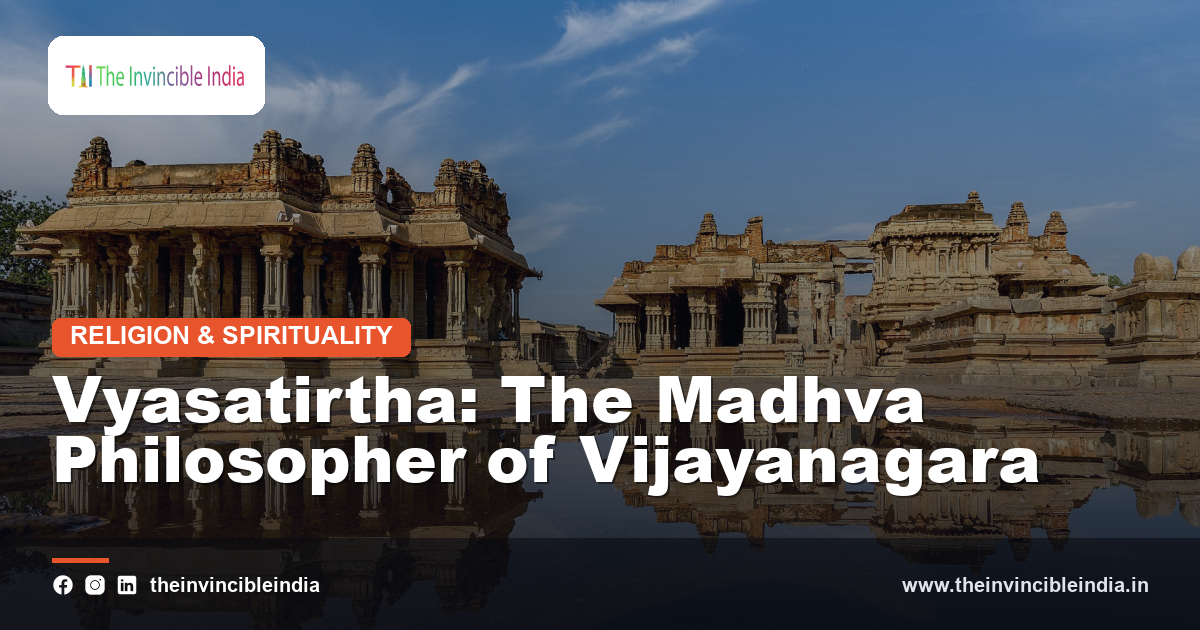
Vyasatirtha, also called Vyasaraja, Vyasa Raya and Chandrikacharya, is remembered as one of the greatest philosophers of the Dvaita Vedanta school founded by Madhvacharya. Traditionally placed in the late fifteenth and early sixteenth centuries, he served as the spiritual preceptor of the Vijayanagara court and wrote works that defended Dvaita against rival schools of thought. He also supported the devotional movement of the Haridasas in Karnataka. This guide describes his life and writings in general terms and notes where details rest on tradition. It also places him within the wider history of Vaishnavism in India.
Quick answer: Vyasatirtha, also known as Vyasaraja, is a Madhva scholar and saint of the late fifteenth and early sixteenth centuries who served as the royal preceptor of the Vijayanagara Empire in present-day Karnataka. He is best known for the Nyayamrita, Tarkatandava and Tatparya Chandrika, three works that defend the Dvaita philosophy of Madhvacharya against rival views. He is also honoured for supporting the Haridasa devotional movement and its poet-saints.
Key Takeaways
- Vyasatirtha, also called Vyasaraja, was a leading philosopher of the Dvaita Vedanta school of Madhvacharya, active in the late fifteenth and early sixteenth centuries.
- He served as the spiritual preceptor of the Vijayanagara court, and tradition links him closely with the emperor Krishnadevaraya.
- His three major works, the Nyayamrita, Tarkatandava and Tatparya Chandrika, are together known as the Vyasatraya.
- He supported the Haridasa movement, and Purandara Dasa and Kanaka Dasa are traditionally counted among those he inspired.
- Tradition credits him with installing many shrines of Hanuman, and his brindavana, the memorial tomb of a saint, is at Navabrindavana near Anegundi on the Tungabhadra river.
- Dates and legends in his life are drawn from hagiography, so specific details are best read as tradition.
The sections below set out his life, works, royal connections and present-day legacy in more detail.
Quick Facts
| Detail | Information |
|---|---|
| Also known as | Vyasaraja, Vyasa Raya, Chandrikacharya |
| Tradition | Dvaita Vedanta of Madhvacharya; Madhva Vaishnavism |
| Era | Late fifteenth to early sixteenth century |
| Region | Karnataka; Vijayanagara Empire |
| Major works | Nyayamrita, Tarkatandava, Tatparya Chandrika |
| Resting place | Navabrindavana, Anegundi, on the Tungabhadra |
Who Was Vyasatirtha?
Vyasatirtha was a scholar, monk and philosopher of the Madhva tradition who is regarded as one of the three great teachers of Dvaita Vedanta after Madhvacharya, alongside Jayatirtha and Raghavendra Tirtha. He is also called Vyasaraja or Vyasa Raya, and some texts use the honorific Chandrikacharya after his commentary known as the Chandrika.
He lived in the Vijayanagara period and became the guru of the royal court, a position that gave him wide influence over the religious life of southern India. His writings are known for their rigorous logic and their skilful defence of Dvaita ideas. For this reason he is counted among the most important thinkers in the history of Indian philosophy, and he remains a central figure for followers of the Madhva faith.
When and Where Did Vyasatirtha Live?
Vyasatirtha lived in the region that is now Karnataka, and tradition places him in the late fifteenth and early sixteenth centuries during the height of the Vijayanagara Empire. Exact years are given differently in different sources, so careful writers describe the period in general terms and avoid claiming precise dates.
His working life unfolded at and around Vijayanagara, the great imperial capital on the Tungabhadra river, whose ruins at Hampi are today a World Heritage Site. This was a time of royal patronage for temples, learning and the arts, and the court welcomed scholars of several traditions. In such a setting a teacher of his stature could shape debate, build institutions and guide generations of students.
What Does Tradition Say About His Early Life and Teachers?
Traditional accounts say that Vyasatirtha was born in a Brahmin family in the Karnataka region, with the village of Bannur in the Mysuru area often named as his birthplace, and that he showed unusual learning from boyhood. He is said to have studied under Brahmanya Tirtha and later under the saint Sripadaraja, also called Lakshminarayana Tirtha, who is himself honoured as an early figure of the Haridasa tradition.
These details come from hagiographies and devotional memory and should be read as tradition and not as documented history. They do, however, convey how followers understand his formation: as a student trained both in the demanding logic of philosophy and in the devotional life of the Madhva order. That combined training shaped the two sides of his legacy, scholarly and devotional.
What Is Dvaita Vedanta?
Dvaita Vedanta is the school of philosophy founded by Madhvacharya in the thirteenth century that teaches a real and eternal distinction between God, individual souls and the material world. In this view Vishnu is the supreme independent reality, while souls and matter depend upon him. The word dvaita means duality or dualism.
This differs from the Advaita Vedanta of Adi Shankaracharya, which teaches the non-difference of the soul and the ultimate reality, and from the qualified non-dualism of Ramanuja. Dvaita places great weight on devotion, on the grace of God and on the idea that souls differ in their nature. Vyasatirtha defended and refined these ideas, which is why later scholars treat him as a pillar of the school.
Why Was Vijayanagara Important to His Work?
Vijayanagara was important to the work of Vyasatirtha because it gave him a royal court, a large audience and the resources to teach, debate and build institutions. The empire, centred on its capital near present-day Hampi, was one of the largest and most prosperous states in southern India and a patron of Hindu religion, literature and architecture.
Scholars of many schools visited the court, and the rulers supported temples dedicated to Vishnu, Shiva and other deities. In this open and competitive atmosphere, philosophers presented their views in public assemblies. Vyasatirtha rose to prominence as the Madhva representative in these exchanges, and his position helped the Dvaita tradition to spread widely across the Kannada-speaking lands and beyond.
How Was He Connected with Krishnadevaraya?
Vyasatirtha is traditionally remembered as the guru of Krishnadevaraya, the celebrated emperor of Vijayanagara who ruled in the early sixteenth century. Accounts say that the king honoured him with gifts, supported his order and sought his counsel in matters of religion. He is also said to have been preceptor to rulers before and after Krishnadevaraya.
A tank near Hampi known as Vyasasamudra is traditionally linked with this royal respect for the saint. The close bond between king and teacher is a recurring theme in Madhva tradition, and it reflects the real importance of religious preceptors in the political culture of the empire. As with other details, the stories are preserved in devotional literature, and their finer points vary between sources.
What Is the Vyasatraya?
The Vyasatraya, meaning the three works of Vyasa, is the name given to the three major philosophical writings of Vyasatirtha: the Nyayamrita, the Tarkatandava and the Tatparya Chandrika. Together they form the core of his scholarly legacy and are studied in Dvaita institutions to this day.
The Tatparya Chandrika is a detailed commentary on the Tattvaprakashika of Jayatirtha, which is itself a commentary on Madhvacharya’s Brahmasutra Bhashya. The Nyayamrita and Tarkatandava are independent works of argument that examine the claims of rival schools. The name Vyasatraya shows how the three texts were seen as a unified body of work, each supporting the others in defence of the Dvaita system.
What Is the Nyayamrita?
The Nyayamrita, meaning the nectar of logic, is the best known work of Vyasatirtha and a landmark of Indian philosophical writing. It is a closely argued text that examines the arguments of Advaita Vedanta, particularly its claim that the world is ultimately unreal, and presents the Dvaita response in the formal language of Indian logic.
The work is admired for its precision and for the skill with which it takes up the best objections of its opponents before answering them. It drew a famous reply from the Advaita scholar Madhusudana Sarasvati in a text called the Advaitasiddhi, and this exchange became one of the celebrated debates in the history of Vedanta. Later commentators wrote further on both works, extending the discussion across generations.
How Did He Engage with Rival Schools of Thought?
Vyasatirtha engaged with rival schools by examining their arguments directly and responding in the formal methods of debate used in Indian philosophy. His main target was Advaita Vedanta, but his writings also deal with the arguments of the Nyaya tradition and other systems, which he tested against the Dvaita position.
This approach is typical of the long tradition of Indian philosophical dialogue, in which each school stated its opponents’ views fairly before offering a reply. For modern readers, his works provide valuable evidence of how ideas were contested in the Vijayanagara period. They also show that Dvaita was not merely a devotional faith but a fully developed intellectual system able to hold its own in learned assemblies.
How Did He Support the Haridasa Movement?
Vyasatirtha supported the Haridasa movement, the devotional current in Karnataka whose poet-saints composed songs in Kannada in praise of Vishnu, often under the name Hari. The movement made the teaching of Dvaita accessible to ordinary people through simple songs, in a way that Sanskrit treatises could not.
He is remembered as a patron and guide of these singers, and some devotional songs in Kannada are also attributed to him. His role shows the two sides of his personality: the stern logician of the Sanskrit texts and the warm supporter of popular devotion. The Haridasa tradition he nurtured became a major part of the cultural heritage of Karnataka and of Carnatic music, which later drew on its compositions.
Who Were Purandara Dasa and Kanaka Dasa to Him?
Purandara Dasa and Kanaka Dasa are two of the best known Haridasa poet-saints, and tradition links both with Vyasatirtha. Purandara Dasa is widely remembered as a disciple who received the guidance of Vyasatirtha, and he is honoured as a founding figure in Carnatic music for his many devotional songs in Kannada.
Kanaka Dasa, who came from the Kuruba community, is also counted among those the saint supported, and stories praise Vyasatirtha for recognising the worth of devotion regardless of birth. These accounts come from tradition and the details differ between tellers, but their message is consistent. The saint is seen as a teacher who valued sincere devotion and who opened the path of Madhva spirituality to a wide circle of people.
Why Is Vyasatirtha Linked with Hanuman Shrines?
Vyasatirtha is traditionally linked with Hanuman shrines because he is credited with installing images of Hanuman, known in the Madhva tradition as Mukhyaprana or Prana Devaru, in many places across southern India. In Madhva belief Hanuman, Bhima and Madhvacharya are regarded as three forms in a single line of the divine wind god Vayu.
The Yantrodharaka Hanuman shrine on a hillock near Hampi is among the best known places associated with his name. The number and the exact sites of these installations come from devotional tradition and are not independently documented. Even so, the practice illustrates how closely the saint is bound up with the religious landscape of Karnataka and with the worship of Hanuman as a model of devotion and strength.
Where Is the Brindavana of Vyasatirtha?
The brindavana of Vyasatirtha is at Navabrindavana, a small island in the Tungabhadra river near Anegundi, close to Hampi in Karnataka. A brindavana is the memorial tomb of a saint in the Madhva tradition, and followers worship it as the abode of the teacher.
Navabrindavana means nine brindavanas, and the site holds the memorials of nine Madhva saints, of whom Vyasatirtha is the best known. It is a quiet and respected place of pilgrimage, reached by boat or by a path along the river, and it draws devotees throughout the year. The setting, among boulders and water, adds to the sense of calm that visitors often describe. The site also forms part of the wider pilgrimage traditions of India.
What Is the Vyasaraja Matha?
The Vyasaraja Matha, also called the Sosale Vyasaraja Matha, is a monastic institution of the Madhva tradition that traces its line to Vyasatirtha. It is one of the major maths of the Dvaita school and is associated with the town of Sosale in Karnataka, with additional centres in other parts of the country.
A matha is a monastery that preserves a lineage of teachers, conducts worship and keeps up the study of scriptures. Through its succession of pontiffs, the Vyasaraja Matha continues the work of teaching and worship that its founder began. The institution is an example of how the intellectual and spiritual legacy of a great teacher can be carried forward through an unbroken chain of disciples over many centuries.
What Legends Surround Vyasatirtha?
Many legends surround Vyasatirtha in Madhva hagiography. One widely told story says that astrologers foresaw a danger to the king Krishnadevaraya, and that the saint sat on the throne for a time to take the burden upon himself, so that the danger passed without harming the ruler. Other tales speak of miracles and of his skill in debate.
These accounts belong to tradition and are not confirmed by independent records, and they differ from one narrator to another. They are best read as expressions of reverence that show how the community saw his spiritual power and his bond with the king. The firmest foundation for understanding him lies in his surviving writings, which can be read directly and which reveal the mind of a major philosopher.
Vyasatirtha Today
Vyasatirtha remains a living presence in the Madhva tradition and in the cultural life of Karnataka. His works are studied in Sanskrit colleges and monasteries, and scholars of Indian philosophy examine the Nyayamrita as a masterpiece of logical argument. His brindavana at Navabrindavana draws pilgrims, and his aradhana, the annual day of remembrance, is observed with worship and recitation.
The songs of the Haridasas he supported are still sung in homes, temples and concert halls. For students of Indian culture, he offers a clear example of how philosophy, devotion and royal patronage could work together in a single life. His legacy shows that deep intellectual inquiry and warm devotion belong to the same heritage, and his name continues to be honoured with great respect.
Sources & Further Reading
- Ministry of Culture, Government of India (indiaculture.gov.in).
- Archaeological Survey of India (asi.nic.in).
Frequently Asked Questions
Who was Vyasatirtha?
Vyasatirtha, also called Vyasaraja, was a Madhva scholar and saint of the late fifteenth and early sixteenth centuries who served as the royal preceptor of the Vijayanagara Empire. He is regarded as one of the three great philosophers of Dvaita Vedanta.
What is Vyasatirtha famous for?
Vyasatirtha is famous for the Vyasatraya, his three works Nyayamrita, Tarkatandava and Tatparya Chandrika, which defend Dvaita philosophy. He is also known for supporting the Haridasa movement and for his close tie with the Vijayanagara court.
What is the Nyayamrita?
The Nyayamrita is Vyasatirtha’s best known work, a detailed philosophical text that examines the arguments of Advaita Vedanta and defends Dvaita. It drew a famous reply from Madhusudana Sarasvati in the Advaitasiddhi.
Where is the brindavana of Vyasatirtha?
The brindavana of Vyasatirtha is at Navabrindavana, an island in the Tungabhadra river near Anegundi and Hampi in Karnataka. The site holds the memorials of nine Madhva saints and is a place of pilgrimage.
How was Vyasatirtha connected with Krishnadevaraya?
Vyasatirtha is traditionally remembered as the guru of the Vijayanagara emperor Krishnadevaraya, who honoured and supported him. Details of their relationship come largely from devotional tradition.
What is Dvaita Vedanta?
Dvaita Vedanta is the school of philosophy founded by Madhvacharya that teaches a real and eternal difference between God, souls and the world. Vyasatirtha is one of its leading thinkers.


